
 100% FREE ACCESS
10th Standard CBSE Syllabus & Materials
10th Standard CBSE
CBSE 10th Social Science ECO - Globalisation and the Indian Economy - New Model Questions Papers Study Material - QB365 Set A
NEW10th Standard CBSE
CBSE 10th Social Science ECO - Money and Credit - New Model Questions Papers Study Material - QB365 Set A
NEW10th Standard CBSE
CBSE 10th Social Science ECO - Sectors of the Indian Economy - New Model Questions Papers Study Material - QB365 Set A
NEW10th Standard CBSE
CBSE 10th Social Science ECO - Development - New Model Questions Papers Study Material - QB365 Set A
NEW10th Standard CBSE
CBSE 10th Social Science PS - Outcomes of Democracy - New Model Questions Papers Study Material - QB365 Set A
NEW10th Standard CBSE
CBSE 10th Social Science PS - Gender, Religion and Caste - New Model Questions Papers Study Material - QB365 Set A

Published on: 26/05/2021
QB365 Provides the updated NCERT Examplar Questions for Class 10 Maths, and also provide the detail solution for each and every ncert examplar questions , QB365 will give all kind of study materials will help to get more marks
Download CBSE Class 10th Standard CBSE Maths question papers, sample papers, important questions, and previous year solved papers in PDF format. Get free study materials, NCERT solutions, and exam preparation resources for Class 10th Standard CBSE Maths
Questions + Answers key
Take MCQ Maths Test1.
If tan \(\theta\) + sec \(\theta\) = l, then prove that \(\sec \theta=\frac{l^{2}+1}{2 l}\)
2.
The mean of the following frequency distribution is 50, but the frequencies f1 and f2 in classes 20-40 and 60-80 respectively are missing. Find the missing frequencies.
| Class interval | 0-20 | 20-40 | 40-60 | 60-80 | 80-100 | Total |
|---|---|---|---|---|---|---|
| Frequency | 17 | f1 | 32 | f2 | 19 | 120 |
3.
The mileage (in km/L) of 50 cars of the same model was tested by a manufacturer and details are tabulated as given below:
| Mileage (in km/L) | 10-12 | 12-14 | 14-16 | 16-18 |
|---|---|---|---|---|
| Number of cars | 7 | 12 | 18 | 13 |
Find the mean mileage. The manufacturer claimed that the mileage of the model was 16 km/L. Do you agree with this claim?
4.
An aircraft has 120 passenger seats. The number of seats occupied during 100 flights is given in the following table:
| Number of seats | 100-104 | 104-108 | 108-112 | 112-116 | 116-120 |
|---|---|---|---|---|---|
| Frequency | 15 | 20 | 32 | 18 | 15 |
Determine the mean number of seats occupied over the flights.
5.
Calculate the mean of the scores of 20 students in a Mathematics test.
| Marks | 10-20 | 20-30 | 30-40 | 40-50 | 50-60 |
|---|---|---|---|---|---|
| Number of students | 2 | 4 | 7 | 6 | 1 |
6.
Calculate the mean of the following data.
| Class | 4-7 | 8-11 | 12-15 | 16-19 |
|---|---|---|---|---|
| Frequency | 5 | 4 | 9 | 10 |
7.
Susan invested certain amount of money in two schemes A and B, which offer interest at the rate of 8% per annum and 9% per annum, respectively. She received Rs.1860 as annual interest. However, had she interchanged the amount of investments in the two schemes, she would received Rs.20 more as annual interest. How much money did she invest in each scheme?
8.
Ankita travels 14 km to her home partly by rickshaw and partly by bus. She takes half an hour, if she travels 2 km by rickshaw and the remaining distance by bus.
On the other hand, if she travels 4 km by rickshaw and the remaining distance by bus, she takes 9 min longer. Find the speed of rickshaw and of the bus.
9.
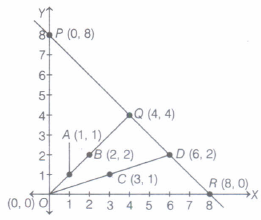
Determine graphically, the vertices of the triangle formed by the lines y=x, 3y=x, x+y=8.
10.
Find the zeroes of the polynomial x2-3 and verify the relationship between the zeroes and the coefficients.
11.
Find the least number that is divisible by all the numbers from 1 to 10 (both inclusive).
12.
If two positive integers a and b are written as a = x3y2 and b = xy3; where x, y are prime numbers, find the HCF of a and b.
13.
Show that the square of an odd positive integer is of the form 8m + 1, where m is some whole number.
14.
Write whether every positive integer can be of the form 4q + 2, where q is an integer. Justify your answer.
15.
Write next three terms of the given AP:
(a + b),(a + 1) + b,(a +1) + (b + 1),...
16.
An AP consists of 37 terms. The sum of the three middle most term is 225 and the sum of the last three is 429. Find the AP.
17.
Find whether the following equations have real roots .If real roots exist, then find them
(i) \(8x^{ 2 }+2x-3=0\)
(ii) \(-2x^{ 2 }+3x+2=0\)
18.
A train travelling at a uniform speed at a uniform speed for 360 km, would have taken 48 min less to travel the same distance , if its speed was 5 km/h more .Find the original speed of the train.
19.
Four circular cardboard pieces of radius 7 cm are placed on a paper in such a way that each piece touches other two pieces, Find the area of the portion enclosed between these pieces.
20.
In the given figure, arcs have been drawn of radius 21 cm each with vertices A, B, C and D of quadrilateral ABCD as centres. Find the area of the shaded region.
21.
The rain water from a roof of dimensions 22 m x 20 m drains into a cylindrical vessel having diameter of base 2 m and height 3.5 m. If the rain water collected from the roof just fill the cylindrical vessel, then find the rainfall in cm.
22.
In a game, the entry fee is Rs. 5. The game consists of tossing a coin 3 times. If one or two heads show, then Sweta gets her entry fee back. If she tosses 3 heads, then she receives double the entry fees. Otherwise she will lose. For tossing a coin three times, find the probability that she
(i) loses the entry fee
(ii) gets double entry fee
(iii) just gets her entry fee
23.
The sum of the first five terms of an AP and the first seven terms of the same AP is 167. If the sum of the first ten terms of this AP is 235, find the sum of its first twenty terms.
24.
Kanoka was given her pocket money on Jan 1st, 2008. She puts Rs.1 on day 1, Rs.2 on day 2, Rs.3 on day 3, and continued doing so til the end of the month, from this money into her piggy bank. She also spent Rs.204 of her pocket money, and found that at the end of the month she still had Rs.100 with her. How much was her pocket money for the month?
25.
If the sum of first 6 terms of an AP is 36 and that of the first 16 terms is 256, find the sum of first 10 terms.
1.
Given, sec \(\theta\) + tan \(\theta\) = l ..........(i)
\(\Rightarrow \frac{(\sec \theta+\tan \theta)(\sec \theta-\tan \theta)}{(\sec \theta-\tan \theta)}=l\)
\(\Rightarrow \frac{\sec ^{2} \theta-\tan ^{2} \theta}{\sec \theta-\tan \theta}=l \Rightarrow \sec \theta-\tan \theta=\frac{1}{l}\) ...(ii)
Hence, find sec \(\theta\) using Eq. (i) and (ii)...
2.
f1=28, f2=24
3.
14.48km/L No, the manufacturer is claiming mileage 1.52km/L more than the average mileage.
4.
109.92
5.
35
6.
Here, class interval are not continuous. But it does not affect mid-values. So, we will solve it without making it continuous.
| Class | Class marks | Frequency | fixi |
|---|---|---|---|
| 4-7 | 5.5 | 5 | 27.5 |
| 8-11 | 9.5 | 4 | 38 |
| 12-15 | 13.5 | 9 | 121.5 |
| 16-19 | 17.5 | 10 | 175 |
| \(\sum { f_{ i } } =28\) | \(\sum { f_{ i }x_{ i } } =362\) |
Mean \(\left( \overline { x } \right) =\frac { \sum { f_{ i }x_{ i } } }{ \sum { f_{ i } } } =\frac { 362 }{ 28 } =12.93\)
7.
Rs.12000 in scheme A and Rs.10000 in scheme B
8.
10 km/h, 40 km/h
9.
Plot the lines as follows (0, 0), (4,4), (6,2)
10.
Recall the identity a2 - b2 = (a - b)(a + b). Using it, we can write:
x2 - 3 = (x - \(\sqrt{3}\))(x + \(\sqrt{3}\))
So, the value of x2 - 3 is zero when x = \(\sqrt{3}\) or x = -\(\sqrt{3}\)
Therefore, the zeroes of x2 - 3 are \(\sqrt{3}\) and -\(\sqrt{3}\)
Now,
sum of zeroes = \(\sqrt{3}\) - \(\sqrt{3}\) = 0 = \(\frac{-(Coefficient \quad of \quad x)}{Coefficient \quad of \quad x^{2}}\)
product of zeroes = (\(\sqrt{3}\))(-\(\sqrt{3}\)) = -3 = \(\frac{-3}{1}=\frac{Constant \quad term}{Coefficient \quad of \quad x^{2}}\)
11.
Factors of 1 to 10 numbers
1 = 1
2 = 1 x 2
3 = 1 x 3
4 = 1 x 2 x 2
5 = 1 x 5
6 = 1 x 2 x 3
7 = 1 x 7
8 = 1 x 2 x 2 x 2
9 = 1 x 3 x 3
10 = 1 x 2 x 5
\(\therefore \) LCM of numbers 1 to 10
= LCM (1, 2, 3, 4, 5, 6, 7, 8, 9, 10)
= 2 x 2 x 2 x 3 x 3 x 5 x 7 = 2520
12.
\(a={ x }^{ 3 }{ y }^{ 2 }=x\times x\times x\times y\times y\) and \(b={ x }{ y }^{ 3 }=x\times y\times y\times y\)
HCF (a,b) = xy2
13.
Let a be any positive integer.
We know that, any odd positive integer is of the form 2q + 1, where q is a whole number.
\(\therefore \) a = 2q + 1
\(\Rightarrow \) a2 = (2q + 1)2 [squaring both sides]
\(\Rightarrow \) a2 = 4q(q + 1) + 1 ...(i)
Note that q(q + 1) is either '0' or even, for any whole number q.
So, let q(q + 1) = 2m where m is a whole number.
From Eq.(i), we get a2 = 4(2m) + 1 = 8m + 1
14.
No, because by Euclid's division lemma,
we have, a = 4q + r, \(0\le r<4\) ...(i)
a can be in the form 4q, 4q + 1, 4q + 2 or 4q + 3
15.
(a + 2) + (b + 1),(a + 2) + (b + 2),(a + 3) + (b + 2)
16.
a18 + a19 + a20 = 225
a35 + a36 + a37 = 429
3, 7, 11, 15, ...
17.
(i) \((i)\frac { 1 }{ 2 } ,\frac { 3 }{ 4 } \)
(ii)\((i)-\frac { 1 }{ 2 } ,2\)
18.
45 km/h.
19.
42 cm2
20.
1386 cm2
21.
Lert height of rainfall be h cm
V Cuboid = VCylinder
\(lbh=\pi r^{ 2 }h\)
\(22\times 20\times h=\frac { 22 }{ 7 } \times 1\times 1\times \frac { 35 }{ 10 } \)
\(\Rightarrow h=\frac { 11 }{ 22\times 20 } \)
\(\Rightarrow h=\frac { 1 }{ 40 } m=2.5cm\)
22.
Possible outcomes on tossing a coin 3 times, are HHH, HHT, HTH, THH, HTT, THT, TTH, TTT
\(\therefore\) Total number of outcomes = 8
(i) Let E1 be the event that Sweta losses the entry fee
i.e. shen tosses tail three times i.e. TTT.
\(\therefore\) Number of outcomes favourable to E1 = 1
Hence, required probability = P(E1) = \(\frac{1}{8}\)
(ii) Let E2, be the event that Sweta gets double entry fee
i.e. she tosses heads three times
i.e. HHH
\(\therefore\) Number of outcomes favourable to E2 = 1
Hence, required probability \(=P\left(E_2\right)=\frac{1}{8}\)
(iii) Let E3 be the event that Sweta gets her entry fee back
i.e. Sweta gets heads one or two times
i.e. event of getting
HTT, THT, TTH, HHT, HTH or THH
\(\therefore\) Number of outcomes favourable to E3 = 6
Hence, required probability = P(E3) = \(\frac{6}{8}=\frac{3}{4}\)
23.
A.T.Q., S5 + S7 = 167
\(\Rightarrow\) \({5\over2}[2a+14d]+{7\over2}[2a+6d]=167\)
\(\Rightarrow\) 5 ( a + 2d ) + 7 ( a + 3d ) = 167
\(\Rightarrow\) 12a + 31d = 167 ...(i)
and S10 = 235
\(\Rightarrow\) \({10\over2}[2a+9d]=235\)
\(\Rightarrow\) 2a + 9d = \({235\over4}=47\) ...(ii)
Multiplying equation (ii) by 6 and then subtractigfrom (i), we have
12a + 31d = 167
12a + 54d = 282
- - -
-23d = -115
d= \({-115\over-23}=5\)
\(\therefore\) From (ii), 2a + 9d = 47
\(\Rightarrow\) 2a + 9 x 5 = 47
\(\Rightarrow\) 2a = 47 - 45
\(\Rightarrow\) 2a = 2 \(\Rightarrow\) a = 1
Hence, S20 = \({20\over2}[2a+19d]\)
= 10 [ 2 x 1 + 19x 5 ]
= 10 [ 2 + 95 ] = 10 x 97 = 970
24.
Here a = 1, d = 1 and n = 31
Sn = \({n\over2}[2a+(n-1)d]\)
\(={31\over2}[2\times1+(31-1)]\)
\(={31\over2}[2+30]={31\over2}\times 32\)
= 496
\(\therefore\) Piggy bank amount = Rs 496
Amount spent = Rs 204
Amount left = Rs 100
Total pocket money = Rs 800
25.
\(\because\) S6 = 36 and S16 = 256.
\(\Rightarrow\) S6 = \({6\over2}\) [ 2a + 5d ]
[ \(\because\) Sn = \({n\over2} [ 2a + ( n - 1)d ]\)
\(\Rightarrow\) S6 = 3 ( 2a + 5d )
\(\Rightarrow\) \({36\over3}\) = 2a + 5d
\(\Rightarrow\) 12 = 2a + 5d ...(i)
and S16 = \({16\over2}[2a+15d]\)
\(\Rightarrow\) \({256\over8}=2a+15d\)
\(\Rightarrow\) 32 = 2a + 15d ...(ii)
Subtracting (i) and (ii), 2n + 5d = 12
2a + 15d = 32
- - -
-10d = -20 \(\Rightarrow\) d = 2
\(\therefore\) From (i), 12 = 2a + 5(2)
12 - 10 = 2a \(\Rightarrow\) 2a = 2 \(\Rightarrow\) a = 1
Hence S10 = \({10\over2}[2a+9d]\)
= 5 ( 2 x 1 + 9 x 2 )
= 5 ( 2 + 18 )
\(\Rightarrow\) S10 = 5 x 20 = 100.

10th Standard CBSE Syllabus & Materials
10th Standard CBSE
CBSE 10th Social Science PS - Federalism - New Model Questions Papers Study Material - QB365 Set A
NEW10th Standard CBSE
CBSE 10th Social Science PS - Power Sharing - New Model Questions Papers Study Material - QB365 Set A
NEW10th Standard CBSE
CBSE 10th Social Science GEO - Manufacturing Industries - New Model Questions Papers Study Material - QB365 Set A
NEW10th Standard CBSE
CBSE 10th Social Science GEO - Minerals and Energy Resources - New Model Questions Papers Study Material - QB365 Set A



NCERT Books

Syllabus

Exam Pattern

Sample Question Papers

Previous year Question Papers

Important Notes

MCQ Practice test

NCERT Exemplers

Case study Questions

Image Based Questions

Passage based Questions

HOT Questions

Value Based Questions

Model Questions Papers
NCERT ( Book Back ) Questions

Assertion and Reason
Important Questions And Answers

CBSE 10th Standard CBSE Subjects
CBSE Standards




