
 100% FREE ACCESS
10th Standard CBSE Syllabus & Materials
10th Standard CBSE
CBSE 10th Social Science ECO - Globalisation and the Indian Economy - New Model Questions Papers Study Material - QB365 Set A
NEW10th Standard CBSE
CBSE 10th Social Science ECO - Money and Credit - New Model Questions Papers Study Material - QB365 Set A
NEW10th Standard CBSE
CBSE 10th Social Science ECO - Sectors of the Indian Economy - New Model Questions Papers Study Material - QB365 Set A
NEW10th Standard CBSE
CBSE 10th Social Science ECO - Development - New Model Questions Papers Study Material - QB365 Set A
NEW10th Standard CBSE
CBSE 10th Social Science PS - Outcomes of Democracy - New Model Questions Papers Study Material - QB365 Set A
NEW10th Standard CBSE
CBSE 10th Social Science PS - Gender, Religion and Caste - New Model Questions Papers Study Material - QB365 Set A

Published on: 26/05/2021
QB365 Provides the updated NCERT Examplar Questions for Class 10 Maths, and also provide the detail solution for each and every ncert examplar questions , QB365 will give all kind of study materials will help to get more marks
Download CBSE Class 10th Standard CBSE Maths question papers, sample papers, important questions, and previous year solved papers in PDF format. Get free study materials, NCERT solutions, and exam preparation resources for Class 10th Standard CBSE Maths
Questions + Answers key
Take MCQ Maths Test1.
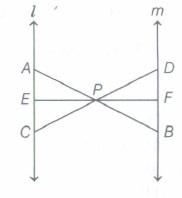
In the given figure, IIIm and line segments AB, CD and EF are concurrent at point P. Prove that \(\frac{A E}{B F}=\frac{A C}{B D}=\frac{C E}{F D}\)
2.
For any positive integer n, prove that n3 - n is divisible by 6.
3.
In \(\triangle PQR,PD\bot QR\) such that D lies on QR. If PQ = a, PR = b, QD = c and DR = d, then prove that (a + b) (a - b) = (c + d) (c - d).
4.
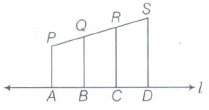
In the given figure, PA, QB, RC and SD are all perpendiculars to a line l, AB = 6 cm, BC = 9 cm, CD = 12 cm and SP = 36 cm. Find PQ, QR and RS.
5.
Shweta prepared two posters on National Integration for decoration on Independence day on triangular sheets (say ABC and DEF). The sides AB and AC and the perimeter P1 of \(\triangle ABC\) are respectively four times the corresponding sides DE and DF and the perimeter P2 of \(\triangle DEF\). Are the two triangular sheets similar? If yes, find \(\frac { ar\left( \triangle ABC \right) }{ ar\left( \triangle DEF \right) } \). What values can be indicated through celebration of national festivals?
6.
Susan invested certain amount of money in two schemes A and B, which offer interest at the rate of 8% per annum and 9% per annum, respectively. She received Rs.1860 as annual interest. However, had she interchanged the amount of investments in the two schemes, she would received Rs.20 more as annual interest. How much money did she invest in each scheme?
7.
Ankita travels 14 km to her home partly by rickshaw and partly by bus. She takes half an hour, if she travels 2 km by rickshaw and the remaining distance by bus.
On the other hand, if she travels 4 km by rickshaw and the remaining distance by bus, she takes 9 min longer. Find the speed of rickshaw and of the bus.
8.
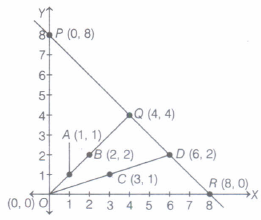
Determine graphically, the vertices of the triangle formed by the lines y=x, 3y=x, x+y=8.
9.
Reduce the following pair of equations into a pair of linear equations and solve them
\(\frac { 2xy }{ x+y } =\frac { 3 }{ 2 } ,\quad \frac { xy }{ 2x-y } =\frac { -3 }{ 10 } ;\quad x+y\neq 0,\quad 2x-y\neq 0\)
10.
Find the zeroes of the polynomial x2-3 and verify the relationship between the zeroes and the coefficients.
11.
Find the least number that is divisible by all the numbers from 1 to 10 (both inclusive).
12.
If two positive integers a and b are written as a = x3y2 and b = xy3; where x, y are prime numbers, find the HCF of a and b.
13.
Show that the square of an odd positive integer is of the form 8m + 1, where m is some whole number.
14.
Write whether every positive integer can be of the form 4q + 2, where q is an integer. Justify your answer.
15.
The sum of four consecutive numbers in an AP is 32 and the ratio of the product of the first and the last terms to the product of the two middle terms is 7:15. Find the numbers.
16.
If the sum of first n terms of an AP is given by Sn= n (4n+1), then find the nth term of the AP. Also, find the AP.
17.
An AP consists of 37 terms. The sum of the three middle most term is 225 and the sum of the last three is 429. Find the AP.
18.
Jaipal Singh repays the total loan of Rs 118000 by paying every month starting with the first instalment of Rs 1000. If the increases the instalment by Rs 100 every month, then what amount will be paid by him in the 30th instalment? What amount of loan does he still have to pay after 30th instalment?
19.
Find whether the following equations have real roots .If real roots exist, then find them
(i) \(8x^{ 2 }+2x-3=0\)
(ii) \(-2x^{ 2 }+3x+2=0\)
20.
A train travelling at a uniform speed at a uniform speed for 360 km, would have taken 48 min less to travel the same distance , if its speed was 5 km/h more .Find the original speed of the train.
21.
Jaspal Singh repays his total loan of Rs.118000 by paying every month starting with the first instalment of Rs.1000. If he increases the instalment by Rs.100 every month,
(i) What will be paid by him in the 30th instalment?
(ii) What amount of loan does he still have to pay after the 30th instalment?
22.
The sum of the first five terms of an AP and the first seven terms of the same AP is 167. If the sum of the first ten terms of this AP is 235, find the sum of its first twenty terms.
23.
Kanoka was given her pocket money on Jan 1st, 2008. She puts Rs.1 on day 1, Rs.2 on day 2, Rs.3 on day 3, and continued doing so til the end of the month, from this money into her piggy bank. She also spent Rs.204 of her pocket money, and found that at the end of the month she still had Rs.100 with her. How much was her pocket money for the month?
24.
If the sum of first 6 terms of an AP is 36 and that of the first 16 terms is 256, find the sum of first 10 terms.
25.
At present Asha's age (in years) is 2 more than the square of her daughter Nisha's age. When Nisha grows to her mother's present age, Asha's age would be one year less than 10times the present age of Nisha. Find the present ages of both Asha and Nisha.
1.
\(\text { In } \triangle A P C \text { and } \Delta B P D \text { , }\)
\(\angle A P C=\angle B P D\) [vertically opposite angles]
and \(\angle P A C=\angle P B D\) [alternate angles]
\(\therefore \Delta A P C \sim \Delta B P D\) [by AA similarity criterion]
\(\Rightarrow \frac{A P}{P B}=\frac{A C}{B D}=\frac{P C}{P D}\) ......(i)
[since, corresponding sides of similar triangles are proportional]
\(\text { In } \Delta A P E \text { and } \Delta B P F\)
\(\angle A P E=\angle B P F\) [vertically opposite angles]
and \(\angle P A E=\angle P B F\) [alternate angles]
\(\therefore \Delta A P E \sim \Delta B P F\) [by AA similarity criterion]
\(\Rightarrow \frac{A P}{P B}=\frac{A E}{B F}=\frac{P E}{P F}\) ......(ii)
[since, corresponding sides of similar triangles are proportional]
\(\text { In } \Delta P E C \text { and } \Delta P F D, \angle E P C=\angle F P D\) [vertically opposite angles]
and \(\angle P C E=\angle P D F\) [alternate angles]
\(
\therefore
\Delta P E C \sim \Delta P F D
\) [by AA similarity criterion]
\(\Rightarrow \frac{P E}{P F}=\frac{P C}{P D}=\frac{E C}{F D}\) ........(iii)
[since, corresponding sides of similar triangles are proportional]
From Eqs, (i), (ii) and (iii), we get
\(\frac{A P}{P B}=\frac{A C}{B D}=\frac{A E}{B F}=\frac{P E}{P F}=\frac{E C}{F D}\)
\(\therefore \frac{A E}{B F}=\frac{A C}{B D}=\frac{C E}{F D}\)
2.
n3-n = n n2-1)
= n (n+1)(n-1)
=( n-1) n(n+1)
= product of threeconsecutive positive integers
Now, we ave to show that the product of three consecutive positive integers is divisible by 6.
We know that any positive integer a is of the form 3q, 3q + 1 or 3q + 2 for some integer q.
Let a, a + 1, a + 2 be any three consecutive integers.
Case I: if a=3q
a(a + l)(a + 2) = 3q(3q + 1)(3q + 2)
= 3q (2r)
= 6qr, which is divisible by 6.
(∵ Product of two consecutive integers (3q + 1) and (3q + 2) is an even integer, say 2r)
Case II: If a=3q + 1
∴ a(a + l)(a + 2) = (3q + 1)(3q + 2)(3q + 3)
= (2r) (3)(q + 1)
= 6r(q + 1),
which is divisible by 6
Case III: If a=3q + 2
ஃ a(a + l)(a + 2) = (3q + 2)(3q + 3)(3q + 4)
= multiple of 6 for ever
= 6r (say),
which is divisible by 6.
Hence, the product of three consecutive integers is divisible by 6.
3.
In \(\triangle PDQ\), we have
PQ2 = PD2 + QD2
PD2 = PQ2 - QD2
= a2 - c2 .... (i)
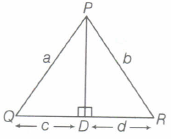
In right \(\triangle PDR\), we have
PR2 = PD2 + DR2
PD2 = PR2 - DR2 = b2 - d2
From Eqs.(i) and (ii)
a2 - c2 = b2 - d2 \(\Rightarrow \) a2 - b2 = c2 - d2
4.
By BPT,
PQ : QR : RS = AB : BC : CD = 6 : 9 : 12
Let PQ = 6x, QR = 9x and RS = 12x
Since, length of PS = 36km
\(\therefore \) PQ + QR + RS = 36
\(\Rightarrow \) 6x + 9x + 12x = 36
\(\Rightarrow \) 27x = 36 \(\Rightarrow \) x = \(\frac{4}{3}\)
PQ = 8 cm, QR = 12 cm and RS = 16 cm
5.
Yes, 16 : 1 ; unity of nation, fraternity and patriotism.
6.
Rs.12000 in scheme A and Rs.10000 in scheme B
7.
10 km/h, 40 km/h
8.
Plot the lines as follows (0, 0), (4,4), (6,2)
9.
The given system of equations is
\(\frac { 2xy }{ x+y } =\frac { 3 }{ 2 } \) and \(\frac { xy }{ 2x-y } =\frac { -3 }{ 10 } \)
\(\Rightarrow\) \(\frac { x+y }{ 2xy } =\frac { 4 }{ 3 } \) and \(\frac { 2x-y }{ xy } =\frac { -10 }{ 3 } \)
\(\frac { 1 }{ y } +\frac { 1 }{ x } =\frac { 4 }{ 3 } \) and \(\frac { 2 }{ y } -\frac { 1 }{ x } =\frac { -10 }{ 3 } \)
Put \(\frac { 1 }{ x } =u\) and \(\frac { 1 }{ y } =v\) then the system of equations becomes u+v=\(\frac { 4 }{3 } \) and -u+2v=\(\frac { -10 }{3 } \)
Now, solve these equation.
x=\(\frac {1}{2}\) and y=\(\frac {-3}{2}\)
10.
Recall the identity a2 - b2 = (a - b)(a + b). Using it, we can write:
x2 - 3 = (x - \(\sqrt{3}\))(x + \(\sqrt{3}\))
So, the value of x2 - 3 is zero when x = \(\sqrt{3}\) or x = -\(\sqrt{3}\)
Therefore, the zeroes of x2 - 3 are \(\sqrt{3}\) and -\(\sqrt{3}\)
Now,
sum of zeroes = \(\sqrt{3}\) - \(\sqrt{3}\) = 0 = \(\frac{-(Coefficient \quad of \quad x)}{Coefficient \quad of \quad x^{2}}\)
product of zeroes = (\(\sqrt{3}\))(-\(\sqrt{3}\)) = -3 = \(\frac{-3}{1}=\frac{Constant \quad term}{Coefficient \quad of \quad x^{2}}\)
11.
Factors of 1 to 10 numbers
1 = 1
2 = 1 x 2
3 = 1 x 3
4 = 1 x 2 x 2
5 = 1 x 5
6 = 1 x 2 x 3
7 = 1 x 7
8 = 1 x 2 x 2 x 2
9 = 1 x 3 x 3
10 = 1 x 2 x 5
\(\therefore \) LCM of numbers 1 to 10
= LCM (1, 2, 3, 4, 5, 6, 7, 8, 9, 10)
= 2 x 2 x 2 x 3 x 3 x 5 x 7 = 2520
12.
\(a={ x }^{ 3 }{ y }^{ 2 }=x\times x\times x\times y\times y\) and \(b={ x }{ y }^{ 3 }=x\times y\times y\times y\)
HCF (a,b) = xy2
13.
Let a be any positive integer.
We know that, any odd positive integer is of the form 2q + 1, where q is a whole number.
\(\therefore \) a = 2q + 1
\(\Rightarrow \) a2 = (2q + 1)2 [squaring both sides]
\(\Rightarrow \) a2 = 4q(q + 1) + 1 ...(i)
Note that q(q + 1) is either '0' or even, for any whole number q.
So, let q(q + 1) = 2m where m is a whole number.
From Eq.(i), we get a2 = 4(2m) + 1 = 8m + 1
14.
No, because by Euclid's division lemma,
we have, a = 4q + r, \(0\le r<4\) ...(i)
a can be in the form 4q, 4q + 1, 4q + 2 or 4q + 3
15.
Let the four consecutive number in AP are
a - 3d, a - d, a + d, a + 3d
Then, we have
(a - 3d) + (a - d) + (a + d) + (a + 3d)
⇒ 4a = 32
⇒ a = 8
Also, it is given that the ratio of the product of first and the last terms to the product of the two middle terms is 7:15, therefore we have
\(\frac { (a-3d)(a+3d) }{ (a-d)(a+d) } =\frac { 7 }{ 15 } \ \)
\(\ \Rightarrow \ \frac { a^{ 2 }-9d^{ 2 } }{ a^{ 2 }-d^{ 2 } } =\frac { 7 }{ 15 } \Rightarrow 15a^{ 2 }-135d^{ 2 }=7a^{ 2 }-7d^{ 2 }\ \)
\(\ \Rightarrow 8a^{ 2 }-128d^{ 2 }\Rightarrow a^{ 2 }=16d^{ 2 }\)
\(\\ \Rightarrow \ 64=16d^{ 2 }\quad \quad \ d \left[ \because \quad a=8 \right] \)
\(\\ \Rightarrow \ d^{ 2 }=4\Rightarrow d=\pm 2\)
Hence, the number are 2, 6, 10, 14 or 14, 10, 6, 2.
16.
8 n-3; 5,13,21,...
17.
a18 + a19 + a20 = 225
a35 + a36 + a37 = 429
3, 7, 11, 15, ...
18.
Here, first instalment, a = Rs 1000
and increases the instalment every month, d = Rs 100
Number of instalments, n = 30
Then, list of numbers is
\(1000,(1000+100),(1000+2\times100),(1000+3\times100)...\)
i.e. 1000, 1100, 1200, 1300,... which is an AP.
Amount paid in 30th instalment,
\({a}_{30}=1000+(30-1)100 \quad[\because {a}_{n}=a+(n-1)d]\)
\(= 1000 + 29 \times 100\)
= 1000 + 2900 = Rs 3900
Amount paid in 30 instalments,
\({S}_{30}=\frac{30}{2}[2 \times 1000+(30-1)100]\)
\([\because {S}_{n}=\frac {n}{2}=\{2a+(n-1)d\}]\)
\(= 15[2000+29 \times 100]=15[2000+2900]\)
= 15[4900 ]= Rs 7500
Hence, amount of loan still, he has to pay
= Rs 118000 - Rs 73500 = Rs 4500
19.
(i) \((i)\frac { 1 }{ 2 } ,\frac { 3 }{ 4 } \)
(ii)\((i)-\frac { 1 }{ 2 } ,2\)
20.
45 km/h.
21.
Since, Jaspal Singh repays his loan of Rs.118000, with first instalment of Rs 1000 and increases each instalment by Rs 100.
\(\therefore \) His instalments are Rs 1000, Rs 1100, Rs 1200, Rs 1300, ... which forms an A.P.
Here, first term is Rs 1000 and common difference is Rs 100.
\(\therefore \) 30th instalment = a30 = a + 29d
= Rs (1000 + 29 \(\times \) 100)
= Rs (1000 + 2900) = Rs 3900
Amount paid in 30 instalments = S30
\(\Rightarrow \) S30 = Rs \(\quad \frac { 30 }{ 2 } (2\times 1000+29\times 100)\)
\(=\ Rs\ 15 (2000+2900)\\ =\ Rs\ 15(4900)\ =\ Rs\ 73500\)
Amount of loan still have to pay
= Rs (118000 - 73500)
= Rs 44500
22.
A.T.Q., S5 + S7 = 167
\(\Rightarrow\) \({5\over2}[2a+14d]+{7\over2}[2a+6d]=167\)
\(\Rightarrow\) 5 ( a + 2d ) + 7 ( a + 3d ) = 167
\(\Rightarrow\) 12a + 31d = 167 ...(i)
and S10 = 235
\(\Rightarrow\) \({10\over2}[2a+9d]=235\)
\(\Rightarrow\) 2a + 9d = \({235\over4}=47\) ...(ii)
Multiplying equation (ii) by 6 and then subtractigfrom (i), we have
12a + 31d = 167
12a + 54d = 282
- - -
-23d = -115
d= \({-115\over-23}=5\)
\(\therefore\) From (ii), 2a + 9d = 47
\(\Rightarrow\) 2a + 9 x 5 = 47
\(\Rightarrow\) 2a = 47 - 45
\(\Rightarrow\) 2a = 2 \(\Rightarrow\) a = 1
Hence, S20 = \({20\over2}[2a+19d]\)
= 10 [ 2 x 1 + 19x 5 ]
= 10 [ 2 + 95 ] = 10 x 97 = 970
23.
Here a = 1, d = 1 and n = 31
Sn = \({n\over2}[2a+(n-1)d]\)
\(={31\over2}[2\times1+(31-1)]\)
\(={31\over2}[2+30]={31\over2}\times 32\)
= 496
\(\therefore\) Piggy bank amount = Rs 496
Amount spent = Rs 204
Amount left = Rs 100
Total pocket money = Rs 800
24.
\(\because\) S6 = 36 and S16 = 256.
\(\Rightarrow\) S6 = \({6\over2}\) [ 2a + 5d ]
[ \(\because\) Sn = \({n\over2} [ 2a + ( n - 1)d ]\)
\(\Rightarrow\) S6 = 3 ( 2a + 5d )
\(\Rightarrow\) \({36\over3}\) = 2a + 5d
\(\Rightarrow\) 12 = 2a + 5d ...(i)
and S16 = \({16\over2}[2a+15d]\)
\(\Rightarrow\) \({256\over8}=2a+15d\)
\(\Rightarrow\) 32 = 2a + 15d ...(ii)
Subtracting (i) and (ii), 2n + 5d = 12
2a + 15d = 32
- - -
-10d = -20 \(\Rightarrow\) d = 2
\(\therefore\) From (i), 12 = 2a + 5(2)
12 - 10 = 2a \(\Rightarrow\) 2a = 2 \(\Rightarrow\) a = 1
Hence S10 = \({10\over2}[2a+9d]\)
= 5 ( 2 x 1 + 9 x 2 )
= 5 ( 2 + 18 )
\(\Rightarrow\) S10 = 5 x 20 = 100.
25.
Let present age of Asha be x years
and present age of Nisha be y years
ATQ x=y2 + 2
Difference in ages = (x years)
Mother's age after (x — y) years is
x+(x-y) = 10y-1
\(\Rightarrow \) 2x-y-10y+1=0
\(\Rightarrow \) 2(y2+2)-11y+1=0
\(\Rightarrow \) 2y2-+4-11y+5=0
\(\Rightarrow \) 2y2-11y+5=0
\(\Rightarrow \)2y2-10y-y+5=0
\(\Rightarrow \) (y-5) (2y-1) =0
\(\Rightarrow \) y=5 or y = \(\frac { 1 }{ 2 } \) [rejecting]
Nisha's present age = 5 years
Asha's present age = 52 + 2 = 27 years.

10th Standard CBSE Syllabus & Materials
10th Standard CBSE
CBSE 10th Social Science PS - Federalism - New Model Questions Papers Study Material - QB365 Set A
NEW10th Standard CBSE
CBSE 10th Social Science PS - Power Sharing - New Model Questions Papers Study Material - QB365 Set A
NEW10th Standard CBSE
CBSE 10th Social Science GEO - Manufacturing Industries - New Model Questions Papers Study Material - QB365 Set A
NEW10th Standard CBSE
CBSE 10th Social Science GEO - Minerals and Energy Resources - New Model Questions Papers Study Material - QB365 Set A



NCERT Books

Syllabus

Exam Pattern

Sample Question Papers

Previous year Question Papers

Important Notes

MCQ Practice test

NCERT Exemplers

Case study Questions

Image Based Questions

Passage based Questions

HOT Questions

Value Based Questions

Model Questions Papers
NCERT ( Book Back ) Questions

Assertion and Reason
Important Questions And Answers

CBSE 10th Standard CBSE Subjects
CBSE Standards




