
 100% FREE ACCESS
10th Standard CBSE Syllabus & Materials
10th Standard CBSE
CBSE 10th Social Science ECO - Globalisation and the Indian Economy - New Model Questions Papers Study Material - QB365 Set A
NEW10th Standard CBSE
CBSE 10th Social Science ECO - Money and Credit - New Model Questions Papers Study Material - QB365 Set A
NEW10th Standard CBSE
CBSE 10th Social Science ECO - Sectors of the Indian Economy - New Model Questions Papers Study Material - QB365 Set A
NEW10th Standard CBSE
CBSE 10th Social Science ECO - Development - New Model Questions Papers Study Material - QB365 Set A
NEW10th Standard CBSE
CBSE 10th Social Science PS - Outcomes of Democracy - New Model Questions Papers Study Material - QB365 Set A
NEW10th Standard CBSE
CBSE 10th Social Science PS - Gender, Religion and Caste - New Model Questions Papers Study Material - QB365 Set A

Published on: 22/05/2021
QB365 Provides the updated CASE Study Questions for Class 10 Maths, and also provide the detail solution for each and every case study questions . Case study questions are latest updated question pattern from NCERT, QB365 will helps to get more marks in Exams
Download CBSE Class 10th Standard CBSE Maths question papers, sample papers, important questions, and previous year solved papers in PDF format. Get free study materials, NCERT solutions, and exam preparation resources for Class 10th Standard CBSE Maths
Questions + Answers key
Take MCQ Maths Test
1.
Puneet went for shopping in the evening by metro with his father who is an expert in mathematics. He told Puneet that path of metro A is given by the equation 2x + 4y = 8 and path of metro B is given by the equation 3x + 6y = 18. His father put some questions to Puneet. Help Puneet to solve the questions.
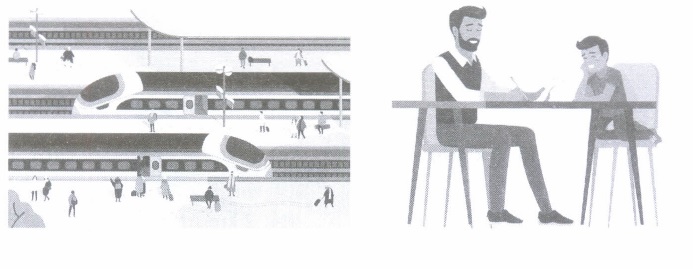
(i) Equation 2x + 4y = 8 intersects the x-axis and y-axis respectively at
| (a) (4,0), (0, 2) | (b) (0,4), (2,0) | (c) (4,0), (2,0) | (d) (0,4), (0, 2) |
(ii) Equation 3x + 6y = 18 intersects the x-axis and y-axis respectively at
| (a) (6,0), (0, 8) | (b) (0,6), (0, 8) | (c) (6,0), (0, 3) | (d) (0,6), (0, 3) |
(iii) Coordinates of point of intersection of two given equations are
| (a) (1,2) | (b) (2,4) | (c) (3,7) | (d) does not exist |
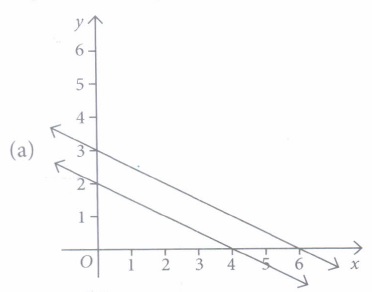
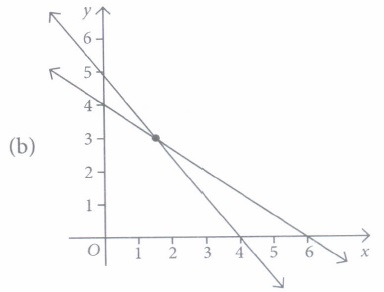
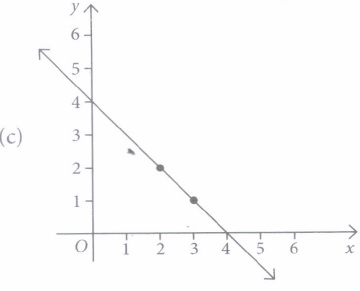
(iv) Represent the equations, 2x + 4y = 8 and 3x + 6y = 18 graphically.
 |
 |
 |
(d) None of these |
(v) System oflinear equations represented by two given lines is
| (a) inconsistent | (b) having infinitely many solutions |
| (c) consistent | (d) overlapping each other |
2.
A boat in the river Ganga near Rishikesh covers 24 km upstream and 36 km downstream in 6 hours while it covers 36 km upstream and 24 km downstream in \(6 \frac{1}{2}\) hours. Consider speed of the boat in still water be x km/hr and speed of the stream be y km/hr and answer the following questions.
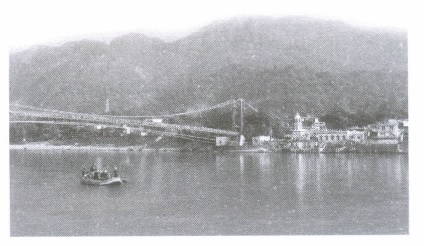
(i) Represent the 1st situation algebraically.
| \((a) \frac{24}{x-y}+\frac{36}{x+y}=6\) | \((b) \frac{24}{x+y}+\frac{36}{x-y}=6\) | \((c) 24 x+36 y=6\) | \((d) 24 x-36 y=6\) |
(ii) Represent the 2nd situation algebraically.
| \((a) \frac{36}{x+y}+\frac{24}{x-y}=\frac{13}{2}\) | \((b) \frac{36}{x-y}+\frac{24}{x+y}=\frac{13}{2}\) | \((c) 36 x-24 y=\frac{13}{2}\) | \((d) 36 x+24 y=\frac{13}{2}\) |
(iii) If u \(=\frac{1}{x-y} \text { and } v=\frac{1}{x+y}, \text { then } u=\)
| \((a) \frac{1}{4}\) | \((b) \frac{1}{12}\) | \((c) \frac{1}{8}\) | \((d) \frac{1}{6}\) |
(iv) Speed of boat in still water is
| (a) 4 km/hr | (b) 6 km/hr | (c) 8 km/hr | (d) 10 krn/hr |
(v) Speed of stream is
| (a) 3 km/hr | (b) 4 km/hr | (c) 2 km/hr | (d) 5 km/hr |
3.
In a office, 8 men and 12 women together can finish a piece of work in 10 days, while 6 men and 8 women together can finish it in 14 days. Let one day's work of a man be l/x and one day's work of a woman be 1/y.
Based on the above information, answer the following questions.
(i) 1st situation can be represented algebraically as
| \((a) \frac{80}{x}-\frac{120}{y}=1\) | \((b) \frac{120}{x}-\frac{80}{y}=1\) | \((c) \frac{120}{x}+\frac{80}{y}=1\) | \((d) \frac{80}{x}+\frac{120}{y}=1\) |
(ii) 2nd situation can be represented algebraically as
| \((a) \frac{112}{x}-\frac{84}{y}=1\) | \((b) \frac{84}{x}-\frac{112}{y}=1\) | \((c) \frac{84}{x}+\frac{112}{y}=1\) | \((d) \frac{112}{x}+\frac{84}{y}=1\) |
(iii) One woman alone can finish the work in
| (a) 220 days | (b) 140 days | (c) 280 days | (d) 160 days |
(iv) One man alone can finish the work in
| (a) 140 days | (b) 220 days | (c) 160 days | (d) 280 days |
(v) If 14 men and 28 women work together, then in what time, the work will be completed?
| (a) 2 days | (b) 3 days | (c) 4 days | (d) 5 days |
4.
Points A and B representing Chandigarh and Kurukshetra respectively are almost 90 km apart from each other on the highway. A car starts from Chandigarh and another from Kurukshetra at the same time. If these cars go in the same direction, they meet in 9 hours and if these cars go in opposite direction they meet in 9/7 hours. Let X and Ybe two cars starting from points A and B respectively and their speed be x km/hr and y km/hr respectively.
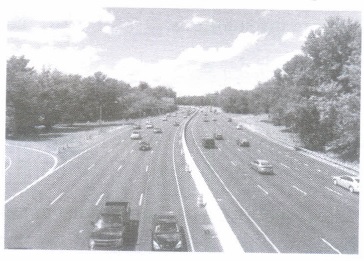
Then, answer the following questions.
(i) When both cars move in the same direction, then the situation can be represented algebraically as
| (a) x - y = 10 | (b) x + y = 10 | (c) x + y = 9 | (d) x - y = 9 |
(ii) When both cars move in opposite direction, then the situation can be represented algebraically as
| (a) x - y=70 | (b) x + y=90 | (c) x + y=70 | (d) x + y=10 |
(iii) Speed of car X is
| (a) 30 km/hr | (b) 40 km/hr | (c) 50 km/hr | (d) 60 km/hr |
(iv) Speed of car Y is
| (a) 50km//hr | (b) 40 km/hr | (c) 30 km/hr | (d) 60 km/hr |
(v) If speed of car X and car Y, each is increased by 10 km/hr, and cars are moving in opposite direction, then after how much time they will meet?
| (a) 5 hrs | (b) 4 hrs | (c) 2 hrs | (d) 1 hr |
5.
A part of monthly hostel charges in a college is fixed and the remaining depends on the number of days one has taken food in the mess. When a student Anu takes food for 25 days, she has to pay Rs 4500 as hostel charges, whereas another student Bindu who takes food for 30 days, has to pay Rs 5200 as hostel charges.
Considering the fixed charges per month by Rs x and the cost of food per day by Rs y, then answer the following questions.
(i) Represent algebraically the situation faced by both Anu and Bindu.
| (a) x + 25y = 4500, x + 30y = 5200 | (b) 25x + y = 4500, 30x + Y = 5200 |
| (c) x - 25y = 4500, x - 30y = 5200 | (d) 25x - y = 4500, 30x - Y = 5200 |
(ii) The system of linear equations, represented by above situations has
| (a) No solution | (b) Unique solution |
| (c) Infinitely many solutions | (d) None of these |
(iii) The cost of food per day is
| (a) Rs 120 | (b) Rs 130 | (c) Rs 140 | (d) Rs 1300 |
(iv) The fixed charges per month for the hostel is
| (a) Rs 1500 | (b) Rs 1200 | (c) Rs 1000 | (d) Rs 1300 |
(v) If Bindu takes food for 20 days, then what amount she has to pay?
| (a) Rs 4000 | (b) Rs 3500 | (c) Rs 3600 | (d) Rs 3800 |
1.
(i) (a): At x-axis, y = 0
\(\therefore\) 2x + 4y = 8 \(\Rightarrow\) x = 4
At y-axis, x = 0
\(\therefore\) 2x + 4y = 8 \(\Rightarrow\) Y = 2
\(\therefore\) Required coordinates are (4, 0), (0, 2).
(ii) (c): At x-axis, y = 0
\(\therefore\) 3x + 6y = 18 \(\Rightarrow\) 3x = 18 \(\Rightarrow\) x = 6
At y-axis, x = 0
\(\therefore\) 3x + 6y = 18 \(\Rightarrow\) 6y = 18 \(\Rightarrow\) Y = 3
\(\therefore\) Required coordinates are (6, 0), (0, 3).
(iii) (d): Since, lines are parallel. So, point of intersection of these lines does not exist.
(iv) (a)
(v) (a): Since the lines are parallel.
\(\therefore\) These equations have no solution i.e., the given system of linear equations is inconsistent.
2.
Speed of boat in upstream = (x - y)km/hr and speed of boat in downstream = (x + y)km/hr.
(i) (a): 1st situation can be represented algebraically as \(\frac{24}{x-y}+\frac{36}{x+y}=6\)
(ii) (b): 2nd situation can be represented algebraically as \(\frac{36}{x-y}+\frac{24}{x+y}=\frac{13}{2}\)
(iii) (c) : Putting \(\frac{1}{x-y}=u \text { and } \frac{1}{x+y}=v\)
we get,
24u + 36v = 6 and 36u + 24v = 13/2
Solving the above equations, we get u \(=\frac{1}{8}, v=\frac{1}{12}\)
(iv) (d): \(\because u=\frac{1}{8}=\frac{1}{x-y} \Rightarrow x-y=8\) ........(i)
\(\text { and } v=\frac{1}{12}=\frac{1}{x+y} \Rightarrow x+y=12\) .........(ii)
Adding equations (i) from (ii), we get 2x = 20 \(\Rightarrow\) x = 10
\(\therefore\) Speed of boat in still water = 10 km/hr -.
(v) (c): From equation (i), 10 - y = 8 \(\Rightarrow\) y = 2
\(\therefore\) Speed of stream = 2 km/hr.
3.
(i) (d): Since 8 men and 12 women can finish the work in 10 days.
\(\therefore\left(\frac{8}{x}+\frac{12}{y}\right)=\frac{1}{10} \Rightarrow \frac{80}{x}+\frac{120}{y}=1\)
(ii) (c): Since 6 men and 8 women can finish a piece of work in 14 days
\(\therefore\left(\frac{6}{x}+\frac{8}{y}\right)=\frac{1}{14} \Rightarrow \frac{84}{x}+\frac{112}{y}=1\)
(iii) (c) : Let \(\frac{1}{x}=u, \frac{1}{y}=v\)
Thus, we have
80u + 120v = 1 and 84u + 112v = 1
Solving above two equations, we get
\(v=\frac{1}{280} \Rightarrow \frac{1}{y}=\frac{1}{280} \Rightarrow y=280\)
Thus one woman alone can finish the work in 280 days.
(iv) (a): We have \(\frac{80}{x}+\frac{120}{y}=1 \Rightarrow \frac{80}{x}+\frac{120}{280}=1\)
\(\Rightarrow \quad \frac{80}{x}=1-\frac{3}{7} \Rightarrow \frac{80}{x}=\frac{4}{7}=\Rightarrow x=140\)
Thus one man alone can finish the work in 140 days.
(v) (d): We have, x = 140 and y = 280
One day's work of 14 men and 28 women
\(=\frac{14}{140}+\frac{28}{280}=\frac{1}{10}+\frac{1}{10}=\frac{2}{10}=\frac{1}{5}\)
Thus, work will be finished in 5 days.
4.
(i) (a) : Suppose two cars meet at point Q. Then,
Distance travelled by car X = A Q,
Distance travelled by car Y = BQ.
It is given that two cars meet in 9 hours.
\(\therefore\) Distance travelled by car X in 9 hours = 9x km
\(\Rightarrow\) AQ=9x
Distance travelled by car Y in 9 hours = 9y km
\(\Rightarrow\) BQ=9y
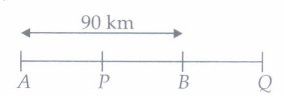
Clearly, AQ - BQ = AB
\(\Rightarrow\) 9x - 9y = 90
\(\Rightarrow\) x-y =10
(ii) (c): Suppose two cars meet at point P. Then
Distance travelled by car X = AP and
Distance travelled by car Y = BP.
In this case, two cars meet in 917 hours.
\(\therefore\) Distance travelled by car X in 9/7 hours = \(\frac {9}{7}\) x km
\(\Rightarrow A P=\frac{9}{7} x\)
Distance travelled by car Y in 9/7 hours \(\frac {9}{7}\) y km
\(\Rightarrow B P=\frac{9}{7} y\)
Clearly, AP + BP = AB
\(\Rightarrow \quad \frac{9}{7} x+\frac{9}{7} y=90 \Rightarrow \frac{9}{7}(x+y)=90 \Rightarrow x+y=70\)
(iii) (b): We have x - y = 10
\(\Rightarrow x+y=70\)
Adding equations (i) and (ii), we get
2x = 80 \(\Rightarrow\) x = 40
Hence, speed of car X is 40 km/hr.
(iv) (c): We have x - y = 10
\(\Rightarrow\) 40 - Y = 10 \(\Rightarrow\) Y = 30
Hence, speed of car y is 30 km/hr.
(v) (d)
5.
(i) (a): For student Anu: Fixed charge + cost of food for 25 days = Rs 4500
i.e., x + 25y = 4500 For student Bindu:
Fixed charges + cost of food for 30 days = Rs 5200
i.e., x + 30y = 5200
(ii) (b): From above, we have a1 = 1, b1, = 25
\(c_{1}=-4500 \text { and } a_{2}=1, b_{2}=30, c_{2}=-5200 \)
\(\therefore \frac{a_{1}}{a_{2}}=1, \frac{b_{1}}{b_{2}}=\frac{25}{30}=\frac{5}{6}, \frac{c_{1}}{c_{2}}=\frac{-4500}{-5200}=\frac{45}{52} \)
\(\Rightarrow \frac{a_{1}}{a_{2}} \neq \frac{b_{1}}{b_{2}} \neq \frac{c_{1}}{c_{2}}\)
Thus, system of linear equations has unique solution
(iii) (c) : We have x + 25y = 4500 .......(i)
and x + 30y = 5200 ........(ii)
Subtracting (i) from (ii), we get
5y=700 \(\Rightarrow\) y=140
\(\therefore\) Cost of food per day is Rs 140
(iv) (c): We have, x + 25y = 4500
\(\Rightarrow\) x = 4500 - 25 x 140
\(\Rightarrow\) x = 4500 - 3500 = 1000
\(\therefore\) Fixed charges per month for the hostel is Rs 1000
(v) (d): We have, x = 1000, Y = 140 and Bindu takes food for 20 days.
\(\therefore\) Amount that Bindu has to pay = Rs (1000 + 20 x 140) = Rs 3800

10th Standard CBSE Syllabus & Materials
10th Standard CBSE
CBSE 10th Social Science PS - Federalism - New Model Questions Papers Study Material - QB365 Set A
NEW10th Standard CBSE
CBSE 10th Social Science PS - Power Sharing - New Model Questions Papers Study Material - QB365 Set A
NEW10th Standard CBSE
CBSE 10th Social Science GEO - Manufacturing Industries - New Model Questions Papers Study Material - QB365 Set A
NEW10th Standard CBSE
CBSE 10th Social Science GEO - Minerals and Energy Resources - New Model Questions Papers Study Material - QB365 Set A



NCERT Books

Syllabus

Exam Pattern

Sample Question Papers

Previous year Question Papers

Important Notes

MCQ Practice test

NCERT Exemplers

Case study Questions

Image Based Questions

Passage based Questions

HOT Questions

Value Based Questions

Model Questions Papers
NCERT ( Book Back ) Questions

Assertion and Reason
Important Questions And Answers

CBSE 10th Standard CBSE Subjects
CBSE Standards



