
 100% FREE ACCESS
10th Standard CBSE Syllabus & Materials
10th Standard CBSE
CBSE 10th Social Science ECO - Globalisation and the Indian Economy - New Model Questions Papers Study Material - QB365 Set A
NEW10th Standard CBSE
CBSE 10th Social Science ECO - Money and Credit - New Model Questions Papers Study Material - QB365 Set A
NEW10th Standard CBSE
CBSE 10th Social Science ECO - Sectors of the Indian Economy - New Model Questions Papers Study Material - QB365 Set A
NEW10th Standard CBSE
CBSE 10th Social Science ECO - Development - New Model Questions Papers Study Material - QB365 Set A
NEW10th Standard CBSE
CBSE 10th Social Science PS - Outcomes of Democracy - New Model Questions Papers Study Material - QB365 Set A
NEW10th Standard CBSE
CBSE 10th Social Science PS - Gender, Religion and Caste - New Model Questions Papers Study Material - QB365 Set A

Published on: 22/05/2021
QB365 Provides the updated CASE Study Questions for Class 10 Maths, and also provide the detail solution for each and every case study questions . Case study questions are latest updated question pattern from NCERT, QB365 will helps to get more marks in Exams
Download CBSE Class 10th Standard CBSE Maths question papers, sample papers, important questions, and previous year solved papers in PDF format. Get free study materials, NCERT solutions, and exam preparation resources for Class 10th Standard CBSE Maths
Questions + Answers key
Take MCQ Maths Test
1.
Shray, who is a social worker, wants to distribute masks, gloves, and hand sanitizer bottles in his block. Number of masks, gloves and sanitizer bottles distributed in 1 day can be represented by the zeroes \(\alpha, \beta, \gamma,(\alpha>\beta>\gamma)\) of the polynomial \(p(x)=x^{3}-18 x^{2}+95 x-150 .\)
Based on the above information, answer the following questions.
(i) Find the value of \(\alpha,\beta,\gamma.\)
| (a) -10, -5,-3 | (b) 3,6,5 |
| (c) 10,5,3 | (d) 4,8,9 |
(ii) The sum of product of zeroes taken two at a time is
| (a) 91 | (b) 92 | (c) 94 | (d) 95 |
(iii) Product of zeroes of polynomial p(x) is
| (a) 150 | (b) 160 | (c) 170 | (d) 180 |
(iv) The value of the polynomial p(x), when x = 4 is
| (a) 5 | (b) 6 | (c) 7 | (d) 8 |
(v) If \(\alpha,\beta,\gamma\) are the zeroes of a polynomial g(x) such that \(\alpha+\beta+\gamma=3, \alpha \beta+\beta \gamma+\gamma \alpha=-16\) and \(\alpha \beta \gamma=-48\) then, g(x) =
| \((a) x^{3}-2 x^{2}-48 x+6\) | \((b) x^{3}+3 x^{2}++16 x-48\) |
| \((c) x^{3}-48 x^{2}-16 x+3\) | \((d) x^{3}-3 x^{2}-16 x+48\) |
2.
Shweta and her husband Sunil who is an architect by profession, visited France. They went to see Mont Blanc Tunnel which is a highway tunnel between France and Italy, under the Mont Blanc Mountain in the Alps, and has a parabolic cross-section. The mathematical representation of the tunnel is shown in the graph.
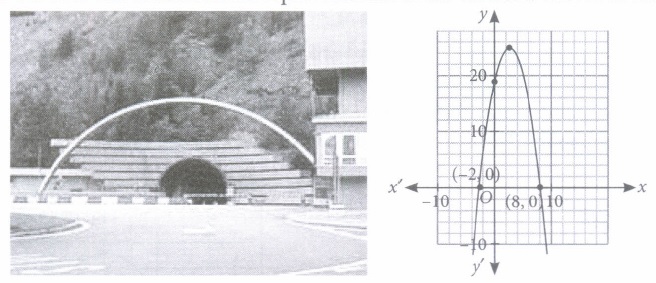
Based on the above information, answer the following questions.
(i) The zeroes of the polynomial whose graph is given, are
| (a) -2,8 | (b) -2, -8 | (c) 2,8 | (d) -2, 0 |
(ii) What will be the expression of the polynomial given in diagram?
| \((a) x^{2}-6 x+16\) | \((b) -x^{2}+6 x+16\) | \((c) x^{2}+6 x+16\) | \((d) -x^{2}-6 x-16\) |
(iii) What is the value of the polynomial, represented by the graph, when x = 4?
| (a) 22 | (b) 23 | (c) 24 | (d) 25 |
(iv) If the tunnel is represented by x2 + 3x - 2, then its zeroes are
| (a) -1, -2 | (b) 1, -2 | (c) -1,2 | (d) 1,2 |
(v) If one zero is 4 and sum of zeroes is -3, then representation of tunnel as a polynomial is
| \((a) x^{2}-x+24\) | \((b) -x^{2}-3 x+28\) | \((c) x^{2}+x+28\) | \((d) x^{2}-x+28\) |
3.
In a soccer match, the path of the soccer ball in a kick is recorded as shown in the following graph.
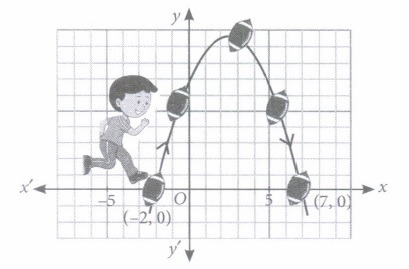
Based on the above i!;formation, answer the following questions.
(i) The shape of path of the soccer ball is a
| (a) Circle | (b) Parabola | (c) Line | (d) None of these |
(ii) The axis of symmetry of the given parabola is
| (a) y-axis | (b) x-axis |
| (c) line parallel to y-axis | (d) line parallel to x-axis |
(iii) The zeroes of the polynomial, represented in the given graph, are
| (a) -1,7 | (b) 5,-2 | (c) -2,7 | (d) -3,8 |
(iv) Which of the following polynomial has -2 and -3 as its zeroes?
| \((a) x^{2}-5 x-5\) | \((b) x^{2}+5 x-6\) | \((c) x^{2}+6 x-5\) | \((d) x^{2}+5 x+6\) |
(v) For what value of 'x', the value of the polynomial \(f(x)=(x-3)^{2}+9 \text { is } 9 ?\)
| (a) 1 | (b) 2 | (c) 3 | (d) 4 |
4.
Pankaj's father gave him some money to buy avocado from the market at the rate of p(x) = x2 - 24x + 128. Let a , \(\beta\) are the zeroes of p(x).
Based on the above information, answer the following questions.
(i) Find the value of a and \(\beta\), where a < \(\beta\).
| (a) -8, -16 | (b) 8,16 | (c) 8,15 | (d) 4,9 |
(ii) Find the value of \(\alpha\) + \(\beta\) + \(\alpha\)\(\beta\).
| (a) 151 | (b) 158 | (c) 152 | (d) 155 |
(iii) The value of p(2) is
| (a) 80 | (b) 81 | (c) 83 | (d) 84 |
(iv) If \(\alpha\) and \(\beta\) are zeroes of \(x^{2}+x-2, \text { then } \frac{1}{\alpha}+\frac{1}{\beta}=\)
| (a) 1/2 | (b) 1/3 | (c) 1/4 | (d) 1/5 |
(v) If sum of zeroes of \(q(x)=k x^{2}+2 x+3 k\) is equal to their product, then k =
| (a) 2/3 | (b) 1/3 | (c) -2/3 | (d) -1/3 |
5.
While playing in garden, Sahiba saw a honeycomb and asked her mother what is that. She replied that it's a honeycomb made by honey bees to store honey. Also, she told her that the shape of the honeycomb formed is parabolic. The mathematical representation of the honeycomb structure is shown in the graph.
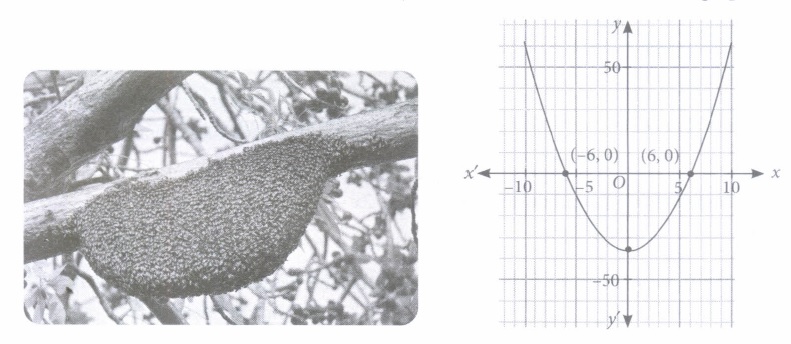
Based on the above information, answer the following questions.
(i) Graph of a quadratic polynomial is in___________shape.
| (a) straight line | (b) parabolic |
| (c) circular | (d) None of these |
(ii) The expression of the polynomial represented by the graph is
| (a) x2-49 | (b) x2-64 | (c) x2-36 | (d) x2-81 |
(iii) Find the value of the polynomial represented by the graph when x = 6.
| (a) -2 | (b) -1 | (c) 0 | (d) 1 |
(iv) The sum of zeroes of the polynomial x2 + 2x - 3 is
| (a) -1 | (b) -2 | (c) 2 | (d) 1 |
(v) If the sum of zeroes of polynomial at2 + 5t + 3a is equal to their product, then find the value of a.
| (a) -5 | (b) -3 | \(\text { (c) } \frac{5}{3}\) | \(\text { (d) } \frac{-5}{3}\) |
1.
(i) (c): For finding \(\alpha,\beta,\) \(\gamma\) consider p(x) = 0
\(\Rightarrow \quad x^{3}-18 x^{2}+95 x-150=0 \)
\(\Rightarrow \quad(x-3)\left(x^{2}-15 x+50\right)=0 \)
\(\Rightarrow \quad(x-3)(x-5)(x-10)=0 \Rightarrow x=10 \text { or } x=5 \text { or } x=3 \)
\(\text { Thus } \alpha=10, \beta=5 \text { and } \gamma=3\)
(ii) (d): Here \(\alpha=10, \beta=5 \text { and } \gamma=3\)
\(\therefore\) Sum of product of zeroes taken two at a time
\(\begin{array}{l} =\alpha \beta+\beta \gamma+\gamma \alpha=(10)(5)+(5)(3)+(3)(10) \\ =50+15+30=95 \end{array}\)
(iii) (a): Product of zeroes of polynomial p(x) = \(\alpha\beta\gamma\)
= (10) (5) (3) = 150
(iv) (b): We have \(p(x)=x^{3}-18 x^{2}+95 x-150\)
\(\begin{array}{l} \text { Now, } p(4)=4^{3}-18(4)^{2}+95(4)-150 \\ =64-288+380-150=6 \end{array}\)
(v) (d): \(g(x)=x^{3}-(\alpha+\beta+\gamma) x^{2} +(\alpha \beta+\beta \gamma+\gamma \alpha) x-\alpha \beta \gamma \)
\(\Rightarrow g(x)=x^{3}-3 x^{2}-16 x-(-48)=x^{3}-3 x^{2}-16 x+48\)
2.
(i) (a): Since, the graph intersects the x-axis at two points, namely x = 8, -2. So, 8, - 2 are the zeroes of the given polynomial.
(ii) (b): The expression of the polynomial given in diagram is \(-x^{2}+6 x+16\)
(iii) (c) : Let \(p(x)=-x^{2}+6 x+16\)
\(\text { When } x=4, p(4)=-4^{2}+6 \times 4+16=24\)
(iv) (d): Let \(f(x)=-x^{2}+3 x-2\)
Now, consider \(f(x)=0 \Rightarrow-x^{2}+3 x-2=0\)
\(\begin{aligned}
&\Rightarrow x^{2}-3 x+2=0 \Rightarrow(x-2)(x-1)=0\\
&\Rightarrow x=1,2 \text { are its zeroes. }
\end{aligned}\)
(v) (b): Let a and \(\beta\) are the zeroes of the required polynomial.
Given \(\alpha + \beta = - 3\)
If \(\alpha\) = 4, then \(\beta\)= -7
\(\therefore \quad \text { Representation of tunnel is }-x^{2}-3 x+28 \text { . }\)
3.
(i) (b): The shape of the path of the soccer ball is a parabola.
(ii) (c): The axis of symmetry of the given curve is a line parallel to y-axis.
(iii) (a): The zeroes of the polynomial, represented in the given graph, are -2 and 7, since the curve cuts the x-axis at these points.
(iv) (d):A polynomial having zeroes -2 and -3 is \(p(x)=x^{2}-(-2-3) x+(-2)(-3)=x^{2}+5 x+6\)
(v) (c): We have \(f(x)=(x-3)^{2}+9\)
\(\text { Now, } 9=(x-3)^{2}+9 \)
\(\Rightarrow(x-3)^{2}=0 \Rightarrow x-3=0 \Rightarrow x=3\)
4.
(i) (b): Given, a and \(\beta\) are the zeroes of
\(p(x)=x^{2}-24 x+128\)
\(\text { Putting } p(x)=0 \text { , we get }\)
\( x^{2}-8 x-16 x+128=0 \)
\(\Rightarrow x(x-8)-16(x-8)=0 \)
\(\Rightarrow (x-8)(x-16)=0 \Rightarrow x=8 \text { or } x=16 \)
\(\therefore \alpha=8, \beta=16\)
(ii) (c) : \(\alpha+\beta+\alpha \beta =8+16+(8)(16) =24+128=152 \)
(iii) (d) : \(p(2)=2^{2}-2 4(2)+128=4-48+128=84\)
(iv) (a): Since a and \(\beta\) are zeroes of \(x^{2}+x-2\)
\(\therefore \quad \alpha+\beta=-1 \text { and } \alpha \beta=-2 \)
\(\text { Now, } \frac{1}{\alpha}+\frac{1}{\beta}=\frac{\beta+\alpha}{\alpha \beta}=\frac{-1}{-2}=\frac{1}{2}\)
(v) (c): Sum of zeroes \(=\frac{-2}{k}\)
Product of zeroes \(=\frac{3 k}{k}=3\)
According to question, we have \(\frac{-2}{k}=3\)
\(\Rightarrow \quad k=\frac{-2}{3}\)
5.
(i) (b): Graph of a quadratic polynomial is a parabolic in shape.
(ii) (c): Since the graph of the polynomial cuts the
x-axis at (-6,0) and (6, 0). So, the zeroes of polynomial are -6 and 6.
\(\therefore\) Required polynomial is p(x) = x2 - (-6 + 6)x + (-6)(6) = x2 - 36
(iii) (c) : We have, p(x) = x2 - 36
Now, p( 6) = 62 - 36 = 36 - 36 = 0
(iv) (b): Letf (x) = x2 + 2x - 3. Then,
\(\text { Sum of zeroes }=-\frac{\text { coefficient of } x}{\text { coefficient of } x^{2}}=-\frac{(2)}{1}=-2\)
(v) (d): The given polynomial is at2+ 5t + 3a Given, sum of zeroes = product of zeroes.
\(\Rightarrow \quad \frac{-5}{a}=\frac{3 a}{a} \Rightarrow a=\frac{-5}{3}\)

10th Standard CBSE Syllabus & Materials
10th Standard CBSE
CBSE 10th Social Science PS - Federalism - New Model Questions Papers Study Material - QB365 Set A
NEW10th Standard CBSE
CBSE 10th Social Science PS - Power Sharing - New Model Questions Papers Study Material - QB365 Set A
NEW10th Standard CBSE
CBSE 10th Social Science GEO - Manufacturing Industries - New Model Questions Papers Study Material - QB365 Set A
NEW10th Standard CBSE
CBSE 10th Social Science GEO - Minerals and Energy Resources - New Model Questions Papers Study Material - QB365 Set A



NCERT Books

Syllabus

Exam Pattern

Sample Question Papers

Previous year Question Papers

Important Notes

MCQ Practice test

NCERT Exemplers

Case study Questions

Image Based Questions

Passage based Questions

HOT Questions

Value Based Questions

Model Questions Papers
NCERT ( Book Back ) Questions

Assertion and Reason
Important Questions And Answers

CBSE 10th Standard CBSE Subjects
CBSE Standards



