
 100% FREE ACCESS
10th Standard CBSE Syllabus & Materials
10th Standard CBSE
CBSE 10th Social Science ECO - Globalisation and the Indian Economy - New Model Questions Papers Study Material - QB365 Set A
NEW10th Standard CBSE
CBSE 10th Social Science ECO - Money and Credit - New Model Questions Papers Study Material - QB365 Set A
NEW10th Standard CBSE
CBSE 10th Social Science ECO - Sectors of the Indian Economy - New Model Questions Papers Study Material - QB365 Set A
NEW10th Standard CBSE
CBSE 10th Social Science ECO - Development - New Model Questions Papers Study Material - QB365 Set A
NEW10th Standard CBSE
CBSE 10th Social Science PS - Outcomes of Democracy - New Model Questions Papers Study Material - QB365 Set A
NEW10th Standard CBSE
CBSE 10th Social Science PS - Gender, Religion and Caste - New Model Questions Papers Study Material - QB365 Set A

Published on: 22/05/2021
QB365 Provides the updated CASE Study Questions for Class 10 Maths, and also provide the detail solution for each and every case study questions . Case study questions are latest updated question pattern from NCERT, QB365 will helps to get more marks in Exams
Download CBSE Class 10th Standard CBSE Maths question papers, sample papers, important questions, and previous year solved papers in PDF format. Get free study materials, NCERT solutions, and exam preparation resources for Class 10th Standard CBSE Maths
Questions + Answers key
Take MCQ Maths Test
1.
Rohit is standing at the top of the building observes a car at an angle of 30°, which is approaching the foot of the building with a uniform speed. 6 seconds later, angle of depression of car formed to be 60°, whose distance at that instant from the building is 25 m.
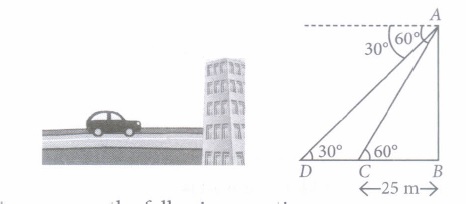
Based on the above information, answer the following questions.
(i) Height of the building is
| \((a) 25\sqrt{2} {~m}\) | (b) 50 m | \((a) 25\sqrt{3} {~m}\) | (d) 25 m |
(ii) Distance between two positions of the car is
| (a) 40 m | (b) 50 m | (c) 60 m | (d) 75 m |
(iii) Total time taken by the car to reach the foot of the building from starting point is
| (a) 4 sec. | (b) 3 sec. | (c) 6 sec. | (d) 9 sec. |
(iv) The distance of the observer from the car when it makes an angle of 60° is
| (a) 25 m | (b) 45 m | (c) 50 m | (d) 75 m |
(v) The angle of elevation increases
| (a) when point of observation moves towards the object |
| (b) when point of observation moves away from the object |
| (c) when object moves away from the observer |
| (d) None of these |
2.
There is fire incident in the house. The house door is locked so, the fireman is trying to enter the house from the window. He places the ladder against the wall such that its top reaches the window as shown in the figure .
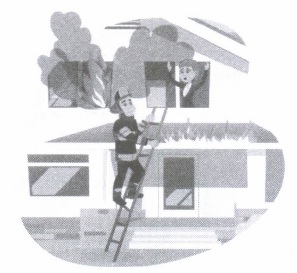
Based on. the above information, answer the following questions.
(i) If window is 6 m above the ground and angle made by the foot ofladder to the ground is 30°, then length of the ladder is
| (a) 8m | (b) 10m | (c) 12m | (d) 14m |
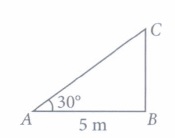
(ii) If fireman place the ladder 5 m away from the wall and angle of elevation is observed to be 30°, then length of the ladder is
| (a) 5 m | \((b) \frac{10}{\sqrt{3}} \mathrm{~m}\) | \((c) \frac{15}{\sqrt{2}} \mathrm{~m}\) | (d) 20 m |
(iii) If fireman places the ladder 2.5 m away from the wall and angle of elevation is observed to be 60°, then find the height of the window. (Take \(\sqrt{3}\) = 1.73)
| (a) 4.325 m | (b) 5.5 m | (c) 6.3 m | (d) 2.5 m |
(iv) If the height of the window is 8 m above the ground and angle of elevation is observed to be 45°, then horizontal distance between the foot of ladder and wall is
| (a) 2 m | (b) 4 m | (c) 6 m | (d) 8 m |
(v) If the fireman gets a 9 m long ladder and window is at 6 m height, then how far should the ladder be placed?
| (a) 5 m | (b) 3\(\sqrt{5}\)m | (c) 3 m | (d) 4 m |
3.
A circus artist is climbing through a 15 m long rope which is highly stretched and tied from the top of a vertical pole to the ground as shown below. Based on the above information, answer the following questions.
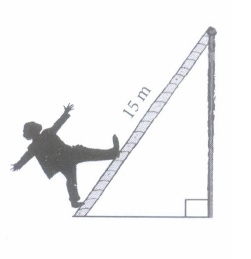
(i) Find the height of the pole, if angle made by rope to the ground level is 45°.
| \((a) 15 \mathrm{~m}\) | \((b) 15 \sqrt{2} \mathrm{~m}\) |
| \((c) \frac{15}{\sqrt{3}} \mathrm{~m}\) | \((d) \frac{15}{\sqrt{2}} \mathrm{~m}\) |
(ii) If the angle made by the rope to the ground level is 45°, then find the distance between artist and pole at ground level.
| \((a) \frac{15}{\sqrt{2}} \mathrm{~m}\) | \((b) 15 \sqrt{2} \mathrm{~m}\) | \((c) 15 \mathrm{~m}\) | \((d) {15}{\sqrt{3}} \mathrm{~m}\) |
(iii) Find the height of the pole if the angle made by the rope to the ground level is 30°.
| (a) 2.5 m | (b) 5 m | (c) 7.5 m | (d) 10 m |
(iv) If the angle made by the rope to the ground level is 30° and 3 m rope is broken, then find the height of the pole
| (a) 2m | (b) 4m | (c) 5m | (d) 6m |
(v) Which mathematical concept is used here?
| (a) Similar Triangles | (b) Pythagoras Theorem |
| (c) Application of Trigonometry | (d) None of these |
4.
There are two windows in a house. First window is at the height of 2 m above the ground and other window is 4 m vertically above the lower window. Ankit and Radha are sitting inside the two windows at points G and F respectively. At an instant, the angles of elevation of a balloon from these windows are observed to be 60° and 30° as shown below
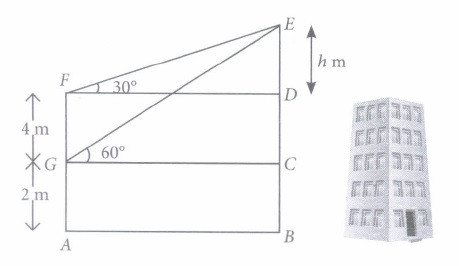
Based on the above information, answer the following questions.
(i) Who is more closer to the balloon?
| (a) Ankit | (b) Radha |
| (c) Both are at equal distance | (d) Can't be determined |
(ii) Value of DF is equal to
| \((a) \frac{h}{\sqrt{3}} \mathrm{~m}\) | \((b) h \sqrt{3} \mathrm{~m}\) | \((c) \frac{h}{2} \mathrm{~m}\) | \((d) 2 h \mathrm{~m}\) |
(iii) Value of h is
| (a) 2 | (b) 3 | (c) 4 | (d) 5 |
(iv) Height of the balloon from the ground is
| (a) 4 m | (b) 6 m | (c) 8 m | (d) 10 m |
(v) If the balloon is moving towards the building, then both angle of elevation will
| (a) remain same | (b) increases | (c) decreases | (d) can't be determined |
5.
There are two temples on each bank of a river. One temple is 50 m high. A man, who is standing on the top of 50 m high temple, observed from the top that angle of depression of the top and foot of other temple are 30° and 60° respectively. (Take \(\sqrt{3}\) = 1.73)
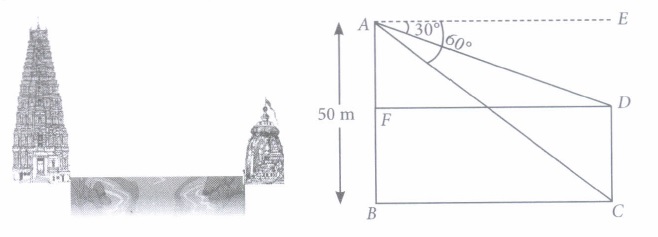
Based on the above information, answer the following questions.
(i) Measure of \(\angle\)ADF is equal to
| (a) 45° | (b) 60° | (c) 30° | (d) 90° |
(ii) Measure of \(\angle\)ACB is equal to
| (a) 45° | (b) 60° | (c) 30° | (d) 90° |
(iii) Width of the river is
| (a) 28.90 m | (b) 26.75 m | (c) 25 m | (d) 27 m |
(iv) Height of the other temple is
| (a) 32.5 m | (b) 35 m | (c) 33.33 m | (d) 40 m |
(v) Angle of depression is always
| (a) reflex angle | (b) straight |
| (c) an obtuse angle | (d) an acute angle |
1.
(i) (c): \(\text { In } \Delta A B C, \frac{A B}{B C}=\tan 60^{\circ}\)
\(\Rightarrow \quad A B=25 \times \sqrt{3}\)
\(\therefore\) Height of building is 25\(\sqrt{3}\) m .
(ii) (b): \(\text { In } \Delta A B D, \frac{A B}{B D}=\tan 30^{\circ}\)
\(\Rightarrow \frac{25 \sqrt{3}}{B D}=\frac{1}{\sqrt{3}} \Rightarrow B D=75 \mathrm{~m}\)
\(\therefore\) Distance between two positions of car = (75 - 25) m = 50m.
(iii) (d): Time taken to cover 50 m distance = 6 sec.
\(\therefore\) Time taken to cover 25 m distance = 3 sec.
\(\therefore\) Total time taken by car = 6 sec + 3 sec = 9 sec
(iv) (c): \(\text { In } \Delta A B C, \frac{B C}{A C}=\cos 60^{\circ}\)
\(\Rightarrow \quad \frac{25}{A C}=\frac{1}{2} \)
\(\Rightarrow A C=50 \mathrm{~m}\)
(v) (a)
2.
(i) (c) : Let AC be the length of the ladder.
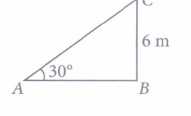
\(\text { In } \Delta A B C, \frac{B C}{A C}=\sin 30^{\circ} \)
\(\Rightarrow \frac{6}{A C}=\frac{1}{2} \Rightarrow A C=12 \mathrm{~m}\)
(ii) (b): \(\text { In } \Delta A B C, \frac{A B}{A C}=\cos 30^{\circ}\)
\(\Rightarrow \frac{5}{A C}=\frac{\sqrt{3}}{2} \Rightarrow A C=\frac{10}{\sqrt{3}} \mathrm{~m}\)
(iii) (a) : Let BC be the height of window from ground.
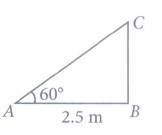
\(\text { In } \Delta A B C, \frac{B C}{A B}=\tan 60^{\circ} \)
\(\Rightarrow \frac{B C}{2.5}=\sqrt{3} \)
\(\Rightarrow B C=2.5 \times 1.73=4.325 \mathrm{~m}\)
(iv) (d): Let AB be the horizontal distance between the foot of ladder and wall.
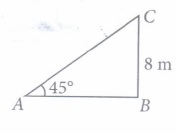
\(\text { In } \Delta A B C, \frac{B C}{A B}=\tan 45^{\circ} \)
\(\Rightarrow \quad \frac{8}{A B}=1 \Rightarrow A B=8 \mathrm{~m}\)
(v) (b): Let the required distance be x.
\(\text { In } \Delta A B C,(9)^{2}=x^{2}+(6)^{2}\)
[By Pythagoras theorem]
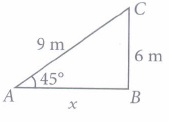
\(\Rightarrow 81-36=x^{2} \Rightarrow 45=x^{2} \)
\(\Rightarrow \quad x=3 \sqrt{5} \mathrm{~m}\)
3.
(i) (d): Let h be the height of the pole.
In \(\Delta\)ABC,
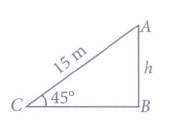
\( \frac{h}{15}=\sin 45^{\circ} \Rightarrow \frac{h}{15}=\frac{1}{\sqrt{2}}\)
\(\Rightarrow \quad h =\frac{15}{\sqrt{2}} \mathrm{~m}\)
(ii) (a): Let x be the required distance.
In \(\Delta\)ABC,
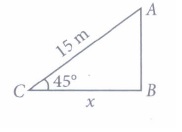
\(\frac{x}{15}=\cos 45^{\circ}=\frac{1}{\sqrt{2}}\)
\(\Rightarrow \quad x=\frac{15}{\sqrt{2}} \mathrm{~m}\)
(iii) (c) : Let h be the height of the pole.
In right triangle ABC,
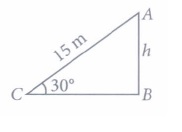
\(\frac{h}{15}=\sin 30^{\circ}=\frac{1}{2}\)
\(\Rightarrow \quad h=\frac{15}{2}=7.5 \mathrm{~m}\)
(iv) (d): If 3 m rope is broken, then the length of the rope is 12 m.
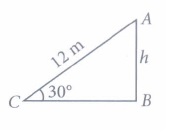
\(\text { In } \Delta A B C, \frac{h}{12}=\sin 30^{\circ}=\frac{1}{2} \)
\(\Rightarrow \quad h=\frac{12}{2}=6 \mathrm{~m}\)
(v) (c)
4.
(i) (b): The person who makes small angle of elevation is more closer to the balloon.
\(\therefore\) Radlra is more closer to the balloon.
(ii) (b): \(\text { In } \Delta E F D, \tan 30^{\circ}=\frac{E D}{D F}\)
\(\Rightarrow \quad \frac{1}{\sqrt{3}}=\frac{h}{D F} \)
\(\Rightarrow \quad D F=h \sqrt{3} \mathrm{~m}\)
(iii) (a): In \(\Delta\)GCE,
\(\begin{array}{l}
\tan 60^{\circ}=\frac{E C}{G C}=\frac{h+4}{D F} \\
\Rightarrow \quad \sqrt{3}=\frac{h+4}{\sqrt{3} h} \Rightarrow 3 h=h+4 \Rightarrow h=2
\end{array}\)
(iv) (c): Height of the balloon from the ground = BE = BC + CD + DE = 2 + 4 + 2 = 8 m
(v) (b)
5.
(i) (c) : Since AE || FD
\(\therefore\) \(\angle\)EAD = \(\angle\)ADF = 30° [Alternate interior angles]
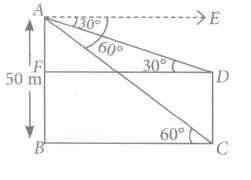
(ii) (b): Since, AE || BC
\(\therefore\) \(\angle\)EAC = \(\angle\)ACB = 60° [Alternate interior angles]
(iii) (a) : In \(\Delta\)ABC,
\(\begin{array}{l}
\tan 60^{\circ}=\frac{A B}{B C} \Rightarrow \sqrt{3}=\frac{50}{B C} \\
\Rightarrow \quad B C=\frac{50}{\sqrt{3}}=28.90 \mathrm{~m}
\end{array}\)
(iv) (c): In \(\Delta\)ADF, \(\tan 30^{\circ}=\frac{A F}{F D}\)
\(\Rightarrow \frac{1}{\sqrt{3}}=\frac{A B-B F}{F D} \Rightarrow \frac{1}{\sqrt{3}}=\frac{50-C D}{\frac{50}{\sqrt{3}}}\)
\(\left[\because F D=B C=\frac{50}{\sqrt{3}}\right] \)
\(\Rightarrow \frac{50}{3}=50-C D \Rightarrow C D=50-\frac{50}{3}=\frac{100}{3}=33.33 \mathrm{~m}\)
(v) (d)

10th Standard CBSE Syllabus & Materials
10th Standard CBSE
CBSE 10th Social Science PS - Federalism - New Model Questions Papers Study Material - QB365 Set A
NEW10th Standard CBSE
CBSE 10th Social Science PS - Power Sharing - New Model Questions Papers Study Material - QB365 Set A
NEW10th Standard CBSE
CBSE 10th Social Science GEO - Manufacturing Industries - New Model Questions Papers Study Material - QB365 Set A
NEW10th Standard CBSE
CBSE 10th Social Science GEO - Minerals and Energy Resources - New Model Questions Papers Study Material - QB365 Set A



NCERT Books

Syllabus

Exam Pattern

Sample Question Papers

Previous year Question Papers

Important Notes

MCQ Practice test

NCERT Exemplers

Case study Questions

Image Based Questions

Passage based Questions

HOT Questions

Value Based Questions

Model Questions Papers
NCERT ( Book Back ) Questions

Assertion and Reason
Important Questions And Answers

CBSE 10th Standard CBSE Subjects
CBSE Standards



