
 100% FREE ACCESS
10th Standard CBSE Syllabus & Materials
10th Standard CBSE
CBSE 10th Social Science ECO - Globalisation and the Indian Economy - New Model Questions Papers Study Material - QB365 Set A
NEW10th Standard CBSE
CBSE 10th Social Science ECO - Money and Credit - New Model Questions Papers Study Material - QB365 Set A
NEW10th Standard CBSE
CBSE 10th Social Science ECO - Sectors of the Indian Economy - New Model Questions Papers Study Material - QB365 Set A
NEW10th Standard CBSE
CBSE 10th Social Science ECO - Development - New Model Questions Papers Study Material - QB365 Set A
NEW10th Standard CBSE
CBSE 10th Social Science PS - Outcomes of Democracy - New Model Questions Papers Study Material - QB365 Set A
NEW10th Standard CBSE
CBSE 10th Social Science PS - Gender, Religion and Caste - New Model Questions Papers Study Material - QB365 Set A

Published on: 26/05/2021
QB365 Provides the updated NCERT Examplar Questions for Class 10 Maths, and also provide the detail solution for each and every ncert examplar questions , QB365 will give all kind of study materials will help to get more marks
Download CBSE Class 10th Standard CBSE Maths question papers, sample papers, important questions, and previous year solved papers in PDF format. Get free study materials, NCERT solutions, and exam preparation resources for Class 10th Standard CBSE Maths
Questions + Answers key
Take MCQ Maths Test1.
In a quadrilateral ABCD, ∠A + ∠D = 90°.
Prove that AC2 + BD2 = AD2 + BC2.
2.
In a ΔPQR, PR2 - PQ2 = QR2 and M is a point on side PR such that QM ⊥ PR. Prove that QM2 = PM x MR.
3.
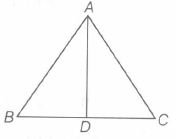
Find the altitude of an equilateral triangle of side 8 cm.
4.
Diagonals of a trapezium PQRS intersect each other at the point O, \(PQ\parallel RS\) and PQ = 3RS. Find the ratio of the areas of \(\triangle POQ\) and \(\triangle ROS\) .
5.
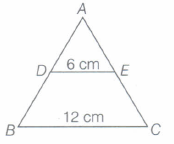
In the given figure, if \(DE\parallel BC\), find the ratio of ar \(\left( \triangle ADE \right) \) and ar \(\left( \triangle DECB \right) \)
6.
If \(\triangle ABC\sim \triangle QRP\), \(\frac { ar\left( \triangle ABC \right) }{ ar\left( \triangle QRP \right) } =\frac { 9 }{ 4 } \), AB = 18 cm and BC = 15 cm, then find PR.
7.
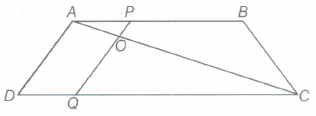
In the given figure, if \(AB\parallel DC\) and AC, PQ intersect each other at the point O, then prove that OA. CQ = OC.AP.
8.
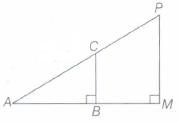
\(\triangle ABC\) and \(\triangle AMP\) are two right angled triangles. right angled at B and M, respectively. Prove that CA x MP = PA x BC
9.
If the lengths of the diagonals of rhombus are 16 cm and 12 cm. Then, find the length of the sides of the rhombus.
10.
A street light bulb is fixed on a pole 6 m above the level of the street. If a woman of height 1.5 m casts a shadow of 3 m, find how far is she away from the base of the pole?
1.
Given A quadrilateral ABCD, in which
\(\angle A+\angle D=90^{\circ}\)
Toprove AC2 + BD2 = AD2 + BC2
Construction Produce AB and CD to meet at E.
Also, join AC and BD
Proof In ΔAED \(\angle A+\angle D=90^{\circ}\) [given]
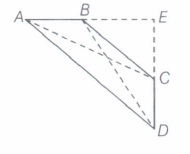
\(\therefore \angle E=180^{\circ}-(\angle A+\angle D)=90^{\circ}\) [by angle sum property of a triangle]
By Pythagoras theorem,
AD2 = AE2 + DE2........(i)
In ΔBEC, by Pythagoras theorem,
BC2 = BE2 + CE2 .........(ii)
On adding Eqs. (i) and (ii), we get
AD2 + BC2 = AE2 + DE2 + BE2 + CE2 .......(iii)
In ΔAEC, by Pythagoras theorem,
AC2 = AE2 + CE2 ......(iv)
and in ΔBED, by Pythagoras theorem,
BD2 = BE2 + DE2 .......(v)
On adding Eqs. (iv) and (v), we get
AC2 + BD2 = AE2 + CE2 + BE2 + DE2........(vi)
From Eqs. (iii) and (vi), we get
AC2 + BD2 = AD2 + BC2
2.
\(P R^{2}-P Q^{2}=Q R^{2} \Rightarrow P R^{2}=P Q^{2}+Q R^{2}\)
\(\Rightarrow\) ΔPQR is right angled triangle, right angled at Q.
3.
Altitude AD which is perpendicular to BC, then D is the mid-point of BC.
BD = CD = \(\frac{1}{2}\) BC = \(\frac{8}{2}\) = 4 cm.
Apply, Pythagoras theorem to find AD.
AD = \(4\sqrt{3}\) cm.
4.
Given, PQRS is a trapezium in which \(PQ\parallel RS\) and PQ = 3RS.
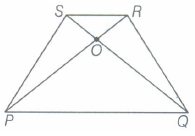
\(\Rightarrow \frac { PQ }{ RS } =\frac { 3 }{ 1 } \) ...(i)
In \(\triangle POQ\) and \(\triangle ROS\),
\(\angle SOR=\angle QOP \) [vertically opposite angles]
\(\angle SRP=\angle RPQ\) [alternate angles]
\(\therefore \triangle POQ\sim \triangle ROS\) [by AA similarity criterion]
By property of area of similar triangle,
\(\frac { ar\left( \triangle POQ \right) }{ ar\left( \triangle ROS \right) } =\frac { { \left( PQ \right) }^{ 2 } }{ { \left( RS \right) }^{ 2 } } =\left( \frac { 3 }{ 1 } \right) ^{ 2 }\) [from Eq.(i)]
\(\Rightarrow \frac { ar\left( \triangle POQ \right) }{ ar\left( \triangle SOR \right) } =\frac { 9 }{ 1 } \)
Hence, the required ratio is 9 : 1.
5.
Given, \(DE\parallel BC\) , DE = 6 cm and BC = 12 cm
In \(\triangle ABC\) and \(\triangle ADE\),
\(\angle ABC=\angle ADE\) [corresponding angles]
\(\angle ACB=\angle AED\) [corresponding angles]
and \(\angle A=\angle A\) [common angle]
\(\therefore \triangle ABC\sim \triangle ADE\) [by AAA similarity criterion]
We know that, the ratio of areas of two similar triangles is equal to the ratio of squares of their corresponding sides.
\(\therefore \frac { ar\left( \triangle ADE \right) }{ ar\left( \triangle ABC \right) } =\frac { { \left( DE \right) }^{ 2 } }{ { \left( BC \right) }^{ 2 } } =\frac { { \left( 6 \right) }^{ 2 } }{ { \left( 12 \right) }^{ 2 } } =\left( \frac { 1 }{ 2 } \right) ^{ 2 }\)
\(\Rightarrow \frac { ar\left( \triangle ADE \right) }{ ar\left( \triangle ABC \right) } =\left( \frac { 1 }{ 2 } \right) ^{ 2 }=\frac { 1 }{ 4 } \)
Let \(ar\left( \triangle ADE \right) =k\) , then \(ar\left( \triangle ABC \right) =4k\)
Now, \(ar\left( \triangle DECB \right) =ar\left( \triangle ADC \right) - ar\left( \triangle ADE \right) \)
= 4k - k = 3k
\(\therefore \) Required ratio = \(ar\left( \triangle ADE \right) : ar\left( \triangle DECB \right) \)
= k : 3k = 1 : 3
6.
Given, \(\triangle ABC\sim \triangle QRP\), AB = 18 cm, BC = 15 cm
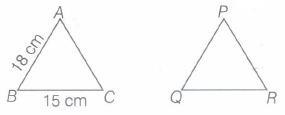
We know that, the ratio of areas of two similar triangles is equal to the ratio of squares of their corresponding sides.
\(\therefore \frac { ar\left( \triangle ABC \right) }{ ar\left( \triangle QRP \right) } =\frac { { \left( BC \right) }^{ 2 } }{ { \left( RP \right) }^{ 2 } } \)
But \(\frac { ar\left( \triangle ABC \right) }{ ar\left( \triangle QRP \right) } =\frac { 9 }{ 4 } \) given]
\(\Rightarrow \frac { { \left( 15 \right) }^{ 2 } }{ { \left( RP \right) }^{ 2 } } =\frac { 9 }{ 4 } \) [\(\because \) BC = 15 cm]
\(\Rightarrow { \left( RP \right) }^{ 2 }=\frac { 225\times 4 }{ 9 } =100\)
\(\therefore \) RP = 10 cm
[taking positive square root]
7.
Prove \(\triangle AOP\) and \(\triangle COQ\) are similar.
then \(\frac { OA }{ OC } =\frac { AP }{ CQ } \) [corresponding sides are proportional]
8.
Prove \(\triangle ABC\) and \(\triangle AMP\) are similar.
then take ratio \(\frac{AC}{AP}=\frac{BC}{MP}\)
9.
Diagonals of a rhombus bisect each other at right angles.
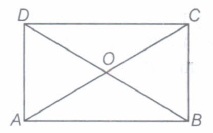
So, OA = OC = 8 cm
and OB = OD = 6 cm
Now use pythagoras theorem in ΔAOB
10 cm.
10.
Draw the figure according to the question and get two triangles. Then, show both triangles are similar by AAA similarity criterion and then calculate the required distance.
She is at 9 m from the base of the pole.

10th Standard CBSE Syllabus & Materials
10th Standard CBSE
CBSE 10th Social Science PS - Federalism - New Model Questions Papers Study Material - QB365 Set A
NEW10th Standard CBSE
CBSE 10th Social Science PS - Power Sharing - New Model Questions Papers Study Material - QB365 Set A
NEW10th Standard CBSE
CBSE 10th Social Science GEO - Manufacturing Industries - New Model Questions Papers Study Material - QB365 Set A
NEW10th Standard CBSE
CBSE 10th Social Science GEO - Minerals and Energy Resources - New Model Questions Papers Study Material - QB365 Set A



NCERT Books

Syllabus

Exam Pattern

Sample Question Papers

Previous year Question Papers

Important Notes

MCQ Practice test

NCERT Exemplers

Case study Questions

Image Based Questions

Passage based Questions

HOT Questions

Value Based Questions

Model Questions Papers
NCERT ( Book Back ) Questions

Assertion and Reason
Important Questions And Answers

CBSE 10th Standard CBSE Subjects
CBSE Standards




