
 100% FREE ACCESS
10th Standard CBSE Syllabus & Materials
10th Standard CBSE
CBSE 10th Social Science ECO - Globalisation and the Indian Economy - New Model Questions Papers Study Material - QB365 Set A
NEW10th Standard CBSE
CBSE 10th Social Science ECO - Money and Credit - New Model Questions Papers Study Material - QB365 Set A
NEW10th Standard CBSE
CBSE 10th Social Science ECO - Sectors of the Indian Economy - New Model Questions Papers Study Material - QB365 Set A
NEW10th Standard CBSE
CBSE 10th Social Science ECO - Development - New Model Questions Papers Study Material - QB365 Set A
NEW10th Standard CBSE
CBSE 10th Social Science PS - Outcomes of Democracy - New Model Questions Papers Study Material - QB365 Set A
NEW10th Standard CBSE
CBSE 10th Social Science PS - Gender, Religion and Caste - New Model Questions Papers Study Material - QB365 Set A

Published on: 26/05/2021
QB365 Provides the updated NCERT Exemplar Questions for Class
10, and also provide the detail solution for each and every NCERT Exemplar questions. NCERT Exemplar questions are latest updated question pattern from NCERT, QB365 will helps to get more marks in Exams
Download CBSE Class 10th Standard CBSE Science question papers, sample papers, important questions, and previous year solved papers in PDF format. Get free study materials, NCERT solutions, and exam preparation resources for Class 10th Standard CBSE Science
Questions + Answers key
Take MCQ Science Test1.
Look at the below figure and answer the following questions:
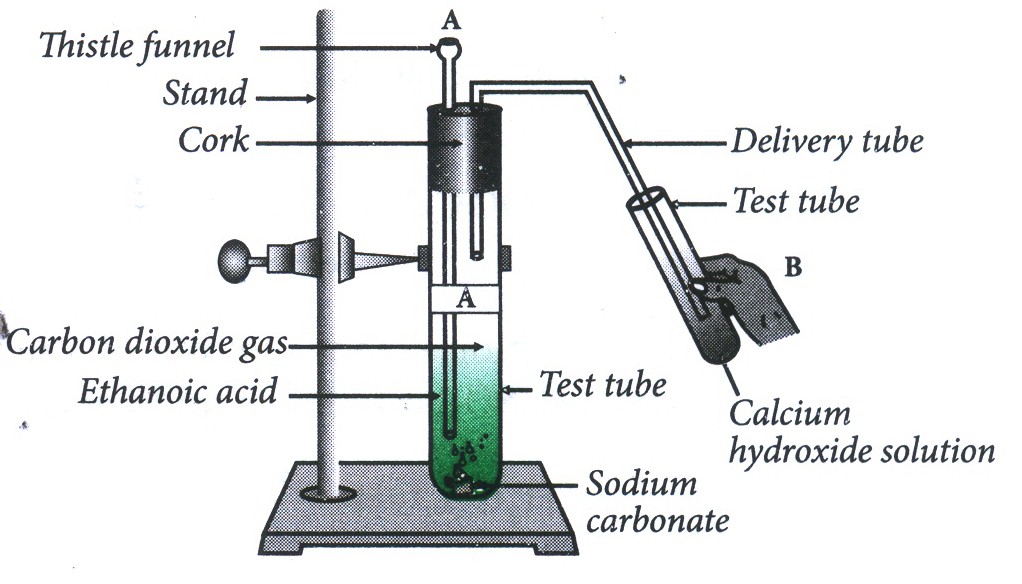
a) What change would you observe in the calcium hydroxide solution taken in tube B?
b) Write the reaction involved in test tubes A and B respectively.
c) If ethanol is given instead of ethanoic acid, would you expect the same change?
d) How can a solution of lime water be prepared in the laboratory?
2.
An organic compound A on heating with concentrated H2SO4 forms a compound B which on addition of one mole of hydrogen in presence of Ni forms a compound C. One mole of compound C on combustion forms two moles of CO2 and 3 moles of H2O. Identify the compounds A, B and C and write the chemical equations of the reactions involved.
3.
Draw the possible isomers of the compound it molecular formula C3H6O and also give their electron dot structures.
4.
How would you bring about the following conversions? Name the process and write the reaction involved.
a) Ethanol to ethene.
b) Propanol to propanoic acid
5.
A compound C (molecular formula, C2H4O2) reacts with Na - metal to form a compound R and evolves a gas which burns with a pop sound. Compound C on treatment with an alcohol A in presence of an acid forms a sweet smelling compound S (molecular formula, C3H6O2). On addition of NaOH to C, it also gives R and water. S on treatment with NaOH solution gives back R and A. Identify C, R, A, S and write down the reactions involved.
1.
a) When carbon dioxide is passed through the calcium hydroxide solution, it turns milky due to the formation of insoluble calcium carbonate.
b) Reaction in Test tube A:
\(\underset{Acetic\ or\ ethnoic\ acid}{2CH_3COOH(1)}+\underset{Sodium\ carbonate}{Na_2CO_3(s)}\rightarrow\underset{Sodium\ acetate}{2CH_3COONa}+\underset{Water}{H_2O}+\underset{Carbon\ ioxide}{CO_2(g)}\)
Reaction in Test tube B:
\(\underset{Calciumhydroxide\\ (Lime\ water)}{Ca(OH)_2(aq)}+\underset{Carbondioxide}{CO_2(g)}\rightarrow\underset{Calcium\ carbonate\\ (White\ ppt)}{CaCO_3(s)\downarrow}\underset{Water}{H_2O}\)
c) No with ethanol no reaction takes place.
d) When a quick lime i.e., calcium oxide is added to water in a test tube, it forms calcium hydroxide which is lime water. This solution is filtered and the clear solution is obtained
\(CaO(s)+H_2O(l)\rightarrow Ca(OH)_2\)
2.
i) Since compound C on combustion forms two moles of CO2 and 3 moles of H2 O, therefore compound C must contain two carbon atoms and six hydrogen atmos. Thus compound C must be C2H6 (ethane)
\(\underset{Ethene(C)}{2C_2H_6}+\underset{Oxygen}{7O_2}\xrightarrow{Heat}\underset{Carbon\ dioxide}{4CO_2}+\underset{Water}{6H_2O}\)
ii) Since compound (C) is obtained by addition of 1 mole of H2 in presence of Ni to compound (B), therefore (B) must be ethane.
\(\underset{Ethene(B)}{CH2}=CH_2+H_2\xrightarrow{Ni/Heat}\underset{Ethene(C)}{CH_3-CH_3}\)
iii) Since compound (B) is formed by heating compound (A) with cone. H2SO4 therefore compound (A) must be ethanol.
\(\underset{Ethanol(A)}{CH_3CH_2OH}\xrightarrow{Conc. H_2SO_4,443K}CH_2=CH_2+\underset{Ethene(B)}{H_2O}\)
3.
-s.jpg)
-s.jpg)
4.
a)\(\underset{Ethanol}{CH_3CH_2OH}\xrightarrow{Conc.H_2SO_4.170^0C}CH_2=\underset{Ethene}{CH_2}+H_2O\)
b)\(\underset{Propanol}{CH_3CH_2CH_2OH+2[O]}\xrightarrow[or\ Aci.K_2Cr_2O_7,\Delta]{AlK.KMnO_4, \Delta}\underset{Propanoic\ acid}{CH_3CH_2COOH}+H_2O\)
5.
Compound with molecular formula C2H4O2 should be Ethanoic acid reacts with Na metal to give sodium ethanoate.
\(\underset{\underset{Ethanoic\ acid}{(C)}}{2CH_3COOH}+2Na\rightarrow\underset{\underset{Sodium\ ethanoate}{(R)}}{2CH_3COONa}+H_2\)
\(\underset{\underset{Ethanoic\ acid}{(C)}}{CH_3COOH}+\underset{\underset{methanol}{(A)}}{CH_3OH}\xrightarrow{conc. H_2SO_4}\underset{\underset{Methyl\ acetate}{(S)}}{CH_3COOCH_3+H_2O}\)
\(CH_3COOH+\underset{Sodium\\ hydroxide}{NAOH}\rightarrow\underset{\underset{Sodium\ ethanoate}{(R)}}{CH_3COONa}+H_2O\)
\(\underset{\underset{Methyl\ acetate}{(s)}}{CH_3COOCH_3}+NaOH\rightarrow\underset{\underset{sodium\ ethanoate}{(R)}}{CH_3COONa}+\underset{\underset{Method}{(A)}}{CH_3OH}\)

10th Standard CBSE Syllabus & Materials
10th Standard CBSE
CBSE 10th Social Science PS - Federalism - New Model Questions Papers Study Material - QB365 Set A
NEW10th Standard CBSE
CBSE 10th Social Science PS - Power Sharing - New Model Questions Papers Study Material - QB365 Set A
NEW10th Standard CBSE
CBSE 10th Social Science GEO - Manufacturing Industries - New Model Questions Papers Study Material - QB365 Set A
NEW10th Standard CBSE
CBSE 10th Social Science GEO - Minerals and Energy Resources - New Model Questions Papers Study Material - QB365 Set A



NCERT Books

Syllabus

Exam Pattern

Sample Question Papers

Previous year Question Papers

Important Notes

MCQ Practice test

NCERT Exemplers

Case study Questions

Image Based Questions

Passage based Questions

HOT Questions

Value Based Questions

Model Questions Papers
NCERT ( Book Back ) Questions

Assertion and Reason
Important Questions And Answers

CBSE 10th Standard CBSE Subjects
CBSE Standards




