
 100% FREE ACCESS
10th Standard CBSE Syllabus & Materials
10th Standard CBSE
CBSE 10th Social Science ECO - Globalisation and the Indian Economy - New Model Questions Papers Study Material - QB365 Set A
NEW10th Standard CBSE
CBSE 10th Social Science ECO - Money and Credit - New Model Questions Papers Study Material - QB365 Set A
NEW10th Standard CBSE
CBSE 10th Social Science ECO - Sectors of the Indian Economy - New Model Questions Papers Study Material - QB365 Set A
NEW10th Standard CBSE
CBSE 10th Social Science ECO - Development - New Model Questions Papers Study Material - QB365 Set A
NEW10th Standard CBSE
CBSE 10th Social Science PS - Outcomes of Democracy - New Model Questions Papers Study Material - QB365 Set A
NEW10th Standard CBSE
CBSE 10th Social Science PS - Gender, Religion and Caste - New Model Questions Papers Study Material - QB365 Set A

Published on: 22/05/2021
QB365 Provides the updated CASE Study Questions for Class 10 , and also provide the detail solution for each and every case study questions . Case study questions are latest updated question pattern from NCERT, QB365 will helps to get more marks in Exams
Download CBSE Class 10th Standard CBSE Science question papers, sample papers, important questions, and previous year solved papers in PDF format. Get free study materials, NCERT solutions, and exam preparation resources for Class 10th Standard CBSE Science
Questions + Answers key
Take MCQ Science Test
1.
Double circulation is a type of circulating system in which the blood passes through the heart twice before completing a full circuit of the body. Blood is pumped from the heart to the lungs and returns to the heart before being distributed to other organs and tissues of the body.
(i) The figure shows blood circulation in humans with labels A to D. Select the option which gives correct identification of label and functions of the part.
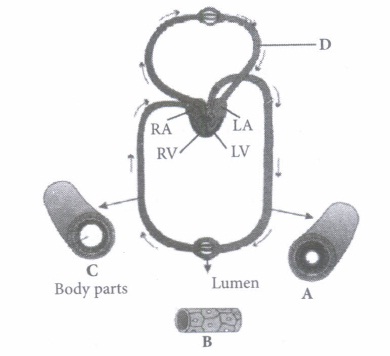
(a) B - Capillary- Thin without muscle layer and wall two cell layers thick
(b) C - Vein-Thin walled and blood flows in jerks/spurts
(c) D - Pulmonary vein-Takes oxygenated blood to heart, PO2 = 95 mm Hg
(d) A - Artery-Thick walled and blood flows evenly
(ii) Incomplete double circulation is seen in
| (a) mammals | (b) pisces | (c) aves | (d) amphibians. |
(iii) Which of the following animals shows double circulatory pathway?
| (a) Snake | (b) Frog | (c) Eel | (d) Whale |
(iv) The given figure is of circulatory system. Identify the labelled parts (A-D) from the list (I-VII).
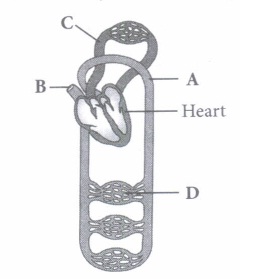
(I) Pulmonary circulation (II) Systemic circulation (III) Superior vena cava (IV) Inferior vena cava
(V) Aorta (VI) Veins and venules (VII)Arterioles and capillaries
| (a) A-(V), B-(lII), C-(I), D-(VII) | (b) A-(VII), B-(IV), C-(I), D-(VI) |
| (c) A-(V), B-(III), C-(lI), D-(VII) | (d) A-(VII), B-(V), C- (I), D-(VI) |
(v) Select the option which properly represents pulmonary circulation in humans.
\(\text { (a) Left auricle } \frac{\text { Deoxygenated }}{\text { blood }}{\longrightarrow} \text { Lungs } \frac{\text { Oxygenated }}{\text { blood }} \text { Right ventricle }\)
\(\text { (b) Left auricle } \frac{\text { Oxygenated }}{\text { blood }}{\longrightarrow} \text { Lungs } \frac{\text { Deoxygenated }}{\text { blood }}{\longrightarrow} \text { Right ventricle }\)
\(\text { (c) Right ventricle } \frac{\text { Deoxygenated }}{\text { blood }}{\longrightarrow} \text { Lungs } \frac{\text { Oxygenated }}{\text { blood }} \rightarrow \text { Left auricle }\)
\(\text { (d) Right ventricle } \frac{\text { Oxygenated }}{\text { blood }}>\text { Lungs } \frac{\text { Deoxygenated }}{\text { blood }} \gg \text { Left auricle }\)
2.
The small intestine is the longest part of the alimentary canal. It is a narrow tube of about 6 metres which lies coiled in the abdomen. The length of small intestine varies in different animals depending on the type of food they eat.
(i) Humans are not able to digest cellulose whereas they are able to digest starch due to
| (a) absence of enzyme cellulase | (b) alkaline pH in small intestine |
| (c) presence of villi | (d) acidic pH in stomach |
(ii) What will happen if the lining X shown in the figure of transverse section of gut is smooth instead of having such foldings?
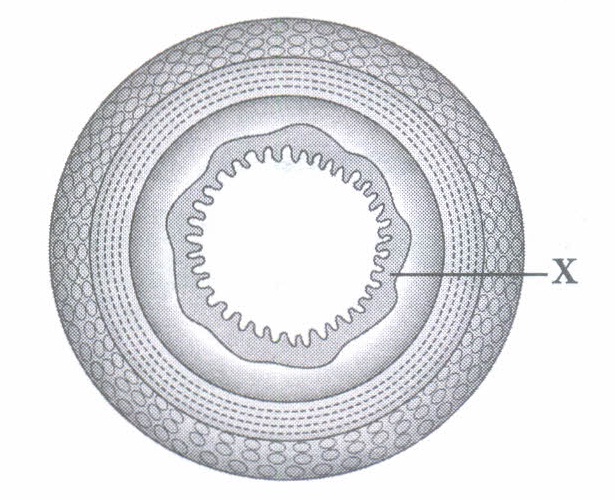
| (a) Surface area of absorption will be enhanced | (b) Surface area of absorption will be reduced |
| (c) Alkaline pH will be changed into acidic pH | (d) None of these |
(iii) Butter cannot be digested in the stomach as lipase and bile are(a) released in small intestine
| (a) released in small intestine | (b) inactive in stomach |
| (c) released in large intestine | (d) absorbed in the stomach. |
(iv) Which of the following is a correct statement?
(a) Herbivores have shorter small intestine as they eat grasses
(b) Carnivores have larger small intestine as they eat meat
(c) Herbivores have larger small intestine as they eat grasses
(d) None of these
(v) Various types of movements are generated by the ______ layer of the small intestine.
| (a) serosa | (b) muscularis | (c) mucosa | (d) submucosa |
3.
A magnetic field is described by drawing the magnetic field lines. When a small north magnetic pole is placed in the magnetic field created by a magnet, it will experience a force. And if the north pole is free, it will move under the influence of magnetic field. The path traced by a north magnetic pole free to move under the influence of a magnetic field is called a magnetic field line. Since the direction of magnetic field line is the direction of force on a north pole, so the magnetic field lines always begin from the N-pole of a magnet and end on the S-pole of the magnet. Inside the magnet, however the direction of magnetic field lines is from the S-pole of the magnet to the N-pole of the magnet. Thus, the magnetic field lines are closed curves. When a small compass is moved along a magnetic field line, the compass needle always sets itself along the line tangential to it. So, a line drawn from the south pole of the compass needle to its north pole indicates the direction of the magnetic field at that point.
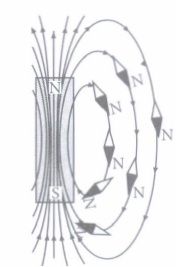
(i) The magnetic field lines
(a) intersect at right angle to one another
(b) intersect at an angle of 45° to each other
(c) do not cross one another
(d) cross at an angle of 60° to one another.
(ii) A strong bar magnet is placed vertically above a horizontal wooden board. The magnetic lines of force will be
(a) only in horizontal plane around the magnet
(b) only in vertical plane around the magnet
(c) in horizontal as well as in vertical planes around the magnet
(d) in all the planes around the magnet.
(iii) Magnetic field lines can be used to determine
(a) the shape of the magnetic field
(b) only the direction of the magnetic field
(c) only the relative strength of the magnetic field
(d) both the direction and the relative strength of the magnetic field.
(iv) The magnetic field lines due to a bar magnet are correctly shown in figure

(v) Which of the following is not true about magnetic field lines?
(a) Magnetic field lines are the closed and continuous curve.
(b) No two field lines can cross each other.
(c) Crowdness of field lines represents the strength of magnetic field.
(d) The direction of field lines is from the north pole to the south pole inside a bar magnet.
4.
Energy flow is the key function of an ecosystem. It is determined by the two basic laws of thermodynamics. Flow of energy in our ecosystem is unidirectional. Green plants capture approximately about 1% of the solar energy incident on the earth to carry out the process of photosynthesis. In an ecosystem, transfer of energy follows 10 percent law, i.e., only 10% energy is transferred from one trophic level to another and remaining 90% of energy is lost in respiration.
(i) Read the given statements and select the incorrect one(s).
I. At each trophic level organisms utilise energy in respiration.
II. Only 10 percent of the solar radiations that fall on earth is used by green plants.
III. Green plants are the ultimate source of entire energy as most of the food chain begin with them.
IV. A food chain usually consist of 3-4 trophic levels.
| (a) I and II only | (b) II and III only | (c) IV only | (d) I and III only |
(ii) Refer to the given flow chart.
Plants \(\rightarrow\) Rat \(\rightarrow\) Snake
20 units 2 units 0.2 unit
The given flow chart states that
(a) flow of energy in an ecosystem is unidirectional
(b) as we move along in a food chain the number of individuals at each trophic level decreases
(c) only 10% of the total energy becomes available to next trophic level
(d) both (a) and (c).
(iii) Nearly 90% of the energy is wasted while moving from one trophic level to other. This energy is used in
| (a) digestion of food | (b) respiration | (c) overcoming entropy | (d) all of these. |
(iv) Refer to the given pyramid.
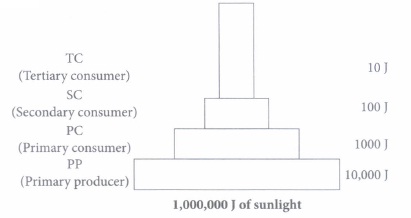
Which of the following best explains the phenomenon?
| (a) First law of thermodynamics | (b) Second law of thermodynamics |
| (c) Third law of thermodynamics | (d) Both (a) and (b) |
(v) Which of the following correctly states the processes involved in energy transfer between the trophic levels?
| Between the sun and producer | Between producer and primary consumers | Between primary and secondary consumers |
| Feeding | Photosynthesis | Feeding |
| Feeding | Feeding | Decomposition |
| Photosynthesis | Feeding | Feeding |
| Photosynthesis | Feeding | Decomposition |
5.
Various components of an ecosystem maintain a balance in nature. Disturbance in any component of the environment cause an imbalance. One of the main environmental problem caused by human activities is global warming. Global warming is a phenomenon caused by the increasing concentration of greenhouse gases in the atmosphere resulting due to enhanced greenhouse effect.
(i) Refer to the given pie chart showing the contribution of different gases to global warming.
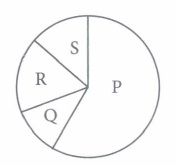
Identify gases P, Q, Rand S and select the incorrect statement regarding them.
(a) P could be a gas that increases in atmosphere due to excessive use of fossil fuel.
(b) Q could be a gas produced by complete combustion of biomass.
(c) R could be synthetic gaseous compounds used as refrigerants in air conditioners and refrigerators.
(d) S could be a gas produced by combustion of nitrogen rich fuel.
(ii) What could not be a source of gas Q given in the above pie chart?
| (a) Flooded paddy field | (b) Cattle |
| (c) Jet fuel | (d) Marshes |
(iii) If there is no CO2 in the atmosphere, then what will be the most likely consequence of this on the temperature of earth?
(a) The temperature remain unchanged as it depends upon the oxygen content of the atmosphere.
(b) The temperature would increase as less greenhouse gases will be absorbed by CO2
(c) The temperature would decrease as CO2 is the principal greenhouse gas.
(d) None of these
(iv) Study carefully the following figure representing greenhouse effect.
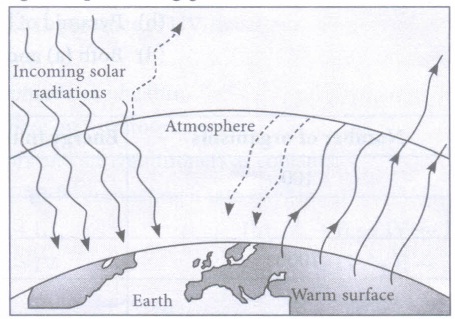
Select the correct statement regarding this.
(a) Much of the long wavelength infrared radiations re-radiated by the earth's surface are absorbed by the atmospheric greenhouse gases.
(b) CO2 , CH4 , CFCs and N2O are the gases which are responsible for greenhouse effect.
(c) The atmosphere is transparent to the incoming short-wavelength radiations and is translucent to the long-wavelength infra-red radiations.
(d) All of these
(v) Greenhouse effect is due to
| (a) accumulation of O3 and depletion of CO2 | (b) accumulation of both O3 and CO2 |
| (c) accumulation of CO2 and depletion of O3 | (d) presence of green plants on the earth |
6.
Some harmful non-biodegradable chemicals, i.e., pesticides (e.g., DDT) and heavy metals (e.g., mercury, arsenic cadmium, etc.) enter the bodies of organism through the food chain and go on concentrating at each trophic level. This phenomenon is called bio-magnification or biological magnification.
(i) Refer to the given food chain
Phytoplankton \(\longrightarrow\) Zooplankton \(\longrightarrow\)Small fish \(\longrightarrow\) Large fish\(\longrightarrow\)Fish eating birds
If concentration of DDT in small fish is estimated to be 0.5 ppm, then amount of DDT in zooplankton and large fish would respectively be
| (a) 0.04 ppm, 2ppm | (b) 2 ppm, 0.04 ppm | (c) 0.04 ppm, 0.04 ppm | (d) 2 ppm, 0.5 ppm. |
(ii) Refer to the given table.
| Organism | Amount of cadmium |
| A | 0.5 ppm |
| B | 25ppm |
| C | 0.003 ppb |
| D | 2ppm |
| E | 0.04ppm |
According to the given data. The correct order in a food chain will be
| (a) E\(\rightarrow\)C\(\rightarrow\)D\(\rightarrow\)A\(\rightarrow\)B | (b) B\(\rightarrow\)D\(\rightarrow\)A\(\rightarrow\)E\(\rightarrow\)C |
| (c) C\(\rightarrow\)E\(\rightarrow\)A\(\rightarrow\)D\(\rightarrow\)B | (d) C\(\rightarrow\)E\(\rightarrow\)A\(\rightarrow\)B\(\rightarrow\)D |
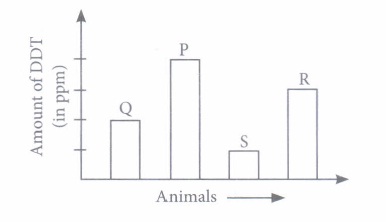
(iii) A group of scientists analysed samples of five different animals from a river for possible accumulation of DDT in their body due to bio-magnification. The result obtained is shown in the given graph.
The correct order of the food chain operating in a river is
| (a) S\(\rightarrow\)P\(\rightarrow\)Q\(\rightarrow\)R | (b) S\(\rightarrow\)Q\(\rightarrow\)R\(\rightarrow\)P |
| (c) P\(\rightarrow\)R\(\rightarrow\)Q\(\rightarrow\)S | (d) P\(\rightarrow\)Q\(\rightarrow\)S\(\rightarrow\)R |
(iv) Higher amount of DDT disturb calcium metabolism of birds. This results in
| (a) thickening of their egg shells | (b) premature breaking of eggs |
| (c) death of their embryos | (d) both (b) and (c) |
(v) When animals are sprayed with poisons, they may die immediately, but their bodies still contain the poison. The poison in their bodies will then be passed on to the animals which eat them. What would be the consequence of a mass poisoning of the rabbit population in a grazing food chain and why?
(a) Plants would die quickly as they are eaten by rabbits
(b) Grasshopper would die quickly as all the animals in the food web would be affected
(c) Western rattlesnakes would quickly become poisoned as they eat rabbits
(d) Hawk would become poisoned as they feed on rabbits
7.
A prism is a transparent refracting medium bounded by two plane surfaces inclined to each other at a certain angle. The refraction of light through a prism follows the laws of refraction. In the prism, refraction takes place on its refracting surface it means when the light enters the prism and when the light leaves the prism. The refraction through a prism is shown. Here, A is the angle of prism, \(\angle\)i is the angle of incidence of the face AB and \(\angle\)e is the angle of emergence at other face AC.
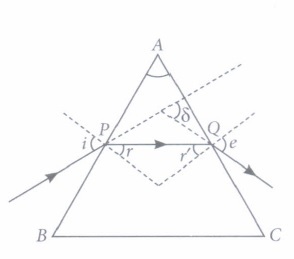
The incident ray suffers a deviation or bending through an angle \(\begin{equation} \delta \end{equation}\) due to the refraction through prism. This angle is called angle of deviation as shown in figure.
\(\angle\)i + \(\angle\)e = \(\angle\)\(\begin{equation} \delta \end{equation}\) + \(\angle\)A
(i) The angle between the two refracting surfaces of a prism is called
| (a) angle of prism | (b) angle of incidence |
| (c) angle of deviation | (d) angle of emergence |
(ii) The angle between the incident ray and the emergent ray is called
| (a) angle of emergence | (b) angle of deviation |
| (c) angle of incidence | (d) none of these |
(iii) When a ray is refracted through a prism, then
| (a) \(\angle\)i=\(\angle\)\(\begin{equation} \delta \end{equation}\) | (b) \(\angle\) i=\(\angle\)e+\(\angle\)\(\begin{equation} \delta \end{equation}\) |
| (c) \(\angle\)\(\begin{equation} \delta \end{equation}\)= \(\angle\)e | (d) \(\angle\)i > \(\angle\)r |
(iv) The angle of deviation depends on
| (a) refractive index of prism | (b) angle of incidence |
| (c) both (a) and (b) | (d) none of these |
(v) The rectangular surfaces of a prism are known as
| (a) reflecting surfaces | (b) dispersing surfaces |
| (c) refracting surfaces | (d) none of these. |
8.
A hydrocarbon (P) has the molecular formula C10H22.A hydrocarbon (Q) has two carbon atoms less than (P) and belong to the same homologous series. A hydrocarbon (R) has two carbon atoms more than (P) and belong to the same homologous series.
(i) What is the molecular formula of (Q)?
| (a) C12H26 | (b) C8H16 | (c) C8H18 | (d) C8H14 |
(ii) To which homologous series do the compound (P), (Q) and (R) belong?
| (a) CnH2n | (b) C2H2n- 2 | (c) CnH2n+2 | (d) CnH2n + 1 |
(iii) What is the molecular formula of (R)?
| (a) C12H26 | (b) C12H24 | (c) C12H22 | (d) Cl2H28 |
(iv) Identify the correct statement about compounds (P), (Q) and (R).
| (a) They have same melting and boiling points. | (b) They have same chemical properties. |
| (c) They have different general formula. | (d) They differ by -CH2 unit. |
(v) Compounds (P), (Q) and (R) are
| (a) alkanes | (b) alkenes | (c) alkynes | (d) none of these. |
9.
Gregor Mendel conducted hybridisation experiments on garden peas for seven years and proposed the laws of inheritance in living organisms. He investigated characters in the garden pea plant that were manifested as two opposing traits, e.g., tall or dwarf plants, yellow and green seeds, etc.
(i) Among the seven pairs of contrasting traits in pea plant as studied by Mendel, the number of traits related
to flower, pod and seed respectively were
| (a) 2,2,2 | (b) 2,2,1 |
| (c) 1,2,2 | (d) 1,1,2. |
(ii) The colour based contrasting traits in seven contrasting pairs, studied by Mendel in pea plant were
| (a) 1 | (b) 2 |
| (c) 3 | (d) 4. |
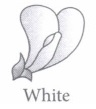
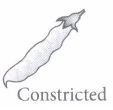
(iii) Refer to the given table of contrasting traits in pea plants studied by Mendel.
| Character | Dominant trait | Recessive trait |
| (i) Seed colour |  |
 |
| (ii) Flower colour | 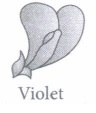 |
 |
| (iii) Pod shape | 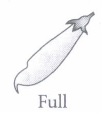 |
 |
| (iv) Flower position | 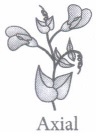 |
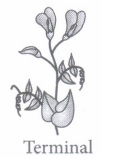 |
Which of the given traits is correctly placed?
(a) (i), (ii) and (iii) only
(b) (ii), (iii) and (iv) only
(c) (ii) and (iii) only
(d) (i), (ii), (iii) and (iv)
(iv) Some of the dominant traits studied by Mendel were
(a) round seed shape, green seed colour and axial flower position
(b) terminal flower position, green pod colour and inflated pod shape
(c) violet flower colour, green pod colour and round seed shape
(d) wrinkled seed shape, yellow pod colour and axial flower position.
(v) Which of the following characters was not chosen by Mendel?
| (a) Pod shape | (b) Pod colour |
| (c) Position of flower | (d) Position of pod |
10.
The chemical reactivity of an element depends upon its electronic configuration. All elements having less than eight electrons in the outermost shell show chemical reactivity. During chemical reactions, atoms of all elements tend to achieve a completely filled valence shell. Metals are electropositive in nature. They have tendency to lose one or more electrons present in the valence shell of their atoms to form cations and achieve nearest noble gas configuration. The compounds formed by the transfer of electrons from one element to other are known as ionic or electrovalent compounds.
(i) The electronic configurations of three elements X, Y and Z are:
X : 2 Y: 2, 8, 7 Z : 2, 8, 2
Which of the following is correct regarding these elements?
| (a) X is a metal. | (b) Y is a metal. |
| (c) Z is a non-metal | (d)Yis a non-metal and Z is a metal |
(ii) Element X reacts with element Y to form a compound Z. During the formation of compound Z, atoms of X lose one electron each whereas atoms of Y gain one electron each. Which of the following properties is not shown by compound Z?
| (a) High melting point |
| (b) Low melting point |
| (c) Occurrence as solid |
| (d) Conduction of electricity in molten state |
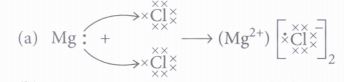
(iii) Which of the following is correct representation of formation of magnesium chloride?
 |
 |
 |
(d) None of these |
(iv) The electronic configuration of sodium ion is
| (a) 2,8,8 | (b) 2,8,2. | (c) 2,6 | (d) 2,8. |
(v)Which of the following represents an electropositive element?
| (a) 2,8,6 | (b) 2,8,8 | (c) 2,8,8,1 | (d) 2, 7 |
11.
Baking powder produces carbon dioxide on heating, so it is used in cooking to make the batter spongy. Although, baking soda also produces CO2 on heating, but it is not used in cooking because on heating, baking soda produces sodium carbonate along with carbon dioxide. Sodium carbonate, thus, produced, makes the taste bitter. Baking powder is the mixture of baking soda and a mild edible acid. Generally, tartaric acid is mixed with baking soda to make baking powder. When baking powder is heated, NaHCO3 decomposes to give CO2 which makes bread and cake fluffy. Tartaric acid helps to remove bitter taste due to formation of sodium tartrate.
\(2 \mathrm{NaHCO}_{3}+ \ \ \mathrm{C}_{4} \mathrm{H}_{6} \mathrm{O}_{6} \quad \longrightarrow \quad 2 \mathrm{CO}_{2}+2 \mathrm{H}_{2} \mathrm{O}+\mathrm{Na}_{2} \mathrm{C}_{4} \mathrm{H}_{4} \mathrm{O}_{6}\)
Baking soda Tartaric acid Carbon dioxide Sodium tartrate
(i) On passing excess CO2 gas in aqueous solution of sodium carbonate, the substance obtained is
| (a) NaOH | (b) NaHCO3 |
| (c) Na2CO3 ·10H2O | (d) Na2CO3 ·H2O |
(ii) When sodium hydrogen carbonate is added to acetic acid, it evolves a gas. Which of the following statements are true about the gas evolved?
(I) It turns lime water milky
(II) It extinguishes a burning splinter
(III) It dissolves in a solution of sodium hydroxide
(IV) It has a pungent odour
| (a) (I) and (II) | (b) (I), (II) and (III) |
| (c) (II), (III) and (IV) | (d) (I) and (IV) |
(iii) Select the correct statement regarding sodium hydrogen carbonate.
| (a) CO and CO2 are produced during the heating ofNaHCO3 |
| (b) It is insoluble in water. |
| (c) It is used in soda-acid fire extinguishers. |
| (d) All of these |
(iv) Acetic acid was added to a solid X kept in a test tube. A colourless and odourless gas was evolved. The gas was passed through lime water which turned milky. It was concluded that
| (a) solid X is sodium hydroxide and the gas evolved is CO2 |
| (b) solid X is sodium bicarbonate and the gas evolved is CO2 |
| (c) solid X is sodium acetate and the gas evolved is CO2 |
| (d) solid X is sodium chloride and the gas evolved is CO2 |
(v) Which of the following statements are correct regarding baking soda?
(I) Baking soda is sodium hydrogen carbonate
(II) On heating, baking soda gives sodium carbonate
(III) It is used for manufacture of soap
(IV) It is an ingredient of baking powder
| (a) I and IV only | (b) I, II and III only |
| (c) I, II and IV only | (d) I, II, III and I |
12.
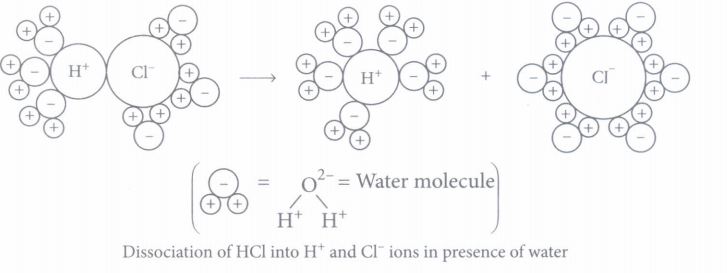
The acidic behaviour of acids is due to the presence of hydrogenil(H+)ions in them. They produce hydrogen ions in the presence of water. Water is a polar solvent and this property of water helps in weakening the bond between the ions and makes them soluble. Hence, acids and bases produce ions in aqueous solutions.
It may be noted that a dry Hel gas or a solution of hydrogen chloride in organic, nonpolar solvents like toluene or benzene do not show acidic properties. This is because hydrogen chloride does not undergo ionization in toluene.
The reason why Hel splits into H+ and CI- ions in presence of water lies in the fact that water molecules, being polar, pull the H+ and Cl - ions apart and thus, the bond in Hel is broken
(i) Identify the wrong statement.
| (a) Higher the hydronium ion concentration, lower is the pH value |
| (b) Universal indicator is used to judge how strong a given acid or base is |
| (c) As the pH value increases from 7 to 14, it represents increase in H+ ion concentration in the solution |
| (d) Value less than 7 on the pH scale represents an acidic solution |
(ii) If the pH of a solution is 8, then its [H+] ion is
| (a) log 10- 8 | (b) 108 | (c) 10- 8 | (d) 8 |
(iii) In terms of acidic strength, which one of the following is in the correct increasing order?
| (a) Water < Acetic acid < Hydrochloric acid | (b) Water < Hydrochloric acid < Acetic acid |
| (c) Acetic acid < Water < Hydrochloric acid | (d) Hydrochloric acid < Water < Acetic acid |
(iv) Which of the following compounds does not give H+ ions in aqueous solution?
| (a) H3 PO4 | (b) C2H5OH | (c) H2CO3 | (d) CH3COOH |
(v) Four solutions labelled as P, Q, Rand Shave pH values 1, 9, 3 and 13 respectively.
Which of the following statements about the given solutions is incorrect?
| (a) Solution P has higher concentration of hydrogen ions than solution R. |
| (b) Solution Q has lower concentration of hydroxide ions than solution S. |
| (c) Solutions P and Q will turn red litmus solution blue. |
| (d) Solution P is highly acidic while solution Q is weakly basic. |
13.
Spore formation, method of asexual reproduction is used by unicellular as well as multicellular organisms.Spores are microscopic units which could be air borne or are present in soil, etc.
(i) A slice of bread kept in open for sometime shows growing white cottony mass which later turns black. This happens because
(a) bacterial spores present in air germinate on the surface of bread slice
(b) fungal spores present in air germinate on the surface of bread slice
(c) protozoan microbes start feeding on bread slice
(d) none ef these.
(ii) Spore formation can be seen in
| (a) Mucor | (b) sweat potato |
| (c) Spirogyra | (d) all of these |
(iii) Bulb like structure at top of erect hyphae where spores are produced is
| (a) sporangiophore | (b) apophysis |
| (c) columella | (d) sporangia. |
(iv) Select the incorrect statement.
(a) Spores can be produced endogenously or exogenously in an organism.
(b) Spores can be air borne or soil borne.
(c) Bacteria produce only exospores.
(d) Rhizopus bears spores in special structures called sporangium.
(v) Observe the given figure showing spores formation in Rhizopus and select the option which is correctly labelled.
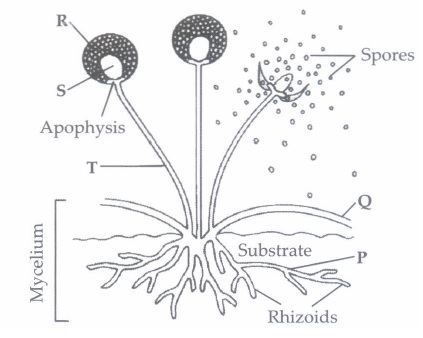
(a) P-Stolon, S-Columella, T-Sporangiophore
(b) Q-Stolon, P-Hypha, S-Sporangium
(c) R-Sporangium, S-Apophysis, T-Sporangiophore
(d) Q-Stolon, R-Sporangium, S-Colume!la
14.
The recurrence of properties of the elements after a certain regular intervals, when they are arranged in the increasing order of their atomic numbers, is called periodicity. There are a number of physical properties such as atomic size, metallic and non -metallic character, etc. which show periodic variation. In periodic table, various properties vary differently from moving left to right in a period and going down in a group. In a period, properties vary because from moving left to right in a period, number of shells remain same but valence electron increases by one number hence nuclear charge increases. In a group, on going down, number of valence shells increases while number of valence electrons remains same.
(i) From top to bottom in a group of the periodic table, the electropositive character of the element
| (a) increases | (b) decreases |
| (c) remains unchanged | (d) changes irregularly |
(ii) Which element has the largest size in the second period?
| (a) N | (b) F |
| (c) Li | (d) Be |
(iii) Which of the following elements has three valence electrons?
| (a) Cs | (b) Ca |
| (c) Al | (d) S |
(iv) In the periodic table, the metallic character of elements
(a) decreases from left to right and decreases down the group
(b) decreases from left to right and increases down the group
(c) increases from left to right and increases down the group
(d) increases from left to right and decreases down the group
(v) Which of the following increases along the period?
| (a) Number of valence electrons | (b) Atomic size |
| (c) Electropositive character | (d) All of these |
15.
Redox reactions are those reactions in which oxidation and reduction occur Simultaneously. A redox reaction is made up of two half reactions. In the first half reaction, oxidation takes place and in second half reaction, reduction occurs. Oxidation is a process in which a substance loses electrons and in reduction, a substance gains electrons. The substance which gains electrons is reduced and acts as an oxidising agent. On the other hand, a substance which loses electrons is oxidised and acts as a reducing agent.
(i) Which of the following is a redox reaction?
| \({ (a) \ } \mathrm{CaCO}_{3} \rightarrow \mathrm{CaO}+\mathrm{CO}_{2}\) | \(\text { (b) } \mathrm{H}_{2}+\mathrm{Cl}_{2} \rightarrow 2 \mathrm{HCl}\) |
| \({ (c) \ } \mathrm{CaO}+2 \mathrm{HCl} \rightarrow \mathrm{CaCl}_{2}+\mathrm{H}_{2} \mathrm{O}\) | \(\text { (d) } \mathrm{NaOH}+\mathrm{HCl} \rightarrow \mathrm{NaCl}+\mathrm{H}_{2} \mathrm{O}\) |
(ii) Identify the reaction in which H2 02 is acting as a reducing agent.
| \(\text { (a) } \mathrm{H}_{2} \mathrm{SO}_{3}+\mathrm{H}_{2} \mathrm{O}_{2} \longrightarrow \mathrm{H}_{2} \mathrm{SO}_{4}+\mathrm{H}_{2} \mathrm{O}\) | \(\text { (b) } 2 \mathrm{Hl}+\mathrm{H}_{2} \mathrm{O}_{2} \longrightarrow 2 \mathrm{H}_{2} \mathrm{O}+\mathrm{I}_{2}\) |
| \(\text { (c) } \mathrm{Cl}_{2}+\mathrm{H}_{2} \mathrm{O}_{2} \longrightarrow 2 \mathrm{HCl}+\mathrm{O}_{2}\) | \(\text { (d) } 2 \mathrm{FeCl}_{2}+2 \mathrm{HCl}+\mathrm{H}_{2} \mathrm{O}_{2} \longrightarrow 2 \mathrm{FeCl}_{3}+2 \mathrm{H}_{2} \mathrm{O}\) |
(iii) For the following reactions, identify the one in which H2S acts as a reducing agent.
| \(\text { (a) } \mathrm{CuSO}_{4}+\mathrm{H}_{2} \mathrm{~S} \longrightarrow \mathrm{CuS}+\mathrm{H}_{2} \mathrm{SO}_{4}\) | \(\text { (b) } \mathrm{Cd}\left(\mathrm{NO}_{3}\right)_{2}+\mathrm{H}_{2} \mathrm{~S} \longrightarrow \mathrm{CdS}+2 \mathrm{HNO}_{3}\) |
| \(\text { (c) } 2 \mathrm{FeCl}_{3}+\mathrm{H}_{2} \mathrm{~S} \longrightarrow 2 \mathrm{FeCl}_{2}+2 \mathrm{HCl}+\mathrm{S}\) | (d) None of these |
(iv) For the following reaction, identify the correct statement.
\(\mathrm{ZnO}+\mathrm{CO} \longrightarrow \mathrm{Zn}+\mathrm{CO}_{2}\)
| (a) ZnO is being reduced. | (b) CO2 is being oxidised |
| (c) CO is being reduced. | (d) ZnO is being oxidised. |
(v) In the following reaction, which substance is reduced?
\(\mathrm{PbS}+4 \mathrm{H}_{2} \mathrm{O}_{2} \longrightarrow \mathrm{PbSO}_{4}+4 \mathrm{H}_{2} \mathrm{O}\)
| (a) H2O | (b) H2 O2 | (c) PbS | d) PbSO4 |
1.
(i) (c): A- Artery: Carries blood from heart to different body parts. It is thick-walled and elastic. It acts as a "pressure reservoir" for maintaining the blood flow. B - Capillary : Nutrients, hormones, gases, etc. can diffuse into tissue cells through capillaries and vice versa. It is thin-walled, and only one cell layer thick resting on basement membrane. C - Vein: Brings blood from different body parts to the heart. It is thin-walled and act as low-resistance conduct for blood flow. D - Pulmonary vein: Two pulmonary veins from each lung transport the oxygenated blood to the left atrium.
(ii) (d): In amphibians, the left atrium receives oxygenated blood from the gills/lungs/skin and the right atrium gets the deoxygenated blood from other body parts. However, they get mixed up in the single ventricle which pumps out mixed blood i.e., incomplete double circulation
(iii) (d): Whale is a mammal and in mammals, two separate circulatory pathways are found - systemic circulation and pulmonary circulation. Oxygenated and deoxygenated bloods received by the left and right atria respectively pass on to the left and right ventricles. Thus, oxygenated and deoxygenated bloods are not mixed. This is referred to as double circulation.
(iv) (a)
(v) (c): Pulmonary circulation is the movement of blood between heart and lungs. During this pathway deoxygenated blood entering the right atrium, moves into the right ventricle. From here it moves through the pulmonary arch into the lungs for oxygenation. Then from lungs the oxygenated blood moves into the left atrium through pulmonary veins.
2.
(i) (a): In human, cellulose is indigestible as it cannot be broken into smaller molecules due to absence of cellulase enzyme.
(ii) (b): Finger-like projections that come out from mucosa of intestine form villi. Cells lining the villi produce numerous microscopic projections called microvilli giving a brush border appearance which increase the surface area for absorption enormously. Villi has a good supply of capillaries and a large lymph vessel for absorption of nutrients. If the inner lining of the small intestine will be smooth, the surface for absorption will be reduced.
(iii) (a)
(iv) (c)
(v) (b)
3.
(i) (c): No two magnetic field lines are found to cross each other. If two field lines crossed each other, it would mean that at the point of intersection, the compass needle would point in two directions at the same time, which is not possible.
(ii) (d): The magnetic field and hence the magnetic line of force exist in all the planes all around the magnet.
(iii) (d): The relative strength of the magnetic field is shown by the degree of closeness of the field lines and the direction of the magnetic field is obtained by tangent to the field lines at the point of intersect.
(iv) (d): The magnetic field lines due to a bar magnet are closed continuous curves directed from N to S outside the magnet and directed from S to N inside the magnet. Hence option (d) is correct.
v) (d): Inside a bar magnet, the direction of field lines is from south pole to north pole
4.
(i) (b): 1% of solar radiation is captured by plants. Sun is the ultimate source of all energy.
(ii) (d)
(iii) (d)
(iv) (d): The given pyramid is pyramid of energy that shows the two basic laws of thermodynamics.
(v) (c): Light energy from the sun is converted to chemical energy in producers via photosynthesis. This chemical energy is then transferred to primary consumer, then subsequently to secondary consumer via feeding.
5.
(i) (b) :In the given pie chart, gases P, Q, Rand S respectively are CO2 , CH4 , CFCs and N2O. Methane is produced by incomplete combustion of biomass.
(ii) (c): Methane (gas Q) is produced by incomplete biomass combustion and incomplete decomposition mostly by anaerobic methanogens. Flooded paddy fields, marshes and cattles are the major source of this gas.
(iii) (c) : CO2 is the principal greenhouse gas that helps to keep the earth warm.
(iv) (d)
(v) (c)
6.
(i) (a): Due to bio-magnification, the concentration of DDT will always be less in zooplanktons than large fish
(ii) (c)
(iii) (b) : Due to bio-magnification the non bio-degradable chemicals such as DDT accumulate and go on concentrating at each trophic level.
(iv) (d) : Higher amounts of DDT disturb calcium metabolism of birds resulting in thinning of egg shells and their premature breaking that kills the embryos.
(v) (d)
7.
(i) (a): The angle between the two refracting surfaces of a prism is called angle of prism.
(ii) (b): The angle between the incident ray and the emergent ray is called angle of deviation.
(iii) (d): As the ray of light enters from rarer medium (air) to denser medium (glass), the angle of incidence is more than angle of refraction.
(iv) (c): More be the refractive index, more be the angle of deviation and it also depends on the refractive index of prism.
(v) (c): The refraction of light takes place through rectangular surfaces.
8.
(i) (c) :Molecular formula of (Q) is CSH1Sas it has two carbon atoms less than (P).
(ii) (c): Compounds (P), (Q) and (R) are alkanes having general formula CnH2n+2.
(iii) (a): Molecular formula of (R) is C12H26 as it has two carbon atoms more than (P)
(iv) (b): Compound (P), (Q) and (R) belong to same homologous series so they have different physical properties but similar chemical properties. They have same general formula CnH2n+2 .They . differ by 2 carbon atoms and 4 hydrogen atoms.
(v) (a)
9.
(i) (a): Characters studied by Mendel are as follows:
| Trait studied | Dominant | Recessive | |
| 1 | Plant height | Tall (T) | Dwarf (t) |
| 2 | Flower position | Axial (A) | Terminal (a) |
| 3 | Flower colour | Violet (V) or (W) | White (v) or (w) |
| 4 | Pod shape | Full or Inflated (I) or (C) | Constricted (i) or (c) |
| 5 | Pod colour | Green (G) or (Y) | Yellow (g) or (y) |
| 6 | Seed shape | Round (R) or (W) | Wrinkled (r) or (w) |
| 7 | Seed colour | Yellow (Y) or (G) | Green (y) or (g) |
(ii) (c)
| Trait studied | Dominant | Recessive | |
| 1 | Plant height | Tall (T) | Dwarf (t) |
| 2 | Flower position | Axial (A) | Terminal (a) |
| 3 | Flower colour | Violet (V) or (W) | White (v) or (w) |
| 4 | Pod shape | Full or Inflated (I) or (C) | Constricted (i) or (c) |
| 5 | Pod colour | Green (G) or (Y) | Yellow (g) or (y) |
| 6 | Seed shape | Round (R) or (W) | Wrinkled (r) or (w) |
| 7 | Seed colour | Yellow (Y) or (G) | Green (y) or (g) |
(iii) (d)
| Trait studied | Dominant | Recessive | |
| 1 | Plant height | Tall (T) | Dwarf (t) |
| 2 | Flower position | Axial (A) | Terminal (a) |
| 3 | Flower colour | Violet (V) or (W) | White (v) or (w) |
| 4 | Pod shape | Full or Inflated (I) or (C) | Constricted (i) or (c) |
| 5 | Pod colour | Green (G) or (Y) | Yellow (g) or (y) |
| 6 | Seed shape | Round (R) or (W) | Wrinkled (r) or (w) |
| 7 | Seed colour | Yellow (Y) or (G) | Green (y) or (g) |
(iv) (c)
| Trait studied | Dominant | Recessive | |
| 1 | Plant height | Tall (T) | Dwarf (t) |
| 2 | Flower position | Axial (A) | Terminal (a) |
| 3 | Flower colour | Violet (V) or (W) | White (v) or (w) |
| 4 | Pod shape | Full or Inflated (I) or (C) | Constricted (i) or (c) |
| 5 | Pod colour | Green (G) or (Y) | Yellow (g) or (y) |
| 6 | Seed shape | Round (R) or (W) | Wrinkled (r) or (w) |
| 7 | Seed colour | Yellow (Y) or (G) | Green (y) or (g) |
(v) (d)
| Trait studied | Dominant | Recessive | |
| 1 | Plant height | Tall (T) | Dwarf (t) |
| 2 | Flower position | Axial (A) | Terminal (a) |
| 3 | Flower colour | Violet (V) or (W) | White (v) or (w) |
| 4 | Pod shape | Full or Inflated (I) or (C) | Constricted (i) or (c) |
| 5 | Pod colour | Green (G) or (Y) | Yellow (g) or (y) |
| 6 | Seed shape | Round (R) or (W) | Wrinkled (r) or (w) |
| 7 | Seed colour | Yellow (Y) or (G) | Green (y) or (g) |
10.
(i) (d)
(Ii) (b): '2' is an ionic compound
\({ (iii) }(\mathrm{a}): \mathrm{Mg} \longrightarrow \mathrm{Mg}^{2+}+2 e^{-}\) \(\mathrm{Cl}+e^{-} \longrightarrow \mathrm{Cl}^{-}\) \(\mathrm{Mg}^{2+}+2 \mathrm{Cl}^{-} \longrightarrow \mathrm{MgCl}_{2}\)
2,8,2 2,8 2,8,7 2,8,8
\((\text { iv })(\mathrm{d}): \mathrm{Na} \longrightarrow \mathrm{Na}^{+}+e^{-}\)
2,8,1 2,8
(v) (c): (a) and (d) represent electronegative elements and (b) represents a noble gas.
11.
\({ (i) }(\mathrm{b}): \mathrm{Na}_{2} \mathrm{CO}_{3}+\mathrm{H}_{2} \mathrm{O}+\mathrm{CO}_{2} \longrightarrow 2 \mathrm{NaHCO}_{3}\)
(ii) (b): \(\mathrm{NaHCO}_{3}+\mathrm{CH}_{3} \mathrm{COOH} \longrightarrow \mathrm{CH}_{3} \mathrm{COONa}\) \(+\mathrm{CO}_{2} \uparrow+\mathrm{H}_{2} \mathrm{O}\)
Carbon dioxide gas is evolved which turns limewater milky. It extinguishes a burning splinter since it is not a supporter of combustion. It dissolves in sodium hydroxide solution and it is an odourless gas.
\({ (iii) }(\mathrm{c}): 2 \mathrm{NaHCO}_{3} \stackrel{\text { Heat }}{\longrightarrow} \mathrm{Na}_{2} \mathrm{CO}_{3}+\mathrm{H}_{2} \mathrm{O}+\mathrm{CO}_{2}\)
NaHCO3 is soluble in water.
\({ (iv) }(\mathbf{b}): \mathrm{NaHCO}_{3}+\mathrm{CH}_{3} \mathrm{COOH} \longrightarrow\) \(\mathrm{CH}_{3} \mathrm{COONa}+\mathrm{CO}_{2}+\mathrm{H}_{2} \mathrm{O}\)
(v) (c): It is not used in manufacture of soap.
12.
(i) (c): As the pH value increases from 7 to 14, it represents decrease in H+ ion concentration in the solution.
(ii) (c): pH = -logl0 [H+] = 8
logl0 [H+] =-8
[H+] = 10- 8 mol/L
(iii) (a)
(iv) (b): C2H5OH is not an ionic compound, it is a covalent compound and hence does not give H+ ions in aqueous solution.
(v) (c): (a) Lower the pH of the solution, more acidic is the solution and higher is the [H+] ions
Thus, solution P (pH = 1) has higher [H+] ions than solution R (pH = 3).
(b) Higher the pH of the solution, more basic is the solution and higher is the [OH-] ions
Thus, solution Q (pH = 9) has lower [OH-] ions than solution S (pH = l3).
(c) Solution P (pH = 1) is acidic which turns blue litmus solution red whereas solution Q (pH = 9) is basic which turns red litmus solution blue.
(d) Solution P (pH = 1) is highly acidic while solution S (pH = l3) is highly basic and solution Q (pH = 9) is weakly basic.
13.
(i) (b): The tiny spores of bread mould (Rhizopus) are always present in air. On coming in contact with moist surface of bread slice they settle on it and germinate to form new fungal hyphae which first look like white cottony mass and later turns black.
(ii) (a): Mucor (fungus) reproduces asexually through spore formation.
(iii) (d)
(iv) (c): Bacteria produce endospore which is a dormant and tough structure that enables bacteria to remain dormant for extended periods under unfavorable conditions.
(v) (d)
14.
(i) (a): As the size of the atom increases down the group, electropositive character increases.
(ii) (c): Li is the first element of the second period. As the size decreases in the period from left to right, therefore, Li is the largest atom in the period.
(iii) (c): Al (Z = 13) : 2, 8, 3
(iv) (b): Metallic character of elements decreases from left to right and increases down the group.
(v) (a): As we move from left to right along a period, the number of valence electrons increases from 1 to 8.
15.
(I) (b) : H2 is oxidised to HCI while Cl2 is reduced to HCl.
(ii) (c)
\((iii) (c): 2 \mathrm{Fe} \mathrm{Cl}_{3}+\mathrm{H}_{2} \mathrm{~S} \longrightarrow 2 \mathrm{FeCl}_{2}+2 \mathrm{HCl}+\mathrm{s}\)
H2 Sitself gets oxidised to Sand reduces FeCl3 to FeCI2
(iv) (a): ZnO is reduced to Zn and CO is oxidised to CO2
(v) (b): H2O2 is reduced to water by removal of oxygen.

10th Standard CBSE Syllabus & Materials
10th Standard CBSE
CBSE 10th Social Science PS - Federalism - New Model Questions Papers Study Material - QB365 Set A
NEW10th Standard CBSE
CBSE 10th Social Science PS - Power Sharing - New Model Questions Papers Study Material - QB365 Set A
NEW10th Standard CBSE
CBSE 10th Social Science GEO - Manufacturing Industries - New Model Questions Papers Study Material - QB365 Set A
NEW10th Standard CBSE
CBSE 10th Social Science GEO - Minerals and Energy Resources - New Model Questions Papers Study Material - QB365 Set A



NCERT Books

Syllabus

Exam Pattern

Sample Question Papers

Previous year Question Papers

Important Notes

MCQ Practice test

NCERT Exemplers

Case study Questions

Image Based Questions

Passage based Questions

HOT Questions

Value Based Questions

Model Questions Papers
NCERT ( Book Back ) Questions

Assertion and Reason
Important Questions And Answers

CBSE 10th Standard CBSE Subjects
CBSE Standards



