
 100% FREE ACCESS
10th Standard CBSE Syllabus & Materials
10th Standard CBSE
CBSE 10th Social Science ECO - Globalisation and the Indian Economy - New Model Questions Papers Study Material - QB365 Set A
NEW10th Standard CBSE
CBSE 10th Social Science ECO - Money and Credit - New Model Questions Papers Study Material - QB365 Set A
NEW10th Standard CBSE
CBSE 10th Social Science ECO - Sectors of the Indian Economy - New Model Questions Papers Study Material - QB365 Set A
NEW10th Standard CBSE
CBSE 10th Social Science ECO - Development - New Model Questions Papers Study Material - QB365 Set A
NEW10th Standard CBSE
CBSE 10th Social Science PS - Outcomes of Democracy - New Model Questions Papers Study Material - QB365 Set A
NEW10th Standard CBSE
CBSE 10th Social Science PS - Gender, Religion and Caste - New Model Questions Papers Study Material - QB365 Set A

Published on: 22/05/2021
QB365 Provides the updated CASE Study Questions for Class 10 , and also provide the detail solution for each and every case study questions . Case study questions are latest updated question pattern from NCERT, QB365 will helps to get more marks in Exams
Download CBSE Class 10th Standard CBSE Science question papers, sample papers, important questions, and previous year solved papers in PDF format. Get free study materials, NCERT solutions, and exam preparation resources for Class 10th Standard CBSE Science
Questions + Answers key
Take MCQ Science Test
1.
Given are the sections of two pipes, A and B. If you need to represent blood vessels with these, which of the pipes would correspond to the artery and which one to a vein. Identify it and answer the following questions.
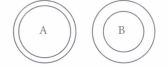
(i) B is best defined as the vessel which
(a) always supply oxygenated blood to the different organs
(b) always carry blood away from the heart to different organs
(c) always break up into capillaries that reunite to form a vein
(d) always carry blood from one visceral organ to another visceral organ.
(ii) In A, valves are present to check backward flow of blood flowing at
| (a) atmospheric pressure | (c) low pressure |
| (b) high pressure | (d) all of these |
(iii) Which of the following statements is correct regarding A?
(a) Carries blood from an organ towards the heart
(b) Always carry oxygenated blood with single exception
(c) Carries blood from heart towards the organ
(d) All of these
(iv) Which of the following statements is incorrect?
(a) A has typically larger lumen than B.
(b) Walls of B are elastic enabling them to stretch and shrink during changes in blood pressure
(c) Flow of blood is slower in A than in B
(d) None of these
(v) Blood pressure in the pulmonary artery is
| (a) more than that of pulmonary vein | (b) less than that in the vena cava |
| (c) same as that in aorta | (d) less than pulmonary vein. |
2.
A current carrying wire produces magnetic field around it. The phenomena in which an electromotive force and current (if the conductor is in the form of a closed circuit) is induced by changing magnetic field (or by passing magnetic field lines) through it is called electromagnetic induction. The emf so developed is called induced emf and current made to flow is called induced current. The cause of induced emf carried out by Faraday and Henry. It can be concluded that the induced current flows in a conductor as long as the magnetic lines of force change within the conductor. In case of relative motion i.e., motion of coil w.r.t to magnet or vice versa, the direction of the current flowing in the conductor is determined by the direction of the relative motion of the conductor with respect to the magnetic field. The induced emf or current is directly proportional to the rate of change in magnetic field.
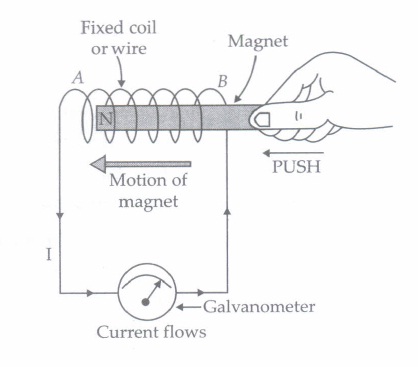
(i) A student connects a coil of wire with a sensitive galvanometer as shown in figure. He will observe the deflection in the galvanometer if bar magnet is
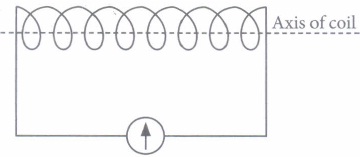
(a) placed near one of the faces of the coil and parallel to the axis of the coil
(b) placed near one of the faces of the coil and perpendicular to the axis of the coil
(c) placed inside the coil
(d) moved towards or away from the coil parallel to the axis of the coil.
(ii) A conducting rod AB moves across two magnets as shown in figure and the needle in the galvanometer deflects momentarily. What is the name of this physical phenomenon?
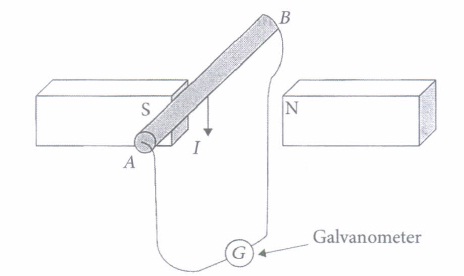
| (a) Electromagnetism | (b) Induced magnetism |
| (c) Electromagnetic induction | (d) Static induction |
(iii) A bar magnet is pushed steadily into a long solenoid connected to a sensitive meter.
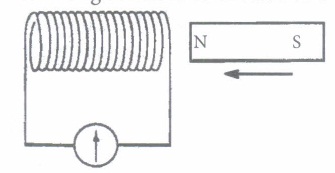
Which of the following would affect the magnitude of the deflection of the meter?
(a) How fast the magnet is pushed into the coil.
(b) The direction in which the coil is wound.
(c) The end of the solenoid the magnet enters.
(d) The pole of the magnet enters the coil first.
(iv) What is the condition of an electromagnetic induction?
(a) There must be a relative motion between galvanometer and coil of wire.
(b) There must be a relative motion between galvanometer and a magnet.
(c) There must be a relative motion between galvanometer and electric motor.
(d) There must be a relative motion between the coil of wire and a magnet.
(v) An induced emf is produced when a magnet is plunged into a coil. The magnitude of induced emf does not depend on
| (a) the number of turns in the coil | (b) the speed with which the magnet is moved |
| (c) the strength of the magnet | (d) the resistivity of the material of the coil |
3.
An ecosystem may be defined as a structural and functional unit of the biosphere comprising living organisms and their non-living environment which interact by means of food chains and biogeochemical cycles resulting in energy-flow, biotic diversity and material cycling to form a stable, self-supporting system.
(i) The two basic processes involved in an ecosystem are
| (a) cycling of materials and food chains | (b) energy flow and self-sustainability |
| (c) carbon cycle and biotic diversity | (d) cycling of materials and flow of energy. |
(ii) Which among the following is not an artificial ecosystem?
| a) Orchard | (b) Lake | (c) Aquarium | (d) Cropland |
(iii) The role of fungi and bacteria in an ecosystem is to
| (a) increase the supply of nutrients | (b) increase the supply of energy |
| (c) release nutrients from dead organic matter | (d) increase the amount of CO2 in the atmosphere. |
(iv) What would one of the likely result if all decomposers in a particular ecosystem were wiped out?
(a) The atmospheric reservoir of carbon dioxide would decline.
(b) More food would be available for other consumers in the ecosystem.
(c) The other organisms in the ecosystem would experience lower death rates.
(d) There would be no significant impact, as dead organic matters would spontaneously decompose.
(v) Which of the following holds true for an ecosystem?
(a) Primary consumers are least dependent upon producers.
(b) Primary consumers most of the time out number producers.
(c) Organic substances such as carbon, nitrogen and oxygen constitute the main abiotic components.
(d) Permanent ecosystems are self-supporting natural ecosystems that maintain themselves for relatively long duration.
4.
The obstruction offered by a conductor in the path of flow of current is called resistance. The SI unit of resistance is ohm (\(\begin{equation}
\Omega
\end{equation}\)). It has been found that the resistance of a conductor depends on the temperature of the conductor. As the temperature increases the resistance also increases. But the resistance of alloys like mangnin, constantan and nichrome is almost unaffected by temperature. The resistance of a conductor also depends on the length of conductor and the area of cross-section of the conductor. More be the length, more will be the resistance, more be the area of cross-section, lesser will be the resistance.
(i) Which of the following is not will desired in material being used for making electrical wires?
| (a) High melting point | (b) High resistance |
| (c) High conductivity | (d) None of these |
(ii) The V - I graph for two metallic wires A and B is given. What is the correct relationship between their temperatures?
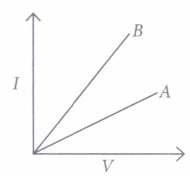
| (a) TA < TB | (b) TA > TB |
| (c) TA = TB | (d) none of these |
(iii) Two wires of same material one of length L and area of cross-section A, other is of length 2L and area A/2 . Which of the following is correct?
| (a) R1 = R2 | (b) R1 = 4R2 |
| (c) R2 = 4R1 | (d) R1 = 2R2 |
(iv) For the same conducting wire
(a) resistance is higher in summer
(b) resistance is higher in winter
(c) resistance is same is summer or in winter
(d) none of these
(v) A wire of resistance 20 \(\begin{equation}
\Omega
\end{equation}\) is cut into 5 equal pieces. The resistance of each part is
| (a) 4 \(\begin{equation} \Omega \end{equation}\) | (b) 10 \(\begin{equation} \Omega \end{equation}\) |
| (c) 100 \(\begin{equation} \Omega \end{equation}\) | (d) 80 \(\begin{equation} \Omega \end{equation}\) |
5.
Various steps of a food chain can be represented sequence wise with producers at base, herbivores above them, followed by primary carnivores and finally the top carnivore at the top. This graphic representation of ecological parameters like number, biomass, energy at different trophic levels is called ecological pyramid. Different types of pyramids are pyramid of energy, pyramid of biomass and pyramid of number.
(i) Refer to the given figure where various trophic levels are represented as P, Q, Rand S. At which level is maximum and minimum energy available respectively?
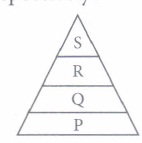
| (a) P, S | (b) S, P | (c) P, R | (d) Q, S |
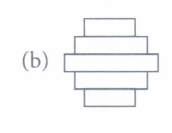
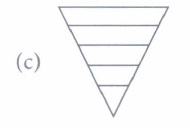
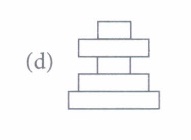
(ii) On the basis of your knowledge, select the pyramid of biomass operating in a grassland ecosystem
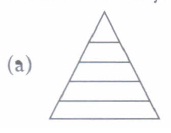 |
 |
 |
 |
(iii) Which of the following food chains is most likely represented by the given pyramid of number?
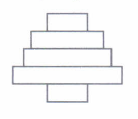
(a) Tree \(\rightarrow\) Aphid \(\rightarrow\) Lady bug - Bird \(\rightarrow\) Hawk
(b) Cyanobacteria \(\rightarrow\) Shrim\(\rightarrow\) Small fish \(\rightarrow\) Fish eating bird - Snake
(c) Plant\(\rightarrow\)Rat \(\rightarrow\)Snake \(\rightarrow\) Meerkat\(\rightarrow\)Lion
(d) Phytoplankton \(\rightarrow\) Zooplankton \(\rightarrow\)Shellfish\(\rightarrow\)Fish \(\rightarrow\)Shark
(iv) Which of the following pyramids is always upright?
| (a) Pyramid of number | (b) Pyramid of biomass |
| (c) Pyramid of energy | (d) Both (a) and (c) |
(v) Refer to the given table
| Trophic level | Number of organisms | Energy in trophic level (arbitrary units) |
| W | 100 | 10,000 |
| X | 1 | 100 |
| Y | 1000 | 100,000 |
| Z | 10 | 1000 |
Which of the following food chains is correct regarding the given data?
| (a) W \(\rightarrow\) X\(\rightarrow\) Y \(\rightarrow\) Z | (b) Y\(\rightarrow\) W \(\rightarrow\) Z\(\rightarrow\) X |
| (c) W \(\rightarrow\)Z \(\rightarrow\)X\(\rightarrow\) Y | (d) Y\(\rightarrow\)X\(\rightarrow\) Z\(\rightarrow\)W |
6.
The relation between distance of an object from the mirror (u), distance of image from the mirror (v) and the focal length (F) is called mirror formula. This formula is valid in all situations for all spherical mirrors for all positions of the object. The size of image formed by a spherical mirror depends on the position of the object from the mirror. The image formed by a spherical mirror can be bigger than the object, equal to the object or smaller than the object. The size of the image relative to the object is given by the linear magnification (m). Thus, the magnification is given by the ratio of height of image to the height of object. If magnification is negative, image is real and if it is positive, image is virtual.
(i) What is the position of an image when an object is placed at a distance of 20 em from a concave mirror of
focal length 20 cm?
| (a) 5 cm | (b) 20 cm |
| (c) 10 cm | (d) infinity |
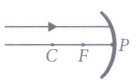
(ii) Which of the following ray diagrams is correct for the ray of light incident on a concave mirror as shown in figure?
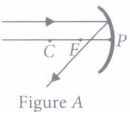 (a) Figure A |
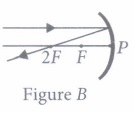 (b) Figure B |
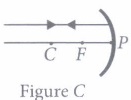 (C) Figure C |
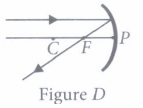 (d) Figure D |
(iii) If the magnification of an image is -2, the characteristic of image will be
| (a) real and inverted | (b) virtual and enlarged |
| (c) virtual and inverted | (d) real and small |
(iv) The mirror formula holds for
| (a) concave mirror | (b) convex mirror |
| (c) plane mirror | (d) all of these |
(v) A parallel beam of light is made to fall on a concave mirror. An image is formed at a distance of7.5 from the mirror. The focal length of the mirror is
| (a) 15 cm | (b) 7.5 cm |
| (c) 3.75 cm | (d) 10 cm |
7.
Two allotropic forms of carbon which are crystalline in nature, are diamond and graphite. They differ physically but chemically they are similar. Diamond is the hardest crystalline form of carbon. In diamond, each carbon atom is linked to four other carbon atoms by covalent bonds. In graphite, each carbon atom is linked to three other carbon atoms by covalent bond. Graphite is relatively soft and greasy. It is also a good conductor of electricity. The C-C bond length in graphite is 141.5 pm while in diamond it is 154 pm.
(i) Which of the following is a good conductor of heat and electricity?
| (a) Coal | (b) Diamond | (c) Charcoal | (d) Graphite |
(ii) Graphite is a good conductor of electricity because
| (a) it has free electrons | (b) it has free atoms | (c) it is crystalline | (d) it is soft and greasy. |
(iii) Which of the following types of binding forces is present in the structure of diamond?
| (a) Ionic | (b) van der Waals' | (c) Covalent | (d) None of these |
(iv) Diamond is not a good conductor of electricity because
| (a) it is very hard | (b) its structure is very compact |
| (c) it is not water soluble | (d) it has no free electron. |
(v) Which of the following is the structure of diamond?

8.
Gregor Mendel conducted hybridisation experiments on garden peas for seven years and proposed the laws of inheritance in living organisms. He investigated characters in the garden pea plant that were manifested as two opposing traits, e.g., tall or dwarf plants, yellow and green seeds, etc.
(i) Among the seven pairs of contrasting traits in pea plant as studied by Mendel, the number of traits related
to flower, pod and seed respectively were
| (a) 2,2,2 | (b) 2,2,1 |
| (c) 1,2,2 | (d) 1,1,2. |
(ii) The colour based contrasting traits in seven contrasting pairs, studied by Mendel in pea plant were
| (a) 1 | (b) 2 |
| (c) 3 | (d) 4. |
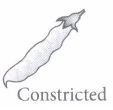
(iii) Refer to the given table of contrasting traits in pea plants studied by Mendel.
| Character | Dominant trait | Recessive trait |
| (i) Seed colour |  |
 |
| (ii) Flower colour | 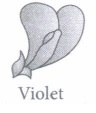 |
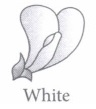 |
| (iii) Pod shape | 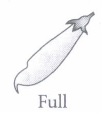 |
 |
| (iv) Flower position | 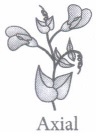 |
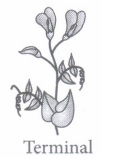 |
Which of the given traits is correctly placed?
(a) (i), (ii) and (iii) only
(b) (ii), (iii) and (iv) only
(c) (ii) and (iii) only
(d) (i), (ii), (iii) and (iv)
(iv) Some of the dominant traits studied by Mendel were
(a) round seed shape, green seed colour and axial flower position
(b) terminal flower position, green pod colour and inflated pod shape
(c) violet flower colour, green pod colour and round seed shape
(d) wrinkled seed shape, yellow pod colour and axial flower position.
(v) Which of the following characters was not chosen by Mendel?
| (a) Pod shape | (b) Pod colour |
| (c) Position of flower | (d) Position of pod |
9.
Metals as we know, are very useful in all fields, industries in particular. Non-metals are no less in any way. Oxygen present in air is essential for breathing as well as for combustion. Non-metals form a large number of compounds which are extremely useful, e.g., ammonia, nitric acid, sulphuric acid, etc.
Non-metals are found to exist in three states of matter. Only solid non-metals are expected to be hard however, they have low density and are brittle. They usually have low melting and boiling points and are poor conductors of electricity.
(i)____________ is a non-metal but is lustrous
| (a) Phosphorus | (b) Sulphur | (c) Bromine | (d) Iodine |
(ii) Which of the following is known as 'King of chemicals'?
| (a) Urea | (b) Ammonia X | (c) Sulphuric acid | (d) Nitric acid |
(iii) Which of the following non-metals is a liquid?
| (a) Carbon | (b) Bromine | (c) Iodine | (d) Sulphur |
(iv) Hydrogen is used
| (a) for the synthesis of ammonia | (b) for the synthesis of methyl alcohol |
| (c) in welding torches | (d) all of these |
(v) Generally, non-metals are bad conductors of electricity but 'X' which is a form of carbon is a good conductor of electricity and is an exceptional non-metal. 'X'is
| (a) diamond | (b) graphite | (c) coal | (d) coke. |
10.
Horticultural methods of vegetative propagation multiply desired varieties of plants quickly from parts of their somatic body. A horticulturist used stem cutting of plant X to propagate it in a short span of time. For plant Y, he pulled a branch of towards ground and covered it with soil leaving the tip of branch exposed. He later on cut the branch from parent plant. The former developed into new plant. He propagated plant Z through underground stems called tubers. Identify the propagation methods used by horticulturist and answer the following questions.
(i) What could be plants X, Y and Z?
| X | Y | Z | |
| (a) | Bougainvillea | Jasmine | Potato |
| (b) | Sugarcane | Ginger | Rose |
| (c) | Begonia | Banana | Chrysanthemum |
| (d) | Guava | Onion | Cactus |
(ii) Select the propagation methods in plants X, Y and Z.
(a) X - root tubers, Y - stem cutting, Z - stem tubers
(b) X - stem cutting, Y - layering, Z - underground stem
(c) X -Iayering, Y - underground stem, Z - underground roots
(d) X - grafting, Y - layering, Z - root tubers
(iii) Select the correct statement for plant Z if it is potato.
(a) Each tuber has many buds called ears
(b) It is necessary to plant the whole potato tuber in the soil to produce new potato plants
(c) Vegetative propagation of potato plants by tubers is much faster than production of potatoes by seeds
(d) All of these.
(iv) Select the plant which propagates by the same method adopted by gardener for plant Y, but naturally it propagates by stolons
| (a) Strawberry | (b) Adiantum |
| (c) Tulsi | (d) Both (a) and (b) |
(v) Identify the given vegetative propagule.
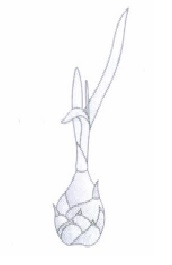
| (a) Bulb | (b) Runner |
| (c) Rhizome | (d) Bulbil |
11.
The preparation of washing soda is carried out through following steps:
Step-I: Manufacture of sodium hydrogen carbonate:\(\mathrm{NaCl}+\mathrm{H}_{2} \mathrm{O}+\mathrm{NH}_{3}+\mathrm{CO}_{2} \longrightarrow \ \mathrm{NaHCO}_{3}+ \ \mathrm{NH}_{4} \mathrm{Cl}\)
Sodium hydrogen carbonate
Step-II: Thermal decomposition of sodium hydrogen carbonate: When dry crystals of sodium hydrogen carbonate are heated strongly, they decompose to form anhydrous sodium carbonate (soda ash). \(2 \mathrm{NaHCO}_{3(s)} \longrightarrow \mathrm{Na}_{2} \mathrm{CO}_{3(s)}+\mathrm{CO}_{2(g)}+\mathrm{H}_{2} \mathrm{O}_{(g)}\)
Step-III: Recrystallisation of sodium carbonate: Sodium carbonate thus obtained is recrystallised to form crystals of washing soda.\(\mathrm{Na}_{2} \mathrm{CO}_{3(s)}+ 10 \mathrm{H}_{2} \mathrm{O}_{(l)} \longrightarrow \mathrm{Na}_{2} \mathrm{CO}_{3} \cdot 10 \mathrm{H}_{2} \mathrm{O}_{(s)}\)
Anhydrous Washing soda
sodium carbonate
(i) Some of the uses of washing soda are given below:
(I) It is used for removing permanent hardness of water
(II) It is used in glass industry
(III) It is used in paper industry
(IV) It is used in the manufacture of sodium compounds such as borax
Select the correct option regarding uses of washing soda
| (a) (I) and (II) only | (b) (II) and (III) only |
| (c) (II) and (IV) only | (d) (I), (II), (III) and (IV) |
(ii) What products will be formed along with water when sodium carbonate reacts with dilute hydrochloric acid?
| (a) CO and NaCI | (b) Na and CO2 |
| (c) NaCI and CO2 | (d) Na and CO |
(iii) Chief raw materials for the manufacture of washing soda are
| (a) sodium chloride, ammonia and limestone |
| (b) ammonia, sodium hydrogen carbonate and copper sulphate |
| (c) sodium hydroxide, calcium chloride and ammonia |
| (d) calcium chloride, sodium chloride and copper sulphate. |
(iv) What is the action of sodium carbonate on litmus paper?
| (a) Turns red litmus blue | (b) Turns blue litmus red | (c) No change on litmus | (d) Both (a) and (b) |
(v) What products will be obtained when solution of sodium carbonate and slaked lime is heated?
| (a) NaOH and CaCl2 | (b) CaCO3 and NaOH |
| (c) NaHCO3 and NaOH | (d) NaCI and CaCO3 |
12.
Chemically, Plaster of Paris (POP) is calcium sulphate hemihydrate, i.e., containing half molecule of water of crystallisation. It is represented by the formula, CaSO4 ·1/2H2O. Half molecule of water of crystallisation means that one water molecule is shared by two formula units of CaSO4. Hence, we also represent its formula as (CaSO4)2·H2O. The name, plaster of Paris, was given to this compound because for the first time, it was made from gypsum which was mainly found in Paris.
(i) The difference of water molecules in gypsum and plaster of Paris is
| (a) 5/2 | (b) 2 | (c) 1/2 | (d) 3/2 |
(ii) Plaster of Paris hardens by
| (a) giving off CO2 | (b) changing into CaCO3 |
| (c) combining with water | (d) giving out water |
(iii) Which of the following statements is incorrect?
| (a) Plaster of Paris is used to ornate designs on walls and ceilings |
| (b) On heating gypsum above 373 K, CaSO4 is obtained |
| (c) Dead burnt plaster is CaSO4 ·2H2O |
| (d) Setting of plaster is due to its hydration into gypsum |
(iv) Select the incorrect statement with respect to gypsum
| (a) It is slightly soluble in water |
| (b) It is also known as alabaster |
| (c) On heating gypsum at 373 K, it loses water molecules and becomes calcium sulphate hemihydrate |
| (d) Chemical formula of gypsum is CaSO4 ·1/2H2O |
(v) Plaster of Paris is obtained by
| (a) adding water to calcium sulphate. |
| (b) adding sulphuric acid to calcium hydroxide |
| (c) heating gypsum to a very high temperature |
| (d) heating gypsum to 100° C |
13.
Oxidation has damaging effect on metals as well as on food. The damaging effect of oxidation on metal is studied as corrosion and that on food is studied as rancidity. The phenomenon due to which metals are slowly eaten away by the reaction of air, water and chemicals present in atmosphere, is called corrosion. For example, iron articles are shiny when new, but get coated with a reddish brown powder when left for sometime. This process is known as rusting of iron. Rancidity is the process of slow oxidation of oil and fat (which are volatile in nature) present in the food materials resulting in the change of smell and taste in them.
(i) Rancidity can be prevented by
| (a) adding antioxidants | (b) packaging oily food in nitrogen gas |
| (c) both (a) and (b) | (d) none of these. |
(ii) Combination of phosphorus and oxygen is an example of
| (a) oxidation | (b) reduction | (c) rancidity | (d) none of these |
(iii) A science teacher wrote the following statements about rancidity :
(I) When fats and oils are reduced, they become rancid.
(II) In chips packet, rancidity is prevented by oxygen.
(III) Rancidity is prevented by adding antioxidants.
Select the correct option.
| (a) (I) only | (b) (II) and (III) only | (c) (III) only | (d) (I), (II), and (III) |
(iv) Two statements are given below regarding rusting of iron.
(I) The rusting of iron is a redox reaction and reaction occurs as, \(4 \mathrm{Fe}+3 \mathrm{O}_{2} \longrightarrow 4 \mathrm{Fe}^{3+}+6 \mathrm{O}^{2-}\)
(II) The metallic iron is oxidised to \(\mathrm{Fe}^{2+} \text { and } \mathrm{O}_{2} \text { is reduced to } \mathrm{O}^{2-}\)
Select the correct statement(s).
| (a) I only | (b) II only | (c) Both I and II | (d) None of these |
(v) Which of the following measures can be adopted to prevent or slow down rancidity?
(I) Food materials should be packed in air tight container.
(II) Food should be refrigerated.
(III) Food materials and cooked food should be kept away from direct sunlight
| (a) Only II and III | (b) Only I and III | (c) Only II and III | (d) I, II and III |
14.
In 1913, Henry Moseley showed that the atomic number of an element is the more fundamental property than its atomic mass. Accordingly, Mendeleev's periodic law was modified and atomic number was adopted as the basis of modern periodic table.
In this periodic table, the elements are arranged in increasing order of their atomic numbers.
There are 18 vertical columns in the periodic table which constitute 18 groups or families. The groups are numbered as 1, 2, 3, ... up to 18. All the members of a particular group have similar outer shell electronic configuration. There are seven horizontal rows of the periodic table which are known as periods.
(i) According to modern periodic law, the properties of elements are the periodic function of their
| (a) atomic masses | (b) atomic volumes |
| (c) atomic numbers | (d) densities |
(ii) All the elements in a period in the periodic table have the same
| (a) atomic number | (b) electronic configuration |
| (c) atomic weight | (d) valence shell |
(iii) Which of the following combinations of elements belong to the same group?
| (a) N, P, As | (b) Li, Be, Al |
| (c) Na, Mg, Al | (d) O, S, Cl |
(iv) The atoms of elements belonging to the same group of periodic table have same number of
| (a) protons | (b) electrons |
| (c) neutrons | (d) electrons in outermost shell |
(v) In the periodic table, the element with atomic number 16 will be placed in the group
| (a) fourteen | (b) sixteen |
| (c) thirteen | (d) fifteen |
15.
In decomposition reactions, a single reactant breaks down to form two or more products. A decomposition reaction is opposite to combination reaction. Thermal decomposition reactions use the energy in form of heat for the decomposition of reactants. Electrolytic decomposition reactions involve the use of electrical energy for the decomposition of reactant molecules. Photolysis or photochemical decomposition involves the use of light energy for the purpose of decomposition.
(i) Which of the following reactions is a decomposition reaction?
| \({ (a) \ } \mathrm{NaOH}+\mathrm{HCl} \longrightarrow \mathrm{NaCl}+\mathrm{H}_{2} \mathrm{O}\) | \({ (b) \ } \mathrm{NH}_{4} \mathrm{CNO} \longrightarrow \mathrm{H}_{2} \mathrm{NCONH}_{2}\) |
| \({ (C) \ } 2 \mathrm{KCIO}_{3} \longrightarrow 2 \mathrm{KCl}+3 \mathrm{O}_{2}\) | \( { (d) \ } \mathrm{H}_{2}+\mathrm{I}_{2} \longrightarrow 2 \mathrm{HI}\) |
\({ (ii) \ } 2 \mathrm{~Pb}\left(\mathrm{NO}_{3}\right)_{2} \longrightarrow 2 \mathrm{PbO}+n A+\mathrm{O}_{2}\)
What is nA in the given reaction?
| (a) 4NO | (b) 4NO2 | (c) 2PbNO2 | (d) NO2 |
(iii) Amino acid is formed by the decomposition of which component of our diet?
| (a) Carbohydrate | (b) Starch | (c) Protein | (d) Fat |
(iv) Silver chloride on exposure to sunlight for a long duration turns grey due to
(I) the formation of silver by decomposition of silver chloride
(II) sublimation of silver chloride
(III) decomposition of chlorine gas from silver chloride
(IV) oxidation of silver chloride
The correct statement(s) is/are
| (a) Only (I) | (b) Only (II) and (III) | (c) Only (I) and (II) | d) Only (IV) |
(v) What type of chemical reaction takes place when electricity is passed through water?
| (a) Thermal decomposition | (b) Electrolytic decomposition |
| (c) Photochemical decomposition | (d) Displacement reaction |
1.
(i) (b): In the given figures B represents artery that carry blood away from the heart to different organs.
(ii) (c): In the given figures, A represents vein. Veins bring blood from different body parts to the heart. The flow of blood in veins is not so fast because the blood in veins is under low pressure. Veins possess valves which prevent backward flow of blood.
(iii) (a): Veins carry deoxygenated blood with single exception, i.e., pulmonary vein. Arteries carry blood from heart towards the organ.
(iv) (d)
(v) (a)
2.
(i) (d) : The deflection in galvanometer can be seen if bar magnet moved towards or away from coil parallel to the axis of the coil.
(ii) (c): If the needle of the galvanometer deflects it means there is change in magnetic field and current is induced.
(iii) (a): By Faraday's law of electromagnetic induction, the e.m.f. induced in a conductor is proportional to the rate of change of magnetic lines of force linking the circuit. Hence, by pushing in the magnet faster, the rate of change of magnetic lines will increase. This results in a larger induced e.m.f. and hence, larger deflection of the meter.
(iv) (d)
(v) (d): Resistivity of coil will determine the resistance of the coil and induced current through it, as induced
\(\text { current }=\frac{\mathrm{emf}}{\text { resistance }}\)
3.
(i) (d)
(ii) (b): Artificial ecosystems are maintained by man and hence are also termed as man-made or man engineered ecosystems. In these ecosystems, man maintains/ disturbs the natural balance by the addition of energy and planned manipulations. Common examples of artificial ecosystems are croplands, orchards, gardens, aquarium, etc.
(iii) (c): Fungi and bacteria are decomposers which serve to convert carbon locked up in dead organic matter into carbon dioxide, which can then be utilised by plants during photosynthesis. A Band D are incorrect since decomposers do not increases the amount of nutrients, energy and carbon dioxide in the ecosystem. They merely allow cycling of nutrients, including carbon, to occur.
(iv) (a)
(v) (d): Primary or first-order consumers include the animals which eat plants or plant products. They are called herbivores. As the herbivores feed on plants/plant products and convert them into animal matter, they are often called key industry animals. Inorganic substances, e.g., carbon, nitrogen, oxygen, calcium, phosphorus, etc. and their compounds (water, carbon dioxide, etc.) constitute the main abiotic components. These occur either in the form of compounds dissolved in water, in the soil or in free state in the air.
4.
(i) (b): The electrical wire should have low resistance.
(ii) (b): More is the temperature, more will be the resistance. The resistance of A is more, so temperature of A is more.
(iii) (c): \(\begin{equation}
R_{1}=\rho \frac{L}{A}, R_{2}=\rho \frac{2 L}{A / 2}
\end{equation}\)
(iv) (a): In summers, temperature is more, so resistance is more.
(v) (a): \(\begin{equation}
R^{\prime}=\frac{R}{5}=\frac{20}{5}=4 \Omega
\end{equation}\)
5.
(i) (a) : Producers contain maximum energy and as energy passes onto higher trophic level along with food, its amount decreases. Hence P has maximum energy while S has least.
(ii) (a): Pyramid of biomass in a grassland ecosystem is upright.
(iii) (a) : Pyramid of number in a tree ecosystem is spindle shaped.
(iv) (c)
(v) (b): The available energy is highest at the producer level and there is gradual decrease in available energy at successive trophic level.
6.
(i) (d): When an object is placed at the focus of a concave mirror, the image is formed at infinity.
(ii) (d): When a light ray parallel to the principal axis is incident on a concave mirror, it passes through the principal focus after reflection. Therefore, figure D is correct.
(iii) (a) : If m is negative, the image will be real and inverted.
(iv) (d)
(v) (b): The distance of object from mirror = \(\infty\)
Using, \(\frac{1}{v}+\frac{1}{u}=\frac{1}{f}\)
\(\frac{1}{\infty}-\left(-\frac{1}{7.5}\right)=\frac{1}{f}\)
f = 7.5 cm
7.
(i) (d)
(ii) (a)
(iii) (c)
(iv) (d): In diamond, one carbon is attached to four other carbon atoms hence it has no free electron.
(v) (a)
8.
(i) (a): Characters studied by Mendel are as follows:
| Trait studied | Dominant | Recessive | |
| 1 | Plant height | Tall (T) | Dwarf (t) |
| 2 | Flower position | Axial (A) | Terminal (a) |
| 3 | Flower colour | Violet (V) or (W) | White (v) or (w) |
| 4 | Pod shape | Full or Inflated (I) or (C) | Constricted (i) or (c) |
| 5 | Pod colour | Green (G) or (Y) | Yellow (g) or (y) |
| 6 | Seed shape | Round (R) or (W) | Wrinkled (r) or (w) |
| 7 | Seed colour | Yellow (Y) or (G) | Green (y) or (g) |
(ii) (c)
| Trait studied | Dominant | Recessive | |
| 1 | Plant height | Tall (T) | Dwarf (t) |
| 2 | Flower position | Axial (A) | Terminal (a) |
| 3 | Flower colour | Violet (V) or (W) | White (v) or (w) |
| 4 | Pod shape | Full or Inflated (I) or (C) | Constricted (i) or (c) |
| 5 | Pod colour | Green (G) or (Y) | Yellow (g) or (y) |
| 6 | Seed shape | Round (R) or (W) | Wrinkled (r) or (w) |
| 7 | Seed colour | Yellow (Y) or (G) | Green (y) or (g) |
(iii) (d)
| Trait studied | Dominant | Recessive | |
| 1 | Plant height | Tall (T) | Dwarf (t) |
| 2 | Flower position | Axial (A) | Terminal (a) |
| 3 | Flower colour | Violet (V) or (W) | White (v) or (w) |
| 4 | Pod shape | Full or Inflated (I) or (C) | Constricted (i) or (c) |
| 5 | Pod colour | Green (G) or (Y) | Yellow (g) or (y) |
| 6 | Seed shape | Round (R) or (W) | Wrinkled (r) or (w) |
| 7 | Seed colour | Yellow (Y) or (G) | Green (y) or (g) |
(iv) (c)
| Trait studied | Dominant | Recessive | |
| 1 | Plant height | Tall (T) | Dwarf (t) |
| 2 | Flower position | Axial (A) | Terminal (a) |
| 3 | Flower colour | Violet (V) or (W) | White (v) or (w) |
| 4 | Pod shape | Full or Inflated (I) or (C) | Constricted (i) or (c) |
| 5 | Pod colour | Green (G) or (Y) | Yellow (g) or (y) |
| 6 | Seed shape | Round (R) or (W) | Wrinkled (r) or (w) |
| 7 | Seed colour | Yellow (Y) or (G) | Green (y) or (g) |
(v) (d)
| Trait studied | Dominant | Recessive | |
| 1 | Plant height | Tall (T) | Dwarf (t) |
| 2 | Flower position | Axial (A) | Terminal (a) |
| 3 | Flower colour | Violet (V) or (W) | White (v) or (w) |
| 4 | Pod shape | Full or Inflated (I) or (C) | Constricted (i) or (c) |
| 5 | Pod colour | Green (G) or (Y) | Yellow (g) or (y) |
| 6 | Seed shape | Round (R) or (W) | Wrinkled (r) or (w) |
| 7 | Seed colour | Yellow (Y) or (G) | Green (y) or (g) |
9.
(i) (d) : Iodine is a lustrous non-metal
(ii) (c): H2 SO4 is known as 'King of Chemicals
(iii) (b): Bromine exists as a liquid.
(iv) (d)
(v) (b): Graphite conducts electricity because of the delocalised electrons in its structure
10.
(i) (a)
(ii) (b)
(iii) (c)
(iv) (a): Many plants like strawberry and raspberry are propagated by the natural layering methods because these plants have runners (soft horizontal stem running above the ground). Whereas the ends of such runners touch the ground new plants are formed.
(v) (d)
11.
(i) (d)
(ii) (c): Na2CO3 reacts with dilute acids to give COgas with brisk effervescence.
\(\mathrm{Na}_{2} \mathrm{CO}_{3(s)}+2 \mathrm{HCl}_{(a q)} \longrightarrow 2 \mathrm{NaCl}_{(a q)}+\mathrm{H}_{2} \mathrm{O}_{(l)}\)\(+\mathrm{CO}_{2(g)} \uparrow\)
Sodium Dil. Hydrochloric Sodium Water Carbon dioxide
carbonate acid chloride
(iii) (a): Chief raw materials for the manufacture of washing soda are sodium chloride (NaCl), ammonia (NH3 ) and limestone (CaCO3)
(iv) (a): Sodium carbonate turns red litmus blue
(v) (b): Sodium hydroxide and calcium carbonate are formed when the solution of sodium carbonate and slaked lime, Ca(OH)2 is heated \(\mathrm{Na}_{2} \mathrm{CO}_{3}+\mathrm{Ca}(\mathrm{OH})_{2} \longrightarrow 2 \mathrm{NaOH}+\mathrm{CaCO}_{3}\)
12.
(i) (d): Gypsum is CaSO4 ·2H2Oand plaster of Paris is CaSO4\(\frac{1}{2}\) H2O. Difference in number of water molecules \(=\frac{3}{2}\).
(ii) (c): Plaster of Paris is hardened by combining with water.
(iii) (c): Dead burnt plaster is CaSO4 (anhydrous calcium sulphate).
(iv) (d): Gypsum: CaSO4 ·2H2O Plaster of paris: CaSO4 ·1/2H2O
(v) (d): Gypsum on heating upto lOO°C gives plaster of Paris.
\(\begin{array}{c} \mathrm{CaSO}_{4} \cdot 2 \mathrm{H}_{2} \mathrm{O} \stackrel{100^{\circ} \mathrm{C}}{\longrightarrow} \mathrm{CaSO}_{4} \cdot \frac{1}{2} \mathrm{H}_{2} \mathrm{O}+1 \frac{1}{2} \mathrm{H}_{2} \mathrm{O} { } \end{array}\)
Gypsum Plaster of Paris
13.
(i) (c): Antioxidants and nitrogen gas prevent oxidation of food
\({ (ii) }\ (\mathrm{a}): 4 \mathrm{P}+3 \mathrm{O}_{2} \longrightarrow 2 \mathrm{P}_{2} \mathrm{O}_{3}, 4 \mathrm{P}+5 \mathrm{O}_{2} \longrightarrow 2 \mathrm{P}_{2} \mathrm{O}_{5}\)
(iii) (c): The oils and fats are slowly oxidised to certain bad smelling compounds, which release foul smell. This is known as rancidity. Rancidity is prevented by filling nitrogen gas in chips packets.
(iv) (a)
(v) (d)
14.
(i) (c) :According to modern periodic law, the properties of elements are the periodic function of their atomic numbers.
(ii) (d): All the elements in a period have the same valence shell.
(iii) (a): N, P and As belong to the same group (group 15).
(iv) (d)
(v) (b): Element with atomic number 16 has electronic configuration 2, 8, 6. Hence, it will be placed in 10 + 6 = 16th group.
15.
(i) (c)
\({ (ii) \ }(b): \ 2 \mathrm{~Pb}\left(\mathrm{NO}_{3}\right)_{2} \longrightarrow 2 \mathrm{PbO}+4 \mathrm{NO}_{2}+\mathrm{O}_{2}\)
(iii) (c) : Proteins in our diet get broken down into amino acids.
\({ (iv) }(\mathrm{a}): 2 \mathrm{AgCl}_{(\mathbf{s})} \stackrel{\text { Sunlight }}{\longrightarrow} 2 \mathrm{Ag}_{(s)}+\mathrm{Cl}_{2(g)}\)
(v) (b): Electrolysis of water is electrolytic decomposition.
\(\mathrm{H}_{2} \mathrm{O} \stackrel{\text { Current }}{\longrightarrow} 2 \mathrm{H}_{2}+\mathrm{O}_{2}\)

10th Standard CBSE Syllabus & Materials
10th Standard CBSE
CBSE 10th Social Science PS - Federalism - New Model Questions Papers Study Material - QB365 Set A
NEW10th Standard CBSE
CBSE 10th Social Science PS - Power Sharing - New Model Questions Papers Study Material - QB365 Set A
NEW10th Standard CBSE
CBSE 10th Social Science GEO - Manufacturing Industries - New Model Questions Papers Study Material - QB365 Set A
NEW10th Standard CBSE
CBSE 10th Social Science GEO - Minerals and Energy Resources - New Model Questions Papers Study Material - QB365 Set A



NCERT Books

Syllabus

Exam Pattern

Sample Question Papers

Previous year Question Papers

Important Notes

MCQ Practice test

NCERT Exemplers

Case study Questions

Image Based Questions

Passage based Questions

HOT Questions

Value Based Questions

Model Questions Papers
NCERT ( Book Back ) Questions

Assertion and Reason
Important Questions And Answers

CBSE 10th Standard CBSE Subjects
CBSE Standards



