
 100% FREE ACCESS
10th Standard CBSE Syllabus & Materials
10th Standard CBSE
CBSE 10th Social Science ECO - Globalisation and the Indian Economy - New Model Questions Papers Study Material - QB365 Set A
NEW10th Standard CBSE
CBSE 10th Social Science ECO - Money and Credit - New Model Questions Papers Study Material - QB365 Set A
NEW10th Standard CBSE
CBSE 10th Social Science ECO - Sectors of the Indian Economy - New Model Questions Papers Study Material - QB365 Set A
NEW10th Standard CBSE
CBSE 10th Social Science ECO - Development - New Model Questions Papers Study Material - QB365 Set A
NEW10th Standard CBSE
CBSE 10th Social Science PS - Outcomes of Democracy - New Model Questions Papers Study Material - QB365 Set A
NEW10th Standard CBSE
CBSE 10th Social Science PS - Gender, Religion and Caste - New Model Questions Papers Study Material - QB365 Set A

Published on: 22/05/2021
QB365 Provides the updated CASE Study Questions for Class 10 , and also provide the detail solution for each and every case study questions . Case study questions are latest updated question pattern from NCERT, QB365 will helps to get more marks in Exams
Download CBSE Class 10th Standard CBSE Science question papers, sample papers, important questions, and previous year solved papers in PDF format. Get free study materials, NCERT solutions, and exam preparation resources for Class 10th Standard CBSE Science
Questions + Answers key
Take MCQ Science Test
1.
The food which is prepared by the process of photosynthesis in the leaves of a plant has to be transported to other parts like stem, roots, branches, etc. Therefore this food is transported to other parts of the plant through phloem.
(i) A few drops of sap were collected by cutting across a plant stem by a suitable method. The sap was tested chemically. Which one of the following test results indicates that it is phloem sap?
| (a) Acidic | (b) Alkaline |
| (c) Low refractive index | (d) Absence of sugar |
(ii) What is the direction of movement of sugars in phloem?
| (a) Bi-directional | (b) Non-directional |
| (c) Upward | (d) Downward |
(iii) The given diagram shows a potato plant forming new tubers. Which route would be taken by most of the food at this time?
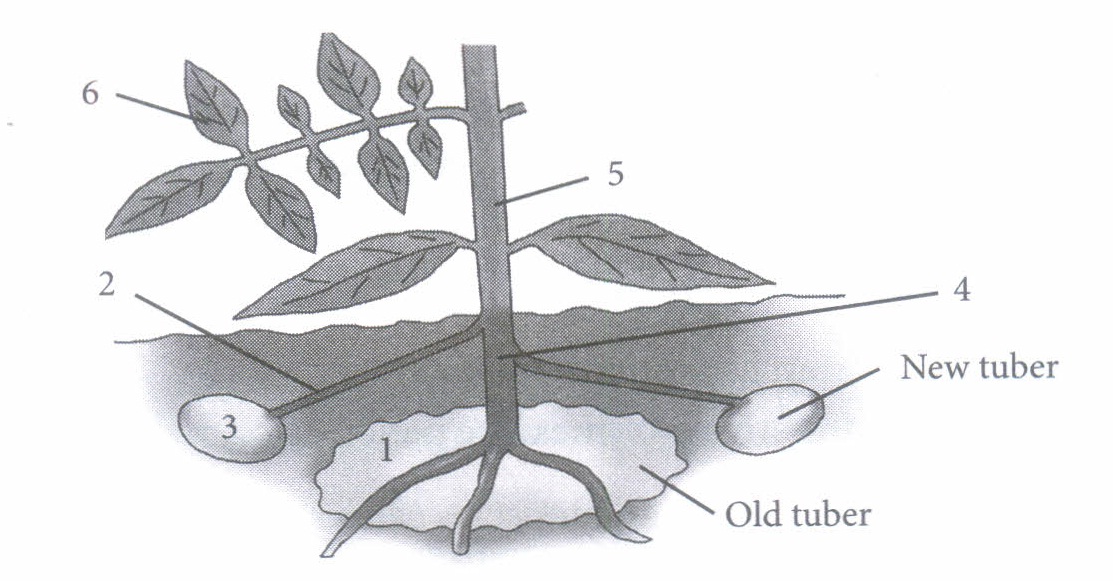
| \(\text { (a) } 1 \rightarrow 4 \rightarrow 2 \rightarrow 3\) | \(\text { (b) } 6 \rightarrow 5 \rightarrow 2 \rightarrow 3\) |
| \(\text { (c) } 1 \rightarrow 4 \rightarrow 5 \rightarrow 6\) | \(\text { (d) } 6 \rightarrow 5 \rightarrow 4 \rightarrow 1\) |
(iv) A girdled plant (upto bast) may survive for some time but it will eventually die, because
(a) water will not move downwards
(b) water will not move upwards
(c) sugars and other organic materials will not move downwards
(d) sugars and other organic materials will not move upwards
(v) Phloem sap is mainly made of
| (a) water and sucrose | (b) water and minerals |
| (c) oligosaccharides and hormones | (d) sucrose only |
2.
The green plants make their food, through photosynthesis and are therefore called autotrophs. All other organisms depend upon green plants for food and are referred to as heterotrophs. Green plants carry out photosynthesis by using light energy of sun. The first phase of reactions are directly light driven therefore called light reactions. The second phase of reactions are not directly light driven but are dependent on the products of light reactions and are called dark reactions.
(i) Which of the following is produced during the light phase of photosynthesis?
| (a) ATP | (b) NADPH | (c) Carbohydrate | (d) Both (a) and (b) |
(ii) In the overall process of photosynthesis, the number of sugar molecules produced is
| (a) 12 | (b) 6 | (c) 4 | (d) l |
(iii) A plant is provided with ideal conditions for photosynthesis and supplied with isotope 14CO2. When the products of the process are analysed carefully, what would be the nature of products?
(a) Both glucose and oxygen are normal.
(b) Both glucose and oxygen are labelled.
(c) Only glucose is labelled and oxygen is normal.
(d) Only oxygen is labelled and glucose is normal.
(iv) Refer to the given diagrammatic representation of an electron micrograph of a section of chloroplast and answer the question .
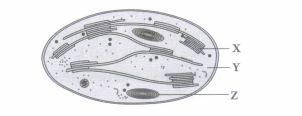
Select the option which correctly depicts the functions of parts X, Y and Z.
| X | Y | Z |
| (a) Dark reaction | Light reaction | Carbohydrate synthesis |
| (b) Light reaction | Carbohydrate synthesis | Carbohydrate storage |
| (c) Light reaction | Carbohydrate storage | Carbohydrate synthesis |
| (d) Carbohydrate synthesis | Carbohydrate storage | Cytoplasmic inheritance |
(v) Following table summarises the differences between light and dark reactions.
| Light reactions | Dark reactions |
| (I) These are also called biosynthetic phase | These are also called photochemical phase. |
| (II) These reactions occur over thylakoids. | These reactions occur in stroma of chloroplasts |
| (III) These produce assimilatory power i.e NADPH and ATP | These consume NADPH and ATP |
| (IV) These are directly dependent upon light | They depend upon the products synthesised during light reactions |
Which of the following is correct group of differences?
| (a) (I), (II) and (III) | (b) (II), (III) and (IV) |
| (c) (II) and (III) | (d) (I) and (IV) |
3.
Transpiration is the evaporative loss of water by plants. It occurs mainly through the stoma in the leaves. Besides the loss of water vapour in transpiration, exchange of oxygen and carbon dioxide in the leaf also occurs through pores called stomata. Normally stomata remain open in the day time and close during the night
(i) Which of the following will not directly affect transpiration?
| (a) Temperature | (b) Light |
| (c) Wind speed | (d) Chlorophyll content of leaves |
(ii) Water vapour comes out from the plant leaf through the stomatal opening. Through the same stomatal opening, carbon dioxide diffuses into the plant during photosynthesis. Reason out the above statements . using one of following options.
(a) The above processes happen only during night time.
(b) One process occurs during day time and the other at night.
(c) Both processes cannot happen Simultaneously.
(d) Both processes can happen together at day time.
(iii) Which of the following statements is not true for stomatal apparatus?
(a) Guard cells invariably possess chloroplasts and mitochondria.
(b) Guard cells are always surrounded by subsidiary cells.
(c) Stomata are involved in gaseous exchange.
(d) Inner wall of guard cells are thick.
(iv) Which of the following is not a purpose of transpiration?
(a) Helps in absorption and transport in plants
(b) Prevents loss of water
(c) Maintains shape and structure of plants by keeping the cells turgid
(d) Supplies water for photosynthesis
(v) Refer to the given graphs regarding factors affecting transpiration rate and select the correct option.
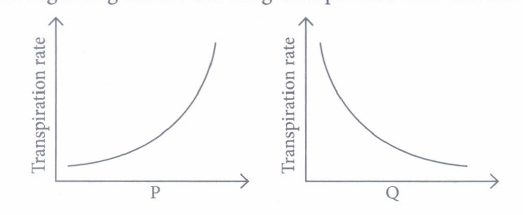
(a) P-Atmospheric temperature; Q-Atmospheric pressure
(b) P-Relative humidity; Q-Atmospheric temperature
(c) P-Air movement; Q-Light
(d) P-Atmospheric pressure; Q-Relative humidity
4.
Water is very important chemical, required as solvent, in many biological processes. It is needed as raw material in photosynthesis, as a main substance from which plants evolve oxygen and provide hydrogen for the synthesis of carbohydrates. It helps in translocation of chemical substances and minerals and in this manner maintains internal transportation. Osmosis is a special type of transport of water molecules that occurs through semipermeable membrane. Osmosis is movement of solvent from the region of higher diffusion pressure to the lower diffusion pressure across a semipermeable membrane. It is of two types - endosmosis and exosmosis. Endosmosis is the osmotic entry of water into a cell, organ or system. Exosmosis is the osmotic withdrawal of water from a cell, organ or system.
(i) A flowering plant is planted in an earthen pot and irrigated. Urea is added in high amounts to make the plant grow faster, but after sometime the plant died. This may be due to
| (a) exosmosis | (b) endosmosis | (c) water logging | (d) suffocation |
(ii) A slice of sugar beet placed in concentrated salt solution would
(a) show no change
(b) loose water and become flaccid initially
(c) absorb small quantity of water
(d) become swollen
(iii) The process of diffusion is involved in
| (a) respiration | (b) photosynthesis | (c) transpiration | (d) all of these. |
(iv) The plant cell cytoplasm is surrounded by both cell wall and cell membrane. The specificity of transport of substances is mostly across the cell membrane, because
(a) cell membrane is impermeable
(b) cell membrane is selectively permeable
(c) cell membrane is fully permeable
(d) cell wall is impermeable.
(v) Based on the given figure which of the following statements is incorrect?
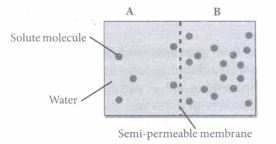
(a) Movement of solvent molecules will take place from chamber A to B.
(b) Movement of solute will take place from A to B.
(c) Presence of a semi-permeable membrane is a prerequisite for this process to occur.
(d) The direction and rate of osmosis depends on both the pressure gradient and concentration gradient
5.
Andre Marie Ampere suggested that a magnet must exert an equal and opposite force on a current carrying conductor, which was experimentally found to be true. But we know that current is due to charges in motion. Thus, it is clear that a charge moving in a magnetic field experience a force, except when it is moving in a direction parallel to it. If the direction of motion is perpendicular to the direction of magnetic field, the magnitude of force experienced depends on the charge, velocity (v), strength of magnetic field (B), and sine of the angle between v and B. Direction of magnetic force is given by Fleming's left hand rule.
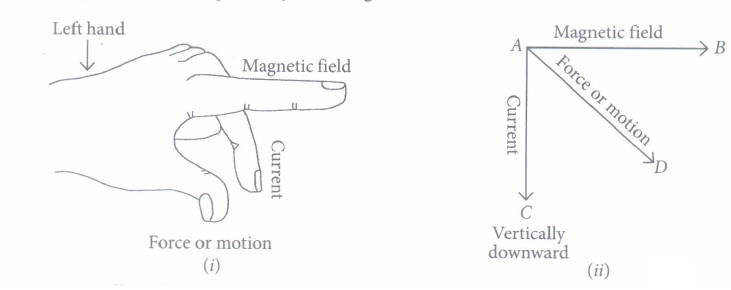
(i) If an electron is travelling horizontally towards east. A magnetic field in vertically downward direction exerts a force on the electron along
| (a) east | (b) west | (c) north | (d) south |
(ii) If a charged particle is moving along a magnetic field line. The magnetic force on the particle is
| (a) along its velocity | (b) opposite to its velocity |
| (c) perpendicular to its velocity | (d) zero |
(iii) A magnetic field exerts no force on
(a) a stationary electric charge
(b) a magnet
(c) an electric charge moving perpendicular to its direction
(d) an unmagnetised iron bar
(iv) A uniform magnetic field exists in the plane of paper pointing from left to right as shown in figure. In the field an electron and a proton move as shown. The electron and the proton experience
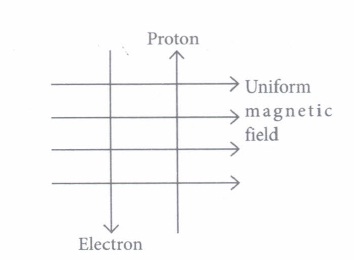
(a) forces both pointing into the plane of paper
(b) forces both pointing out of the plane of paper
(c) forces pointing into the plane of paper and out of the plane of paper, respectively
(d) force pointing opposite and along the direction of the uniform magnetic field respectively
(v) An electron beam enters a magnetic field at right angles to it as shown in the figure. The direction of force acting on the electron beam will be
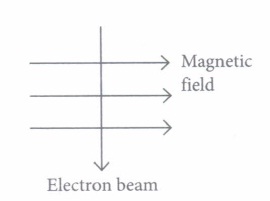
| (a) to the left | (b) to the right | (c) into the page | (d) out of the page |
6.
A lens is a piece of any transparent material bounded by two curved surfaces. There are two types of lenses convex lens and concave lens.
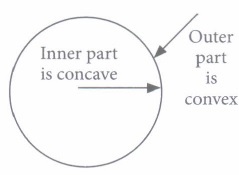
Convex lens is made up of a transparent medium bounded by two spherical surfaces such that thicker at the middle and thinner at the edges. Concave lens is also made up of a transparent medium such that thicker at the edge and thinner at the middle. The mid point of the lens is called optical centre.
A point on the principal axis, where the incident parallel rays meet or appears to come out after refraction is called focus.
A convex lens converges a parallel beam of light to other side whereas concave lens spreads out.
(i) Which of the following lenses would you prefer to use while reading small letters found in dictionary?
(a) A convex lens of focal length 50 cm
(b) A concave lens of focal length 50 cm
(c) A convex lens of focal length 5 cm
(d) A concave lens of focal length 5 cm
(ii) Which type of lenes are shown in given figure (i) and (ii).
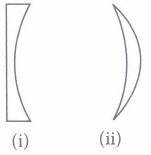
(a) Plano concave, concavo convex
(b) Plano convex, convexo concave
(c) Double concave, concave convex
(d) Convexo concave, double convex
(iii) A small bulb is placed at the focal point of a converging lens. When the bulb is switched on, the lens produces
(a) a convergent beam of light
(b) a divergent beam of light
(c) a parallel beam of light
(d) a patch of coloured light
(iv) The part oflens through which the refraction takes place is called
| (a) aperture | (b) centre of curvature |
| (c) principal axis | (d) focus |
(v) A water drop acts as a
| (a) convex lens | (b) concave lens |
| (c) double concave lens | (d) none of these |
7.
An organic molecule has the following structure:
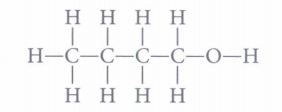
(i) To which homologous series does this molecule belong?
| (a) Aldehydes | (b) Ketones | (c) Alcohols | (d) Alkanes |
(ii) What is the general formula of this homologous series?
| (a) CnH2n+1OH | (b) CnH2n + 2 | (c) C |
(d) CnH2n+1CHO |
(iii) Which is the next member of this series?
| (a) C4H9OH | (b) C3H7OH | (c) C5H11OH | (d) C6H13OH |
(iv) Which is the third member of this series?
| (a) C3H7O H | (b) C4H9OH | (c) C2H5OH | (d) CH3OH |
(v) Which is the second member of this series?
| (a) Ethanol | (b) Methanol | (c) Propanol | (d) Butanol |
8.
As neutral atom carbon has electronic configuration K L. To gain inert gas configuration carbon can either 2, 4 donate 4 valence electrons (helium gas configuration) or gain 4 electrons (neon gas configuration), but it cannot do so. To acquire inert gas configuration carbon can only share its 4 valence electrons with other atoms forming covalent bonds. A covalent bond can be defined as a chemical bond formed between two atoms by mutual sharing of valence electrons so that each atom acquires the stable electronic configuration of the nearest noble gas. The concept of covalent bonds was given by Langmuir and Lewis to explain bonding in non-ionic compounds. The covalent bonds are of three types. If each atom contributes one electron, the covalent bond formed is called a single covalent bond and is represented by a single line (-) and if each atom contributes two electrons, the covalent bond formed is called a double bond and is represented by a double line (=) and if each atom contributes three electrons, the covalent bond formed is called a triple bond and is represented by a triple line (=).
(i) Which of the following do not contain a double bond?
I. S02
II. NH3
III. HCl
IV. 02
| (a) I and II only | (b) II and III only | (c) III and IV only | (d) I and IV only |
(ii) Which of the following contains a triple bond?
| (a) N2 | (b) O2 | (c) CO2 | (d) H2 |
(iii) The shared pair of electrons is said to constitute a _______________ bond between two hydrogen atoms.
| (a) single | (b) double | (c) triple | (d) ionic |
(iv) Which of the following molecules has all its atoms joined together by double covalent bonds?
| (a) Methane | (b) Water | (c) Carbon dioxide | (d) Nitrogen trichloride |
(v) Chlorine forms a diatomic molecule, Cl2 . The electron dot structure for this molecule is
 a.JPG) |
 b.JPG) |
 c JPG.JPG) |
 d.JPG) |
9.
Sex determination is the method by which distinction between males and females is established in a species. The sex of an individual is determined by specific chromosomes. These chromosomes are called sex chromosomes or allosomes. X and Y chromosomes are called sex chromosomes. The normal chromosomes other than the sex chromosomes of an individual are known as autosomes.
(i) In XX-XO type of sex determination
(a) females produce two different types of gametes
(b) males produce two different types of gametes
(c) females produce gametes with Y chromosome
(d) males produce gametes with Y chromosome.
(ii) A couple has six daughters. What is the possibility of their having a girl next time?
| (a) 10% | (b) 50% |
| (c) 90% | (d) 100% |
(iii) Number of autosomes present in liver cells of a human female is
| (a) 22 autosomes | (b) 22 pairs |
| (c) 23 autosomes | (d) 23 pairs. |
(iv) XX-XO type of sex determination and XX-XY type of sex determination are the examples of
| (a) male heterogamety | (b) female heterogamety |
| (c) male homogamety | (d) both (b) and (c). |
(v) Select the incorrect statement.
(a) In male grasshoppers, 50% of sperms have no sex chromosome
(b) Female fruitfly is heterogametic
(c) Human male produces two types of sperms 50% having X chromosome and 50% having Y chromosomes
(d) In turtle, sex determination is regulated by environmental factors.
10.
Although there is no sharp line of distinction between metals and non-metals yet there are some distinctive differences. The main points of differences are:
| Property | Metals | Non-metals |
| Electronic structure | They have 1 to 3 electrons in the outermost shell of their atoms | They have 4 to 8 electrons in the outermost shell of their atoms. |
| State of existence | They are mostly solid at room temperature except mercury and gallium which are liquid. | They are either solids or gases at room temperature (except bromine which is a liquid). |
| Density | They have high density. | They have low density. |
| Nature of ions | They are electropositive elements and hence, lose one or more electrons to form positive ions. | They are electronegative elements and hence, gain one or more electrons to form negative ions. |
| Nature of chlorides | They generally combine with chlorine to form solid ionic chlorides which conduct electricity in the aqueous solution or in the molten state. | They combine with chlorine to form covalen chlorides. These are either gases or liquids. Non-metal chlorides do not contain ions, therefore, they do not conduct electricity. |
| Nature of oxides | They form basic oxides, though some oxides are amphoteric also. | They form acidic or neutral oxides. |
| Displacement of hydrogen from acids | Metals which lie above hydrogen in the reactivity series displace hydrogen from acids. | They do not displace hydrogen from acids. |
(i) Match column-I with column-Il and select the correct option using the given code
| Column-I | Column-II |
| P. A metal that forms amphoteric oxides | (I) Ga |
| Q. A metal which melts when keep on our palm | (II) Au |
| R. A metal that has highest density | (III) Al |
| S. A metal which cannot displace hydrogen from acids | (IV) Os |
| (a) P-(II), Q-(I), R-(lII), S-(lV) | (b) P-(III), Q-(I), R-(IV), S-(lI) |
| (c) P-(lV), Q-(II), R-(lII), S-(I) | (d) P-(lII), Q-(II), R-(I), S-(lV) |
(ii) State True (T) or False (F) for the following statements.
(I) Non-metals react with acids to give a salt and hydrogen gas.
(II) Zinc oxide is amphoteric in nature.
(III) Copper oxide is basic in nature.
(IV) Hydrogen gas is evolved when a metal reacts with dilute acid.
(V) Copper reacts vigorously with dilute HCl.
| (I) | (II) | (III) | (IV) | (V) | |
| (a) | F | F | F | T | T |
| (b) | T | F | T | F | F |
| (c) | F | T | F | F | T |
| (d) | F | T | T | T | F |
(iii) Tick (✓) the correct statements and cross (x) the incorrect statements.
(I) Non-metals are either solids or gases except mercury which is a liquid.
(II) Sodium is a metal and can lose its electrons easily.
(III) Most non-metals produce acidic oxides when dissolved in water. Most metals produce basic oxides on reaction with water.
(IV) Graphite is a conductor of electricity.
| (I) | (II) | (III) | (IV) | |
| (a) | ✓ | メ | ✓ | メ |
| (b) | メ | ✓ | メ | ✓ |
| (c) | メ | ✓ | ✓ | ✓ |
| (d) | メ | ✓ | ✓ | メ |
(iv) An element X (atomic number 12) reacts with another element Y (atomic number 17) to form a compound Z. Which of the following statements are true regarding this compound?
I. Molecular formula of Z is XY2
II. It is soluble in water.
III. X and Yare joined by sharing of electrons.
IV. It would conduct electricity in the molten state.
| (a) II and III only | (b) I and II only | (c) I, III and IV only | (d) I, II and IV only |
(v) Which of the following metals form an amphoteric oxide?
| (a) Zn | (b) Ca | (c) Na | (d) Cu |
11.
Preeti is very fond of gardening. She has different flowering plants in her garden. One day few naughty children entered her garden and plucked many leaves of Bryophyllum plant and threw them here and there in the garden. After few days, Preeti observed that new Bryophyllum plants were coming out from the leaves which fell on the ground.
(i) What does the incidence cited in the paragraph indicate?
(a) Bryophyllum leaves have special buds that germinate to give rise to new plant
(b) Bryophyllum can propagate vegetatively through leaves
(c) Bryophyllum is a flowering plant that reproduces only asexually
(d) Both (a) and (b)
(ii) Which of the following plants can propagate vegetatively through leaves like Bryophyllum?
| (a) Guava | (b) Begonia |
| (c) Ginger | (d) Mint |
(iii) Do you think any other vegetative part of Bryophyllum can help in propagation? If yes, then which part?
| (a) Roots | (b) Stems |
| (c) Flowers | (d) Fruits |
(iv) Which of the following plants is artificially propagated (vegetatively) by stem cuttings in horticultural practices?
| (a) Potato | (b) Snake plant |
| (c) Rose | (d) Water hyacinth |
(v) In which of the following pairs both the plants can be vegetatively propagated by leaf pieces?
| (a) Adiantum and Kalanchoe | (b) Chrysanthemum and Agave |
| (c) Agave and Dioscorea | (d) Bryophyllum and Asparagus |
12.
Acids turn blue litmus red but have no effect on red litmus. Bases turn red litmus blue but have no effect on blue litmus. The sample in which phenolphthalein remains colourless while methyl orange changes to pink/ red are acids while the samples in which phenolphthalein colour changes to pink and methyl orange changes to yellow are bases. Some observations of different sample solutions in litmus, phenolphthalein and methyl orange indicator are given in the table.
| Sample solution | Red litmus solution | Blue litmus solution | Phenolphthalein indicator |
Methyl orange indicator |
| HCI | No colour change | Red | Colourless | Red/ Pink |
| H2 SO4 | No colour change | Red | Colourless | Red/ Pink |
| HNO3 | No colour change | Red | Colourless | Red/ Pink |
| CH3COOH | No colour change | Red | Colourless | Red/ Pink |
| NaOH | Blue | No colour change | Pink | Yellow |
| Ca(OH)2 | Blue | No colour change | Pink | Yellow |
| KOH | Blue | No colour change | Pink | Yellow |
| Mg(OH)2 | Blue | No colour change | Pink | Yellow |
| NH4 OH | Blue | No colour change | Pink (Becomes colourless after sometime) | Yellow (Becomes colourless after sometime) |
(i) Which of the following substances does not turn red litmus solution to blue?
| (a) AI(OH)3 | (b) Mg(OH)2 | (c) H3 PO4 | (d) NH4OH |
(ii) Phenolphthalein's colour in basic medium is ___________but in acid it is ___________ .
| (a) pink, colourless | (b) yellow, pink | (c) pink, orange | (d) blue, red |
(iii) Which of the following acids are edible?
(I) Citric acid
(II) Tartaric acid
(III) Hydrochloric acid
(IV) Carbonic acid.
| (a) (I) and (II) only | (b) (1), (II) and (IV) only | (c) (I), (II) and (III) only | (d) (I), (II), (III) and (IV) |
(iv) The colour of methyl orange in neutral solution is
| (a) red | (b) orange | (c) yellow | (d) purple |
(v) Which of the following cannot act as an indicator?
| (a) Methyl orange | (b) Methyl chloride | (c) Turmeric juice | (d) Phenolphthalein |
13.
Sodium chloride obtained from sea water or from lakes contains many impurities such as sulphates of sodium and magnesium along with chlorides of calcium and magnesium. The chlorides of calcium and magnesium are particularly undesirable on account of their deliquescent nature.
For its purification, common salt is dissolved in minimum quantity of water to get a saturated solution from which insoluble impurities are filtered off. Then hydrogen chloride gas is passed through the saturated solution and the crystals of pure NaCl separate out. The soluble impurities remain in the mother liquor. The crystals are filtered, washed and dried.
(i) Select the correct statement regarding salt NaCl.
| (a) Pure NaCI is hygroscopic in nature |
| (b) It is soluble in alcohol |
| (c) Pure NaCI is not hygroscopic, it shows hygroscopic nature due to impurities |
| (d) It is a brown crystalline solid |
(ii) Nature of aqueous solution of common salt is
| (a) acidic | (b) alkaline | (c) basic | (d) neutral |
(iii) In the given series of reactions, Y and Z respectively are
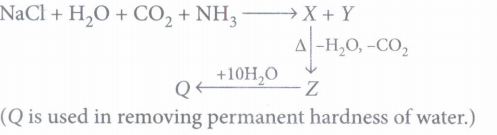 2
2
| (a) NaHCO3 , NaOCl2 | (b) NH4CI, Na2CO3 | (c) Na2CO3 , NH4CI | (d) Na2CO3, NaHCO3 |
(iv) Which of the following compounds is alkaline in aqueous medium?
| (a) Na2CO3 | (b) NaCI | (c) H2CO3 | (d) CuSO4 |
(v) Some statements regarding salt NaCI are given below
(I) It is prepared by chlor-alkali process
(II) It is a white crystalline substance
(III) It also exists in the form of rocks and is called rock salt
(IV) It is a neutral salt, pH value of NaCI is 7
| (a) II and III only | (b) III and IV only | (c) I and IV only | (d) II, III and IV only |
14.
All the elements on the left side and in the middle of the periodic table (except hydrogen) are metallic elements or metals. Also, majority of elements in periodic table are metals. In the modern periodic table, the metals are separated from non-metals by a zig-zag line. Some non-metals are gases, some are liquids and rest are solids at room temperature. They generally differ from metals in appearance and in other physical properties. Some elements that lie along the zig-zag line that separates metals from non-metals, have properties that fall between those of metals and non-metals. These elements are regarded as semi-metals or metalloids.
(i) From the given set of metals and non-metals, identify the non-metals.
\(\mathrm{S}, \mathrm{Mg}, \mathrm{Al}, \mathrm{P}, \mathrm{N}, \mathrm{Na}, \mathrm{K}\)
| (a) S, P, K | (b) Mg, AI, Na |
| (c) S, P, N | (d) S, AI, K |
(ii) Which of the following groups contains metals, non-metals and metalloids?
| (a) Group 1 | (b) Group 17 |
| (c) Group 14 | (d) Group 2 |
(iii) Which of the following elements is a metalloid?
| a) Pb | (b) Sb |
| (c) Bi | (d) Zn |
(iv) Silicon is a metalloid because
(a) its valency is 4
(b) it has three electron shells
(c) it shows properties of both metals and non-metals
(d) it is a liquid metal
(v) The lightest metal is
| (a) Li | (b) Fe |
| (c) Cu | (d) Ag |
15.
In a balanced chemical reaction, equal number of atoms are present on both sides of reaction. A balanced chemical reaction is based on law of conservation of mass which means that total mass of reactants and products participating in a reaction must be equal. For example, a balanced chemical equation of burning of magnesium in oxygen to form magnesium oxide is written as :
\(2 \mathrm{Mg}+\mathrm{O}_{2} \longrightarrow 2 \mathrm{MgO}\)
The mass of reactants (2 x 24 + 32 = 80) is equal to the mass of products [2 x (24 + 16) = 80]
(i) In a reaction, 35 g of reactant, PQ breaks down into 20 g of product, P and an unknown amount of product, Q. Using the law of conservation of mass, weight of products, Q will be
| (a) 25g | (b) 35g | (c) 30g | (d) 15g |
(ii) When solid mercury (II) oxide is heated, liquid mercury and oxygen gas are produced. Which of the following statements is true regarding the balanced chemical equation for this process?
(a) 1 mole of mercury (II) oxide produces two moles of mercury and one mole of oxygen gas
(b) 2 moles of mercury (II) oxide produce one mole of mercury and one mole of oxygen gas
(c) 1 mole of mercury (II) oxide produces half mole of mercury and half mole of oxygen gas
(d) 2 moles of mercury (II) oxide produce 2 moles of mercury and one mole of oxygen gas
(iii) Which of the following laws is satisfied by a balanced chemical equation?
| (a) Law of multiple proportions | (b) Law of conservation of mass |
| (c) Law of conservation of motion | (d) Law of conservation of magnetism |
(iv) In the given chemical reaction
\(\mathrm{C}_{6} \mathrm{H}_{6(l)}+15 \mathrm{O}_{2(g)} \longrightarrow m \mathrm{CO}_{2(g)}+n \mathrm{H}_{2} \mathrm{O}_{(l)}\)
The values of m and n are respectively
| (a) 14 and 8 | (b) 12 and 6 | (c) 8 and 10 | (d) 12 and 10 |
(v) Sulphur dioxide reacts with oxygen to form sulphur trioxide. What would be the molar ratio of sulphur dioxide to sulphur trioxide?
| (a) 2: 3 | (b) 1: 1 | (c) 1: 2 | (d) 3: 2 |
1.
(i) (b)
(ii) (a): Food is transported by vascular tissue phloem from source to sink. Source is a part that synthesise food and sink is a part that stores or needs the food. Since source and sink can be reversed depending on plant's need, therefore direction of movement of sugar in phloem can be bidirectional, i.e., both upwards or downwards.
(iii) (b)
(iv) (c)
2.
(i) (d):In light reaction of photosynthesis assimilatory power is produced, i.e., energy rich ATP molecules and reduced coenzyme NADPH.
(ii) (d): The equation of photosynthesis may be represented as \(6 \mathrm{CO}_{2}+12 \mathrm{H}_{2} \mathrm{O} \rightarrow \mathrm{C}_{6} \mathrm{H}_{12} \mathrm{O}_{6}+6 \mathrm{H}_{2} \mathrm{O}+6 \mathrm{O}_{2}\)
No. of C6H12O6 (sugar) molecules produced =1
(iii) (c)
(iv) (b): Light reactions (or photochemical phase) of photosynthesis mainly occur on the grana thylakoids. Dark reactions (or biosynthetic phase) which involve synthesis of carbohydrates by CO2 fixation, occur inthe stroma (or matrix) of chloroplasts. The chloroplast matrix of higher plants stores starch temporarily in the form of starch granules.
(v) (b): Light reactions are also called photochemical phase whereas dark reactions are also called biochemical phase.
3.
(i) (d)
(ii) (d)
(iii) (b): The epidermal surface of the leaf exhibits a large number of minute openings called stomata. The stomata are bordered by two specialized epidermal cells - the guard cells which in some cases are accompanied by subsidiary cells. The walls of guard cells are unevenly thickened. Each guard cell has thick, inelastic inner wall and thin, elastic outer wall. Stomatal aperture is present in between the guard cells. Guard cells are not always surrounded by accessory cells or subsidiary cells.
(iv) (b)
(v) (a)
4.
(i) (a): Urea solution is more concentrated than the sap present in plant cells, so plant cells lose water to the soil through the process of exosmosis. Loss of water caused plant to die.
(ii) (b)
(iii) (d): Diffusion keeps the cell walls of the internal plant tissues moist. It is a means of spreading of ions and other substances through protoplast. Transpiration or loss of water in vapour form is a diffusion process. Exchange of gases during photosynthesis and respiration between the plant interior and outside air also occurs through diffusion.
(iv) (b)
(v) (b)
5.
(i) (d): Fleming's left hand rule is used to determine the direction of force on electron i.e., in south direction.
(ii) (d): The angle between velocity and magnetic field is zero. Therefore, magnetic force on the particle is zero.
(iii) (a)
(iv) (a): As the direction of current is taken opposite to the direction of motion of electrons, therefore, current from the motion of electron and proton is in the same direction, i.e., from bottom to top. Now, according to Fleming's left hand rule, the electron and the proton experience forces both pointing into the plane of paper.
(v) (c)
6.
(i) (c): Convex lens is used as magnifying glass.
For better performance its focal length should be small.
(ii) (a)
(iii) (c)
(iv) (a): A aperture is the area of the lens available for refraction.
(v) (a): Water droplets behave like a convex lens only as refraction takes place on outer surface.
7.
(i) (c) :Alcohol (-OH).
(ii) (a): Cn H2n+1 OH is the general formula of the homologous series of alcohol.
(iii) (c)
(iv) (a)
(v) (a): Ethanol; C2H5OH is the second member of this series.
8.
(i) (b): Both NH3 and HCI have single bonds.
(ii) (a): N=N
(iii) (a)
(iv) (c): O=C=O
(v) (c): In chlorine molecule, both chlorine atoms contribute one electron and thus share single electron pair to form single covalent bond. As shared pair is shared by both atoms, they acquire inert gas configuration of argon atom in valence shell.

9.
(i) (b) : In XX-XO type and XX-XY type of sex determining mechanisms, males produce two different types of gametes, either with or without X-chromosome (XO type), or some gametes with X-chromosome and some with Y-chromosome (XY type). Such type of sex determination mechanism is designated to be the example of male heterogamety. In both, females are homogametic and produce X type of gametes in both the cases and have XX genotype.
(ii) (b): The possibility of having a girl or boy child is equal i.e., 50%, as 50% male gametes are Y type and 50% are X type. Fusion of egg with X type sperm will produce a girl child.
(iii) (b): In humans, number of autosomes are 2n = 44 or 22 pairs regardless of the sex.
(iv) (a): In XX-XO type and XX-XY type of sex determining mechanisms, males produce two different types of gametes, either with or without X-chromosome (XO type), or some gametes with X-chromosome and some with Y-chromosome (XY type). Such type of sex determination mechanism is designated to be the example of male heterogamety. In both, females are homogametic and produce X type of gametes in both the cases and have XX genotype.
(v) (b): Male fruitfly is heterogametic whereas female fruitfly is homogametic.
10.
(i) (b)
(ii) (d)
(iii) (c)
(iv) (d): An element (X) with atomic number 12 is Mg. Element (Y) with atomic number 17 is Cl. Therefore, compound (Z) will be MgCI2. It is soluble in water. It is an ionic compound and it conducts electricity in the molten state.
(v) (a)
11.
(i) (d): Bryophyllum propagates vegetatively though buds present on the margins of its leaves.
(ii) (b): Begonia propagates vegetatively through its leaves.
(iii) (b): If a broken piece of stem of Bryophyllum is planted in soil, it develops into a new Bryophyllum plant.
(iv) (c): Rose plants are artificially propagated by stem cuttings. A piece of stem having bud is cut and buried in soil. After few days it develops roots and later on grows into new rose plant.
(v) (a)
12.
(i) (c)
(ii) (a)
(iii) (b): Citric and tartaric acid are from organic substances such as lemon and tamarind respectively and they are edible. Hydrochloric acid though formed inside stomach is not edible. Carbonic acid is a mild acid and is edible in the form of soda water.
(iv) (b)
(v) (b)
13.
(i) (c): NaCI is insoluble in alcohol and it is a white crystalline solid. Pure NaCI is not hygroscopic in nature
(ii) (d): Aqueous solution of common salt is neutral in nature.
\(\mathrm{NaCl}+\mathrm{H}_{2} \mathrm{O} \ \ \ \longrightarrow \mathrm{NaOH} \ + \ \ \ \ \ \mathrm{HCl}\)
Strong base Strong acid
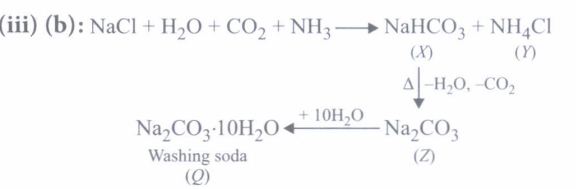
(iv) (a): When Na2CO3 (sodium carbonate) is dissolved in water then it forms alkaline aqueous solution due to the formation of NaOH which is a strong alkali.
(v) (d): Sodium hydroxide (NaOH) is prepared by chlor-alkali process.
14.
(i) (c): S, P,N are non-metals while Mg, AI, K and Na are metals.
(ii) (c): \(\text { Group-14 } \underbrace{C}_{\text {Non-metal }} \underbrace{\text { Si Ge }}_{\text {Metalloids }} \underbrace{\text { Sn } P b}_{\text {Metals }}\)
(iii) (b)
(iv) (c)
(V) (a): Li is the lightest metal.
15.
\(\text { (i) }(\mathbf{d}): P Q \longrightarrow P+Q\)
\(35 \mathrm{~g} \quad \ \ \ 20 \mathrm{~g}+\text { ? }\)
According to law of conservation of mass, Mass of PQ = Mass of P + Mass of Q
\(\therefore\) Mass of Q = (35 - 20)g = 15 g
\({ (ii) \ }(\mathbf{d}): 2 \mathrm{HgO}_{(s)} \longrightarrow 2 \mathrm{Hg}_{(l)}+\mathrm{O}_{2(g)}\)
(iii) (b)
(iv) (b)
(v) (b)

10th Standard CBSE Syllabus & Materials
10th Standard CBSE
CBSE 10th Social Science PS - Federalism - New Model Questions Papers Study Material - QB365 Set A
NEW10th Standard CBSE
CBSE 10th Social Science PS - Power Sharing - New Model Questions Papers Study Material - QB365 Set A
NEW10th Standard CBSE
CBSE 10th Social Science GEO - Manufacturing Industries - New Model Questions Papers Study Material - QB365 Set A
NEW10th Standard CBSE
CBSE 10th Social Science GEO - Minerals and Energy Resources - New Model Questions Papers Study Material - QB365 Set A



NCERT Books

Syllabus

Exam Pattern

Sample Question Papers

Previous year Question Papers

Important Notes

MCQ Practice test

NCERT Exemplers

Case study Questions

Image Based Questions

Passage based Questions

HOT Questions

Value Based Questions

Model Questions Papers
NCERT ( Book Back ) Questions

Assertion and Reason
Important Questions And Answers

CBSE 10th Standard CBSE Subjects
CBSE Standards



