
 100% FREE ACCESS
10th Standard CBSE Syllabus & Materials
10th Standard CBSE
CBSE 10th Social Science ECO - Globalisation and the Indian Economy - New Model Questions Papers Study Material - QB365 Set A
NEW10th Standard CBSE
CBSE 10th Social Science ECO - Money and Credit - New Model Questions Papers Study Material - QB365 Set A
NEW10th Standard CBSE
CBSE 10th Social Science ECO - Sectors of the Indian Economy - New Model Questions Papers Study Material - QB365 Set A
NEW10th Standard CBSE
CBSE 10th Social Science ECO - Development - New Model Questions Papers Study Material - QB365 Set A
NEW10th Standard CBSE
CBSE 10th Social Science PS - Outcomes of Democracy - New Model Questions Papers Study Material - QB365 Set A
NEW10th Standard CBSE
CBSE 10th Social Science PS - Gender, Religion and Caste - New Model Questions Papers Study Material - QB365 Set A

Published on: 26/05/2021
QB365 Provides the updated NCERT Exemplar Questions for Class
10, and also provide the detail solution for each and every NCERT Exemplar questions. NCERT Exemplar questions are latest updated question pattern from NCERT, QB365 will helps to get more marks in Exams
Download CBSE Class 10th Standard CBSE Science question papers, sample papers, important questions, and previous year solved papers in PDF format. Get free study materials, NCERT solutions, and exam preparation resources for Class 10th Standard CBSE Science
Questions + Answers key
Take MCQ Science Test1.
From amongst the metals sodium, calcium, aluminium, copper and magnesium, name the metal.
(i) which reacts with water only on boiling and
(ii) another which does not react even with steam.
2.
(a) Name the chief ore of iron. Write its formula.
(b) How is an iron ore concentrated? Describe it briefly.
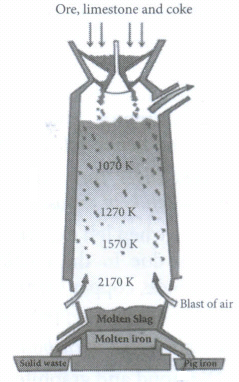
(c) Draw a labelled diagram of the blast furnace used in the extraction of iron from its concentrated ore.
3.
Name a major ore from which iron is extracted. Write chemical equations for the reactions that take place in the blast furnace for the extraction of iron from this ore.
4.
On adding dilute HCl acid to copper oxide powder, the solution formed is blue-green. Predict the new compound formed which imparts a blue-green colour to the solution.
5.
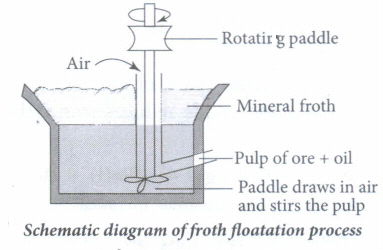
Describe with a labelled diagram, the froth Floatation Process used to separate the gangue from a Sulphide ore.
1.
(i) Magnesium reacts with water only on boiling.
(ii) Copper metal does not react even with steam.
2.
Haematite (Fe2O3) is an important ore of iron.
In the upper part of the blast furnace, carbon monoxide reduces iron (III) oxide to iron metal.
\(\underset { Iron(III)oxide }{ { Fe }_{ 2 }{ O }_{ 3 } } +\underset { Carbonmonoxide }{ 3CO(g) } \rightarrow \underset { Ironmetal }{ 2Fe(I) } +\underset { Carbondioxide }{ { 3CO }_{ 2 }(g) } \)
Following reactions are involved in the blast furnace:
(i) Formation of carbon monoxide
\(\underset { Carbon }{ C(s) } +\underset { Oxygen }{ { O }_{ 2 }(g) } \rightarrow \underset { Carbondioxide }{ { CO }_{ 2 }(g) } +Heat\\ \underset { Carbondioxide }{ { CO }_{ 2 }(g) } +\underset { Coke }{ C(s) } \rightarrow \underset { Carbonmonoxide }{ 2CO(g) } \)
(ii) Reduction of iron (III) oxide or haematite to iron
\(\underset { Iron(III)oxide }{ { Fe }_{ 2 }{ O }_{ 3 } } +\underset { Carbonmonoxide }{ 3CO(g) } \rightarrow \underset { Ironmetal }{ 2Fe(I) } +\underset { Carbondioxide }{ { 3CO }_{ 2 }(g) } \)
3.
Haematite (Fe2O3) is an important ore of iron.
In the upper part of the blast furnace, carbon monoxide reduces iron (III) oxide to iron metal.
\(\underset { Iron(III)oxide }{ { Fe }_{ 2 }{ O }_{ 3 } } +\underset { Carbonmonoxide }{ 3CO(g) } \rightarrow \underset { Ironmetal }{ 2Fe(I) } +\underset { Carbondioxide }{ { 3CO }_{ 2 }(g) } \)
Following reactions are involved in the blast furnace:
(i) Formation of carbon monoxide
\(\underset { Carbon }{ C(s) } +\underset { Oxygen }{ { O }_{ 2 }(g) } \rightarrow \underset { Carbondioxide }{ { CO }_{ 2 }(g) } +Heat\\ \underset { Carbondioxide }{ { CO }_{ 2 }(g) } +\underset { Coke }{ C(s) } \rightarrow \underset { Carbonmonoxide }{ 2CO(g) } \)
(ii) Reduction of iron (III) oxide or haematite to iron
\(\underset { Iron(III)oxide }{ { Fe }_{ 2 }{ O }_{ 3 } } +\underset { Carbonmonoxide }{ 3CO(g) } \rightarrow \underset { Ironmetal }{ 2Fe(I) } +\underset { Carbondioxide }{ { 3CO }_{ 2 }(g) } \)
4.
The name of the compound is cupric chloride which gives blue-green colour to the solution.
\(CuO+2HCI\rightarrow { CuCI }_{ 2 }+{ H }_{ 2 }O\)
5.
The method of froth floatation is applied to remove gangue from sulphide ores. In this process, mineral and gangue particles are separated by first wetting the mineral particles with oil and gangue particles with water, and then the mineral particles are carried out by forming froth. Sometimes, depressants are used for separating two sulphide ores by selectively preventing one ore from forming froth. For example, NaCN is used as a depressant for separating two sulphide ores, ZnS and PbS.

10th Standard CBSE Syllabus & Materials
10th Standard CBSE
CBSE 10th Social Science PS - Federalism - New Model Questions Papers Study Material - QB365 Set A
NEW10th Standard CBSE
CBSE 10th Social Science PS - Power Sharing - New Model Questions Papers Study Material - QB365 Set A
NEW10th Standard CBSE
CBSE 10th Social Science GEO - Manufacturing Industries - New Model Questions Papers Study Material - QB365 Set A
NEW10th Standard CBSE
CBSE 10th Social Science GEO - Minerals and Energy Resources - New Model Questions Papers Study Material - QB365 Set A



NCERT Books

Syllabus

Exam Pattern

Sample Question Papers

Previous year Question Papers

Important Notes

MCQ Practice test

NCERT Exemplers

Case study Questions

Image Based Questions

Passage based Questions

HOT Questions

Value Based Questions

Model Questions Papers
NCERT ( Book Back ) Questions

Assertion and Reason
Important Questions And Answers

CBSE 10th Standard CBSE Subjects
CBSE Standards




