
 100% FREE ACCESS
10th Standard CBSE Syllabus & Materials
10th Standard CBSE
CBSE 10th Social Science ECO - Globalisation and the Indian Economy - New Model Questions Papers Study Material - QB365 Set A
NEW10th Standard CBSE
CBSE 10th Social Science ECO - Money and Credit - New Model Questions Papers Study Material - QB365 Set A
NEW10th Standard CBSE
CBSE 10th Social Science ECO - Sectors of the Indian Economy - New Model Questions Papers Study Material - QB365 Set A
NEW10th Standard CBSE
CBSE 10th Social Science ECO - Development - New Model Questions Papers Study Material - QB365 Set A
NEW10th Standard CBSE
CBSE 10th Social Science PS - Outcomes of Democracy - New Model Questions Papers Study Material - QB365 Set A
NEW10th Standard CBSE
CBSE 10th Social Science PS - Gender, Religion and Caste - New Model Questions Papers Study Material - QB365 Set A

Published on: 26/05/2021
QB365 Provides the updated NCERT Exemplar Questions for Class
10, and also provide the detail solution for each and every NCERT Exemplar questions. NCERT Exemplar questions are latest updated question pattern from NCERT, QB365 will helps to get more marks in Exams
Download CBSE Class 10th Standard CBSE Science question papers, sample papers, important questions, and previous year solved papers in PDF format. Get free study materials, NCERT solutions, and exam preparation resources for Class 10th Standard CBSE Science
Questions + Answers key
Take MCQ Science Test1.
Give the steps involved in the extraction of metals of low and medium reactivity from their respective sulphide ores.
2.
An element A burns with golden flame in air. It reacts with another element B, atomic number 17 to give a product C. An aqueous solution of product C on electrolysis gives a compound D and liberates hydrogen. Identify A, B, C and D. Also write down the equations for the reactions involved.
3.
Of the three metals X, Y and Z, X reacts with cold water, Y with hot water and Z with steam only. Identify X, Y and Z and also arrange them in order of increasing reactivity.
4.
Explain the following
(a) Reactivity of Al decreases if it is dipped in HNO3.
(b) Carbon cannot reduce the oxides of Na or Mg
(c) NaCl is not a conductor of electricity in solid state whereas it does conduct electricity in aqueous solution as well as in molten state.
(d) Iron articles are galvanised
(e) Metals like Na, K, Ca and Mg are never found in their free state in nature.
5.
A non-metal A which is the largest costituent of air, when heated with H2 in 1 : 3 ratio in the presence of catalyst (Fe) gives a gas B. On heating with O2 it gives an oxide C. If this oxide is passed into water in the presence of air it gives an acid D which acts as a strong oxidising agent.
(a) Identify A, B, C and D
(b) To which group of periodic table does this non - metal belong?
1.
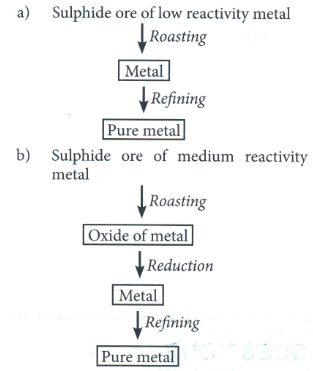
2.
Since the element B belongs to atomic number 17, it must be chlorine.
The element which burns golden flame in air is sodium. Therefore, the element A must be sodium.
When element sodium and chlorine reacts, it forms sodium chloride, the compound C. The compound C on electrolysis gives sodium hydroxide and hydrogen gas.
Thus, A = Na; B = CI2; C = NaCI; D = NaOH.
Chemical Reactions involved:
\(2Na+{ CI }_{ 2 }\rightarrow 2NaCI\)
\(2NaCI(aq)+{ 2H }_{ 2 }O(I)\rightarrow 2NaOH(aq)+{ CI }_{ 2 }(g)+{ H }_{ 2 }(g)\)
3.
Since the metal X react with cold water, it must be high in the reactivity series i.e., sodium or potassium.
X is alkali metal, Na or K.
Since the metal Y reacts with hot water, it must be middle in the reactivity series i.e., magnesium or calcium.
Y is alkaline earth metal, Mg or Ca.
Since the metal X reacts with steam only, it must be low in the reactivity series i.e., iron Z is Fe.
Increasing reactivity series : Na > Mg > Fe.
4.
(a) Due to the formation of a layer of oxide i.e., Al2O3
(b) Na or Mg is more reactive metals as compared to carbon.
(c) In solid NaCI, the movement of ions is not possible due to its rigid structure but in aqueous solution or molten state, the ions can move freely.
(d) To protect from corrosion.
(e) They are highly reactive.
5.
Since the non-metal A is the largest costituent of air, it must be Nitrogen. When nitrogen is heated with hydrogen in the ratio of 1 : 3, it gives ammonia in presence of iron as a catalyst [Haber's process]. When nitrogen is heated with oxygen, it gives nitric oxide. When this oxide is passed through water in presence of air, it gives nitric acid which acts as a strong oxidising agent.
(a) A - N2; B - NH3; C - NO; D - HNO3
(b) Element A belongs to Group - 15 of the Periodic Table.

10th Standard CBSE Syllabus & Materials
10th Standard CBSE
CBSE 10th Social Science PS - Federalism - New Model Questions Papers Study Material - QB365 Set A
NEW10th Standard CBSE
CBSE 10th Social Science PS - Power Sharing - New Model Questions Papers Study Material - QB365 Set A
NEW10th Standard CBSE
CBSE 10th Social Science GEO - Manufacturing Industries - New Model Questions Papers Study Material - QB365 Set A
NEW10th Standard CBSE
CBSE 10th Social Science GEO - Minerals and Energy Resources - New Model Questions Papers Study Material - QB365 Set A



NCERT Books

Syllabus

Exam Pattern

Sample Question Papers

Previous year Question Papers

Important Notes

MCQ Practice test

NCERT Exemplers

Case study Questions

Image Based Questions

Passage based Questions

HOT Questions

Value Based Questions

Model Questions Papers
NCERT ( Book Back ) Questions

Assertion and Reason
Important Questions And Answers

CBSE 10th Standard CBSE Subjects
CBSE Standards




