
 100% FREE ACCESS
10th Standard CBSE Syllabus & Materials
10th Standard CBSE
CBSE 10th Social Science ECO - Globalisation and the Indian Economy - New Model Questions Papers Study Material - QB365 Set A
NEW10th Standard CBSE
CBSE 10th Social Science ECO - Money and Credit - New Model Questions Papers Study Material - QB365 Set A
NEW10th Standard CBSE
CBSE 10th Social Science ECO - Sectors of the Indian Economy - New Model Questions Papers Study Material - QB365 Set A
NEW10th Standard CBSE
CBSE 10th Social Science ECO - Development - New Model Questions Papers Study Material - QB365 Set A
NEW10th Standard CBSE
CBSE 10th Social Science PS - Outcomes of Democracy - New Model Questions Papers Study Material - QB365 Set A
NEW10th Standard CBSE
CBSE 10th Social Science PS - Gender, Religion and Caste - New Model Questions Papers Study Material - QB365 Set A

Published on: 26/05/2021
QB365 Provides the updated NCERT Exemplar Questions for Class
10, and also provide the detail solution for each and every NCERT Exemplar questions. NCERT Exemplar questions are latest updated question pattern from NCERT, QB365 will helps to get more marks in Exams
Download CBSE Class 10th Standard CBSE Science question papers, sample papers, important questions, and previous year solved papers in PDF format. Get free study materials, NCERT solutions, and exam preparation resources for Class 10th Standard CBSE Science
Questions + Answers key
Take MCQ Science Test1.
(a) Name one main ore of Aluminium. Write its formula. Which two main impurities are associated with this ore?
(b) Describe with chemical equations, the method employed for the enrichment of the above named ore.
2.
(a) What is an 'activity series' of metals? Arrange the metals Zn, Mg, Al, Cu and Fe in a decreasing order of reactivity.
(b) What would you observe when you put
(i) Some zinc pieces into blue copper sulphate solution?
(ii) Some copper pieces into green ferrous sulphate solution?
(c) Name a metal which combines with hydrogen gas. Name the compound formed.
3.
(a) What is corrosion of metals? Name one metal which does not corrode and one which corrodes on being kept in atmosphere.
(b) How will you show that the rusting of iron needs oxygen and moisture at the same time?
4.
(a) Write chemical equations for the reactions involved in obtaining pure alumina from the mineral bauxite which has impurities of iron oxide and silica.
(b) Draw a labelled diagram of the electrolytic tank cell used for the extraction of aluminium from alumina.
5.
(i) Why Sulphuric acid is called the 'king of chemicals'?
(ii) Name the gas evolved when :
(a) Concentrated Sulphuric acid acts on Sulphur.
(b) Dilute Sulphuric acid acts on Sodium carbonate.
(iii) State the colour change you would observe on adding concentrated sulphuric acid to :
(a) Blue Copper sulphate crystals.
(b) Colourless cane-sugar crystals.
1.
(a) The main ore of aluminium is bauxite ore. Its formula is A1203.The impurities sociated with this ore are iron oxide and sand. .
(b) The reaction involved in obtaining pure alumina from mineral bauxite having impurities of iron oxide and silica are:
(i) \(\underset { Aluminiumoxide\\ (frombauxiteore) }{ { A1 }_{ 2 }{ O }_{ 3 } } +\underset { Sodiumhydroxide\\ \quad (hot) }{ 2NaOH(aq) } \rightarrow \underset { Sodiumaluminate\\ \quad (Soluble) }{ { 2NaA1O }_{ 2 }(aq) } +\underset { Water }{ { H }_{ 2 }O(1) } \)
The iron oxide and silica (sand) present in the bauxite ore do not dissolve in sodium hydroxide solution. Therefore, they are separated by filtration.
(ii) \(\underset { Sodiumaluminate }{ { NaA1O }_{ 2 }(aq) } +\underset { Water }{ { 2H }_{ 2 }O(1) } \rightarrow \underset { Aluminiumhydroxide\\ \quad (Whiteppt) }{ { A1(OH) }_{ 3 }(s) } +\underset { Sodiumhydroxide }{ NaOH(aq) } \)
(iii) \(\underset { Aluminiumhydroxide }{ { 2A1(OH) }_{ 3 }(s) } \underrightarrow { heat } \underset { Aluminiumoxide\\ \quad (Pure) }{ { A1 }_{ 2 }{ O }_{ 3 }(s) } +\underset { Steam }{ { 3H }_{ 2 }O(g) } \)
2.
(a) The arrangement of metals in a vertical column in the order of decreasing reactivity is called the 'activity series' of metals.
Following is the order of decreasing order of reactivity:
Cu> Fe> Zn> AI> Mg
(b) (i) When some zinc is put into blue copper sulphate solution, the blue colour of the copper sulphate solution fades gradually due to the formation of colourless zinc sulphate and red-brown copper metal is deposited on the zinc strip.
\(\underset { Coppersulphate\\ \quad (blue) }{ { CuSO }_{ 4 }(aq) } +\underset { Zinc }{ Zn } \rightarrow \underset { Zincsulphate\\ (Colourless) }{ { ZnSO }_{ 4 }(aq) } +\underset { \quad Copper\\ (Red-brown) }{ Cu(s) } \)
(ii) No reaction will take place since copper is less reactive than iron and hence will not displace it from ferrous sulphate solution.
(c) Sodium metal combines with hydrogen gas to form sodium hydride.
\(\underset { Sodiummetal }{ 2Na(s) } +\underset { Hydrogengas }{ { H }_{ 2 }(g) } \rightarrow \underset { Sodiumhydride }{ 2NaH(s) } \)
3.
(a) The eating up of metals by the action of air and moisture on their surface is called corrosion.
(i) Metal which does not corrode on being kept in the atmosphere is gold.
(ii) Metal which corrodes on being kept in the atmosphere is iron.
(b) Take three boiling tubes and label them as A, B, and C. Place clean iron nails, free from rust, in each tube. Add water to tube A in such a manner that some parts of the nails are exposed to air and seal it with the help of a rubber cork. Add boiled water to tube B in such a way that the nails are completely submerged. Then, pour some amount of kerosene oil in the tube and seal it with the help of a rubber cork. Add anhydrous calcium chloride to tube C and then seal it. Leave the tubes undisturbed for two weeks and observe the changes.
4.
(a) The reaction involved in obtaining pure alumina from the mineral bauxite having impurities of iron oxide and silica is:
(i) \(\underset { Aluminiumoxide\\ (frombauxiteore) }{ { AI }_{ 2 }{ O }_{ 3 }(s) } +\underset { Sodiumhydroxide\\ \quad (hot) }{ 2NaOH(aq) } \rightarrow \underset { Sodiumaluminate\\ \quad (Soluble) }{ { 2NaAIO }_{ 2 }(aq) } +\underset { Water }{ { H }_{ 2 }O(I) } \)
The iron oxide and silica (sand) present in the bauxite ore do not dissolve in sodium hydroxide solution. Therefore, they are separated by filtration.
(ii) \(\underset { Sodiumaluminate }{ { NaAIO }_{ 2 }(aq) } +\underset { Water }{ { 2H }_{ 2 }O(I) } \rightarrow \underset { Aluminiumhydroxide\\ \quad (Whiteppt) }{ { AI(OH) }_{ 3 }(s) } +\underset { Sodiumhydroxide }{ NaOH(aq) } \)
(iii) \(\underset { Aluminiumhydroxide }{ { 2AI(OH) }_{ 3 }(s) } \underrightarrow { heat } \underset { Aluminiumoxide\\ \quad (Pure) }{ { AI }_{ 2 }{ O }_{ 3 }(s) } +\underset { Steam }{ { 3H }_{ 2 }O(g) } \)
(b)
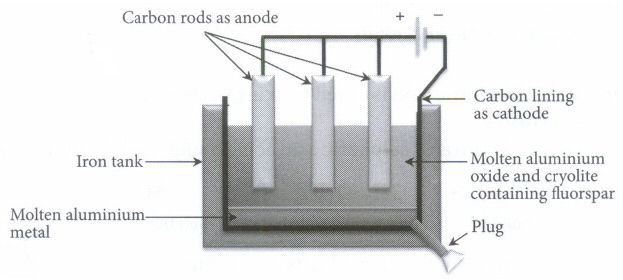
5.
(i) Concentrated sulphuric acid is called the king of chemicals as it is a very strong acid and is highly corrosive.
(ii) (a) When concentrated sulphuric acid acts on sulphur, sulphur dioxide gas is evolved.
\(\underset { Suphur }{ S(s) } +\underset { Suphuricacid(conc.) }{ { 2H }_{ 2 }{ SO }_{ 4 }(I) } \underrightarrow { \Delta } \underset { Sulphurdioxide }{ { 3SO }_{ 2 }(g) } +\underset { Water }{ { 2H }_{ 2 }O(I) } \)
(b) When dilute sulphuric acid acts on sodium carbonate, carbon dioxide gas is evolved.
\(\underset { Sodiumcarbonate }{ { Na }_{ 2 }{ CO }_{ 3 }(g) } +\underset { Sulphuricacid }{ { H }_{ 2 }{ SO }_{ 4 }(aq) } \rightarrow \underset { Sodiumsulphate }{ { Na }_{ 2 }{ SO }_{ 4 }(aq) } +\underset { Carbondioxide }{ { CO }_{ 2 }(g) } +\underset { Water }{ { H }_{ 2 }O(I) } \)
(iii) (a) When concentrated sulphuric acid is added to blue copper sulphate crystals, white coloured anhydrous copper sulphate is formed.
\(\underset { Copper(II)sulphatepentahydrate\\ \quad \quad (BlueCrystal) }{ { CuSO }_{ 4 }.{ 5H }_{ 2 }O } \overset { { conc.H }_{ 2 }{ SO }_{ 4 } }{ \underset { { -5H }_{ 2 }O }{ \longrightarrow } } \underset { Anhydrouscopper(II)sulphate\\ \quad \quad (Whitepowder) }{ { CuSO }_{ 4 } } \)
(b) When concentrated sulphuric acid is added to colourless cane sugar crystals, it dehydrates sugar to a black mass of carbon known as sugar charcoal.
\(\underset { Sugar\\ (White) }{ { C }_{ 12 }{ H }_{ 22 }{ O }_{ 11 } } \overset { { conc.H }_{ 2 }{ SO }_{ 4 } }{ \underset { { -11H }_{ 2 }O }{ \longrightarrow } } \underset { Carbon\\ (Black) }{ 12C } \)

10th Standard CBSE Syllabus & Materials
10th Standard CBSE
CBSE 10th Social Science PS - Federalism - New Model Questions Papers Study Material - QB365 Set A
NEW10th Standard CBSE
CBSE 10th Social Science PS - Power Sharing - New Model Questions Papers Study Material - QB365 Set A
NEW10th Standard CBSE
CBSE 10th Social Science GEO - Manufacturing Industries - New Model Questions Papers Study Material - QB365 Set A
NEW10th Standard CBSE
CBSE 10th Social Science GEO - Minerals and Energy Resources - New Model Questions Papers Study Material - QB365 Set A



NCERT Books

Syllabus

Exam Pattern

Sample Question Papers

Previous year Question Papers

Important Notes

MCQ Practice test

NCERT Exemplers

Case study Questions

Image Based Questions

Passage based Questions

HOT Questions

Value Based Questions

Model Questions Papers
NCERT ( Book Back ) Questions

Assertion and Reason
Important Questions And Answers

CBSE 10th Standard CBSE Subjects
CBSE Standards




