
 100% FREE ACCESS
10th Standard CBSE Syllabus & Materials
10th Standard CBSE
CBSE 10th Social Science ECO - Globalisation and the Indian Economy - New Model Questions Papers Study Material - QB365 Set A
NEW10th Standard CBSE
CBSE 10th Social Science ECO - Money and Credit - New Model Questions Papers Study Material - QB365 Set A
NEW10th Standard CBSE
CBSE 10th Social Science ECO - Sectors of the Indian Economy - New Model Questions Papers Study Material - QB365 Set A
NEW10th Standard CBSE
CBSE 10th Social Science ECO - Development - New Model Questions Papers Study Material - QB365 Set A
NEW10th Standard CBSE
CBSE 10th Social Science PS - Outcomes of Democracy - New Model Questions Papers Study Material - QB365 Set A
NEW10th Standard CBSE
CBSE 10th Social Science PS - Gender, Religion and Caste - New Model Questions Papers Study Material - QB365 Set A

Published on: 25/05/2021
QB365 Provides the updated NCERT Exemplar Questions for Class
10, and also provide the detail solution for each and every NCERT Exemplar questions. NCERT Exemplar questions are latest updated question pattern from NCERT, QB365 will helps to get more marks in Exams
Download CBSE Class 10th Standard CBSE Science question papers, sample papers, important questions, and previous year solved papers in PDF format. Get free study materials, NCERT solutions, and exam preparation resources for Class 10th Standard CBSE Science
Questions + Answers key
Take MCQ Science Test1.
What are fossils? What do they tell about the process of evolution?
2.
An atom has electronic configuration 2, 8, 7.
(a) What is the atomic number of this element?
(b) To which of the following elements would it be chemically similar? (Atomic numbers are given in parentheses.)
N(7) F(9) P(15) Ar(18)
3.
What are 'mineral' and 'ore'?
4.
Give reasons for the following:
(a) Metals can be given different shapes according to our needs.
(B) Hydrogen is not evolved when a metal reacts with nitric acid.
5.
Give reasons for the following :
(i) Metals are regarded as electro-positive elements
(ii) When a piece of copper metal is added to a solution of zinc sulphate, no change takes place, but the blue colour of copper sulphate fades away when a piece of zinc is placed in its solution.
(iii) Articles made of alimunium do not corrode even though aluminium is an active metal.
6.
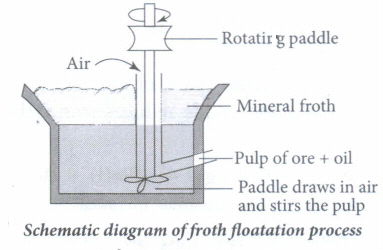
Describe with a labelled diagram, the froth Floatation Process used to separate the gangue from a Sulphide ore.
7.
A coil of insulated copper wire is connected to a galvanometer. What will happen if a bar magnet is
(i) Pushed into the coil
(ii) Withdrawn from inside the coil
(iii) Held stationary inside the coil
8.
State whether the following statements are true or false.
(a) The field at the centre of a long circular coil carrying current will be parallel straight lines.
(b) A wire with a green insulation is usually the live wire of an electric supply.
9.
What are tropic movements?
10.
Five solutions A, B, C, D and E when tested with universal indicator showed pH as 4, 1, 11, 7 and 9 respectively. Which solution is ?
(i) neutral
(ii) strongly alkaline
(iii) strongly acidic
(iv) weakly acidic
(v) weakly alkaline
Arrange the pH in increasing order of H+ion concentration.
1.
The remains (or impressions) of dead animals or plants, that lived in the remote past, are known as fossils.
(a) Fossils provide evidence for evolution, e.g.r a fossil called Archaeopteryx had feathered wings like birds but teeth and tail like reptiles hence suggesting that birds and reptiles had a common ancestor.
(b) Fossils provide direct evidence of past life and thus provide convincing proof of organic evolution.
2.
(a) The atomic number of element is 17.
(b) It belongs chemically to F(9) because the electronic configuration of F is 2,7 and having same valence electrons.
3.
Mineral :
It is a naturally occurring substance which contains elements or compounds.
Ores :
Those minerals which contain a very large percentage of a particular metal and the metal can be extracted economically are called ores.
4.
(a) Metals are malleable and ductile i.e. it can be drawn into sheets and wires, it does not break due to high tensile strength and therefore it can be used for our needs.
(b) Nitric acid is strong oxidising agent, when metals react with nitric acid it does not release H2 gas as oxidise it to form H2 O.
5.
(i) Metals are regarded as electropositive elements because they lose electrons to form metal cations.
(ii) When a piece of copper metal is added to .a solution of zinc sulphate, no change takes place since copper is less reactive than zinc and hence will not displace it from zinc sulphate solution. When some zinc is put into blue copper sulphate solution, the blue colour of the copper sulphate solution fades gradually due to the formation of colourless zinc sulphate and red-brown copper metal is deposited on the zinc strip. The reaction takes place as zinc is more reactive than copper.
\(\underset { Copersulphate\\ \quad (Blue) }{ { CuSO }_{ 4 }(aq) } +\underset { Zinc }{ Zn } \rightarrow \underset { ZincSulphate\\ (Colourless) }{ { ZnSO }_{ 4 }(aq) } +\underset { Copper\\ (Red-brown) }{ Cu(s) } \)
(iii) Articles made of aluminium do not corrode even though aluminium is an active metal as a protective layer of aluminium oxide is formed over the aluminium metal.
6.
The method of froth floatation is applied to remove gangue from sulphide ores. In this process, mineral and gangue particles are separated by first wetting the mineral particles with oil and gangue particles with water, and then the mineral particles are carried out by forming froth. Sometimes, depressants are used for separating two sulphide ores by selectively preventing one ore from forming froth. For example, NaCN is used as a depressant for separating two sulphide ores, ZnS and PbS.
7.
(i) When the bar magnet is pushed into the coil, the galvanometer needle would show deflection.
(ii) Withdrawn from the coil, the galvanometer needle would show deflection.
(iii) When the bar magnet is kept stationary inside the coil, when the bar magnet galvanometer needle would show no deflection.
8.
(i) True
(ii) False, the wire with green insulation is the earth wire not the live wire.
9.
Tropic movements are directional movements which are either towards the stimuli or away from it.
(i) Phototropism: Movement is in response to light: stem positive, root negative.
(ii) Geotropism: Movement is in response to gravity: stem negative, root positive.
(iii) Hydrotropism: Movement in response to water: stem negative, root positive.
(iv) Chemotropism: Growth of pollen tubes towards ovules.
For example, the shoot usually grows in the direction of sunlight. This is called positive phototropic movement.
10.
| Solution | A | B | C | D | E |
| pH Value | 4 | 1 | 11 | 7 | 9 |
| (i) D | (ii) C | (iii) B | (iv) A | (v) E |
pH in increasing order of H+ion concentration is C < E < D < A < B

10th Standard CBSE Syllabus & Materials
10th Standard CBSE
CBSE 10th Social Science PS - Federalism - New Model Questions Papers Study Material - QB365 Set A
NEW10th Standard CBSE
CBSE 10th Social Science PS - Power Sharing - New Model Questions Papers Study Material - QB365 Set A
NEW10th Standard CBSE
CBSE 10th Social Science GEO - Manufacturing Industries - New Model Questions Papers Study Material - QB365 Set A
NEW10th Standard CBSE
CBSE 10th Social Science GEO - Minerals and Energy Resources - New Model Questions Papers Study Material - QB365 Set A



NCERT Books

Syllabus

Exam Pattern

Sample Question Papers

Previous year Question Papers

Important Notes

MCQ Practice test

NCERT Exemplers

Case study Questions

Image Based Questions

Passage based Questions

HOT Questions

Value Based Questions

Model Questions Papers
NCERT ( Book Back ) Questions

Assertion and Reason
Important Questions And Answers

CBSE 10th Standard CBSE Subjects
CBSE Standards




