
 100% FREE ACCESS
10th Standard CBSE Syllabus & Materials
10th Standard CBSE
CBSE 10th Social Science ECO - Globalisation and the Indian Economy - New Model Questions Papers Study Material - QB365 Set A
NEW10th Standard CBSE
CBSE 10th Social Science ECO - Money and Credit - New Model Questions Papers Study Material - QB365 Set A
NEW10th Standard CBSE
CBSE 10th Social Science ECO - Sectors of the Indian Economy - New Model Questions Papers Study Material - QB365 Set A
NEW10th Standard CBSE
CBSE 10th Social Science ECO - Development - New Model Questions Papers Study Material - QB365 Set A
NEW10th Standard CBSE
CBSE 10th Social Science PS - Outcomes of Democracy - New Model Questions Papers Study Material - QB365 Set A
NEW10th Standard CBSE
CBSE 10th Social Science PS - Gender, Religion and Caste - New Model Questions Papers Study Material - QB365 Set A

Published on: 25/05/2021
QB365 Provides the updated NCERT Exemplar Questions for Class
10, and also provide the detail solution for each and every NCERT Exemplar questions. NCERT Exemplar questions are latest updated question pattern from NCERT, QB365 will helps to get more marks in Exams
Download CBSE Class 10th Standard CBSE Science question papers, sample papers, important questions, and previous year solved papers in PDF format. Get free study materials, NCERT solutions, and exam preparation resources for Class 10th Standard CBSE Science
Questions + Answers key
Take MCQ Science Test1.
Look at the below figure and answer the following questions:
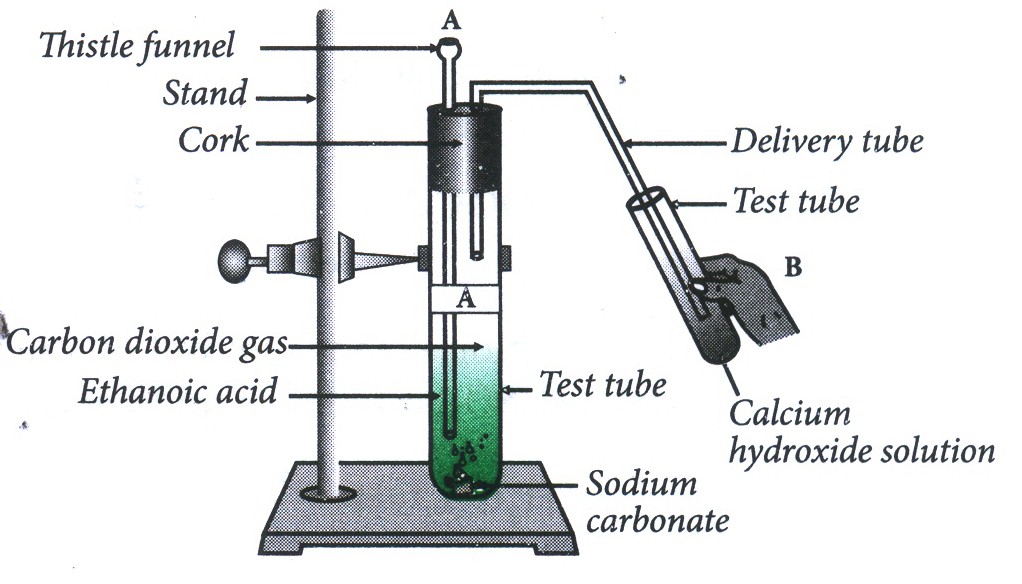
a) What change would you observe in the calcium hydroxide solution taken in tube B?
b) Write the reaction involved in test tubes A and B respectively.
c) If ethanol is given instead of ethanoic acid, would you expect the same change?
d) How can a solution of lime water be prepared in the laboratory?
2.
(a) Define focal length of a divergent lens.
(b) A divergent lens of focal length 30 cm forms the image of an object of size 6 cm on the same side as the object at a distance of 15 cm from its optical centre. Use lens formula to determine the distance of the object from the lens and the size of the image formed.
(c) Draw a ray diagram to show the formation of image in the above situation.
3.
(a) Why did Mendel choose garden pea for his experiment? Write two reasons.
(b) List two contrasting visible characters of garden pea Mendel used for his experiment.
(c) Explain in brief how Mendel interpreted his results to show that the traits may be dominant or recessive.
4.
All the human races like Africans, Asians, Europeans, Americans and others might have evolved from a common ancestor. Provide a few evidences in support of this view.
5.
Describe sexually transmitted diseases and mention the ways to prevent them.
6.
a) What are hydrocarbons? Give examples
b) Give the structural differences between saturated and unsaturated hydrocarbons with two example each.
c) What is a functional group? Give example of four different functional groups.
7.
(i) Why Sulphuric acid is called the 'king of chemicals'?
(ii) Name the gas evolved when :
(a) Concentrated Sulphuric acid acts on Sulphur.
(b) Dilute Sulphuric acid acts on Sodium carbonate.
(iii) State the colour change you would observe on adding concentrated sulphuric acid to :
(a) Blue Copper sulphate crystals.
(b) Colourless cane-sugar crystals.
8.
A non-metal A which is the largest costituent of air, when heated with H2 in 1 : 3 ratio in the presence of catalyst (Fe) gives a gas B. On heating with O2 it gives an oxide C. If this oxide is passed into water in the presence of air it gives an acid D which acts as a strong oxidising agent.
(a) Identify A, B, C and D
(b) To which group of periodic table does this non - metal belong?
9.
Explain the process of breathing in man.
10.
How does a solenoid behave like a magnet? Can you determine the north and South poles of a current-carrying solenoid with the help of a bar magnet? Explain.
11.
What are reflex actions? Give two examples. Explain a reflex arc.
12.
For making cake, baking powder is taken. If at home your mother uses baking soda instead of baking powder in cake,
(a) How will it affect the taste of the cake and why?
(b) How can baking soda be converted into baking powder?
(c) What is the role of tartaric acid added to baking soda?
13.
An element A which is a yellow solid at room temperature shows catenation and allotropy. A forms two oxides which are also formed during the thermal decomposition of ferrous sulphate crystals and are the major air pollutants.
(a) Identify the element A
(b) Write the electronic configuration of A
(c) Write the balanced chemical equation for the thermal decomposition of ferrous sulphate crystals?
(d) What would be the nature (acidic/ basic ) of oxides formed?
(e) Locate the Position of the element in the Modern Periodic Table.
14.
In the Modern Periodic Table, calcium (atomic number 20) is surrounded by elements with atomic numbers 12, 19, 21 and 38. Which of these have physical and chemical properties resembling calcium?
15.
(a) What property do all elements in the same column of the Periodic Table as boron have in common?
(b) What property do all elements in the same column of the Periodic Table as fluorine have in common?
1.
a) When carbon dioxide is passed through the calcium hydroxide solution, it turns milky due to the formation of insoluble calcium carbonate.
b) Reaction in Test tube A:
\(\underset{Acetic\ or\ ethnoic\ acid}{2CH_3COOH(1)}+\underset{Sodium\ carbonate}{Na_2CO_3(s)}\rightarrow\underset{Sodium\ acetate}{2CH_3COONa}+\underset{Water}{H_2O}+\underset{Carbon\ ioxide}{CO_2(g)}\)
Reaction in Test tube B:
\(\underset{Calciumhydroxide\\ (Lime\ water)}{Ca(OH)_2(aq)}+\underset{Carbondioxide}{CO_2(g)}\rightarrow\underset{Calcium\ carbonate\\ (White\ ppt)}{CaCO_3(s)\downarrow}\underset{Water}{H_2O}\)
c) No with ethanol no reaction takes place.
d) When a quick lime i.e., calcium oxide is added to water in a test tube, it forms calcium hydroxide which is lime water. This solution is filtered and the clear solution is obtained
\(CaO(s)+H_2O(l)\rightarrow Ca(OH)_2\)
2.
(a) (i) The principal focus of a diverging lens is a point on its principal axis from which light rays, originally parallel to the axis appear to diverge after passing through the diverging (concave) lens.
(ii) The distance between pole and principal focus of a diverging lens is called the focal length in the given diagram OF is the focal length.
-S.png)
(b) Divergent lens (Concave lens) Focal length, f = -30 cm
Size of the object, h1 = 6 cm
Image distance, v = -15 cm
Object distance, u = ?
Size of the image, h2 = ?
According to the lens formula,
\(\frac { 1 }{ f } =\frac { 1 }{ v } +\frac { 1 }{ u } \)
\(\frac { 1 }{ -30 } =\frac { -1 }{ -15 } +\frac { 1 }{ u } \)
\(\Rightarrow \frac { 1 }{ u } =\frac { -1 }{ 15 } +\frac { 1 }{ 30 } =\frac { -2+1 }{ 30 } =\frac { -1 }{ 30 } \)
u=-30cm
\(\frac { { h }_{ 2 } }{ { h }_{ 1 } } =\frac { v }{ u } \)
\(\Rightarrow \frac { { h }_{ 2 } }{ 6 } =\frac { -15 }{ -30 } \)
\(\Rightarrow { h }_{ 2 }=\frac { 15 }{ 30 } \times 6=+3cm\)
-S.png)
3.
(a) Mendel choose garden pea for his experiment because pea plants was self fertilising and have short life cycle.
(b) Mendel performed experiments on a garden pea (Pisumsativum) with different visible contrasting characters. He selected seven contrasting pairs of characters such as tall / short plants, purple / white flower colour etc.
(c) Mendel performed his experiment on tall and dwarf plant and interpreted his results to show that the traits may be dominant or recessive. Parent plants: True breeding tall pea plant was crossed with true breeding dwarf pea plant. Production of F1 plants: All F1 plants were found to be tall. Results of self-pollination ofF1 plants or F2plants: Mendel found that on self-pollination of F1 plants, the progenies obtained in F2 generations were not all tall plants. Instead, one- fourth of F2plants were found to be dwarf.
Mendel's explanation for the reappearance of the short trait: From this experiment, Mendel concluded that the F1 tall plants were not true breeding. They were carrying
both the traits. They appeared tall, because the tall trait was dominant over the dwarf trait.
4.
DNA sequences are used for studying human evolution. There is no biological basis to the idea of human races. All human beings are a single species but there is a great diversity of human forms and features across the earth. The earliest members of human species Homo sapiens are traced from Africa.
The evidences in support are as follows:
1.Common body plan, structure, physiology and metabolism.
2.Constant chromosome number
3. Common genetic blue print
4. Free inter-breeding
5.
A disease which can be transmitted through sexual contact is called sexually transmitted disease or STD. Lack of hygiene is usually a major factor in providing conditions for spread of STDs. But unprotected sex with multiple and unknown partners is the biggest reason for the spread of STDs. Some of the ways to prevents STDs are as follows
(a) Being faithful to one's life partner
(b) Avoiding sexual contact with unknown person.
(c) Using condom during sexual intercourse
(d) Maintain personal hygiene.
6.
a) Compounds of carbon and hydrogen only are called hydrocarbons. For example
methane (CH4), ethane (C2H6), ethene (C2H4), ethyne (C2H2), cydohexane
(C6H12), benzene (C6H6) etc.
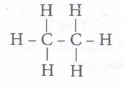
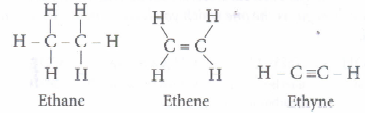
b) Saturated hydrocarbons contains only C - C and C - H single covalent bonds while
unsaturated hydrocarbons contain at least one C = C double bond (besides C - C
and C - H single covalent bonds) or one triple bond.
c) That portion of the organic molecule which largely determine its chemical properties is called the functional group. For example, -OH (alcoholic group),  (keto group) - CHO (aldehyde group), -COOH (carboxyl group).
7.
(i) Concentrated sulphuric acid is called the king of chemicals as it is a very strong acid and is highly corrosive.
(ii) (a) When concentrated sulphuric acid acts on sulphur, sulphur dioxide gas is evolved.
\(\underset { Suphur }{ S(s) } +\underset { Suphuricacid(conc.) }{ { 2H }_{ 2 }{ SO }_{ 4 }(I) } \underrightarrow { \Delta } \underset { Sulphurdioxide }{ { 3SO }_{ 2 }(g) } +\underset { Water }{ { 2H }_{ 2 }O(I) } \)
(b) When dilute sulphuric acid acts on sodium carbonate, carbon dioxide gas is evolved.
\(\underset { Sodiumcarbonate }{ { Na }_{ 2 }{ CO }_{ 3 }(g) } +\underset { Sulphuricacid }{ { H }_{ 2 }{ SO }_{ 4 }(aq) } \rightarrow \underset { Sodiumsulphate }{ { Na }_{ 2 }{ SO }_{ 4 }(aq) } +\underset { Carbondioxide }{ { CO }_{ 2 }(g) } +\underset { Water }{ { H }_{ 2 }O(I) } \)
(iii) (a) When concentrated sulphuric acid is added to blue copper sulphate crystals, white coloured anhydrous copper sulphate is formed.
\(\underset { Copper(II)sulphatepentahydrate\\ \quad \quad (BlueCrystal) }{ { CuSO }_{ 4 }.{ 5H }_{ 2 }O } \overset { { conc.H }_{ 2 }{ SO }_{ 4 } }{ \underset { { -5H }_{ 2 }O }{ \longrightarrow } } \underset { Anhydrouscopper(II)sulphate\\ \quad \quad (Whitepowder) }{ { CuSO }_{ 4 } } \)
(b) When concentrated sulphuric acid is added to colourless cane sugar crystals, it dehydrates sugar to a black mass of carbon known as sugar charcoal.
\(\underset { Sugar\\ (White) }{ { C }_{ 12 }{ H }_{ 22 }{ O }_{ 11 } } \overset { { conc.H }_{ 2 }{ SO }_{ 4 } }{ \underset { { -11H }_{ 2 }O }{ \longrightarrow } } \underset { Carbon\\ (Black) }{ 12C } \)
8.
Since the non-metal A is the largest costituent of air, it must be Nitrogen. When nitrogen is heated with hydrogen in the ratio of 1 : 3, it gives ammonia in presence of iron as a catalyst [Haber's process]. When nitrogen is heated with oxygen, it gives nitric oxide. When this oxide is passed through water in presence of air, it gives nitric acid which acts as a strong oxidising agent.
(a) A - N2; B - NH3; C - NO; D - HNO3
(b) Element A belongs to Group - 15 of the Periodic Table.
9.
The mechanism of exchange of gases takes place between the blood and body tissues during respiration. The air enters the lungs through nostrils. As the blood passes
through the body tissues, the oxygen present in it diffuses into the cells due to its higher concentration in the blood. A red pigment called haemoglobin in the blood carries the oxygen. This oxygen combines with the digested food to release energy, which takes place in mitochondria of the cells. The carbon dioxide produced during the respiration diffuses into the blood stream from where it is carried to lungs and expelled out. The blood which comes from the lungs has a higher concentration of oxygen but the body tissues have a higher concentration of carbon dioxide. Due to the difference in the concentrations, the exchange of gases between the blood and the body tissues takes place. Thus, in this way the process of gaseous exchange is completed in the human respiratory system. The total area for gaseous exchange provided by 300 million alveoli in 2 IU,ngsis 400-800 square feet.
10.
A solenoid behaves like a magnet when electric current flows through it. Any current carrying conductor creates a magnetic field around it. For determining the different poles of a solenoid, we can use a bar magnet and look for interaction between different poles of a solenoid, we can use a bar magnet and look for interaction between different poles of two magnets. If the north pole of the bar magnet gets repulsed by a particular pole of the electromagnet (solenoid) then it gets confirmed that the bar by a particular pole of the electromagnet (solenoid) then it gets confirmed that the bar magnet was brought near the north pole of the electromagnet.
11.
Reflex action is a special case of involuntary movement involuntary organs. When a voluntary organ is in the vicinity of a sudden danger, it is immediately pulled away from the danger to save itself. For example; when your hand touches a very hot electric iron, you move away your hand in a jerk. All of this happens in flash and your hand is saved from the imminent injury. This is an example of reflex action.
Reflex Arc: The path through which nerves signals; involved in a reflex action; travel is called the reflex arc. The following flow chart shows the flow of signal in a reflex arc. Receptor \(\rightarrow\) Sensory Neuron\(\rightarrow\) Relayneuron \(\rightarrow\) Motor neuron \(\rightarrow\) Effector (muscle) The receptor is the organ which comes in the danger zone. The sensory neurons pick signals from the receptor and send them to the relay neuron. The relay neuron is present in the spinal cord. The spinal cord sends signals to the effector via the motor neuron. The effector comes in action moves the receptor away from the danger.
12.
(a) Baking soda is sodium hydrogen carbonate. On heating, it is converted carbonate. On heating, it is converted into sodium carbonate which is bitter to taste.
\(2NaHCO_3\xrightarrow{Heat}Na_2CO_3+H_2O+CO_2\)
(b) Baking soda can be converted into baking powder by the addition of appropriate acid to it.
(c) The role of tartaric acid is to neutralise sodium carbonate and cake will not taste bitter.
13.
(a) The element A which is a yellow solid at room temperature and shows catenation and allotropy is sulphur (S).
(b) The atomic number of sulphur is 16. Therefore, its electronic configuration is 2, 8, 6.
(c) \(\underset { Ferroussulphate }{ { 2FeSO }_{ 4 } } \underrightarrow { Heat } \underset { Ferricoxide }{ { Fe }_{ 2 }{ O }_{ 3 } } +\underset { Sulphurdioxide }{ { SO }_{ 2 } } +\underset { Sulphurtrioxide }{ { SO }_{ 3 } } \)
Both SO2 and SO3 are major air pollutions.
(d) Since sulphur is a non-metal, therefore both S02 and S03 are acidic oxide since they dissolve in water to form the corresponding acids.
\(\underset { Sulphurdioxide }{ { SO }_{ 2 } } +\underset { Water }{ { H }_{ 2 }O } \rightarrow \underset { Sulphurousacid }{ { H }_{ 2 }{ SO }_{ 3 } } \\ \underset { Ferroustrioxide }{ { SO }_{ 3 } } +\underset { Water }{ { H }_{ 2 }O } \rightarrow \underset { Sulphuricacid }{ { H }_{ 2 }{ SO }_{ 4 } } \)
(e) Since sulphur contains six valence electrons, therefore it lies in group 6 + 10 = 16.Further, since atomic number of sulphur (S) is 16. It lies in the 3rd period.
14.
Atomic number of Calcium is 20 and its electronic configuration is 2, 8, 8, 2. To see the resemblance with Calcium, first we have to check the Electronic Configuration of respective elements.
| Elements with given Atomic Number | Electronic Configuration |
| Element with Atomic Number - 12 | 2,8,2 |
| Element with Atomic Number - 19 | 2,8,8,1 |
| Element with Atomic Number - 21 | 2,8,8,3 |
| Element with Atomic Number - 38 | 2,8,18,8,2 |
From above, it is clear, elements with atomic number 12 and 38 has same electronic configuration of valence shell as that of Calcium, and therefore, will have physical and chemical properties resembling calcium.
15.
(a) The properties of all elements in the boron family
(i) All the elements show valency of 3.
(b) The properties of all the elements in halogen family
(i) All the elements possess seven electrons in the valence shell.

10th Standard CBSE Syllabus & Materials
10th Standard CBSE
CBSE 10th Social Science PS - Federalism - New Model Questions Papers Study Material - QB365 Set A
NEW10th Standard CBSE
CBSE 10th Social Science PS - Power Sharing - New Model Questions Papers Study Material - QB365 Set A
NEW10th Standard CBSE
CBSE 10th Social Science GEO - Manufacturing Industries - New Model Questions Papers Study Material - QB365 Set A
NEW10th Standard CBSE
CBSE 10th Social Science GEO - Minerals and Energy Resources - New Model Questions Papers Study Material - QB365 Set A



NCERT Books

Syllabus

Exam Pattern

Sample Question Papers

Previous year Question Papers

Important Notes

MCQ Practice test

NCERT Exemplers

Case study Questions

Image Based Questions

Passage based Questions

HOT Questions

Value Based Questions

Model Questions Papers
NCERT ( Book Back ) Questions

Assertion and Reason
Important Questions And Answers

CBSE 10th Standard CBSE Subjects
CBSE Standards




