
 100% FREE ACCESS
10th Standard CBSE Syllabus & Materials
10th Standard CBSE
CBSE 10th Social Science ECO - Globalisation and the Indian Economy - New Model Questions Papers Study Material - QB365 Set A
NEW10th Standard CBSE
CBSE 10th Social Science ECO - Money and Credit - New Model Questions Papers Study Material - QB365 Set A
NEW10th Standard CBSE
CBSE 10th Social Science ECO - Sectors of the Indian Economy - New Model Questions Papers Study Material - QB365 Set A
NEW10th Standard CBSE
CBSE 10th Social Science ECO - Development - New Model Questions Papers Study Material - QB365 Set A
NEW10th Standard CBSE
CBSE 10th Social Science PS - Outcomes of Democracy - New Model Questions Papers Study Material - QB365 Set A
NEW10th Standard CBSE
CBSE 10th Social Science PS - Gender, Religion and Caste - New Model Questions Papers Study Material - QB365 Set A

Published on: 25/05/2021
QB365 Provides the updated NCERT Exemplar Questions for Class
10, and also provide the detail solution for each and every NCERT Exemplar questions. NCERT Exemplar questions are latest updated question pattern from NCERT, QB365 will helps to get more marks in Exams
Download CBSE Class 10th Standard CBSE Science question papers, sample papers, important questions, and previous year solved papers in PDF format. Get free study materials, NCERT solutions, and exam preparation resources for Class 10th Standard CBSE Science
Questions + Answers key
Take MCQ Science Test1.
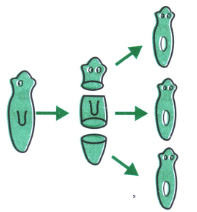
Why are budding, fragmentation and regeneration all considered as asexual types of reproduction? With neat diagrams explain the process of regeneration in Planaria.
2.
(a) Draw a ray diagram to show the formation of image by a convex lens when an object is placed in front of the lens between its placed in front of the lens between its optical centre and principal focus.
(b) In the above ray diagram mark the object-distance (u) and the image-distance (v) with their proper signs (+ve or -ve as per the new Cartesian sign convention) and state how these distances are related to the focal length if) of the convex lens in this case.
(c) Find the power of a convex lens which forms a real, and inverted image of magnification -1 of an object placed at a distance of 20 cm from its optical centre.
3.
It is desired to obtain an erect image of an object, using concave mirror of focal length of 12 cm
(i) What should be the range of distance of an object placed in front of the mirror?
(ii) Will the image be smaller or larger than the object? Draw ray diagram to show the formation of image in this case.
(iii) Where will the image of this object be, if its placed 24 cm in front of the mirror?
Draw a ray diagram for this situation also to justify your answer.
Show the positions of the pole, the principal and the centre of curvature in the above ray diagrams.
4.
A student focussed the image of a candle flame on a white screen using a convex lens. He noted down the position of the candle screen and the lens as under
Position of candle = 12.0 cm
Position of convex lens = 50.0 cm
Position of the screen = 88.0 cm
(a) What is the focal length of the convex lens?
(b) Where will the image be formed if he shifts the candle towards the lens at a position of 31.0 cm?
(c) What will be the nature of the image formed if he further shifts the candle towards the lens?
(d) Draw a ray diagram to show the formation of the image in case c) as said above.
5.
Esters are sweet-smelling substances and are used in making perfumes. Suggest some activity and the reaction involved for the preparation of an ester with well labeled diagram.
6.
(a) Name one main ore of Aluminium. Write its formula. Which two main impurities are associated with this ore?
(b) Describe with chemical equations, the method employed for the enrichment of the above named ore.
7.
What is an alloy? How is an alloy made? List two purpose of making alloys. Mention the constituents and two properties of each of the following alloys.
(i) Stainless steel
(ii) Brass
8.
Explain the mechanism of photosymthesis.
9.
Nervous and hormonal system together perform the function of control and coordination in human beings. Justify the statement with the help of an example.
10.
A sulphate salt of Group 2 element of the Periodic Table is a white, soft substance. Which can be moulded into different shapes by making its dough. When this compound is left in open for sometime, it becomes a solid mass and cannot be used for moulding purposes. Identify the sulphate salt and why does it show such a behaviour? Give the reaction involved.
11.
An element A which is a yellow solid at room temperature shows catenation and allotropy. A forms two oxides which are also formed during the thermal decomposition of ferrous sulphate crystals and are the major air pollutants.
(a) Identify the element A
(b) Write the electronic configuration of A
(c) Write the balanced chemical equation for the thermal decomposition of ferrous sulphate crystals?
(d) What would be the nature (acidic/ basic ) of oxides formed?
(e) Locate the Position of the element in the Modern Periodic Table.
12.
An element A (atomic number 17) reacts with an element B (atomic number 20) to form a divalent halide.
(a) Where in the periodic table are elements A and B placed?
(b) Classify A and B as metal (s), non-metal(s) or metalloid(s).
(c) What will be the nature of oxide of element B? Identify the nature of bonding in the compound formed.
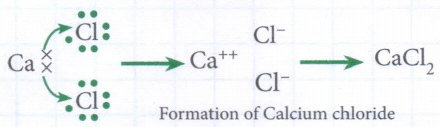
(d) Draw the electron dot structure of the divalent halide.
13.
Compare and contrast the arrangement of elements in Mendeleev's Periodic Table and the Modern Periodic Table.
14.
Give reasons for the appearance of new combinations of characters in the F2 progeny.
15.
Give reasons why acquired characters are not inherited.
1.
Budding, fragmentation and regeneration are considered as asexual types of reproduction because gamete formation does not happen during these modes of reproduction and a single parent carries out the process of reproduction.
The above figures shows regeneration in planaria:
When the body of planaria is cut off into several part, each part regenerates its complementary part to develop into a new individual.
2.
(a) When the object is placed in front of a convex lens between its optical centre and principal focus (i.e., between O and F1)
-S.png)
The image formed is
(i) behind the object (on the same date)
(ii) virtual
(iii) magnified
(b) -u (OB)
-v (OB')
+(OF)
The relation between u, v and f is
given by the lens formula \(\frac { 1 }{ f } =\frac { 1 }{ u } -\frac { 1 }{ v } \)
As both (u) and (v) are negative, the above equation will change to
\(\frac { 1 }{ f } =\frac { 1 }{ (-v) } -\frac { 1 }{ (-u) } \)
\(\frac { 1 }{ f } =\frac { -1 }{ v } -\frac { 1 }{ u } \)
\(\Rightarrow \frac { 1 }{ f } =\frac { 1 }{ u } -\frac { 1 }{ v } \)
(c) Type of lens = Convex lens
Object distance, u = -20 cm
Magnification, m = -1
Nature of image = Real and inverted
\(\because \quad m=\frac { v }{ u } \)
\(-1=\frac { v }{ -2 } \)
\(\Rightarrow v=+20cm\)
According to the lens formula
\(\frac { 1 }{ f } =\frac { 1 }{ v } -\frac { 1 }{ u } \)
\(\Rightarrow \frac { 1 }{ f } =\frac { 1 }{ 20 } -\frac { 1 }{ -20 } \)
\(\frac { 1 }{ f } =\frac { 1 }{ 20 } +\frac { 1 }{ 20 } \)
\(\Rightarrow \frac { 1 }{ f } =\frac { 2 }{ 20 } \)
\(f=+10cm=\frac { 10 }{ 100 } m=\frac { 1 }{ 10 } m\)
\(\therefore \quad power,P=\frac { 1 }{ f } =\frac { 1 }{ 1/10 } =+10D\)
3.
In a concave mirror an erect image will be obtained when the object is placed between pole and focus of the mirror.
-S.png)
Since, focal length is 12 cm,
(i) Therefore, the range of object distance is between 0 cm to <12 cm (from zero to less than 12 cm).
(ii) Image formed wall be magnified. i.e. larger than the object.
(iii) If the object is placed at 24 cm in front of the mirror, it means that object is placed at 2F. ie., at the centre of curvature (at C) of the mirror.
-S.png)
The real, inverted and same size (of the object) image will also be formed at 24 cm.
4.
Given
(a) Position of candle = 12.0 cm
Position of convex lens = 50.0 cm
Position of the screen = 88.0 cm
Therefore u = 50.0 - 12.0 = 38.0 cm
v = 88.0-50.0 = 38.0 cm
Therefore u = v
Hence both lie at 2F,
therefore F = 38/2 = 19 cm.
(b) u = 50.0-31.0 = -19 cm
f = +19 cm, v = ?
Using \(\frac { 1 }{ f } =\frac { 1 }{ u } +\frac { 1 }{ v } \)
We have \(\frac { 1 }{ 19 } =\frac { -1 }{ 19 } +\frac { 1 }{ v } \)
or v=infinity.
(c) If he further shifts the candle towards the lens the image will become virtual and erect.
(d) The ray diagram is as shown
-S.png)
5.
Carboxylic acid reacts with alcohols to form ester. For example, when ethanoic acid is warmed with ethanol in presence of a few drops of concentrated sulphuric acid as catalyst, an ester (ethyl ethanoate, commonly called ethyl acetate) and water are formed.
\(\underset{Acetic\ or\ ethanoic\ acid}{CH_COOH}+\underset{Ethanol}{C_2H_5OH}\xrightarrow{Conc. H_2SO_4}\underset{Ethyl\ ethanoate}{CH_3COOC_2H_5}+\underset{Water}{H_2O)}\)
Ester are sweet -smelling substances. So they are widely used in making perfumes and flavoring agents. Further, the reaction between a carboxylic acid and an alcohol to form a sweet ester is used as a test for alcohols as well as carboxylic acids.
6.
(a) The main ore of aluminium is bauxite ore. Its formula is A1203.The impurities sociated with this ore are iron oxide and sand. .
(b) The reaction involved in obtaining pure alumina from mineral bauxite having impurities of iron oxide and silica are:
(i) \(\underset { Aluminiumoxide\\ (frombauxiteore) }{ { A1 }_{ 2 }{ O }_{ 3 } } +\underset { Sodiumhydroxide\\ \quad (hot) }{ 2NaOH(aq) } \rightarrow \underset { Sodiumaluminate\\ \quad (Soluble) }{ { 2NaA1O }_{ 2 }(aq) } +\underset { Water }{ { H }_{ 2 }O(1) } \)
The iron oxide and silica (sand) present in the bauxite ore do not dissolve in sodium hydroxide solution. Therefore, they are separated by filtration.
(ii) \(\underset { Sodiumaluminate }{ { NaA1O }_{ 2 }(aq) } +\underset { Water }{ { 2H }_{ 2 }O(1) } \rightarrow \underset { Aluminiumhydroxide\\ \quad (Whiteppt) }{ { A1(OH) }_{ 3 }(s) } +\underset { Sodiumhydroxide }{ NaOH(aq) } \)
(iii) \(\underset { Aluminiumhydroxide }{ { 2A1(OH) }_{ 3 }(s) } \underrightarrow { heat } \underset { Aluminiumoxide\\ \quad (Pure) }{ { A1 }_{ 2 }{ O }_{ 3 }(s) } +\underset { Steam }{ { 3H }_{ 2 }O(g) } \)
7.
(i) An alloy is a homogenous mixture of two or more metals. It sometimes contains a non -metal component also.
(ii) It is made by heating the components in a definite proportion and then uniformly mixing them in the molten state and then cooling.
(iii) Two purposes of making alloys are:
(a) To make a substance resistant to corrosion
(b) To make a substance strong and hard
(iv) Constituents of Stainless steel:
Iron, nickel, and chromium
(v) Two properties of stainless steel are:
(a) It is resistant to corrosion.
(b) It is more durable.
(vi) Constituents of Brass:
Copper and Zinc
(vii) Two properties of brass are:
(a) It is resistant to corrosion.
(b) It is more malleable.
8.
Food is prepared in the green leaves of the plant by combining carbon dioxide and water in presence of sunlight and chlorophyll. The carbon dioxide required for photosynthesis is taken by the plants from air. The carbon dioxide enters the leaves through tiny pores called stomata. The water required is taken from soil. The sunlight provides the energy required to carry out the preparation of food. The green pigment called chlorophyll present in green leaves help to absorb energy from sunlight. The oxygen produced as a by-product goes into the air.
The food prepared by the green leaves is in the form of glucose. This glucose is sent to different parts of the plant. The excess glucose is changed into starch and is stored in the leaves of the plant. The food prepared by photosynthesis provides all the energy to a plant which it needs to grow. Thus, it is clear that the green plants convert sunlight energy into chemical energy. by making food. When we eat plant foods such as fruits, vegetables, food grains etc., the chemical energy stored in them is released in our body during respiration.
During the process of photosynthesis, the following three steps take place:
(i) Absorption of sunlight energy by chlorophyll.
(ii) Conversion of sunlight energy into chemical energy and splitting of water into hydrogen and oxygen using sunlight energy.
(iii) Reduction of carbon dioxide to form carbohydrates using the chemical energy.
9.
The endocrine and neural system both works together for the normal functioning of our body. The synthesis and release of certain hormones is regulated by the neural system. Also, the release of certain hormones influences the activity of nerves.
For example, hypothalamus receives neural signals from brain and releases hormones.
In case of deficiency of iodine, body produces less thyroxine hormone. Hypothalamus releases hormones to stimulate pituitary gland which further stimulates thyroid gland to secrete thyoxine.
10.
The Substance which is used for making different shapes is Plaster of Paris. Its chemical name is calcium sulphate hemihydrate \([CaSO_4.1/2H_2O].\) The two formula unit of \(CaSO_4\) share one molecule of water. As a result, it is soft. When it is left open for some time, it absorbs moisture from the atmosphere and forms gypsum, which is a hard solid mass.
\(\underset{Plaster\ of\ Paris}{CaSO_4.{1\over 2}H_2O}+1{1\over2}{H_2O}\rightarrow \underset{Gypsum}{CaSO_4.2H_2O}\)
11.
(a) The element A which is a yellow solid at room temperature and shows catenation and allotropy is sulphur (S).
(b) The atomic number of sulphur is 16. Therefore, its electronic configuration is 2, 8, 6.
(c) \(\underset { Ferroussulphate }{ { 2FeSO }_{ 4 } } \underrightarrow { Heat } \underset { Ferricoxide }{ { Fe }_{ 2 }{ O }_{ 3 } } +\underset { Sulphurdioxide }{ { SO }_{ 2 } } +\underset { Sulphurtrioxide }{ { SO }_{ 3 } } \)
Both SO2 and SO3 are major air pollutions.
(d) Since sulphur is a non-metal, therefore both S02 and S03 are acidic oxide since they dissolve in water to form the corresponding acids.
\(\underset { Sulphurdioxide }{ { SO }_{ 2 } } +\underset { Water }{ { H }_{ 2 }O } \rightarrow \underset { Sulphurousacid }{ { H }_{ 2 }{ SO }_{ 3 } } \\ \underset { Ferroustrioxide }{ { SO }_{ 3 } } +\underset { Water }{ { H }_{ 2 }O } \rightarrow \underset { Sulphuricacid }{ { H }_{ 2 }{ SO }_{ 4 } } \)
(e) Since sulphur contains six valence electrons, therefore it lies in group 6 + 10 = 16.Further, since atomic number of sulphur (S) is 16. It lies in the 3rd period.
12.
(a) The electronic configuration of element A with atomic number 17 is 2, 8, 7. Since it has 7 valence electrons, therefore, it lies in group 17 (1O + 7). Further, since in element A, third shell is being filled, it lies in third period. In other words A is chlorine.
Further, the electronic configuration of element B with atomic number 20 is 2, 8, 8,2. Since it has 2 valence electrons, it lies in the group 2. Further since in element B fourth shell is being filled, it lies in 4th period.
(b) Since element A has seven electrons in the valence shell and needs one more electron to complete its octet therefore it is a non-metal. Further since element B has two electrons in the valance shell which it can easily lose to achieve the stable electronic configuration of the nearest inert gas, therefore it is a metal.
(c) Since element B is a metal therefore its oxide (CaO) must be basic in nature. Further since metals and non -metals form ionic compounds, therefore the natyre of bonding in calcium oxide is ionic.
(d) The electron dot structure of divalent metal halide CaC12 is
13.
| Mendeleev's Periodic Table | Modern Periodic Table |
|
1. It has 8 groups and 6 periods |
It has 18 groups and 7 periods |
| 2. Transition elements are not separated. | Transition elements are given separate place |
| 3. The inert gases were not present | The inert gases are present in separate group. |
| 4. Lanthanides and Actinides were not present. | Lanthanides and Actinides are at the bottom of the Periodic Table. |
| 5. Position of element i.e., group number and period number cannot be predicted. |
Group number and period number can bepredicted from its electronic configuration. |
| 6. Elements are arranged accordingto the atomic mass. | Elements are arranged according to the atomic number. |
14.
Since the traits inherit independently there is appearance of new combinations of characters in F2 progeny.
15.
Only those changes in the DNA or germ cells will be passed on to the progeny resulting in the variations in them. Since acquired characters do not produce any change in the DNA of germ cells, they cannot be inherited.

10th Standard CBSE Syllabus & Materials
10th Standard CBSE
CBSE 10th Social Science PS - Federalism - New Model Questions Papers Study Material - QB365 Set A
NEW10th Standard CBSE
CBSE 10th Social Science PS - Power Sharing - New Model Questions Papers Study Material - QB365 Set A
NEW10th Standard CBSE
CBSE 10th Social Science GEO - Manufacturing Industries - New Model Questions Papers Study Material - QB365 Set A
NEW10th Standard CBSE
CBSE 10th Social Science GEO - Minerals and Energy Resources - New Model Questions Papers Study Material - QB365 Set A



NCERT Books

Syllabus

Exam Pattern

Sample Question Papers

Previous year Question Papers

Important Notes

MCQ Practice test

NCERT Exemplers

Case study Questions

Image Based Questions

Passage based Questions

HOT Questions

Value Based Questions

Model Questions Papers
NCERT ( Book Back ) Questions

Assertion and Reason
Important Questions And Answers

CBSE 10th Standard CBSE Subjects
CBSE Standards




