
 100% FREE ACCESS
10th Standard CBSE Syllabus & Materials
10th Standard CBSE
CBSE 10th Social Science ECO - Globalisation and the Indian Economy - New Model Questions Papers Study Material - QB365 Set A
NEW10th Standard CBSE
CBSE 10th Social Science ECO - Money and Credit - New Model Questions Papers Study Material - QB365 Set A
NEW10th Standard CBSE
CBSE 10th Social Science ECO - Sectors of the Indian Economy - New Model Questions Papers Study Material - QB365 Set A
NEW10th Standard CBSE
CBSE 10th Social Science ECO - Development - New Model Questions Papers Study Material - QB365 Set A
NEW10th Standard CBSE
CBSE 10th Social Science PS - Outcomes of Democracy - New Model Questions Papers Study Material - QB365 Set A
NEW10th Standard CBSE
CBSE 10th Social Science PS - Gender, Religion and Caste - New Model Questions Papers Study Material - QB365 Set A

Published on: 26/05/2021
QB365 Provides the updated NCERT Exemplar Questions for Class
10, and also provide the detail solution for each and every NCERT Exemplar questions. NCERT Exemplar questions are latest updated question pattern from NCERT, QB365 will helps to get more marks in Exams
Download CBSE Class 10th Standard CBSE Science question papers, sample papers, important questions, and previous year solved papers in PDF format. Get free study materials, NCERT solutions, and exam preparation resources for Class 10th Standard CBSE Science
Questions + Answers key
Take MCQ Science Test1.
Arrange the following elements in the increasing order of their metallic character Mg, Ca, K, Ge, Ga
2.
Write the formula of the product formed when the element X (atomic number 19) combines with the element Y (atomic number 17). Draw its electronic dot structure. What is the nature of the bond formed?
3.
Identify and name the metals out of the following elements whose electronic configurations are given below
(a) 2,8,2
(b) 2,8,1
(c) 2,8,7
(d) 2,1
4.
Arrange the following elements in increasing order of their atomic radii.
(a) Li, Be, F, N
(b) Cl, At, Br I
5.
How does the electronic configuration of an atom relate to its position in the Modern Periodic Table?
1.
Arranging the given elements into different groups and periods in order of their increasing atomic numbers we have:
| Group No: | 1 | 2 | 13 | 14 |
| Third Period: | Mg | - | - | - |
| Fourth Period: | K | Ca | Ga | Ge |
Since the metallic character decrease along a period from left to right, therefore, metallic character increases in the order: Ge < Ga < Ca < K. .
Since metallic character increases down the group from top to bottom, therefore Ca is more metallic than Mg.
Combining above two results, the overall metallic character increases in the order: Ge < Ga < Mg < Ca < K.
2.
Since the atomic number of the element X is 19, so its electronic configuration is 2, 8,8, 1 and hence the element X in the metal potassium. Further the atomic number of the element Y is 17, so its electronic configuration is 2, 8, 7 and hence the element Y is the non-metal chlorine. Now we know that metals lose the valence electrons and the nonmetal accept the electrons lost by the metals to acquire the stable electronic configuration of the nearest noble gas. As a result, metals form positive ions (cations) and non-metals form negative ions (anions) and an ionic bond is formed between the positively and the negatively charged species. In other words, the formula of the product formed between K and Cl is K+ Cl- and its electron dot structure is
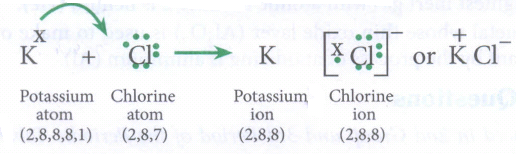
The nature of bond is ionic bond.
3.
Since elements 1 - 3 electrons in the valence shell are metals, those having 4 valence electrons may be non-metals, metalloids or may even be metals those having 5-8 valence electrons are non-metals. Thus elements a), b) and d) are metals while element c) is a non-metal.
| Electronic configuration | No. of valence electrons | Metal/Nonmetal | Atomic number | Name of the element |
| a) 2,8,2 | 2 | Metal | 2+8+2=12 | Magnesium |
| b) 2,8,1 | 1 | Metal | 2+8+1=11 | Sodium |
| c) 2, 8, 7 | 7 | Non-metal | 2+8+7=17 | Chlorine |
| d) 2,1 | 3 | Metal | 2+1=3 | Lithium |
4.
(a) Atomic radii decrease along a period from left to right due to increasing nuclear charge. Thus the atomic radii of Li, Be, F and N increase in the order: F<N<Be<Li.
(b) Atomic radii increase in a group from top to bottom due to the corresponding increase in the number of filled electronic shells. The atomic radii of Cl, At, Br and I increase in the order : Cl<Br<I<At.
5.
The electronic configuration is related to the position of element in Periodic table. The numbers of electrons in outermost shell show the number of group and the number of shells shows the number of periods.

10th Standard CBSE Syllabus & Materials
10th Standard CBSE
CBSE 10th Social Science PS - Federalism - New Model Questions Papers Study Material - QB365 Set A
NEW10th Standard CBSE
CBSE 10th Social Science PS - Power Sharing - New Model Questions Papers Study Material - QB365 Set A
NEW10th Standard CBSE
CBSE 10th Social Science GEO - Manufacturing Industries - New Model Questions Papers Study Material - QB365 Set A
NEW10th Standard CBSE
CBSE 10th Social Science GEO - Minerals and Energy Resources - New Model Questions Papers Study Material - QB365 Set A



NCERT Books

Syllabus

Exam Pattern

Sample Question Papers

Previous year Question Papers

Important Notes

MCQ Practice test

NCERT Exemplers

Case study Questions

Image Based Questions

Passage based Questions

HOT Questions

Value Based Questions

Model Questions Papers
NCERT ( Book Back ) Questions

Assertion and Reason
Important Questions And Answers

CBSE 10th Standard CBSE Subjects
CBSE Standards




