
 100% FREE ACCESS
10th Standard CBSE Syllabus & Materials
10th Standard CBSE
CBSE 10th Social Science ECO - Globalisation and the Indian Economy - New Model Questions Papers Study Material - QB365 Set A
NEW10th Standard CBSE
CBSE 10th Social Science ECO - Money and Credit - New Model Questions Papers Study Material - QB365 Set A
NEW10th Standard CBSE
CBSE 10th Social Science ECO - Sectors of the Indian Economy - New Model Questions Papers Study Material - QB365 Set A
NEW10th Standard CBSE
CBSE 10th Social Science ECO - Development - New Model Questions Papers Study Material - QB365 Set A
NEW10th Standard CBSE
CBSE 10th Social Science PS - Outcomes of Democracy - New Model Questions Papers Study Material - QB365 Set A
NEW10th Standard CBSE
CBSE 10th Social Science PS - Gender, Religion and Caste - New Model Questions Papers Study Material - QB365 Set A

Published on: 26/05/2021
QB365 Provides the updated NCERT Exemplar Questions for Class
10, and also provide the detail solution for each and every NCERT Exemplar questions. NCERT Exemplar questions are latest updated question pattern from NCERT, QB365 will helps to get more marks in Exams
Download CBSE Class 10th Standard CBSE Science question papers, sample papers, important questions, and previous year solved papers in PDF format. Get free study materials, NCERT solutions, and exam preparation resources for Class 10th Standard CBSE Science
Questions + Answers key
Take MCQ Science Test1.
(a) Electropositive nature of the element(s) increases down the group and decreases across the period
(b) Electronegativity of the element decreases down the group and increases across the period
(c) Atomic size increases down the group and decreases across a period (left to right)
(d) Metallic character increases down the group and decreases across a period.
On the basis of the above trends of the Periodic Table, answer the following about the elements with atomic numbers 3 to 9.
(a) Name the most electropositive element among them.
(b) name the most electronegative element.
(c) Name the element with smallest atomic size.
(d) Name the element which shows maximum valency.
2.
Mendeleev' predicted the existence of certain elements not known at that time and named two of them as Eka-silicon and Eka-aluminium.
(a) Name the elements which have taken the place of these elements.
(b) Mention the group and the period of these elements in the Modern Periodic Table.
(c) Classify these elements as metals, non-metals or metalloid.
(d) How many valence electrons are present in each one of them?
3.
Atomic number of a few elements are given below 10, 20, 7, 14
(a) Identify the elements.
(b) Identify the Group number of these elements in the Periodic Table.
(c) Identify the Periods of these elements in the Periodic Table.
(d) What would be the electronic configuration for each of these elements?
(e) Determine the valency of these elements.
4.
An element A (atomic number 17) reacts with an element B (atomic number 20) to form a divalent halide.
(a) Where in the periodic table are elements A and B placed?
(b) Classify A and B as metal (s), non-metal(s) or metalloid(s).
(c) What will be the nature of oxide of element B? Identify the nature of bonding in the compound formed.
(d) Draw the electron dot structure of the divalent halide.
5.
An element is placed in 2nd Group and 3rd Period of the Periodic Table, burns in presence of oxygen to form a basic oxide.
(a) Identify the element.
(b) Write the electronic configuration.
(c) Write the balanced equation when it burns in the presence of air.
(d) Write a balanced equation when this oxide is dissolved in water.
(e) Draw the electron dot structure for the formation of this oxide.
1.
The names and symbols of elements having atomic numbers 3 - 9 are :
| Atomic number | 3 | 4 | 5 | 6 | 7 | 8 | 9 |
| Name | Lithium | Beryllium | Boron | Carbon | Nitrogen | Oxygen | Fluorine |
| Symbol | Li | Be | B | C | N | O | F |
a) Lithium (Li)
b) Fluorine (F)
c) Fluorine (F)
d) Boron (B)
e) Carbon (C)
2.
(a) Eka-silicon for germanium (Ge) and eka-aluminium for gallium(Ga).
(b) Group number of Ga is 13 and its period is 4th and group number of Ge is 14 and its period is also 4th.
(c) Both Ga and Ge are metalloids.
(d) Ga lies in group 13, therefore, it has 13 - 10 = 3 valence electrons. Similarly, Ge lies in group 14 and hence it has 14 - 10 = 4 valence electrons.
3.
| Atomic No. | Electronic Configuration | Group No. | Period No. | Valency | Element |
| 10 | 2,8 | 18 | 2nd | Zero | Neon |
| 20 | 2,8,8,2 | 2 | 4th | 2 | Calcium |
| 7 | 2,54 | 15 | 2nd | 3 | Nitrogen |
| 14 | 2,8,4 | 14 | 3rd | 4 | Silicon |
4.
(a) The electronic configuration of element A with atomic number 17 is 2, 8, 7. Since it has 7 valence electrons, therefore, it lies in group 17 (1O + 7). Further, since in element A, third shell is being filled, it lies in third period. In other words A is chlorine.
Further, the electronic configuration of element B with atomic number 20 is 2, 8, 8,2. Since it has 2 valence electrons, it lies in the group 2. Further since in element B fourth shell is being filled, it lies in 4th period.
(b) Since element A has seven electrons in the valence shell and needs one more electron to complete its octet therefore it is a non-metal. Further since element B has two electrons in the valance shell which it can easily lose to achieve the stable electronic configuration of the nearest inert gas, therefore it is a metal.
(c) Since element B is a metal therefore its oxide (CaO) must be basic in nature. Further since metals and non -metals form ionic compounds, therefore the natyre of bonding in calcium oxide is ionic.
(d) The electron dot structure of divalent metal halide CaC12 is
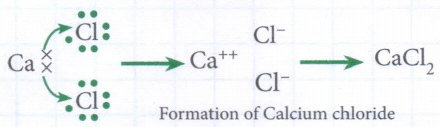
5.
(a) Since the element lies in group 2, it must be an alkaline earth metalj Since it lies in the third period, it must be magnesium (Mg).
(b) Atomic number of Mg is 12, therefore, its electronic configuration is
KLM
282
(c) \(\underset { Magnesium }{ 2Mg(s) } +\underset { Oxygen }{ { O }_{ 2 }(g) } \underrightarrow { Heat } \underset { Magnesiumoxide }{ 2MgO(s) } \)
(d) \(\underset { Magnesiumoxide }{ MgO(s) } +\underset { Water }{ { H }_{ 2 }O(1) } \rightarrow \underset { Magnesiumhydroxide }{ { Mg(OH) }_{ 2 }(aq) } \)
(e) 

10th Standard CBSE Syllabus & Materials
10th Standard CBSE
CBSE 10th Social Science PS - Federalism - New Model Questions Papers Study Material - QB365 Set A
NEW10th Standard CBSE
CBSE 10th Social Science PS - Power Sharing - New Model Questions Papers Study Material - QB365 Set A
NEW10th Standard CBSE
CBSE 10th Social Science GEO - Manufacturing Industries - New Model Questions Papers Study Material - QB365 Set A
NEW10th Standard CBSE
CBSE 10th Social Science GEO - Minerals and Energy Resources - New Model Questions Papers Study Material - QB365 Set A



NCERT Books

Syllabus

Exam Pattern

Sample Question Papers

Previous year Question Papers

Important Notes

MCQ Practice test

NCERT Exemplers

Case study Questions

Image Based Questions

Passage based Questions

HOT Questions

Value Based Questions

Model Questions Papers
NCERT ( Book Back ) Questions

Assertion and Reason
Important Questions And Answers

CBSE 10th Standard CBSE Subjects
CBSE Standards




