
 100% FREE ACCESS
11th Standard CBSE Syllabus & Materials
11th Standard CBSE
CBSE 11th Economics PART-A - Presentation of Data - New Sample Question Papers Study Material - QB365 Set A
NEW11th Standard CBSE
CBSE 11th Economics PART-A - Organisation of Data - New Sample Question Papers Study Material - QB365 Set A
NEW11th Standard CBSE
CBSE 11th Economics PART-A - Collection of Data - New Sample Question Papers Study Material - QB365 Set A
NEW11th Standard CBSE
CBSE 11th Economics PART-A - Introduction to Economics and Statistics - New Sample Question Papers Study Material - QB365 Set A
NEW11th Standard CBSE
CBSE 11th Business Studies International Trade Sample Question Papers Study Material - QB365 Set A
NEW11th Standard CBSE
CBSE 11th Business Studies Evolution and Fundamentals of Business Sample Question Papers Study Material - QB365 Set A

Published on: 18/08/2026
Download CBSE Class 11th Standard CBSE Biology question papers, sample papers, important questions, and previous year solved papers in PDF format. Get free study materials, NCERT solutions, and exam preparation resources for Class 11th Standard CBSE Biology
Questions + Answers key
Take MCQ Biology Test
1.
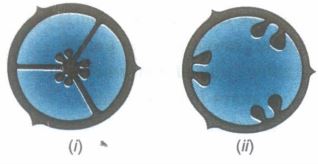
Name the type of placentation shown in the given figures (i) and (ii). Give one example of each type.
2.
Define a taxon.
3.
Which group of plants shows micorrhiza?
4.
What is the role of radula in Mollusca?
5.
What are dolipores? In which class of fungi are these present?
6.
Can we relate metabolism with growth of the body?
7.
8.
9.
10.
Assertion (A) : Radial symnetry in animals is advantageous in detecting food and danger.
Reason (R) : It allows the anirnal to be able to respond to stimulun from any direction
If both A and R are true and R is the correct explanation of A
If both A and R are true, but R is not the correct explanation of A
If A is true, but R is false
If A is false, but R is true
11.
Malpighian tubules are ______.
excretory organs of insects
excretory organs of frog
respiratory organs of insects
endocrine glands of insects
12.
Naked cytoplasm, multinucleated and saprophytic are the characteristics of ______.
Monera
Protista
Fungi
Slime moulds
13.
Protein synthesis takes place in which cell organelle?
Golgi Body
Endoplasmic Reticulum
Ribosomes
Lysosome
14.
Which organelle is not found in plant cells?
Mitochondria
Plastids
Rough ER
Centriole
15.
Companion cells are found in which tissue?
Xylem
Phloem
Both xylem and phloem
None of these
16.
What is the full form of ICBN?
International Council for Botanical Nomenclature
International Code for Botanical Nomenclature
International Code for Biological Nomenclature
Indian Code for Biological Nomenclature
17.
Genus represents ______.
an individual plant or animal
a collection of plants or animals
a group of closely related species of plants or animals.
None of the above
18.
The term systematics refers to______.
identification and classification of plants and animals.
nomenclature and identification of plants and animals.
diversity of kinds of organisms and their relationship.
different kinds of organisms and their classification
19.
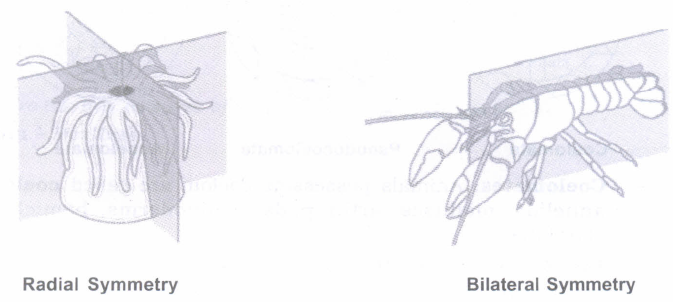
What are the symmetries based on which animals can be classified? Describe with appropriate diagram.
20.
With the help of proper diagram describe various regions of root.
21.
Which factors were responsible for the extinction of dinosaurs (ancient reptiles)? Why reptiles became the first successful land animals?
22.
Briefly describe the components of a typical bacteria cell
23.
Give the general characteristics of dinoflagellates.
24.
Who developed the staining procedure to stain the bacterial cells?
Mention the two categories of bacteria based on that and differentiate between them.
25.
Excretory organs of different animals are given below. Choose correctly and write in the space provided.
| Animal | Excretory organ/Unit |
| (a) Balanoglossus | (i) Metanephridia |
| (b) Leech | (ii) Nephridia |
| (c) Locust | (iii) Flame cells |
| (d) Liver fluke | (iv) Absent |
| (e) Sea urchin | (v) Malpighian tubules |
26.
Explain digestion in frogs.
27.
What are the main differences among Chlorophyceae, Phaeophyceae and Rhodophyceae?
28.
Is extra genomic DNA present in prokaryotes and eukaryotes?If yes, locate their position in both types of organisms.
29.
Distinguish between the cell membrane and cell wall.
30.
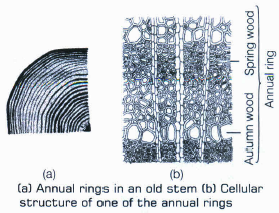
Demonstrate and explain the formation of annual ring in the transverse section of the stem.
31.
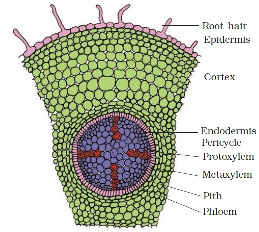
Draw the diagram of a dicot root and a monocot root. Write two points difference between them.
32.
Why should plants be described morphologically?
33.
In pteridophytes, the main plant body is a sporophyte which is differentiated into true root, stem and leaves. These organs possess well differentiated vascular tissues.
(i) What are sporophylls?
(ii) Name any two species of pteridophytes which show heterospory.
(iii) Name the male and female sex organ of pteridophytes.
(iv) Can pteridophytes surpass the advantages of gymnosperms
(v) What is the economic importance of Azolla?
34.
The diagrammatic representation of stomatal apparatus of a dicot plant is shown below. Answer the questions that follow:
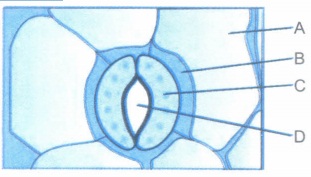
(a) Identify the parts labelled A, B, C and D
(b) How does C differ from B?
35.
Bryophytes are the first land plants, which occur in damp, cool and shady places. They are known as amphibians of plant kingdom, as they need water for fertilisation. In general, Bryophytes are of little economic importance; but, they are of great ecological importance.
(a) Write two ecological significance of mosses.
(b) Name the moss used for trans-shipment of living material. Justify your answer.
36.
37.
38.
39.
1.
(i) Axile placentation e.g., China rose, lemon.
(ii) Parietal placentation e.g., cucumber, watermelon.
2.
A taxon represents any category or unit of classification or a rank.
3.
Gymnosperms : Mycorrhizae is a symbiotic relationship that is shown by fungi and the Gymnosperms. Mycorrhiza shows a mutually beneficial relationship between the fungus and the roots of higher plants such as that of Gymnosperms and Angiosperms.
4.
Radula is the rasping organ that helps in feeding.
5.
Dolipores or central pores are barrel-shaped outgrowths present in septa of class-Basidiomycetes (club fungi).
6.
Yes, metabolism occurs due to two phenomena, i.e., anabolism and catabolism. The growth of living things occurs when quantity of anabolic reactions exceeds quantity of catabolic reactions.
7.
(b)
8.
(a)
9.
(d)
10.
(a)
If both A and R are true and R is the correct explanation of A
11.
(a)
excretory organs of insects
12.
(d)
Slime moulds
13.
(c)
Ribosomes
14.
(d)
Centriole
15.
(b)
Phloem
16.
(b)
International Code for Botanical Nomenclature
17.
Genus represents a group of closely related species of plants or animals.
18.
Systematics refers to study of diversity of kinds of organisms and their relationship.
19.
Animals can be categorized on the basis of their symmetry. Sponges are mostly asymmetrical, i.e., any plane that passes through the centre does not divide them into equal halves.
Radial Symmetry. When any plane passing through the central axis of the body divides the organism into two identical halves, it is called radial symmetry. Coelenterates, ctenophores and echinoderms have this kind of body plan.
Bilateral Symmetry. In certain animals the body can be divided into identical left and right halves in only one plane and this type of symmetry is called bilateral symmetry. Examples: Annelids, Arthropods, Mammals
20.
(a) Root Cap. The root is covered at the apex by a thimble-like structure called the root cap. It protects the tender apex of the root as it makes its way through the soil.
(b) Region of Elongation. A few millimetres above the root cap is the region of meristematic activity. The cells of this region are very small, thin-walled and with dense protoplasm. They divide repeatedly. The cells proximal to this region undergo rapid elongation and enlargement and are responsible for the growth of the root in length. This region is called the region of elongation
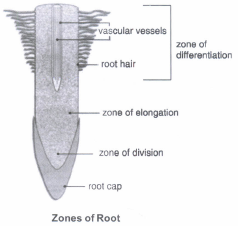
(c) Region of Maturation. The cells of the elongation zone gradually differentiate and mature. Hence, this zone, proximal to region of elongation, is called the region of maturation. From this region some of the epidermal cells form very fine and delicate, thread-like structures called root hairs. These root hairs absorb water and minerals from the soil.
21.
During the Jurassic period of Mesozoic era, certain gigantic reptiles roamed on land, swarm in water and flew in the air. these reptiles were called dinosaurs. These animals disappeared during a short time at the end of the cretacean period.
Their extinction occurred due to competition with early mammals or from climatic changes due to the collision must have produced huge dust clouds into air, screening sunlight from the earth. The lack of sunlight would have destroyed vegetation and cooled the atmosphere. These may be the reason for extinction of dinosaurs.
Reasons for successful adaptation on land by reptiles are
(i) Horny scales which reduce loss of water.
(ii) Internal fertilisation as gametes cannot survive on land.
(iii) Shell around the egg to check desiccation.
(iv) Fluid-filled amnion around the embryo to provide aquatic environment for development on land.
22.
A bacterial cell consists of following components
Cell envelope : It is the outer covering of protoplasm of bacterial cell. It contains mucilage sheath, cell wall and plasma membrane.
Cytoplasm : It is a crystallo - colloidal complex that forms the protoplasm excluding its nucleoid. Membrane bound cell organelles are absent. Cytoplasm along with nucleoid are together called as protoplasm.
Nucleoid : It represents the genetic material of prokaryotes. Nucleoid consists of a single circular strand of DNA duplex which is super coiled with the help of RNA. No nuclear envelope is present.
Plasmids : these are self-replicating , extrachromosomal segments of double-stranded, circular, naked DNA.
Flagella : These are unstranded, equivalent to a single microtubular fibre. These help in movement and locomotion.
Pili and Fimbriae : Pili are longer, fewer and thicker tubular outgrowths made up of protein pilin. Fimbriae are small bristle-like fibres sprouting from cell surface in large number. Pili are helpful in attaching to recipient cell and forming conjugation tube. Fimbriae cause agglutination of RBC.They also help in mutual clinging of bacteria.
23.
(i) Dinoflagellates are unicellular organisms.
(ii) Dinoflagellates are motile in nature. Some of their forms are non-motile in nature.
(iii) Dinoflagellates are found in both marine and freshwater, though mostly in marine form.
24.
a. Gram is the scientist.
b. Gram-positive bacteria and gram negative bacteria.
c. Those bacteria which take up and retain the gram stain, are called gram positive bacteria.
d. Those bacteria which do not take up the gram stain, are called gram negative bacteria.
25.
(a) Metanephridia
(b) Nephridia
(c) Malpighian tubules
(d) Flame cells
(e) Absent.
26.
Digestion in Frog:
(i) In the stomach digestion of food takes place by the action of Hel and gastric juices secreted from the walls of the stomach.
(ii) Partially digested food called chyme is passed from stomach to the first part of the intestine, the duodenum. The duodenum receives bile from gall bladder and pancreatic juices from the pancreas through a common bile duct.
(iii) Bile emulsifies fat and pancreatic juices digest carbohydrates and proteins. Final digestion takes place in the intestine.
(iv) Digested food is absorbed by the numerous finger-like folds in the inner wall of intestine called villi and microvilli.
27.
| Characteristics | Chlorophyceae | Phaeophyceae | Rhodophyceae |
|---|---|---|---|
| Pigments | Chlorophyll a and b | Chlorophyll a, C and fucoxanthin | Chlorophyll a, d and phycoerythrin |
| Stored Food | Starch | Mannitol and Laminarin | Floridean Starch |
| Cell Wall | Cellulose | Cellulose and Algin | Cellulose |
| Flagellar number and position of insertion | 2 - 8 , equal apical | 2, unequal lateral | Absent |
28.
Yes, extra genomic DNA is present in both prokaryotes and eukaryotes.
In the case of eukaryotes, extragenomic DNA is present in two organelles e.g. Plastids and mitochondria. Both these organelles with the help of their own DNA, synthesise some of their proteins. Thus, these organelles are known as semiautonomous organelles.
In the case of prokaryotic cells, the extragenomic DNA is present in the form of plasmids. The plasmids are circular DNA molecules, which confer certain unique phenotypic characters to such bacteria. One such character is resistance to bacteria. This plasmid DNA is also used to monitor bacteria transformation with foreign DNA.
29.
| Cell Membrane | Cell Wall |
| It is found in both prokaryotes and eukaryotes | It is found in only plant cells as well as bacteria, fungi, algae and some archaea, i.e., absent in animal cells and Protozoa |
| Its function is to separate the components inside the cell from outside | Its function is to provide barrier to undesirable sustain and attack of pathogen |
| It provides support to the cytoskeleton of the cell, give shape to the cell | It provides strength and rigidity to the cell |
30.
In the transverse section of the stem, the springwood and autumnwood appear in the form of distinct concentric circles known as annual rings.One spring wood circle and one autumnwood circle together constitute an annual ring.
Like this, year after year such rings appear and their identity is well-marked.
31.
Dicot root :
Monocot root :
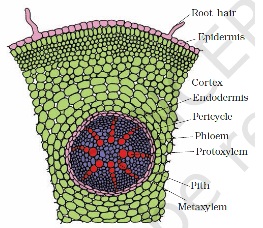
Differences In doicot roots, cortex region is narrow asnd in monocot roots, it is wider.The older roots of dicot plants have a covering of cork, while in monocots, it is covered by exodermis.
32.
Morphology helps us to understand different aspects of plant life-like ecology, genetics etc. Plant Breeding, crop protection, and crop productivity only depend on morphological characteristics like size, shape, thickness and orientation of leaves, number of flowering shoots, etc.
33.
(i) The sporophytes bear sporangia that are subtended by leaf-like appendages called sporophylls.
(ii) Selaginella and Salvinia produce two kinds of spores, i.e. macro and micro are known as heterosporous.
(iii) In pteridophytes,male and female sex organs are called antheridia and archegonia respectiveiy
(iv) No, gymnosperms are an advarced group of kingdom - Plantae with advanced toot foundatíion. Also, gymnosperms produce seed. Thus, pteridophytes cannot surpass the advantages of gymnosperms.
(v) Azolla is a water fern, it plays an important role in maintaining the fertility of rice field by fixing the nitrogen.
34.
(a) A - Epidermal cell
B - Subsidiary cell
C - Guard cell
D - Stomatal pore
(b) C (guard cell) has chloroplasts, but B (subsidiary cell) does not have chloroplasts.
35.
(a) Ecological significance of mosses
(i) Mosses grow as dense mats and prevent soil erosion by reducing the impact of falling rain on soil.
(ii) Along with lichens, they initiate succession on bare rocks.
(b) Sphagnum; it is due to its capacity to hold water.
36.
37.
38.
39.

11th Standard CBSE Syllabus & Materials
11th Standard CBSE
CBSE 11th Business Studies Forms of Business Organisation Sample Question Papers Study Material - QB365 Set A
NEW11th Standard CBSE
CBSE 11th Business Studies Business, Trade and Commerce Sample Question Papers Study Material - QB365 Set A
NEW11th Standard CBSE
CBSE 11th Physics Waves Sample Question Papers Study Material - QB365 Set A
NEW11th Standard CBSE
CBSE 11th Physics Kinetic Theory Sample Question Papers Study Material - QB365 Set A



NCERT Books

Syllabus

Exam Pattern

Sample Question Papers

Previous year Question Papers

Important Notes

MCQ Practice test

NCERT Exemplers

Case study Questions

Image Based Questions

Passage based Questions

HOT Questions

Value Based Questions

Model Questions Papers
NCERT ( Book Back ) Questions

Assertion and Reason
Important Questions And Answers

CBSE 11th Standard CBSE Subjects
CBSE Standards







