
 100% FREE ACCESS
11th Standard CBSE Syllabus & Materials
11th Standard CBSE
CBSE 11th Economics PART-A - Presentation of Data - New Sample Question Papers Study Material - QB365 Set A
NEW11th Standard CBSE
CBSE 11th Economics PART-A - Organisation of Data - New Sample Question Papers Study Material - QB365 Set A
NEW11th Standard CBSE
CBSE 11th Economics PART-A - Collection of Data - New Sample Question Papers Study Material - QB365 Set A
NEW11th Standard CBSE
CBSE 11th Economics PART-A - Introduction to Economics and Statistics - New Sample Question Papers Study Material - QB365 Set A
NEW11th Standard CBSE
CBSE 11th Business Studies International Trade Sample Question Papers Study Material - QB365 Set A
NEW11th Standard CBSE
CBSE 11th Business Studies Evolution and Fundamentals of Business Sample Question Papers Study Material - QB365 Set A

Published on: 18/08/2026
Download CBSE Class 11th Standard CBSE Biology question papers, sample papers, important questions, and previous year solved papers in PDF format. Get free study materials, NCERT solutions, and exam preparation resources for Class 11th Standard CBSE Biology
Questions + Answers key
Take MCQ Biology Test
1.
How is a pinnately compound leaf different from a palmately compound leaf?
2.
'X' is the female reproductive part of the flower, which consisits of three parts A,B and C. 'A' is the swollen botton part and C is the stocky part. Name all X,A,B, and C.
3.
How the runners of grasses can serve as means of vegatative propagetion?
4.
Differentiate between (a) Racemose and cymose inflorescence (b) Apocarpous and syncarpous ovary
5.
Define the term inflorescence. Explain the basis for the different types inflorescence in flowering plants.
6.
Justify the following statements on the basis of external features.
(a) Underground parts of a plant are not always roots.
(b) Flower is a modified shoot.
7.
What is a flower? Describe the parts of a typical angiosperm flower.
8.
Take one flower of the family Solanaceae and write its semi-technical description. Also draw their floral diagram.
9.
Define the following terms:
(a) aestivation
(b) placentation
(c) actinomorphic
(d) zygomorphic
(e) superior ovary
(f) perigynous flower
(g) epipetalous stamen
10.
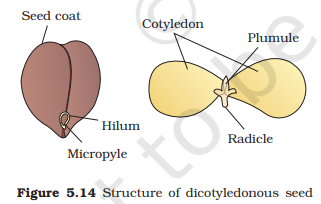
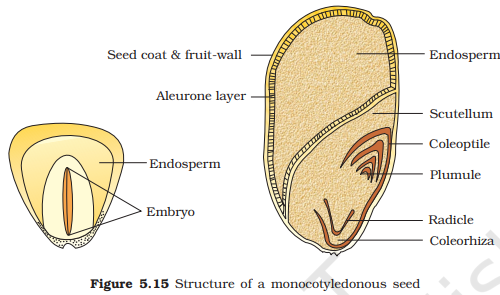
Draw the labelled diagram of the following:
(i) gram seed
(ii) V.S. of maize seed
11.
Describe the arrangement of floral members in relation to their insertion on thalamus.
12.
Describe the various types of placentations found in flowering plants.
13.
Explain with suitable examples the different types of phyllotaxy.
1.
| Pinnately Compound Leaf | Palmately Compound Leaf |
| The leaflets arise lateral to the rachis all along its length. | Leaflets arise from the tip of the rachis as the fingers of a palm. |
| The rachis may branch | The rachis does not branch. |
| e.g., rose, neem | e.g., silk, cotton. |
2.
X is a carpel; A is ovary; B is style and C is stigma.
3.
When a runner gets cut incidentally into the several parts and each can grow independently.
4.
Differentiate between recemose inflorescene and cymose inflorescene are
| Racemose inflorescene | Cymose inflorescene |
| Flowers are bome laterally. | Flowers are actually terminal |
| Growing point does not end in a flower. | Growing point or terminal bud always ends in a flower. |
| Flowers develop from all sides. | Flowers develop from one or two sides. |
| Opening of flowers occurs at short intervals | Opening of successive flowers takes longer intervals. |
| Young fruits are not protected by flowers | Young fruits are protected by flowers |
(ii) Differentiate between apocarpous and syncarpous ovary is
| Apocarpous Ovary | Syncarpous Ovary |
| It has more than one and free carpels. | It has more than one and fused carpels. |
| e.g lotus,rose | e.g. Hibiscus (Shoe flower), Petunia |
5.
The inflorescence is how the flowers are arranged on the flowering axis. During the flowering season, the vegetative apex of the stem gets converted into a floral meristem. Based on whether the floral axis continues to grow or ends in a flower, the inflorescence is classified into racemose and cymose. In racemose inflorescence, the floral axis continues to grow and produces flowers laterally. On the other hand, in a cymose inflorescence, the main axis terminates into a flower. Hence, it is limited in growth.
Growth : Indefinite (race mose) and definite.
Number of branches : Cymose, uniparous, biparous, multiparous
Pedicel : Presence or absence of pedicel in inflorescene.
Branching of peduncle : Unbranched and branched.
Sex of flowers : Certain types have unisexual flowers. e.g, Catkin.
6.
(a) Underground parts of a plant are not always roots. Sometimes stem or stem branches occur underground to perform some special functions. For example, potato tubar is a modified stem which is underground. A potato tubar shows nodes and internodes, scale leaves and buds at the nodes.
(b) Flower is a modified shoot consisiting of a highly reduced stem bracnch to form thalamus in which the nodes are borne only towards the trip. The floral parts, i.e. sepals,petals,stamens and carpels are arranged in their respective whorls and arise from nodes.
7.
A flower can be defined as the reproductive unit of any angiosperms. Flowers carry out sexual reproduction in angiosperms. A typical flower is generally an attractively modified stem with a condensed axis.
A flower has four different parts, they are - calyx, corolla, androecium, and gynoecium. The parts androecium and gynoecium contain the male and female reproductive organs of a flower respectively.
The parts of typical angiospermic flowers are as follows-
a) Calyx- The calyx is the outermost whorl of a flower. They mainly contain sepals. They are green, and leaf like structures that cover and protect the flowers during the initial stage or bud stage. When the arrangement of sepals in a flower are free, then they are called polysepalous, while when fused are called gamosepalous.
b) Corolla- The corolla of a flower is a layer that is found inside the calyx. It contains beautifully and attractively coloured petals. These petals help in alluring and attracting insects for pollination. When the petals in a flower are free, they are called polypetalous flowers, while the flower with fused petals are called as gamopetalous flower.
c) Androecium- It is the next part or whorl present after corolla. The androecium typically consists of stamens, which are the male reproductive unit of a flower and is composed of two parts - anther and filament. The anther is the bilobed structure with a stalk called filament. Inside the anther, pollen grains are formed, which are transferred to another plant by pollination.
d) Gynoecium- The gynoecium is the innermost part or whorl of a flower. It consists of pistils, which are the female reproductive organs of flowers. A pistil is composed of three parts: stigma, style and ovary.
8.
Semi-technical descriptions of flowers of following families are:
Fabaceae
Family - Fabaceae
Vegetative characters
Herb
Leaf: Pinnately compound, alternately arranged with leaf tendrils with the pulvinus present at the leaf base. Venation is reticulate.
Root: Tap root system with root nodules.
Floral features:
Inflorescence: racemose .
Flower: zygomorphic and bisexual.
Calyx: Sepals which are gamosepalous while aestivation is imbricate.
Corolla: five petals (polypetalous) with vexillary aestivation.
Androecium: ten anthers that are diadelphous with dithecous anthers.
Gynoecium: Monocarpellary superior ovary which is unilocular with marginal placentation.
Fruit: Legume pod with non-endospermic seeds
Floral formula:

Floral Diagram:

Solanaceae
Solanum lycopersicum (Tomato)
Family - Solanaceae
Vegetative characters
Shrub
Stem: herbaceous stem, aerial, erect , branched solid
Leaf: alternate , simple, exstipulate and reticulate venation
Floral features:
Inflorescence: Cymose
Flower: bisexual and actinomorphic.
Calyx: five sepals, united persistant, valvate aestivation
Corolla: five petals, united, valvate aestivation
Androecium: five stamens, epipetalous
Gynoecium: bicarpellary, syncarpous superior ovary, bilocular, placenta swollen with many ovules
Fruit: berry
Seeds: many endosperms
9.
(a) Aestivation : The mode of arrangement of sepals or petals in relation to one another in a flower bud is called aestivation.
(b) Placentation : The pattern by which the ovules are attached in an ovary is called placentation.
(c) Actinomorphic : A flower having radial symmetry is said to be actinomorpnic. The parts of each whorl are similar in size and shape. The flower can be divided in two equal halves along more than one median longitudinal plane.
(d) Zygomorphic : A flower having bilateral symmetry is termed as zygomorpic. The parts of one or more whorls are dissimilar. The flower can be divided into two equal halves in only one vertical plane.
(e) Superior ovary : The ovary is called superior when it is borne above the point attachment of perianth and stamens on the thalamus.
(f) Perigynous flower: It is the condition in which gynoecium of a flower is situated in the centre and other parts of the flower are located on the rim of the thalamus almost at the same level, it is called perigynous. Here ovary is half superior, e.g., peach, plum.
(g) Epipetalous stamen : epipetalous stamen that are connected to the petals by their filaments, thus appearing to arise from them.
10.
(i)
(ii)
11.
Based on the position of the calyx, corolla, and androecium (with respect to the ovary on the thalamus), the flower is described as hypogynous, perigynous, and epigynous. In hypogynous flowers, the ovary occupies the highest position on the thalamus while other floral parts are situated below it. In these flowers, the ovary is superior e.g., China rose, mustard etc.
In perigynous flowers, the ovary is situated at the centre and other floral parts are arranged on the rim of the thalamus. The ovary here is said to be half inferior e.g., plum, rose, peach
In epigynous flowers, the thalamus grows around the ovary fusing with its wall. The other floral parts are present above the ovary. Hence, the ovary is said to be inferior e.g., flowers of guava and cucumber.
12.
The arrangement of ovules within the ovary is called placentation.
It is the following types
(i) Marginal The placenta forms a ridge along the ventral suture and ovules are borne on the ridge,
e.g., pea, bean etc
(ii) Axile The margins of the carpels fuse to form a central axis on which the ovules are attached.
e.g., Hibiscus, Citrus, etc.
(iii) Parietal The placnta develops on the ovary wall,
e.g., Cucurbita.
(iv) Basal The placenta arises from the base of the unilocular ovary and bears a single ovule,
e.g., sunflower
(v) Free-Central The ovules are borne on central axis and septa are ansent, e.g., primrose.
13.
The mode of arrangement of leaves on the stem and its branches is called phyllotaxy (Phyllon-leaf; taxis arrangement). They are arranged most systematically, regularly and mathematically, so as to get proper sunlight and avoid overcrowding.
Phyllotaxy in leaves is of following three types.
(i) Alternate: A single leaf arises at a node. e.g, China rose, mango, mustard, sunflower, etc.
(ii) Oppposite: Two leaves arise at a node,opposite to each other e.g, guava, Calotropis tulsi, etc.
(iii) Whorled: More than two leaves arise at each node forming a circle or whorl, e.g, Alstonia Scholaris etc.

11th Standard CBSE Syllabus & Materials
11th Standard CBSE
CBSE 11th Business Studies Forms of Business Organisation Sample Question Papers Study Material - QB365 Set A
NEW11th Standard CBSE
CBSE 11th Business Studies Business, Trade and Commerce Sample Question Papers Study Material - QB365 Set A
NEW11th Standard CBSE
CBSE 11th Physics Waves Sample Question Papers Study Material - QB365 Set A
NEW11th Standard CBSE
CBSE 11th Physics Kinetic Theory Sample Question Papers Study Material - QB365 Set A



NCERT Books

Syllabus

Exam Pattern

Sample Question Papers

Previous year Question Papers

Important Notes

MCQ Practice test

NCERT Exemplers

Case study Questions

Image Based Questions

Passage based Questions

HOT Questions

Value Based Questions

Model Questions Papers
NCERT ( Book Back ) Questions

Assertion and Reason
Important Questions And Answers

CBSE 11th Standard CBSE Subjects
CBSE Standards







