
 100% FREE ACCESS
11th Standard CBSE Syllabus & Materials
11th Standard CBSE
CBSE 11th Economics PART-A - Presentation of Data - New Sample Question Papers Study Material - QB365 Set A
NEW11th Standard CBSE
CBSE 11th Economics PART-A - Organisation of Data - New Sample Question Papers Study Material - QB365 Set A
NEW11th Standard CBSE
CBSE 11th Economics PART-A - Collection of Data - New Sample Question Papers Study Material - QB365 Set A
NEW11th Standard CBSE
CBSE 11th Economics PART-A - Introduction to Economics and Statistics - New Sample Question Papers Study Material - QB365 Set A
NEW11th Standard CBSE
CBSE 11th Business Studies International Trade Sample Question Papers Study Material - QB365 Set A
NEW11th Standard CBSE
CBSE 11th Business Studies Evolution and Fundamentals of Business Sample Question Papers Study Material - QB365 Set A

Published on: 12/10/2019
Breathing and Exchange of Gases
Download CBSE Class 11th Standard CBSE Biology question papers, sample papers, important questions, and previous year solved papers in PDF format. Get free study materials, NCERT solutions, and exam preparation resources for Class 11th Standard CBSE Biology
Questions + Answers key
Take MCQ Biology Test
1.
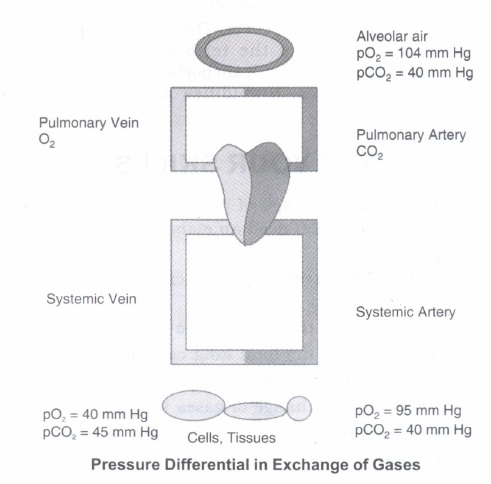
Give a diagrammatic representation of transport of gases in alveoli and systemic tissues.
2.
What are the various respiratory mechanisms in different animals?
3.
Explain the structure of human respiratory system with the help of suitable diagram.
4.
How does diaphragm facilitate respiration?
5.
Distinguish between
(a) IRV and ERV
(b) Inspiratory capacity and Expiratory capacity.
(c) Vital capacity and Total lung capacity.
6.
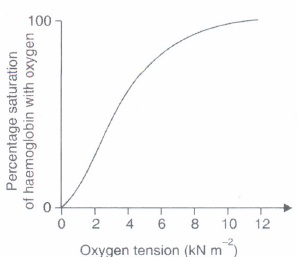
Define oxygen dissociation curve. Can you suggest any reason for its sigmoidal pattern?
7.
What are the major transport mechanisms for CO2 ? Explain.
8.
What is Tidal volume? Find out the Tidal volume (approximate value) for a healthy human in an hour.
9.
Give a chart of partial pressure of oxygen and carbon dioxide at different places in the respiratory system:
10.
Explain the role of haemoglobin in transport of oxygen.
1.
2.
i) Mechanisms of breathing vary among different groups of animals depending mainly on their habitats and levels of organisation.
ii) Lower invertebrates like sponges, coelenterates, flatworms, etc., exchange O2 with CO2 by simple diffusion over their entire body surface.
iii) Earthworms use their moist cuticle and insects have a network of tubes (tracheal tubes) to transport atmospheric air within the body.
iv) Special vascularised structures called gills are used by most of the aquatic arthropods and mollusks.
v) Vascularised bags called lungs are used by the terrestrial forms for the exchange of gases. Among vertebrates, fishes use gills whereas reptiles, birds and mammals respire through lungs. Amphibians like frogs can respire through their moist skin also. Mammals have a well developed respiratory system
3.
Structure of Respiratory System
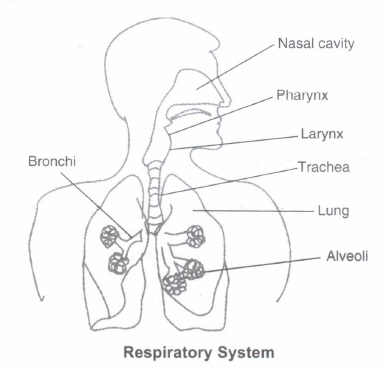
Pharynx. We have a pair of external nostrils opening out above the upper lips. It leads to a nasal chamber through the nasal passage. The nasal chamber opens into nasopharynx, which is a portion of pharynx, the common passage for food and air.
Larynx. Nasopharynx opens through glottis of the larynx region into the trachea. Larynx is a cartilaginous box which helps in sound production and hence called the sound box. During swallowing glottis can be covered by a thin elastic cartilaginous flap called epiglottis to prevent the entry of food into the larynx.
Trachea. Trachea is a straight tube extending up to the mid-thoracic cavity, which divides at the level of 5th thoracic vertebra into a right and left primary bronchi.
Bronchi. Each bronchi undergoes repeated divisions to form the secondary and tertiary bronchi and bronchioles ending up in very thin terminal bronchioles. The tracheae, primary, secondary and tertiary bronchi, and initial bronchioles are supported by incomplete cartilaginous rings. Each terminal bronchiole gives rise to a number of very thin, irregular-walled and vascularised bag-like structures called alveoli.
Lungs. The branching network of bronchi, bronchioles and alveoli comprise the lungs. We have two lungs which are covered by a double layered pleura. Pleura is filled with pleural fluid. It reduces friction on the lung surface. The outer pleural membrane is in close contact with the thoracic lining whereas the inner pleural membrane is in contact with the lung surface.
4.
The diaphragm and a specialised set of muscles - external and internal intercostals between the ribs, help in generation of such gradients. Inspiration is initiated by the contraction of diaphragm which increases the volume of thoracic chamber in the antero-posterior axis. The contraction of external inter-costal muscles lifts up the ribs and the sternum causing an increase in the volume of the thoracic chamber in the dorso-ventral axis. The overall increase in the thoracic volume causes a similar increase in pulmonary volume. An increase in pulmonary volume decreases the intra-pulmonary pressure to less than the atmospheric pressure which forces the air from outside to move into the lungs, i.e., inspiration.
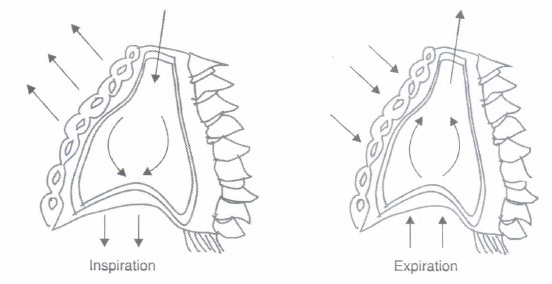
Relaxation of the diaphragm and the intercostal muscles returns the diaphragm and sternum to their normal positions and reduce the thoracic volume and thereby the pulmonary volume. This leads to an increase in intrapulmonary pressure to slightly above the atmospheric pressure causing the expulsion of air from the lungs, i.e., expiration.
5.
Part (a): IRV vs ERV
| Inspiratory Reserve Volume(IRV) | Expiratory Reserve Volume (ERV) |
| 1. The maximum volume of air that can be inhaled after normal inspiration is called inspiratory reserve volume. | 1. The maximum volume of air that can be forcefully exhaled after normal expiration is called expiratory reserve volume. |
| 2. The IRV of the human lungs is about 2500 - 3500 mL. | 2. The ERV of the human lungs is about 1000-1100 mL. |
Part (b): Inspiratory Capacity vs Expiratory Capacity
| Inspiratory capacity (IC) | Expiratory capacity (EC) |
| 1. It is the volume air that can be inhaled after normal expiration. | 1. It is the volume of air that can be exhaled after a normal inspiration. |
| 2. It includes tidal volume and inspiratory reserve volume | 2. It includes the tidal volume along with the expiratory reserve volume |
| 3. IC = TV + IRV | 3. EC = TV + ERV |
Part (c): Vital capacity vs Total lung capacity
| Vital capacity (VC) | Total lung capacity (TLC) |
| 1. It is the maximum volume of air that can be exhaled after maximum inspiration. | 1. It is the maximum volume of air in the lungs after maximum inspiration. |
| 2. IC + ERV = VC = 4000 mL in humans. | 2. TLC = IC + ERV + RV = 5000-6000 mL in humans. |
6.
Oxygen dissociation curve shows the relationship between percentage saturation of haemoglobin with oxygen and partial pressure of oxygen. Each haemoglobin can bind with 4 molecules of oxygen at the most. The first molecule of oxygen binds with he most difficulty. But each subsequent moleculeases the binding of nest oxygen molecule. This results in graph rising rapidly. When all the 4 oxygen molecules bind, no further binding is possible. The graph plateaus at this stage. This explains the sigmoid curve.
7.
Transport of Carbon dioxide
CO2 is carried by haemoglobin as carbamino-haemoglobin (about 20-25 per cent). This binding is related to the partial pressure of CO2, pO2 is a major factor which could affect this binding. When pCO2 is high and pO2 is low as in the tissues, more binding of carbon dioxide occurs whereas, when the pCO2 is low and pO2 is high as in the alveoli, dissociation of CO2 from carbamino-haemoglobin takes place, i.e., CO2which is bound to haemoglobin from the tissues is delivered at the alveoli.
RBCs contain a very high concentration of the enzyme, carbonic anhydrase and minute quantities of the same is present in the plasma too. This enzyme facilitates the following reaction in both directions.
\({ CO }_{ 2 }+{ H }_{ 2 }O\overset { Carbonic\\ anhydrase }{ \rightleftarrows } { H }_{ 2 }{ CO }_{ 3 }\overset { Carbonic\\ anhydrase }{ \rightleftarrows } { HCO }_{ 3 }^{ - }+{ H }^{ + }\)
At the tissue site where partial pressure of CO2is high due to catabolism, CO2 diffuses into blood (RBCs and plasma) and forms HCO3- and H+. At the alveolar site where pCO2 is low, the reaction proceeds in the opposite direction leading to the formation of CO2and H2O. Thus, CO2trapped as bicarbonate at the tissue level and transported to the alveoli is released out as CO2, Every 100 ml of deoxygenated blood delivers approximately 4 ml of CO2to the alveoli.
8.
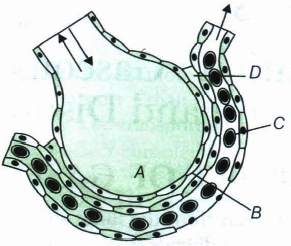
Tidal volume is the volume of air inspired or expired during normal respiration. It is about 6000 to 8000 mL of air per minute.
The hourly tidal volume for a healthy human can be calculated as:
Tidal volume = 6000 to 8000 mL/minute
Tidal volume in an hour = 6000 to 8000 mL × (60 min)
= 3.6 × 10⁵ mL to 4.8 × 10⁵ mL
Therefore, the hourly tidal volume for a healthy human is approximately 3.6 × 10⁵ mL to 4.8 × 10⁵ mL.
9.
| Partial Pressure of Gases Compared to Atmospheric Pressure | |||||
| Respiratory Gases |
Atmospheric Air |
Alveoli | Blood (Deoxygenated) |
Blood (Oxygenated) |
Tissue |
| O2 | 159 | 104 | 40 | 95 | 40 |
| CO | 0.3 | 40 | 45 | 40 | 45 |
10.
Alveoli are the primary sites of exchange of gases. Exchange of gases also occur between blood and tissues. O2 and CO2 are exchanged in these sites by simple diffusion mainly based on pressure/ concentration gradient. Solubility of the gases as well as the thickness of the membranes involved in diffusion are also some of the important factors that can affect the rate of diffusion. Pressure contributed by an individual gas in a mixture of gases is called partial pressure and is represented as pO2 for oxygen and pCO2 for carbon dioxide.

11th Standard CBSE Syllabus & Materials
11th Standard CBSE
CBSE 11th Business Studies Forms of Business Organisation Sample Question Papers Study Material - QB365 Set A
NEW11th Standard CBSE
CBSE 11th Business Studies Business, Trade and Commerce Sample Question Papers Study Material - QB365 Set A
NEW11th Standard CBSE
CBSE 11th Physics Waves Sample Question Papers Study Material - QB365 Set A
NEW11th Standard CBSE
CBSE 11th Physics Kinetic Theory Sample Question Papers Study Material - QB365 Set A



CBSE 11th Standard CBSE Subjects
CBSE Standards









