
 100% FREE ACCESS
11th Standard CBSE Syllabus & Materials
11th Standard CBSE
CBSE 11th Economics PART-A - Presentation of Data - New Sample Question Papers Study Material - QB365 Set A
NEW11th Standard CBSE
CBSE 11th Economics PART-A - Organisation of Data - New Sample Question Papers Study Material - QB365 Set A
NEW11th Standard CBSE
CBSE 11th Economics PART-A - Collection of Data - New Sample Question Papers Study Material - QB365 Set A
NEW11th Standard CBSE
CBSE 11th Economics PART-A - Introduction to Economics and Statistics - New Sample Question Papers Study Material - QB365 Set A
NEW11th Standard CBSE
CBSE 11th Business Studies International Trade Sample Question Papers Study Material - QB365 Set A
NEW11th Standard CBSE
CBSE 11th Business Studies Evolution and Fundamentals of Business Sample Question Papers Study Material - QB365 Set A

Published on: 10/09/2019
Chemical Coordination and Integration
Download CBSE Class 11th Standard CBSE Biology question papers, sample papers, important questions, and previous year solved papers in PDF format. Get free study materials, NCERT solutions, and exam preparation resources for Class 11th Standard CBSE Biology
Questions + Answers key
Take MCQ Biology Test
1.
When does the secretion of Adrenocorticotropin take place in the body? what is the purpose of its secretion?
2.
Distinguish between endocrine and exocrine glands.
3.
Which hormone is responsible for maintenance of diurnal rhythm of our body? Mention its source.
4.
There are many endocrine glands in human body. Name the gland, which is absent in male and the one absent in female.
5.
Identify the neurohormone that has its functioning in inhibiting the secretion of growth hormone from anterior lobe of pituitary.
6.
Mention the name of the hormone that is responsible for urge of sex in males
7.
Which composite gland contains both exocrine and endocrine portions.
8.
What are the relesing hormone?
9.
What is meant by 'synergistic effect'? Explain with an example
10.
Diagrammatically indicate the location of the various endocrine glands in our body.
11.
How does progesterone function in a human female?
12.
Fill up the blank spaces (i) - (vi) in the table given below
| Name of Endocrine Gland | Secreted Hormone | Functions of the Hormone |
| Pituitary | (i) | Reabsorption of water and electrolytes in the kidney |
| (ii) .......... | Insulin | (iii) ..... |
| Thymus | Thymosins | (iv) ..... |
| Ovary | (v) .... and | |
| (vi) ..... | Thyroxine | Development of growing ovarian follicles controls the metabolism of proteins, fats and carbohydrates. |
13.
How do you justify the statement that hormones of adrenal medulla are emergency hormones?
14.
Mention the major classes of hormones released in humans. Give the examples of each.
15.
Write short notes on the functions of the following hormones:
(a) Parathyroid hormone (PTH)
(b) Thyroid hormones
(c) Thymosins
(d) Androgens
(e) Estrogens
(f) Insulin and Glucagon
16.
List the hormones secreted by the following:
(a) Hypothalamus
(b) Pituitary
(c) Thyroid
(d) Parathyroid
(e) Adrenal
(f) Pancreas
(g) Testis
(h) Ovary
(i) Thymus
(j) Atrium
(k) Kidney
(l) G-I Tract
17.
Calcium plays a very important role in the formation of bones. Write about the role of endocrine glands and hormones responsible for maintaining calcium homoeostasis.
18.
Match the following columns
| Column I | Column II |
| T4 | Hypothalamus |
| PTH | Thyroid |
| GnRH | Pituitary |
| LH | Parathyroid |
19.
Melanotrophin (MSH) : _______.
20.
Gonadotrophins (LH, FSH) : _______.
21.
Corticotrophin (ACTH) : _______.
22.
Thyrotrophin (TSH) : ______.
23.
Hypothalamic hormones : ______.
1.
Adrenocorticotropin is secreted when adrenocorticotropin Releasing Hormone (ACRH) stimulates the corticotroph cells of the anterior lobe of pituitary gland.
It is released because its stimulation is responsible for the synthesis and secretion of glucocorticoid steroid hormone from the adrenal cortex od adrenal gland.
2.
| Endocrine Glands | Exocrine Glands. |
| They do not have ducts | They have ducts |
| They secrete hormones directly into blood | They secrete their secretions into the ducts |
| e.g,, thyroid, hypothalamus pituitary, etc | e.g., sweat and oil glands (of skin ) liver and salivary glands. |
3.
The hormone responsible for diurnal rhythm of our body is melatonin. The source of its secretion is pineal gland
4.
The glands, which are asbsent in male are ovaries and which are absent in female are tests.
5.
Somatostatin inhibits the secretion of growth hormone from anterior lobe of pituitary gland.
6.
Testosterone homone is responsible for ruge of sex in males.
7.
The pancreas has both exocrine and endocrine parts.
8.
Any substance, usually of hypothalamic origin, capable of accelerating the rate of secretion of a given hormone by the anterior pituitary gland.
9.
It is a type of hormones complement each other's actions and both are needed for full expression of the hormone effects. e.g., the production, secretion and ejection of milk by mammary glands require the synergistic effects of oestrogens, progesterone, prolactin and oxytocin.
10.
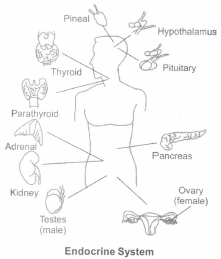
11.
Following are the functions performed by progesterone
(i) Helps in maintaining pregnancy.
(ii) Stimulates the development of secretory alveoli in mammary gland and secretion of milk.
(iii) Its secretion is influenced by luteinising hormone of anterior pituitary.
12.
(i) Vasopressin
(ii) Pancreas
(iii) Reduces blood glucose level
(iv) Differentiation of T-Iymphocytes
(v) Estrogen
(vi) Thyroid.
13.
Hormones of adrenal medulla, adrenaline and noradrenaline are secreted in response to any kind of stress, danger and during emergency situations like fall in blood pressure or sugar, increase respiratory rate and heartbeat. CNS at the time of stress or danger. All these conditions need more energy for their action. Thus, because these hormones prepare the body to face stress or danger hence, are called emergency hormones.
14.
Although hormones are chemically diverse, they generally belong to one of four different chemical groups
(i) Steriod hormones : These hormones are manufactured by endocrine cells form cholesterol, an important type of lipid in the human body. Examples include cortisol, aldosterone, oestrogen, progesterone and testosterone.
(ii) Amino acid derivatives : The thyroid hormones (T3 and T4) are synthesised from the amino acid throsine and iodide, respectively. Adernaline (also known as epinephrine) and noradrenaline (also known as nerephrine) are produced by the medulla of the adernal gland, are also derived from tyrosine. Melatonin is synthesised from the amino acid tryptophan.
(iii) Protein hormones : These hormones are long, folded chains of amino acids. Included among these hormones are insulin , glucagons, parathyroid hormone, growth hormone, prolactin, etc.
(iv) Peptide hormones : Hormones such as oxytocin and antidiuretic hormone re smaller than protein horemone. They are made up of a short chain of amino acids.
15.
(a) Function of Parathyroid Hormone. Parathyroid hormone (PTH)increases the Ca2+ levels in the blood. PTH acts on bones and stimulates the process of bone resorption (dissolution/ demineralisation). PTH also stimulates reabsorption of Ca2+ by the renal tubules and increases Ca2+ absorption from the digested food.It is, thus, clear that PTH is a hypercalcemic hormone, i.e., it increases the blood Ca2+ levels. Along with TCT, it plays a significant role in calcium balance in the body.
(b) Functions of Thyroid Hormones. Thyroid hormones play an important role in the regulation of the basal metabolic rate. These hormones also support the process of red blood cell formation. Thyroid hormones control the metabolism of carbohydrates, proteins and fats. Maintenance of water and electrolyte balance is also influenced by thyroid hormones. Thyroid gland also secretes a protein hormone called thyrocalcitonin (TCT)which regulates the blood calcium levels.
(c) Functions of Thymosins. Thymosins playa major role in the differentiation of T-Iymphocytes, which provide cell-mediated immunity. In addition, thymosins also promote production of antibodies to provide humoral immunity.
(d) Androgens. Development of male accessory sex organs, spermatogenesis
(e) Estrogens. Development of female accessory organs, mammary glands, ovarian follicle
(f) Insulin and Glucagon. Insulin maintains glucose homeostasis and glucagon maintains normal glucose level in blood.
16.
(a) Hypothalamus - Releasing hormone and Inhibiting hormone.
(b) Pituitary - Growth hormone, Prolactin, Thyroid stimulating hormone, Adrenocorticotrophic hormone, Luteinizing hormone, Follicle stimulating hormone, Melatonin.
(c) Thyroid - Tetraiodothyronine, Triiodothyronine.
(d) Parathyroid - Parathyroid hormone.
(e) Adrenal - Adrenalin or Epinephrine, Noradrenaline or norepinephrine Corticoids.
(f) Pancreas - Glucagon, Insulin.
(g) Testis - Testosterone.
(h) Ovary - Estrogen, Progesterone.
(i) Thymus - Thymosin.
(j) Atrium - Atrial Natriuretic Factor
(k) Kidney - Erythropoietin.
(l) GI Tract - Gastrin, Secretin, Cholecystokinin (CCK)Gastric Inhibitory Peptide (GIP)
17.
The endocrine glands and hormones that are responsible for maintaining calcium homeostasis, are thyroid and parathyroid glands and their associated hormones an calcitonin and Parathyroid Hormone (PTH).
(i) Parathyroid glands are the glands developed from the endoderm of the embryo The cells of parathyroid glands are of two types, i.e., chief cells and oxyphil cells. Thr chief cells of the parathyroid glands secrete parathyroid hormone (PTH).
This hormone (PTH) is involved in regulating calcium and phosphate balance betweer the blood and other tissue. It mobilises the release of calcium into the blood from bones. PTH increases calcium reabsorption by the body organs like intestine anc kidneys.
(ii) Thyroid gland is the largest endocrine gland located anterior to the thyroid cartilage o. the larynx in the neck. This gland plays a vital role in maintaining calcium homeostasis It releases thyroculcitonin hormone produced by the parafollicular cells, also called 'C cells.
This hormone is secreted when the calcium level in blood gets high. It is a 32 aminc acid peptide hormone that lowers the calcium level by suppressing release of catciurr ions from the bones. Thus, calcitonin has an action opposite to that of the parathyroic hormone on calcium homeostasis.

18.
19.
()
Melanocytes
20.
()
Testis and Ovaries
21.
()
Adrenal cortex
22.
()
Thyroid Gland
23.
()
Pituitary gland

11th Standard CBSE Syllabus & Materials
11th Standard CBSE
CBSE 11th Business Studies Forms of Business Organisation Sample Question Papers Study Material - QB365 Set A
NEW11th Standard CBSE
CBSE 11th Business Studies Business, Trade and Commerce Sample Question Papers Study Material - QB365 Set A
NEW11th Standard CBSE
CBSE 11th Physics Waves Sample Question Papers Study Material - QB365 Set A
NEW11th Standard CBSE
CBSE 11th Physics Kinetic Theory Sample Question Papers Study Material - QB365 Set A



CBSE 11th Standard CBSE Subjects
CBSE Standards









