
 100% FREE ACCESS
11th Standard CBSE Syllabus & Materials
11th Standard CBSE
CBSE 11th Economics PART-A - Presentation of Data - New Sample Question Papers Study Material - QB365 Set A
NEW11th Standard CBSE
CBSE 11th Economics PART-A - Organisation of Data - New Sample Question Papers Study Material - QB365 Set A
NEW11th Standard CBSE
CBSE 11th Economics PART-A - Collection of Data - New Sample Question Papers Study Material - QB365 Set A
NEW11th Standard CBSE
CBSE 11th Economics PART-A - Introduction to Economics and Statistics - New Sample Question Papers Study Material - QB365 Set A
NEW11th Standard CBSE
CBSE 11th Business Studies International Trade Sample Question Papers Study Material - QB365 Set A
NEW11th Standard CBSE
CBSE 11th Business Studies Evolution and Fundamentals of Business Sample Question Papers Study Material - QB365 Set A

Published on: 10/09/2019
Digestion and Absorption
Download CBSE Class 11th Standard CBSE Biology question papers, sample papers, important questions, and previous year solved papers in PDF format. Get free study materials, NCERT solutions, and exam preparation resources for Class 11th Standard CBSE Biology
Questions + Answers key
Take MCQ Biology Test
1.
Which type of monosaccharide are absorbed by the mechanism of simple diffusion?
2.
Out of the three types of salivary glands, which one is situated in the upper palate on either side of cheek?
3.
State the indispensable protease of small intestine which does not directly take part in protein digestion
4.
During swallowing of food, the windpipe are closed by a flap-like structure. Identify it.
5.
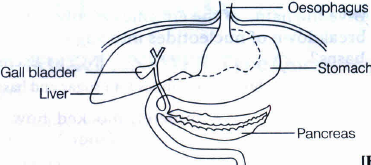
The diagram shows part of the human alimentary canal.Which two structures produce substances involved in the digestion of fats?
6.
Name any two enzymes of saliva and also mention their function
7.
Trypsin acts at an alkaline pH.What provides this alkalinity?Give the two actions of trypsin.
8.
What is the location of ileocaecal valve in the alimentary canal of the human? Mention it's role.
9.
Why does our mouth become watery sometimes when we eat or think about the food we like?
10.
Which part of the alimentary canal produce local digestive hormones? What would happen if these hormones are not produced?
11.
Fill in the blanks A - F in the different columns of the table given below.
| Enzyme | Site of Action | Substrate | Product of Action |
| Salivary amylase | Mouth and Stomach | A | Maltose |
| B | Stomach | Proteins | Proteoses and peptones |
| Trypsin | C | Proteins, peptones and proteoses | Dipeptides |
| Lipase | Small intestine | Fats | D |
| E | Small intestine | Nucleic acid | Nucleotides and nucleosides |
| Lactase | Small intestine | F | Glucose and galactose |
12.
What would happen if the liver does not secrete bile?
13.
Distinguish between constipation and indigestion.Mention their major causes.
14.
How is fat absorbed in the blood?
15.
What are the functions of liver?
16.
Discuss the main steps in the digestion of proteins as the food passes through different parts of the alimentary canal.
17.
How does butter in your food get digested and absorbed in the body? Explain
18.
Succus entericus is the name given to
a junction between ileum and large intestine
intestinal juice
swelling in the gut
appendix
19.
Gastric juice contains
pepsin, lipase and rennin
trypsin, lipase and rennin
trypsin, pepsin and lipase
trypsin, pepsin and rennin
20.
Salivary gland
21.
Digestion of fat
22.
Hydrolysis of starch
23.
Bilirubin and biliverdin
1.
()
Glucose,a monosaccharide is absorbed by a simple diffusion
2.
()
Parotid glands (a type of salivary glands) is situated in the upper palate on either side of the cheek.
3.
()
Enterokinase is protease enzyme of small intestine, which does not directly take part in the protein digestion.
4.
()
Epiglottis is a flap-like structure, that closes the windpipe during swallowing of food.
5.
Bile is produced by the liver and pancreatic juice is secreted by pancreas.Liver and pancreas are the two glands of alimentary canal these produce substances (enzymes and bile free) involved in the digestion of fat.
6.
Lysozyme and salivary amylase.Lysozyme kills bacteria and amylase digest carbohydrate,specially starch
7.
The alkaline pH is provided by the following type of secretions
(i) Secretion of Brunner's glands,
(ii) The bicarbonates from the pancreas
(iii) Bile
Actions of trypsin are follows as
(i) Activates other proteases and
(ii) Acts on the proteins proteases and peptones.
8.
Ileocaecal valve is present where an ileum of small intestine enters the cecum of the large intestine. It helps in preventing the backflow of fecal matter from caecum into ileum.
9.
The salivary glands present in our mouth produce saliva, which makes our mouth watery. The brain registers, that food is coming and instructs the salivary gland present underneath the tongue to produce saliva, which helps in breakdown of food as we chew it. Thus, making it softer as it enters the gut.
10.
The local digestive hormones are produced by gastric and intestinal mucosa e.g., secretin, cholesyctokinine, etc. The hormones stimulate the activity of enzymes. If these are not produced, the process of digestion will be hindered and digestive system will not work properly.
11.
A - Starch, B - Pepsin, C - Duodenum, D - Fatty acids + Glycerol, E - Nucleases and F - Lactose.
12.
If the liver would stop secreting the bile,following may happen
(i) The fats in our diet would not digested, it is because bile helps in emulsiying fats and breaks it down for the body to absorb
(ii) The liver makes bile from chlesterol.Thus,higher levels of cholesterol in the body may occur.
(iii) Bilirubin is made from our dead red blood cells and is a type of a pigment , that also acts as a part of the bile.Hence, if the liver does not secrete bile, the bilirubin would stay in blood instead of being converted by the liver into soluble form and flows with the bile.
(iv) This may our skin,white of the wyes more yellow in color(jaundice),darken our urine and the stools would be whiter in color.
13.
Constipation In this condition,the faces are retained within the rectum as the bowl movement occur irregularly.The causes of constipation are water defiency,lack of roughage in diet,etc.
Indigestion In this condition,the food is not properly digested leading to a feeling of fullness.The causes of indegestion are inadequate enzyme secretion,anxiety,food poisoning,over eating and spicy food
14.
Absorption of fat takes place in the following ways
(i) Digested fat is absorbed in the small intestine
(ii) Bile salts break up bigger molecules of fat into small droplets called micelles that move into intestinal mucosa
(iii) They are reformed into small protein coated fat globules called chylomicrons
(iv) These are transported to lymph vessels(lacteals) in this villi
(v) These lymph vessels ultimately release the absorbed substances into bloodstream.
15.
Functions of Liver:
Synthesis
1. A large part of amino acid synthesis.
2. The liver performs several roles in carbohydrate metabolism:
3. The liver is responsible for the mainstay of protein metabolism, synthesis as well as degradation.
4. The liver also performs several roles in lipid metabolism:
5. The liver produces coagulation factors I (fibrinogen), II (prothrombin), V, VII, IX, X and XI, as well as protein C, protein S and antithrombin.
6. In the first trimester of fetus the liver is the main site of red blood cell production. By the 32nd week of gestation, the bone marrow has almost completely taken over that task.
7. The liver produces and excretes bile (a greenish liquid) required for emulsifying fats. Some of the bile drains directly into the duodenum, and some is stored in the gallbladder.
Breakdown
1.The breakdown of insulin and other hormones.
2. The liver breaks down hemoglobin, creating metabolites that are added to bile as pigment (bilirubin and biliverdin).
3. The liver breaks down toxic substances and most medicinal products in a process called drug metabolism.
4. The liver converts ammonia to urea.
16.
Digestion of proteins in stomach
The proenzyme pepsinogen on exposure to HCl, gets converted into active enzyme pepsin.
Protein \(\rightarrow\)Proteoses + Peptones
Pepsin always acts in acidic medium (pH 1.8). In infants, milk proteins are digested by rennin.
Digestion of protein in small intestine Pancreatic juice contains proenzyme, i.e., trypsinogen that gets activated by an enterokinase, which is secreted by intestinal mucosa, into active trypsin. Trypsin acts in alkaline medium.
\(Protein\underrightarrow { Trypsin\quad /\quad Chymotrypsin } Dipeptides\)
The dipeptides are changed into amino acids by the enzyme succus entericus (intestinal juice).
\(Dipeptides\underrightarrow { Dipeptidases } Amino\quad acids\)
17.
(i) Digestion of butter Butter is a fatty substance and by esterases most importat of which is lipase.Digestion of butter starts in stomach and gets completed in small intestine
(a)In stomach Gastric juices contain a weak lipolytic gastric lipase,which hydrolyses only small amount of fats
(b) In intenstine Bilw salts of the bile juice emulsify the fats and increase the surface area for the action of lipases,while its sodium bicarbonate provides alkaline medium in small intestine.
Pancreatic lipase is strongest lipolytic enzyme that hydrolyses about two-third of triglycerides.Intestinal liapse hydrolyses remaining triglycerids.But,fat digestion is never complete.Digestion products include glycerol,fatty acids,monoglycerides and small amount of aiglycerides
18.
(b)
intestinal juice
19.
(a)
pepsin, lipase and rennin
20.
()
Parotid
21.
()
Lipases
22.
()
Amylases
23.
()
Bile

11th Standard CBSE Syllabus & Materials
11th Standard CBSE
CBSE 11th Business Studies Forms of Business Organisation Sample Question Papers Study Material - QB365 Set A
NEW11th Standard CBSE
CBSE 11th Business Studies Business, Trade and Commerce Sample Question Papers Study Material - QB365 Set A
NEW11th Standard CBSE
CBSE 11th Physics Waves Sample Question Papers Study Material - QB365 Set A
NEW11th Standard CBSE
CBSE 11th Physics Kinetic Theory Sample Question Papers Study Material - QB365 Set A



CBSE 11th Standard CBSE Subjects
CBSE Standards









