
 100% FREE ACCESS
11th Standard CBSE Syllabus & Materials
11th Standard CBSE
CBSE 11th Economics PART-A - Presentation of Data - New Sample Question Papers Study Material - QB365 Set A
NEW11th Standard CBSE
CBSE 11th Economics PART-A - Organisation of Data - New Sample Question Papers Study Material - QB365 Set A
NEW11th Standard CBSE
CBSE 11th Economics PART-A - Collection of Data - New Sample Question Papers Study Material - QB365 Set A
NEW11th Standard CBSE
CBSE 11th Economics PART-A - Introduction to Economics and Statistics - New Sample Question Papers Study Material - QB365 Set A
NEW11th Standard CBSE
CBSE 11th Business Studies International Trade Sample Question Papers Study Material - QB365 Set A
NEW11th Standard CBSE
CBSE 11th Business Studies Evolution and Fundamentals of Business Sample Question Papers Study Material - QB365 Set A

Published on: 12/10/2019
Digestion and Absorption
Download CBSE Class 11th Standard CBSE Biology question papers, sample papers, important questions, and previous year solved papers in PDF format. Get free study materials, NCERT solutions, and exam preparation resources for Class 11th Standard CBSE Biology
Questions + Answers key
Take MCQ Biology Test
1.
Make a well labeled diagram of the digestive system of human.
2.
Explain absorption of food in the small intestine
3.
How is food digested in the stomach?
4.
Explain different enzyme's action in the succus eniericus.
5.
Explain how digestion takes place in mouth?
6.
What are the functions of liver?
7.
How are the activities of gastrointestinal tract regulated?
8.
Discuss the main steps in the digestion of proteins as the food passes through different parts of the alimentary canal.
9.
How does butter in your food get digested and absorbed in the body? Explain
10.
Name of the largest gland present in human body. Describe its role in digestion of food.
1.
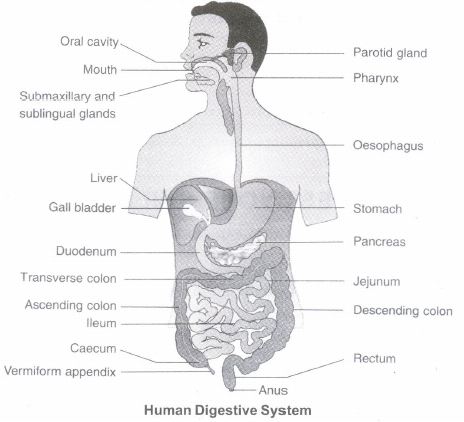
2.
The breakdown of bio-macromolecules mentioned above occurs in the duodenum region of the small intestine. The simple substances thus formed are absorbed in the jejunum and ileum regions of the small intestine. The undigested and unabsorbed substances are passed on to the large intestine. No significant digestive activity occurs in the large intestine. The functions of large intestine are:
(i) absorption of some water, lTlincrals and certain drugs;
(ii) secretion of mucus which helps in adhering the waste (undigested) particles together and lubricating it for an easy passage.
Transport of water depends upon the osmotic gradient. Active transport occurs against the concentration gradient and hence requires energy. Various nutrients like amino acids, monosaccharides like glucose, electrolytes like Na+ are absorbed into the blood by this mechanism.
Fatty acids and glycerol being insoluble, cannot be absorbed into the blood. They are first incorporated into small droplets called micelles which move into the intestinal mucosa. They are re-formed into very small protein coated fat globules called the chylomicrons which are transported into the lymph vessels (lacteals) in the villi. These lymph vessels ultimately release the absorbed substances into the blood stream.
3.
The stomach stores the food for 4-5 hours.The food mixes thoroughly with the acidic gastric juice of the stomach by the churning movements of its muscular wall and is called the chyme. The proenzyme pepsinogen, on exposure to hydrochloric acid gets converted into the active enzyme pepsin, the proteolytic enzyme of the stomach. Pepsin converts proteins into proteoses and peptones (peptides).
The mucus and bicarbonates present in the gastric juice play an important role in lubrication and protection of the mucosal epithelium from excoriation by the highly concentrated hydrochloric acid.
Hel provides the acidic pH (pH 1.8) optimal for pepsins. Rennin is a proteolytic enzyme found in gastric juice of infants which helps in the digestion of milk proteins.Small amounts of lipases are also secreted by gastric glands.
4.
Dipeptides\(\overset { Dipeptidases }{ \longrightarrow } \) Amino Acids
Maltose\(\overset { Maltase }{ \longrightarrow } \) Glucose + Glucose
Lactose \(\overset { Lactase }{ \longrightarrow } \)Glucose + Galactose
Sucrose\(\overset { Sucrase }{ \longrightarrow } \) Glucose + Fructose
Nucleotides\(\overset { Nucleotidase }{ \longrightarrow } \) Nucleosides \(\overset { Nucleotidase }{ \longrightarrow } \)Sugars + Bases
Di-and Monoglycerides \(\overset { Lypase }{ \longrightarrow } \)Fatty Acids + Glycerol.
5.
Digestion Process in Mouth. The buccal cavity performs two major functions,mastication of food and facilitation of swallowing. The teeth and the tongue with the help of saliva masticate and mix up the food thoroughly. Mucus in saliva helps in lubricating and adhering the masticated food particles into a bolus.
Action of Saliva. The saliva secreted into the oral cavity contains electrolytes (Na+, K+,CI-, HCO-) and enzymes, salivary amylase and lysozyme.The chemical process of digestion is initiated in the oral cavity by the hydrolytic action of the carbohydrate splitting enzyme, the salivary amylase. About 30 per cent of starch is hydrolysed here by this enzyme (optimum pH 6.8) into a disaccharide - maltose. Lysozyme present in saliva acts as an antibacterial agent that prevents infections.
Starch \(\overset { Salivary\quad Amylase }{ \underset { pH\quad 6.8 }{ \longrightarrow } } \) Maltose
The bolus is then conveyed into the pharynx and then into the oesophagus by swallowing or deglutition.The bolus further passes down through the oesophagus by succes sive waves of muscular contractions called peristalsis. The gastrooesophageal sphincter controls the passage of food into the stomach.
6.
Functions of Liver:
Synthesis
1. A large part of amino acid synthesis.
2. The liver performs several roles in carbohydrate metabolism:
3. The liver is responsible for the mainstay of protein metabolism, synthesis as well as degradation.
4. The liver also performs several roles in lipid metabolism:
5. The liver produces coagulation factors I (fibrinogen), II (prothrombin), V, VII, IX, X and XI, as well as protein C, protein S and antithrombin.
6. In the first trimester of fetus the liver is the main site of red blood cell production. By the 32nd week of gestation, the bone marrow has almost completely taken over that task.
7. The liver produces and excretes bile (a greenish liquid) required for emulsifying fats. Some of the bile drains directly into the duodenum, and some is stored in the gallbladder.
Breakdown
1.The breakdown of insulin and other hormones.
2. The liver breaks down hemoglobin, creating metabolites that are added to bile as pigment (bilirubin and biliverdin).
3. The liver breaks down toxic substances and most medicinal products in a process called drug metabolism.
4. The liver converts ammonia to urea.
7.
The activities of the gastrointestinal tract are under neural and hormonal control for proper coordination of different parts
The sight, smell and/or the presence of food in the oral cavity can stimulate the secretion of saliva
Similarly, gastric and intestinal secretions are also stimulated by neural signals.
The muscular activites of different parts of the alimentary canal can also be moderated by neural mechanisms (both local and through CNS).
Hormonal control of the secretion of digestive juices is carried out by local hormones produced by the gastric and intestinal mucosa.
8.
Digestion of proteins in stomach
The proenzyme pepsinogen on exposure to HCl, gets converted into active enzyme pepsin.
Protein \(\rightarrow\)Proteoses + Peptones
Pepsin always acts in acidic medium (pH 1.8). In infants, milk proteins are digested by rennin.
Digestion of protein in small intestine Pancreatic juice contains proenzyme, i.e., trypsinogen that gets activated by an enterokinase, which is secreted by intestinal mucosa, into active trypsin. Trypsin acts in alkaline medium.
\(Protein\underrightarrow { Trypsin\quad /\quad Chymotrypsin } Dipeptides\)
The dipeptides are changed into amino acids by the enzyme succus entericus (intestinal juice).
\(Dipeptides\underrightarrow { Dipeptidases } Amino\quad acids\)
9.
(i) Digestion of butter Butter is a fatty substance and by esterases most importat of which is lipase.Digestion of butter starts in stomach and gets completed in small intestine
(a)In stomach Gastric juices contain a weak lipolytic gastric lipase,which hydrolyses only small amount of fats
(b) In intenstine Bilw salts of the bile juice emulsify the fats and increase the surface area for the action of lipases,while its sodium bicarbonate provides alkaline medium in small intestine.
Pancreatic lipase is strongest lipolytic enzyme that hydrolyses about two-third of triglycerides.Intestinal liapse hydrolyses remaining triglycerids.But,fat digestion is never complete.Digestion products include glycerol,fatty acids,monoglycerides and small amount of aiglycerides
10.
Liver of the largest gland present in human body which is mainly responsible for the digestion of food
Role of liver in digestion of food
(i) Its hepatic cells secrete bile juice which passes through the hepatic duct into the gall bladder.
(ii) It has its major role in processing of proteins i.e., formation of urea.
(iii) Bile secreted by it is mainly responsible for digestion of fats for easy absorption in the body.
(iv) Also responsible for the removal of toxins from blood.

11th Standard CBSE Syllabus & Materials
11th Standard CBSE
CBSE 11th Business Studies Forms of Business Organisation Sample Question Papers Study Material - QB365 Set A
NEW11th Standard CBSE
CBSE 11th Business Studies Business, Trade and Commerce Sample Question Papers Study Material - QB365 Set A
NEW11th Standard CBSE
CBSE 11th Physics Waves Sample Question Papers Study Material - QB365 Set A
NEW11th Standard CBSE
CBSE 11th Physics Kinetic Theory Sample Question Papers Study Material - QB365 Set A



CBSE 11th Standard CBSE Subjects
CBSE Standards









