
 100% FREE ACCESS
11th Standard CBSE Syllabus & Materials
11th Standard CBSE
CBSE 11th Economics PART-A - Presentation of Data - New Sample Question Papers Study Material - QB365 Set A
NEW11th Standard CBSE
CBSE 11th Economics PART-A - Organisation of Data - New Sample Question Papers Study Material - QB365 Set A
NEW11th Standard CBSE
CBSE 11th Economics PART-A - Collection of Data - New Sample Question Papers Study Material - QB365 Set A
NEW11th Standard CBSE
CBSE 11th Economics PART-A - Introduction to Economics and Statistics - New Sample Question Papers Study Material - QB365 Set A
NEW11th Standard CBSE
CBSE 11th Business Studies International Trade Sample Question Papers Study Material - QB365 Set A
NEW11th Standard CBSE
CBSE 11th Business Studies Evolution and Fundamentals of Business Sample Question Papers Study Material - QB365 Set A

Published on: 28/09/2019
Digestion and Absorption
Download CBSE Class 11th Standard CBSE Biology question papers, sample papers, important questions, and previous year solved papers in PDF format. Get free study materials, NCERT solutions, and exam preparation resources for Class 11th Standard CBSE Biology
Questions + Answers key
Take MCQ Biology Test
1.
What are the symptoms of marasmus?
2.
What are the causes of kwashiorkar?
3.
What are the causes of marasmus?
4.
What is the function of large intestine?
5.
What is digestive waste and how is it removed from the body?
6.
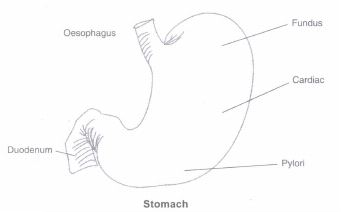
Give a diagram showing different regions of the stomach
7.
What is the role of appendix in digestion?
8.
What would happen if HCl were not secreted in the stomach?
9.
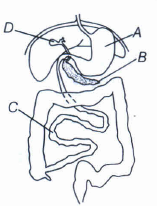
Out of the parts labelled as A, B, C and D of alimentary canal in the diagram below.Where is the enzyme responsible for the first stage of protein digestion produced?Label all parts, i.e., A-D.
10.
What would happen if for some reason goblet cells become non-functional. Why are these important for digestive system?
11.
Give the name along with the function of each of the three major kinds of cells of the gastric glands.
12.
Explain the action of different enzymes in succus entericus.
13.
Distinguish between constipation and indigestion.Mention their major causes.
14.
What would happen if HCl will not be secreted in the stomach?
15.
How is fat absorbed in the blood?
1.
Symptoms of marasmus:
i) Thinning of limbs
ii) Dry and wrinkled skin
iii) Very low body weight
iv) Growth retardation.
v) Impaired development of brain and mental faculty.
2.
Causes of Kwashiorkar:
Protein deficiency unaccompanied by calorie deficiency can lead to kwashiorkor.It results from the replacement of mother's milk by a hhigh-calorie low protein diet in child more than one year in age.
3.
Causes of marasmus:
Simultaneous deficiency of proteins and calories can lead to marasmus.In infants less than a year in age, if mother's milk is replaced too early by other foods which are poor in both proteins and calorific value; marasmus can be prevalent. This can happen if the mother has second pregnancy or childbirth when the older infant is still too young.
4.
Types of cells in gastric glands.
(a) Mucus neck cells secrete mucus.
(b) Peptic or chief cells secrete proenzyme pepsinogen.
(c) Parietal or oxyntic cells secrete HCl and intrinsic factor. Infrinsic factor is essential for absorption of vitamin B12.
5.
After digestion and absorption of food is over the residue left makes the digestive waste. The digestive wastes, solidified into coherent faeces in the rectum initiate a neural reflex causing an urge or desire for its removal. The egestion of faeces to the outside through the anal opening (defaecation) is a voluntary process and is carried out by a mass peristaltic movement.
6.
7.
Appendix is a vestigial organ and plays no role in digestion in human beings.
8.
Importance of HCl secreted by stomach:
HCl provides the acidic pH (pH 1.8) optimal for pepsins. Rennin is a proteolytic enzyme found in gastric juice of infants which helps in the digestion of milk proteins. Small amounts of lipases are also secreted by gastric glands. Without HCl, infants won't be able to digest milk proteins.
HCl is also necessary to kill harmful bacteria which may be present in the food. In the absence of HCl harmful bacteria will not be killed creating problems.
9.
In the labelled part A(i.e., the stomach,) the enzyme responsible for first stage of protein digestion is produced.A-stomac, B-pancrease,C-small intestine,D-gall bladder.
10.
If goblet cells are non-functional for some reason, this will adversely affect smooth movement of food down the intestine due to the absence of much.
These glands secrete mucus which along with succus entericus which helps in digestion and movement of food material in the alimentary canal.
11.
Gastric gland includes three major types of cells. These are as follows
| Mucus (neck) cells | Secrete mucus |
| Peptic or chief cells | Secrete pepsinogen |
| Parietal or oxyntic cells | Secrete hydrochloric acid and intrinsic factor. |
12.
\(Dipeptides\underrightarrow { Dipeptidases } Amino\quad Acids\)
\(\\ Maltose\ \underrightarrow { Maltase } Glucose+ Glucose\)
\(\\ Lactose\ \underrightarrow { Lactase } Glucose +\ Galactose\)
\(\\ Sucrose \underrightarrow { Sucrase } \ Glucose\ +\ Fructose\)
\(\\ Nucleotides\ \underrightarrow { Nucleotidase } Nucleosides\ \underrightarrow { Nucleosidase } Sugars\ +\ Bases\)
\(\\ Di\ and\ monoglycerides\ \underrightarrow { Lipase } \ Fatty\ acids\ +\ Glycerol\)
13.
Constipation In this condition,the faces are retained within the rectum as the bowl movement occur irregularly.The causes of constipation are water defiency,lack of roughage in diet,etc.
Indigestion In this condition,the food is not properly digested leading to a feeling of fullness.The causes of indegestion are inadequate enzyme secretion,anxiety,food poisoning,over eating and spicy food
14.
If HCl will not be secreted in the stomach, pepsinogen (proenzyme) and prorennin (proenzyme) will not be converted into pepsin and rennin, respectively. HCl provides acidic medium. So that the enzyme can act on food in stomach. It also kills bacteria and other harmful organisms that may be present along with food.
15.
Absorption of fat takes place in the following ways
(i) Digested fat is absorbed in the small intestine
(ii) Bile salts break up bigger molecules of fat into small droplets called micelles that move into intestinal mucosa
(iii) They are reformed into small protein coated fat globules called chylomicrons
(iv) These are transported to lymph vessels(lacteals) in this villi
(v) These lymph vessels ultimately release the absorbed substances into bloodstream.

11th Standard CBSE Syllabus & Materials
11th Standard CBSE
CBSE 11th Business Studies Forms of Business Organisation Sample Question Papers Study Material - QB365 Set A
NEW11th Standard CBSE
CBSE 11th Business Studies Business, Trade and Commerce Sample Question Papers Study Material - QB365 Set A
NEW11th Standard CBSE
CBSE 11th Physics Waves Sample Question Papers Study Material - QB365 Set A
NEW11th Standard CBSE
CBSE 11th Physics Kinetic Theory Sample Question Papers Study Material - QB365 Set A



CBSE 11th Standard CBSE Subjects
CBSE Standards









