
 100% FREE ACCESS
11th Standard CBSE Syllabus & Materials
11th Standard CBSE
CBSE 11th Economics PART-A - Presentation of Data - New Sample Question Papers Study Material - QB365 Set A
NEW11th Standard CBSE
CBSE 11th Economics PART-A - Organisation of Data - New Sample Question Papers Study Material - QB365 Set A
NEW11th Standard CBSE
CBSE 11th Economics PART-A - Collection of Data - New Sample Question Papers Study Material - QB365 Set A
NEW11th Standard CBSE
CBSE 11th Economics PART-A - Introduction to Economics and Statistics - New Sample Question Papers Study Material - QB365 Set A
NEW11th Standard CBSE
CBSE 11th Business Studies International Trade Sample Question Papers Study Material - QB365 Set A
NEW11th Standard CBSE
CBSE 11th Business Studies Evolution and Fundamentals of Business Sample Question Papers Study Material - QB365 Set A

Published on: 10/09/2019
Excretory Products and Their Elimination
Download CBSE Class 11th Standard CBSE Biology question papers, sample papers, important questions, and previous year solved papers in PDF format. Get free study materials, NCERT solutions, and exam preparation resources for Class 11th Standard CBSE Biology
Questions + Answers key
Take MCQ Biology Test
1.
Explain mechanisms by which nephron adds some materials to the filtrate?
2.
Name the pigment that causes pale yellow colour of urine.
3.
Explain the function of vasa recta?
4.
What will happen if the stretch receptors of the urinary bladder wall are totally removed? Explain.
5.
State the importance of counter current systems in renal functioning.
6.
Discuss the regulation of kidney function by the heart.
7.
Give the name of the nitrogenous waste which is produced in birds.In what form is it eliminated from the body?What is the advantage of this type of excretion?
8.
How does ADH regulate body fluid volume.Explain?
9.
In which part of the excretory system of mammals you can first use the term urine?
10.
By which part of the vasa recta NaCl is returned to the medullary interstitium?
11.
Explain micturition.
12.
Give a brief account of the counter current mechanism.
13.
Write a brief note on atrial natriuretic factor.
14.
Give the name of the layers through which the glomerular capillary blood pressure causes filtration.
15.
Where do ultrafiltration, reabsorption, and secretion occur in a nephron?
16.
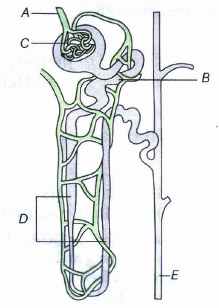
(i) Study the given structure carefully and label the parts given as A, B, C, D and E.
(ii) Give one major function of each of these.
17.
The glomerular filtrate in the loop of Henle gets concentrated in the descending and then gets diluted in the ascending limbs.Explain
18.
Terrestrial animals are generally either ureotelic or uricotelic, not ammonotelic, why ?
19.
ADH
20.
Uricotelism
21.
Micturition
22.
Bowman's capsule
23.
Match the items of column I with those of column II:
|
Column I |
Column II |
||
|
(a) |
Ammonotelism |
(i) |
Birds |
|
(b) |
Bowman’s capsule |
(ii) |
Water reabsorption |
|
(c) |
Micturition |
(iii) |
Bony fish |
|
(d) |
Uricotelism |
(iv) |
Urinary bladder |
|
(d) |
ADH |
(v) |
Renal tubule |
1.
Reabsorption mechanism by the PCT.
2.
Urine color generally ranges from a pale-yellow color to deep amber. This coloring is primarily caused by the pigment urochrome, also known as urobilin.
3.
The vasa recta helps in reabsorption of important nutrients from medullary interstitial tissues.
4.
As urine collects in the urinary bladder, the muscular walls of the bladder distend to accomodate it.The stretch receptors on the wall of the bladder send signals to the CNS by stimulating the sensory nerve ending in the bladder.It causes an urge to pass out the urine.So if the stretch receptors are totally removed from the bladder, urine will not be collected in the bladder and urination will keep continuing.
5.
The counter current mechanism has been evolved in higher vertebrates (birds and mammals including man) to excrete hypertonic urine(urine is more concentrated than blood) for conserving body water so necessary for land life.
6.
Atrial Natriuretic Factor(ANF) is secreted by the atria of heart, when blood flow increases. It causes vasodilation (dilation of blood vessels) and thereby, decrease the blood pressure. ANF works antagonistically to RAAS.
7.
Birds excrete uric acid in the form of pellet or paste (semi-solid form). It helps is conservation of water.
8.
Excessive loss of fluid from the body activates osmoreceptors, which stimulate the hypothalamus to release ADH from the neurohypophysis. ADH facilitates water reabsorption from posterior parts of tubule.This decreases osmolarity of blood.
An increase in body fluid volume can switch off the osmoreceptors and suppress the ADH release to complete the feedback.ADH also causes constrictory effects on blood vessels.
9.
The nephron and the collecting duct are lined by a transport epithelium that processes the filtrate, forming the urine. The fluid out of the collecting duct is called urine.
10.
NaCl is returned to the medullary interstitium by the ascending part of the vasa recta by reabsorption mechanism.
11.
Micturition : Urine formed by the nephrons is ultimately carried to the urinary bladder where it is stored till a voluntary signal is given by the central nervous system (CNS). This signal is initiated by the stretching of the urinary bladder as it gets filled with urine. In response, the stretch receptors on the walls of the bladder send signals to the CNS. The CNS passes on motor messages to initiate the contraction of smooth muscles of the bladder and simultaneous relaxation of the urethral sphincter causing the release of urine. The process of release of urine is called micturition and the neural mechanisms causing it is called the micturition reflex.
12.
Counter Current Mechanism. The Henle's loop and vasa recta play a significant role in this. The flow of filtrate in the two limbs of Henle's loop is in opposite directions and thus forms a counter current. The flow of blood through the two limbs of vasa recta is also in a counter current pattern. The proximity between the Henle's loop and vasa recta, as well as the counter current in them help in maintaining an increasing osmolarity towards the inner medullary interstitium, i.e., from 300 mOsmolL-1 in the cortex to about 1200 mOsmolL-1 in the inner medulla. This gradient is mainly caused by NaCI and urea. NaCI is transported by the ascending limb of Henle's loop which is exchanged with the descending limb of vasa recta. NaCl is returned to the interstitium by the ascending portion of vasa recta.
Similarly, small amounts of urea enter the thin segment of the ascending limb of Henle's loop which is transported back to the interstitium by the collecting tubule.
The above described transport of substances facilitated by the special arrangement of Henle's loop and vasa recta is called the counter current mechanism. This mechanism helps to maintain a concentration gradient in the medullary interstitium. Presence of such interstitial gradient helps in an easy passage of water from the collecting tubule thereby concentrating the filtrate (urine). Human kidneys can produce urine nearly four times concentrated than the initial filtrate, formed.
13.
ANF is commonly known as Atrial Natriuretic Factor.
ANF is a hormone produced by the walls of the atria of the heart in response to an increase in blood volume and pressure.It increases sodium excretion and decreases blood pressure.
ANF inhibits release of renin from Juxta Glomerular Apparatus(JGA) and thereby, inhibits NaCl reabsorption by the collecting duct and reduces aldosterone release from the adrenal gland.
Function The function of counter current mechanism is to concentrate NaCl in the intestitial fluid and thereby cause water to diffuse out of the collecting tubules and ducts and concentrate the urine.
14.
The layers through which the glomerular capillary blood pressure causes filtration are
i) The endothelium of glomerular blood vessels.
ii) The epithelium of Bowman's capsule.
iii) A basement membrane (present between these two above mentioned layers)
15.
i) Ultrafiltration occurs in Bowman's capsule.
ii) Reabsorption occur in PCT, loop of Henle ,DCT and Collecting ducts.
iii) Secretion occurs in PCT, loop of Henle and DCT.
16.
(i) A - Afferent arteriole,
B - Proximal convoluted tubule,
C - Glomerulus,
D - Loop of Henle,
E - Collecting duct
(ii) Following are the functions of each above mentioned part
A - Carry blood to glomerulus for ultrafiltration.
B - Selective reabsorption of useful substances.
C - Ultrafiltration of blood.
D - Maintenance of the high osmolarity of medullary interstitial fluid.
E - Reabsorption of water to form hypertonic urine.
17.
The gradient of increasing hyperosmolarity of medullary interstitium is maintained by a counter current mechanism and the proximity between the Henle's loop and vasa recta.
This gradient is mainly caused by NaCl and urea.The transport of these substances facilitated by the special arrangement of Henle's loop and vasa recta is called the counter current mechanism.
NaCl is transported by the ascending limb of Henle's loop, which is exchanged with the descending limb of vasa recta.NaCl is returned to the medullary interstitium by the ascending part of the vasa recta.
But,contrarily, the water diffuses into the blood of ascending limb of vasa recta and is carried away into the general blood circulation.
Permeability to urea is found only in the deeper parts of thin ascending limbs of Henle's loops and collecting ducts.Urea diffuses out of the collecting ducts and enters into the thin.
18.
Terrestrial adaptation requires the production of less toxic nitrogenous wastes like urea and uric acid for the conservation of water. Aquatic animals excrete ammonia which requires a large amount of water to dissolve. The huge quantity of water to dissolve. The huge quantity of water is easily available to such animals from surroundings. However, for terrestrial animals, such a huge quantity of
water is not available, hence they modify NH3 to comparatively less toxic products like urea and uric acid which require less amount of water for their excretíon.
19.
()
Water reabsorption
20.
()
Birds
21.
()
Urinary bladder
22.
()
Renal tubule
23.
()
|
Column I |
Column II |
||
|
(a) |
Ammonotelism |
(iii) |
Bony fish |
|
(b) |
Bowman’s capsule |
(v) |
Renal tubule |
|
(c) |
Micturition |
(iv) |
Urinary bladder |
|
(d) |
Uricotelism |
(i) |
Birds |
|
(d) |
ADH |
(ii) |
Water reabsorption |

11th Standard CBSE Syllabus & Materials
11th Standard CBSE
CBSE 11th Business Studies Forms of Business Organisation Sample Question Papers Study Material - QB365 Set A
NEW11th Standard CBSE
CBSE 11th Business Studies Business, Trade and Commerce Sample Question Papers Study Material - QB365 Set A
NEW11th Standard CBSE
CBSE 11th Physics Waves Sample Question Papers Study Material - QB365 Set A
NEW11th Standard CBSE
CBSE 11th Physics Kinetic Theory Sample Question Papers Study Material - QB365 Set A



CBSE 11th Standard CBSE Subjects
CBSE Standards









