
 100% FREE ACCESS
11th Standard CBSE Syllabus & Materials
11th Standard CBSE
CBSE 11th Economics PART-A - Presentation of Data - New Sample Question Papers Study Material - QB365 Set A
NEW11th Standard CBSE
CBSE 11th Economics PART-A - Organisation of Data - New Sample Question Papers Study Material - QB365 Set A
NEW11th Standard CBSE
CBSE 11th Economics PART-A - Collection of Data - New Sample Question Papers Study Material - QB365 Set A
NEW11th Standard CBSE
CBSE 11th Economics PART-A - Introduction to Economics and Statistics - New Sample Question Papers Study Material - QB365 Set A
NEW11th Standard CBSE
CBSE 11th Business Studies International Trade Sample Question Papers Study Material - QB365 Set A
NEW11th Standard CBSE
CBSE 11th Business Studies Evolution and Fundamentals of Business Sample Question Papers Study Material - QB365 Set A

Published on: 28/09/2019
Excretory Products and Their Elimination
Download CBSE Class 11th Standard CBSE Biology question papers, sample papers, important questions, and previous year solved papers in PDF format. Get free study materials, NCERT solutions, and exam preparation resources for Class 11th Standard CBSE Biology
Questions + Answers key
Take MCQ Biology Test
1.
What is the function of collecting duct in kidneys?
2.
Function of kidney is regulated by several mechanisms. Discuss reasons for this.
3.
Mechanism of concentration of the filtrate
4.
Draw a well labelled diagram of glomerulus.
5.
How much fluid is filtered by glomerulus in a day? Why is the amount of urine produced is much lesser than GFR?
6.
Explain micturition.
7.
Describe the role of liver, lungs and skin in excretion.
8.
Give a brief account of the counter current mechanism.
9.
Explain the autoregulatory mechanism of GFR.
10.
Write a brief note on atrial natriuretic factor.
11.
How is glomerular filtrate hypertonic and hypotonic in descending and ascending limb of loop of Henle,respectively.What is the effect of ADH on collecting tubules.
12.
Where do ultrafiltration, reabsorption, and secretion occur in a nephron?
13.
Where does the urine formation take place? Name the processes involved in the formation of urine.
14.
What is ureotelism? Describe the process of formation of urea.
15.
Show the structure of a renal corpuscle with the help of a diagram
1.
Function of Collecting Duct. This long duct extends from the cortex of the kidney to the inner parts of the medulla. Large amounts of water could be reabsorbed from this region to produce concentrated urine. This segment allows passage of small amounts of urea into the medullary interstitium to keep up the osmolarity. It also plays a role in the maintenance of pH and ionic balance of blood by the selective secretion of \({ H }^{ + }\) and \({ K }^{ + }\) ions.
2.
Kidney is one of the important organs in the whole body. Excretion is a means to remove harmful waste products from the body. If they will remain in the body for a long time they can create fatal complications. Apart from that kidney also plays an important role in osmotic balance of the body. All major biological indicators, like blood pressure, heart rate, etc. are affected by the osmotic balance. If kidney will function less than the required level then this will lead to high blood pressure creating further problems. If kidney will function more than the required level then this will lead to fluid loss reducing the optimum volume of blood in the body, which can create a condition of reduced blood pressure. All the ions involved in maintaining the osmotic balance need to be maintained at an optimum level. All of this necessitated that kidney should function in proper manner. Hence, kidney is regulated by several mechanisms of feedbacks.
3.
The Henle's loop and vasa recta playa significant role in this. The flow of filtrate in the two limbs of Henle's loop is in opposite directions and thus forms a counter current. The flow of blood through the two limbs of vasa recta is also in a counter current pattern. The proximity between the Henle's loop and vasa recta, as well as the counter current in them help in maintaining an increasing osmolarity towards the inner medullary interstitium, i.e., from 300 mtrsmollr' in the cortex to about 1200 ra.Osmoll:' in the inner medulla. This gradient is mainly caused by NaCl and urea. NaCl is transported by the ascending limb of Henle's loop which is exchanged with the descending limb of vasa recta. NaCl is returned to the interstitium by the ascending portion of vasa recta. Similarly, small amounts of urea enter the thin segment of the ascending limb of Henle's loop which is transported back to the interstitium by the collecting tubule.
The above described transport of substances facilitated by the special arrangement of Henle's loop and vasa recta is called the counter current mechanism. This mechanism helps to maintain a concentration gradient in the medullary interstitium. Presence of such interstitial gradient helps in an easy passage of water from the collecting tubule thereby concentrating the filtrate (urine). Human kidneys can produce urine nearly four times concentrated than the initial filtrate formed.
4.
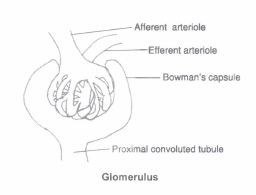
5.
On an average the daily GFR is 180 litre. Expulsion of such a large volume of fluid would lead to many complications. To prevent this, much of the fluid is reabsorbed by different portions of tubule. This results in just 1.5 litre of urine produced in a day.
6.
Micturition : Urine formed by the nephrons is ultimately carried to the urinary bladder where it is stored till a voluntary signal is given by the central nervous system (CNS). This signal is initiated by the stretching of the urinary bladder as it gets filled with urine. In response, the stretch receptors on the walls of the bladder send signals to the CNS. The CNS passes on motor messages to initiate the contraction of smooth muscles of the bladder and simultaneous relaxation of the urethral sphincter causing the release of urine. The process of release of urine is called micturition and the neural mechanisms causing it is called the micturition reflex.
7.
Lungs : Lungs remove large amounts of CO2 (18 litres/day) and also significant quantities of water every day.
Liver : Liver, the largest gland in our body, secretes bile containing substances like bilirubin, biliverdin, cholesterol, degraded steroid hormones, vitamins and drugs. Most of these substances ultimately pass out along with digestive wastes.
Skin : The sweat and sebaceous glands in the skin can eliminate certain substances through their secretions. Sweat produced by the sweat glands is a watery fluid containing NaCl, small amounts of urea, lactic acid, etc. Though the primary function of sweat is to facilitate a cooling effect on the body surface, it also helps in the removal of some of the wastes mentioned above. Sebaceous glands eliminate certain substances like sterols, hydrocarbons and waxes through sebum. This secretion provides a protective oily covering for the skin.
8.
Counter Current Mechanism. The Henle's loop and vasa recta play a significant role in this. The flow of filtrate in the two limbs of Henle's loop is in opposite directions and thus forms a counter current. The flow of blood through the two limbs of vasa recta is also in a counter current pattern. The proximity between the Henle's loop and vasa recta, as well as the counter current in them help in maintaining an increasing osmolarity towards the inner medullary interstitium, i.e., from 300 mOsmolL-1 in the cortex to about 1200 mOsmolL-1 in the inner medulla. This gradient is mainly caused by NaCI and urea. NaCI is transported by the ascending limb of Henle's loop which is exchanged with the descending limb of vasa recta. NaCl is returned to the interstitium by the ascending portion of vasa recta.
Similarly, small amounts of urea enter the thin segment of the ascending limb of Henle's loop which is transported back to the interstitium by the collecting tubule.
The above described transport of substances facilitated by the special arrangement of Henle's loop and vasa recta is called the counter current mechanism. This mechanism helps to maintain a concentration gradient in the medullary interstitium. Presence of such interstitial gradient helps in an easy passage of water from the collecting tubule thereby concentrating the filtrate (urine). Human kidneys can produce urine nearly four times concentrated than the initial filtrate, formed.
9.
Regulation of GFR : The kidneys have built-in mechanisms for the regulation of glomerular filtration rate. One such efficient mechanism is carried out by juxta glomerular apparatus (JGA). JGA is a special sensitive region formed by cellular modifications in the distal convoluted tubule and the afferent arteriole at the location of their contact. A fall in GFR can activate the JG cells to release renin which can stimulate the glomerular blood flow and thereby the GFR back to normal.
10.
ANF is commonly known as Atrial Natriuretic Factor.
ANF is a hormone produced by the walls of the atria of the heart in response to an increase in blood volume and pressure.It increases sodium excretion and decreases blood pressure.
ANF inhibits release of renin from Juxta Glomerular Apparatus(JGA) and thereby, inhibits NaCl reabsorption by the collecting duct and reduces aldosterone release from the adrenal gland.
Function The function of counter current mechanism is to concentrate NaCl in the intestitial fluid and thereby cause water to diffuse out of the collecting tubules and ducts and concentrate the urine.
11.
Counter current system is found in two limbs of loop of Henle.The ascending limb transports Na+ and some urea into surrounding medullary tissue.It is impermeable to water.So,it makes urine diluted or hypotonic.The walls of decending limbs are permeable to water and salt, so Na+ and water from surrounding fluid are absorbed.So the content of urine becomes hypertonic.
ADH(Antidiuretic Hormone) is secreted when the osmotic pressure of blood increases due to excess loss of water and body.The hormone renders the walls of distal convoluted tubule, Collecting Tubule(CT) and collecting duct of a nephron permeable to water and increases the reabsorption of water into the surrounding tissues and particular capillaries.The urine becomes hyperosmotic and less in volume and water is conserved in the body.
12.
i) Ultrafiltration occurs in Bowman's capsule.
ii) Reabsorption occur in PCT, loop of Henle ,DCT and Collecting ducts.
iii) Secretion occurs in PCT, loop of Henle and DCT.
13.
The process of urine formation is called uropoiesis.
Urine formation occurs in the Kidneys.It involves three steps.
i) Glomerular filtration
ii) Selective reabsorbtion
iii) Tubular secretion
14.
The process of excreting urea is called ureotelism.
Animals, which do not live in a high abundance of water convert toxic ammonia product in the body ijnto urea by the livser and then relese it into the blood. This, in turn, is filtered and excreted out by the kidneys.
15.
Representing the structure fo a renal corpuscle


11th Standard CBSE Syllabus & Materials
11th Standard CBSE
CBSE 11th Business Studies Forms of Business Organisation Sample Question Papers Study Material - QB365 Set A
NEW11th Standard CBSE
CBSE 11th Business Studies Business, Trade and Commerce Sample Question Papers Study Material - QB365 Set A
NEW11th Standard CBSE
CBSE 11th Physics Waves Sample Question Papers Study Material - QB365 Set A
NEW11th Standard CBSE
CBSE 11th Physics Kinetic Theory Sample Question Papers Study Material - QB365 Set A



CBSE 11th Standard CBSE Subjects
CBSE Standards









