
 100% FREE ACCESS
11th Standard CBSE Syllabus & Materials
11th Standard CBSE
CBSE 11th Economics PART-A - Presentation of Data - New Sample Question Papers Study Material - QB365 Set A
NEW11th Standard CBSE
CBSE 11th Economics PART-A - Organisation of Data - New Sample Question Papers Study Material - QB365 Set A
NEW11th Standard CBSE
CBSE 11th Economics PART-A - Collection of Data - New Sample Question Papers Study Material - QB365 Set A
NEW11th Standard CBSE
CBSE 11th Economics PART-A - Introduction to Economics and Statistics - New Sample Question Papers Study Material - QB365 Set A
NEW11th Standard CBSE
CBSE 11th Business Studies International Trade Sample Question Papers Study Material - QB365 Set A
NEW11th Standard CBSE
CBSE 11th Business Studies Evolution and Fundamentals of Business Sample Question Papers Study Material - QB365 Set A

Published on: 10/09/2019
Locomotion and Movement
Download CBSE Class 11th Standard CBSE Biology question papers, sample papers, important questions, and previous year solved papers in PDF format. Get free study materials, NCERT solutions, and exam preparation resources for Class 11th Standard CBSE Biology
Questions + Answers key
Take MCQ Biology Test
1.
What are floating ribs? How many of them are there in the human body?
2.
Name the pigment concerned with storage of oxygen in vertebrate muscles?
3.
What kind of muscle fibers are richly found in the extensor muscles of the back? What characteristics enable these fibres to serve their purpose?
4.
What is the role of calcium in muscle contraction?
5.
Why is osteoarthritis common in old people?
6.
How many total bones are there in human body? Name the largest and strongest bone
7.
Give the location of ball and socket joint in a human body
8.
Give an example of cartilaginous joints.
9.
What is the difference between the matrix of bone and cartilage?
10.
Which energy is converted to mechanical energy during contraction?
11.
Give an example of red muscle fiber.
12.
What are the different types of movements exhibited by the cells of human body?
13.
Give the name of the major parts of human skeleton.Also mention the number of bones in each part.
14.
Why are muscles rigidly locked in whatever position they are after death? What is the phenomenon known as?
15.
In old age, people often suffer from stiff and inflammed joints. What is this condition called? What are the possible reasons for these symptoms?
16.
How do you distinguish between a skeletal muscle and a cardiac muscle.
17.
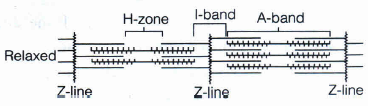
(i) How does a muscle return to its original form during relaxation?Also draw a diagram showing relaxation of muscle.
(ii) What causes muscle fatigue?
18.
Differentiate between pectoral and pelvic girdle
19.
Sternum is present on the ventral side of the body.
20.
There are 11 pairs of ribs in man.
21.
Human skeleton has 206 bones.
22.
Actin is present in thin filament
23.
______________and______________ pairs of ribs are called floating ribs.
24.
Thin filament of myofibril contains 2 'F' actins and two other proteins namely_________________ and_________________
25.
The number of phalanges in each limb of human is___________________________
26.
All mammals (except a few) have_______________________ cervical vertebra.
1.
The last two pairs of ribs aare known as the floating ribs i.e. 11th and 12th pair. These are comparatively smaller and have cartilaginous tips. They are only connected to the thoracic vertebrae, there is no attachment present ventrallly. Hence the name floating ribs. These are two in numbers.
2.
Myoglobin is the oxygen binding compound in the muscles. It is mostly present in all mammals. It helps in storing oxygen. It's structure and function are similar to hemoglobin present in blood.
3.
Red striated muscle fibres.
Their abundant myoglobin and mitochondria enable them to serve their purpose.
4.
Calcium plays a key regulatory role in muscle contraction. The increase in Ca2+ level leads to their binding to troponin subunit. Thu's exposing active sites on F-actin leading to cross-bridge formation.
5.
Old people generallly develop osteoarthritis because the secretion of synovial fluid in the joints decreases with age.
6.
Human body contains 206 bones. Femur is the largest and strongest bone of human body.
7.
Shoulder joint (between pectoral girdle and head of humerus).
8.
The joint between the adjacent vertebrae of vertebral column.
9.
The matrix of the bone is hard due to calcium salts, whereas, the cartilage has slightly pliable matrix due to chondroitin salts.
10.
During muscle contraction, chemical energy is converted to mechanical energy when ATP is hydrolysed during cross-bridge cycling. This mechanical energy is then distributed and stored in the tissue as the muscle deforms or is used to perform external work.
11.
Red muscle fibres are called slow-twitch fibres as they contract slowly for a long time without experiencing any kind of fatigue. An example of red muscles is the extensor muscles. This is one of the reasons why red muscles are put to use during strenuous activities like exercising.
12.
Cells of the human body exhibit three main types of movements, namely, amoeboid, ciliary and muscular.
Amoeboid Movement :
Some specialised cells in our body like macrophages and leucocytes in blood exhibit amoeboid movement. It is effected by pseudopodia formed by the streaming of protoplasm (as in Amoeba). Cytoskeletal elements like microfilaments are also involved in amoeboid movement. Ciliary Movement. Ciliary movement occurs in most of our internal tubular organs which are lined by ciliated epithelium. The coordinated movements of cilia in the trachea help us in removing dust particles and some of the foreign substances inhaled alongwith the atmospheric air. Passage of ova through the female reproductive tract is also facilitated by the ciliary movement.
Muscular Movement :
Movement of our limbs, jaws, tongue, etc, require muscular movement. The contractile property of muscles are effectivelyused for locomotion and other movements by human beings and majority of multicellular organisms. Locomotion requires a perfect coordinated activity of muscular, skeletal and neural systems.
13.
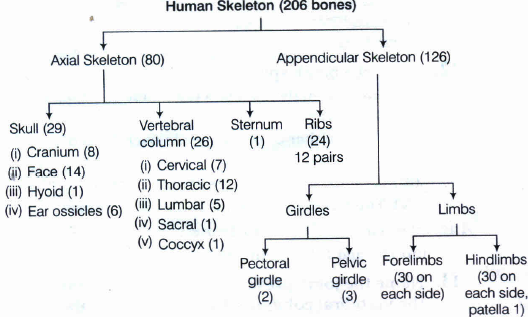
14.
Muscles require ATP to relax as well as to contract. On animal's death, its muscles soon exhaust ATP and lose the ability to contract or relax. They become rigidly locked in whatever position they were when ATP gets completely used up. This phenomenon is known as Rigor Mortis. It is used in determining the time of death.
15.
This condition is called as arthritis.
The possible reasons can be
(i) inflammation of the synovial membrane,
(ii) progressive erosion of articular cartilage,
(iii) infection by a microorganism,
(iv) due to metabolic defect causing excess of uric acid and urate crystals.
16.
Differences between skeletal muscle and cardiac muscle
| skeletal muscle | cardiac muscle |
| It is found in limbs, tongue, all parts in association with the skeleton of organism | It is found in the walls of heart and large veins. |
| Fibres are unbranched | Fibres are branched |
| It is multinucleate | It is uninucleate |
| No oblique bridge and intercalated discs | Oblique bridge and intercalated discs are present. |
| It gets fatigued soon. | It never gets fatigued |
| It is voluntary in nature. | It is involuntary. |
17.
(i) The calcium ions after contraction are quickly pumped back to the sarcoplasmic cisternae.This leads to blocking of active sites on actin.The Z-line returns to the original position.Causing muscles to return to its original position, i.e., relaxation form.
(ii) Repeated activation of the muscles leads to accumulation of lactic acid due to anaerobic breakdown of glycogen in them which causes fatigue.
18.
Pectoral and pelvic girdle help in the articulation of upper and lower limbs, respectively. Each girdle is made of two equal halves.
Each half of a pectoral girdle consists of clavicle and scapula. Scapula is a large triangular flat bone. There is glenoid cavity at the joint of scapula, clavicle and acromian process, which articulates with the head of humerus to form the shoulder joint.
Each half of pelvic girdle is formed by three bones, i.e., ilium, ischium and pubis. At the point of their fusion, there is a cavity called acetabulum to which the head of femur articulates.
19.
(a)
20.
(b)
21.
(a)
22.
(a)
23.
()
11th, 12th
24.
()
tropomyosin, troponin
25.
()
14
26.
()
7

11th Standard CBSE Syllabus & Materials
11th Standard CBSE
CBSE 11th Business Studies Forms of Business Organisation Sample Question Papers Study Material - QB365 Set A
NEW11th Standard CBSE
CBSE 11th Business Studies Business, Trade and Commerce Sample Question Papers Study Material - QB365 Set A
NEW11th Standard CBSE
CBSE 11th Physics Waves Sample Question Papers Study Material - QB365 Set A
NEW11th Standard CBSE
CBSE 11th Physics Kinetic Theory Sample Question Papers Study Material - QB365 Set A



CBSE 11th Standard CBSE Subjects
CBSE Standards









