
 100% FREE ACCESS
11th Standard CBSE Syllabus & Materials
11th Standard CBSE
CBSE 11th Economics PART-A - Presentation of Data - New Sample Question Papers Study Material - QB365 Set A
NEW11th Standard CBSE
CBSE 11th Economics PART-A - Organisation of Data - New Sample Question Papers Study Material - QB365 Set A
NEW11th Standard CBSE
CBSE 11th Economics PART-A - Collection of Data - New Sample Question Papers Study Material - QB365 Set A
NEW11th Standard CBSE
CBSE 11th Economics PART-A - Introduction to Economics and Statistics - New Sample Question Papers Study Material - QB365 Set A
NEW11th Standard CBSE
CBSE 11th Business Studies International Trade Sample Question Papers Study Material - QB365 Set A
NEW11th Standard CBSE
CBSE 11th Business Studies Evolution and Fundamentals of Business Sample Question Papers Study Material - QB365 Set A

Published on: 19/09/2019
Locomotion and Movement
Download CBSE Class 11th Standard CBSE Biology question papers, sample papers, important questions, and previous year solved papers in PDF format. Get free study materials, NCERT solutions, and exam preparation resources for Class 11th Standard CBSE Biology
Questions + Answers key
Take MCQ Biology Test
1.
What is arthritis and what are the causes of arthritis?
2.
Give some examples of flagellar movement.
3.
Describe the structure of the human skull.
4.
What is anaerobic muscle?
5.
What is aerobic muscle?
6.
Give a brief explanation of muscle contraction.
7.
What are the special properties of muscles?
8.
Name the type of joint between the following:-
(a) atlas/axis
(b) carpal/metacarpal of thumb
(c) between phalanges
(d) femur/acetabulum
(e) between cranial bones
(f) between pubic bones in the pelvic girdle
9.
Define sliding filament theory of muscle contraction.
10.
Draw the diagram of a sarcomere of skeletal muscle showing different regions.
11.
Why do muscles fatigue?
12.
Give function of a sternum.
13.
What are floating ribs? How many of them are there in the human body?
14.
Why is muscle fibre a syncitium? How are myofilaments arranged in it?
15.
What kind of muscle fibers are richly found in the extensor muscles of the back? What characteristics enable these fibres to serve their purpose?
1.
Arhtritis is inflammation of joints. This happens mostly in synovial joints. Because of ageing and wear and tear the synovial fluid dries up. This leads to corrosion of cartilage. At the end the movement of joints is not as smooth as it should be. This results in general discomfort while doing normal tasks and causes swelling and pain of the affected joint.
2.
Some examples of flagellar movement are as follow:
i) Swimming of spermatozoa
ii) Maintenance of water current in the canal system of sponges.
iii) Locomotion in Euglena
3.
The skull is composed of two sets of bones - cranial and facial, that totals to 22 bones. Cranial bones are 8 in number. They form the hard protective outer covering, cranium for the brain. The facial region is made up of 14 skeletal elements which form the front part of the skull. A single U-shaped bone called hyoid is present at the base of the buccal cavity and it is also included in the skull. Each middle ear contains three tiny bones - Malleus, Incus and Stapes, collectively called Ear Ossicles. The skull region articulates with the superior region of the vertebral column with the help of two occipital condyles (dicondylic skull).
4.
Certain muscles have low concentration of myoglobin which gives them a white appearance. They depend on anaerobic process for energy and are called as anaerobic muscles.
5.
Certain muscles have high concentration of myoglobin which gives it a red appearance. They also contain plenty of mitochondria which utilize large amounts of oxygen to produce ATP. Because of this they are also called aerobic muscles.
6.
When acetylcholine is released from nerve cells the calcium channels open in muscles. This facilitates sliding of actin filaments towards each other. This results in muscle contraction.
7.
Special properties of muscles are: Excitability, Contractility, Elasticity, and Extensibility.
8.
(a) Pivot joint
(b) Saddle joint
(c) Gliding joint
(d) Ball and socket joint
(e) Fibrous joint
(f) Cartilaginous joint
9.
Sliding Filament Theory of Muscle Contraction
Mechanism of muscle contraction is best explained by the sliding filament theory which states that contraction of a muscle fibre takes place by the sliding of the thin filaments over the thick filaments.
10.
Sarcomere of Skeletal Muscle
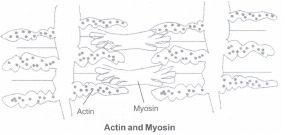
11.
The continuous contraction and relaxation in muscles cause movement in organs. If it continues for a longer time then condition are created in muscle cells and anaerobic respiration begins due to which lactic acid is formed. Thus, accumulation of lactic acid cause muscle fatigue. After talking some rest in some course of time liver degrades the lactic acid and person is relieved from pain.
12.
The sternum is a flat dagger-shaped bone located on the ventral midline of the thorax. Ribs bones attach themselves to the sternum in the front.
13.
The last two pairs of ribs aare known as the floating ribs i.e. 11th and 12th pair. These are comparatively smaller and have cartilaginous tips. They are only connected to the thoracic vertebrae, there is no attachment present ventrallly. Hence the name floating ribs. These are two in numbers.
14.
Muscle fibre is a syncitium as the sarcoplasm contains many nuclei. Myofilaments are parallelly arranged and are present in large number in muscle fibre.
15.
Red striated muscle fibres.
Their abundant myoglobin and mitochondria enable them to serve their purpose.

11th Standard CBSE Syllabus & Materials
11th Standard CBSE
CBSE 11th Business Studies Forms of Business Organisation Sample Question Papers Study Material - QB365 Set A
NEW11th Standard CBSE
CBSE 11th Business Studies Business, Trade and Commerce Sample Question Papers Study Material - QB365 Set A
NEW11th Standard CBSE
CBSE 11th Physics Waves Sample Question Papers Study Material - QB365 Set A
NEW11th Standard CBSE
CBSE 11th Physics Kinetic Theory Sample Question Papers Study Material - QB365 Set A



CBSE 11th Standard CBSE Subjects
CBSE Standards









