
 100% FREE ACCESS
11th Standard CBSE Syllabus & Materials
11th Standard CBSE
CBSE 11th Economics PART-A - Presentation of Data - New Sample Question Papers Study Material - QB365 Set A
NEW11th Standard CBSE
CBSE 11th Economics PART-A - Organisation of Data - New Sample Question Papers Study Material - QB365 Set A
NEW11th Standard CBSE
CBSE 11th Economics PART-A - Collection of Data - New Sample Question Papers Study Material - QB365 Set A
NEW11th Standard CBSE
CBSE 11th Economics PART-A - Introduction to Economics and Statistics - New Sample Question Papers Study Material - QB365 Set A
NEW11th Standard CBSE
CBSE 11th Business Studies International Trade Sample Question Papers Study Material - QB365 Set A
NEW11th Standard CBSE
CBSE 11th Business Studies Evolution and Fundamentals of Business Sample Question Papers Study Material - QB365 Set A

Published on: 09/09/2019
Mineral Nutrition
Download CBSE Class 11th Standard CBSE Biology question papers, sample papers, important questions, and previous year solved papers in PDF format. Get free study materials, NCERT solutions, and exam preparation resources for Class 11th Standard CBSE Biology
Questions + Answers key
Take MCQ Biology Test
1.
Why are the elements C,H,O and N called structural elements?
2.
List an example of one aerobic and one anerobic nitrogen-fixing bacteria.
3.
Name two factors responsible for the formation of oxides of nitrogen in the atmosphere.
4.
Give the main difference between leghaemolobin and haemoglobin
5.
Name the best conductive tissue for mineral nutrients in plants.
6.
Mineral elements play a paramount role in the performance and maintenance of life activities of a plant.If agree, Justify giving any four important reasons.
7.
The technique of solution culture has been developed to avoid contamination.Justify.How?
8.
The nodule bacteria Rhizobium fixes nitrogen only in the presence of leghaemoglobin, comment.
9.
Plants of leguminous family usually contain more amount of protein than other plants? If yes, justify.
10.
Complete the equation for reductive amination
\({ (i) } \begin{aligned}
+\mathrm{NH}_{4}^{+}+\text {NADPH } \stackrel{(i i)}{\longrightarrow} \text { Glutamate }
+\mathbf{H}_{2} \mathbf{O}+\mathbf{N A D P}
\end{aligned}\)
11.
A farmer adds/supplies Na, Ca, Mg and Fe regularly to his field and yet he observes that the plants show deficiency of Ca, Mg and Fe. Give a valid reason and suggest a way to help the farmer to improve the growth of plants.
12.
Why is that certain plants deficiency symptoms appear first in younger parts of the plant, while in others they do so in mature organs?
13.
How are the terms critical concentration and deficient different from each other in terms of concentration of an essential element in plants?Can you find the values of critical concentration and deficient minerals FE and Zn.
14.
In what form do plants absorb phosphorus from the soil?Name one cell organelle and one organic molecule that require phosphorus in the cell.List any two phosphorus deficiency symptoms in leaves.
15.
Describes nitrification along with the equations and the organisms involved in each step.
16.
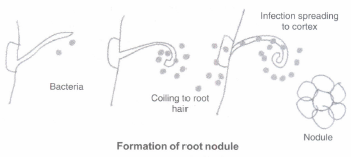
What are the steps involved in formation of a root nodule?
17.
How are the minerals absorbed by the plants?
18.
Name at least five different deficiency symptoms in plants. Describe them and correlate them with the concerned mineral deficiency.
19.
Hydroponics have been shown to be a successful technique for growing of plants, yet most of the crops are still grown on land. Why?
1.
()
Because they are components of the biomolecules of the cells, which form structural parts
2.
()
Aerobic nitrogen-fixing bacteria-Azotobacter Anaerobic nitrogen-fixing bacteria-Clostridium
3.
()
Two factors responsible for the formation of oxides of nitrogen are
(i) lightning
(ii) ultraviolet radiation
4.
()
leghaemolobin is the pigment present in the root nodules of leguminous plants while,haemoglobin is the pigment found in human blood.
5.
()
Xylem
6.
Mineral elements play a paramount role in the performance and maintenance of life activities of a plant
(i)maintaining the structural constituents of the plant body.
(ii)influencing the osmotic pressure of cells
(iii)helping in the permeability of cytoplasmic membranes.
(iv)reducing toxic and antagonistic effects.
7.
The technique of solution culture or hydroponic is the better technique to avoid contamination because in solution culture, the plants are grown directly in pure salt solution which are taken in suitable vessels(preferably made up of natural polyethene or borosilicate contamination.
8.
This is because the pigment leghaemoglobin acts as an oxygen scanenger by creating an anaerobic condition which is known to be important for the activity of nitrogenase enzyme
9.
Plants of leguminous family have root nodules in which the symbiotic bacteria Rhizobium fix atmospheric nitrogen into ammonia. The ammonia is subsequently available for many important biological molecules such as amino acids. proteins, vitamins and nucleic acids
10.
(i) a ketoglutaric acid.
(ii) Glutamate dehydrogenase.
11.
It is important to know that manganese completes with iron and mahnesium for the uptake and with magnesium for binding with enzymes.Manganese also inhibites calcium translocation in shoot apex therefore,excess of mangganese may , infact, induces deficiency of iron, magnesium and calcium.
Thus, what appears as symptoms of manganes toxicity may actually be the deficiency symptoms of iron, magnesium and calcium.
The farmer should not add excess manganese in the soil to prevent manganese toxicity.
12.
For elements that are actively mobilised within the plants and exported to young developing tissues, the deficiency symptoms tend to appear first in the order tissues.
e.g., the deficiency symptoms of nitrogen, potassium and magnesium are visible first in the senescent leaves. In the older leaves,biomolecules containing these elements are broken down making these elements available for mobilising to younger leaves.
The deficiency symptoms tend to appear forst in the young tissues, whenever the elements are relatively immobile and are not transported out of the mature organs,e.g, elemnts like sulphur and calcium are a part of the structural component of the cell hence, are not easily released.
13.
The concentration of the essential element below which plant growth is retarded is termed as critical concentration.The element is said to be deficient when present below the critical concentration.
Yes , we can find the values of critical concentration and deficient for minerals Fe and Zn by absorbing the morphological changes.If the concentrations of these elements are present below the critical values, then it may eventually lead to the death of the plant.Morphological changes are indicative of certain element deficiencies and are called deficiency symptoms.
14.
Plants absorb from the soil in the form of phosphate ions(either as \({ H }_{ 2 }{ PO }_{ 4 }^{ - }\) or as \({ H }_{ 2 }{ PO }_{ 4 }^{2 - }\) .Phosphate is a constituent of cell membrane.
It is constituent of nucleic acids, proteins and the nucleotides.
Two phosphorus deficiency symptoms are following
(i) Delay in seed germination.
(ii) Purple spots on the leaves of the plants.
15.
(i) Nitrification is the process of oxidation of ammonia, first into nitrite and then into nitrate.
(ii) Ammonia is oxidised into nitrite, by bacteria like Nitrococcus and Nitrosomonas. \({ 2NH }_{ 3 }+3O_{ 2 }\longrightarrow { 2NO }_{ 2 }^{ - }+2H^{ + }+2H_{ 2 }O\)
(iii) Nitrite is further oxidised to nitrate with the help of bacteria Nitrobacter. \(2NO_{ 2 }+O_{ 2 }\longrightarrow 2NO_{ 3 }\)
16.
Steps in the development of root nodules:
(a) Rhizobium bacteria contact a susceptible root hair, divide near it,
(b) Upon successful infection of the root hair cause it to curl,
(c) Infected thread carries the bacteria to the inner cortex. The bacteria get modified into rod-shaped bacteroids and cause inner cortical and pericycle cells to divide. Division and growth of cortical and pericycle cells lead to nodule formation,
(d) A mature nodule is complete with vascular tissues continuous with those of the root.
17.
Plants uptake essential elements from the soil through their roots and from the air through their leaves. Nutrient uptake in the soil is achieved by cation exchange, wherein root hairs pump hydrogen ions (H+)into the soil through proton pumps. These hydrogen ions displace cations attached to negatively charged soil particles so that the cations are available for uptake by the root. In the leaves, stomata open to take in carbon dioxide and expel oxygen. The carbon dioxide molecules are used as the carbon source in photosynthesis.
Though nitrogen is plentiful in the earth's atmosphere, relatively few plants engage in nitrogen fixation (conversion of atmospheric nitrogen to a biologically useful form). Most plants therefore require nitrogen compounds to be present in the soil in which they grow.
18.
Iron Deficiency
Iron (Fe) deficiency is a plant disorder also known as "lime-induced chlorosis". It can be confused with manganese deficiency. A deficiency in the soil is rare but iron can be unavailable for absorption if soil pH is not between about 5 and 6.5. A common problem is when the soil is too alkaline (the pH is above 6.5). Also, iron deficiency can develop if the soil is too waterlogged or has been overfertilised. Elements like calcium, zinc, manganese, phosphorus, or copper can tie up iron if they are present in high amounts.
Iron is needed to produce chlorophyll, hence its deficiency causes chlorosis. For example, iron is used in the active site of glutamyl-tRNA reductase, an enzyme needed for the formation of 5-Aminolevulinic acid which is a precursor of heme and chlorophyll.
Symptoms. Symptoms include leaves turning yellow or brown in the margins between the veins which may remain green, while young leaves may appear to be bleached. Fruit would be of poor quality and quantity. Any plant may be affected, but raspberries and pears are particularly susceptible, as well as most acid-loving plants such as azaleas and camellias.
Treatment. Iron deficiency can be avoided by choosing appropriate soil for the growing conditions (e.g., avoid growing acid loving plants on lime soils), or by adding well-rotted manure or compost.
Potassium Deficiency
Plants require potassium ions (K+)for protein synthesis and for the opening and closing of stomata, which is regulated by proton pumps to make surrounding guard cells either turgid or flaccid. A deficiency of potassium ions can impair a plant's ability to maintain these processes.
Symptoms. The deficiency most commonly affects fruits and vegetables, notably potatoes, tomatoes, apples, currants, and gooseberries, and typical symptoms are brown scorching and curling of leaf tips, and yellowing of leaf veins. Purple spots may also appear on the leaf undersides.
Deficient plants may be more prone to frost damage and disease, and their symptoms can often be confused with wind scorch or drought.
Prevention and Cure. Prevention and cure can be achieved in the shorter term by feeding with home-made comfrey liquid, adding seaweed meal, composted bracken or other organic potassium-rich fertilisers. In the longer term the soil structure should be improved by adding plenty of well rotted compost or manure. Wood ash has high potassium content, but should be composted first as it is in a highly soluble form.
Calcium Deficiency
Calcium (Ca) deficiency is a plant disorder that can be caused by insufficient calcium in the growing medium, but is more frequently a product of a compromised nutrient mobility system in the plant. This may be due to water shortages, which slow the transportation of calcium to the plant, or can be caused by excessive usage of potassium or nitrogen fertilizers.
Symptoms
Calcium deficiency symptoms appear initially as generally stunted plant growth, necrotic leaf margins on young leaves or curling of the leaves, and eventual death of terminal buds and root tips. Generally the new growth of the plant is affected first. The mature leaves may be affected if the problem persists.
Treatment
Calcium deficiency can be rectified by adding Agricultural lime to acid soils, aiming at a pH of 6.5, unless the plant in question specifically prefers acidic soil. Organic matter should be added to the soil in order to improve its moistureretaining capacity.
Plant damage is difficult to reverse, so take corrective action immediately. Make supplemental applications of calcium nitrate at 200 ppm nitrogen. Test and correct the pH if needed because calcium deficiency is often associated with low pH.
Nitrogen Deficiency
Nitrogen (N) deficiency in plants can occur when woody material such as sawdust is added to the soil. Soil organisms will utilise any nitrogen in order to break this down, thus making it temporarily unavailable to growing plants. 'Nitrogen robbery' is more likely on light soils and those low in organic matter content, although all soils are susceptible. Cold weather, especially early in the season, can also cause a temporary shortage.
Symptoms. All vegetables apart from nitrogen fixing legumes are prone to this disorder. Symptoms include poor plant growth, leaves are pale green or yellow in the case of brassicas. Lower leaves show symptoms first. Leaves in this state are said to be etiolated with reduced chlorophyll. Floweringand fruiting may be delayed.
Prevention and Control
Prevention and control of nitrogen deficiency can be achieved in the short term by using grass mowings as a mulch, or foliar feeding with manure, and in the longer term by building up levels of organic matter in the soil. Sowing green manure crops such as grazing rye to cover soil over the winter will help to prevent nitrogen leaching, while leguminous green manures such as winter tares will fix additional nitrogen from the atmosphere.
Manganese Deficiency
Manganese (Mn)deficiency is a plant disorder that is often confused with, and occurs with, iron deficiency. Most common in poorly drained soils, also where organic matter levels are high. Manganese may be unavailable to plants where pH is high.
Symptoms
Affected plants include onion, apple, peas, French beans, cherry and raspberry, and symptoms include yellowing of leaves with smallest leaf veins remaining green to produce a 'chequered' effect. The plant may seem to grow away from the problem so that younger leaves may appear to be unaffected. Brown spots may appear on leaf surfaces, and severely affected leaves turn brown and wither.
Prevention. Prevention can be achieved by improving soil structure. Do not over-lime.
19.
The technique of growing plants in a nutrient solution is known as hydroponics.
This method requires purified water and mineral nutrient salts. After a series of experiments, in which the roots of the plants were immersed in nutrient solutions and an element was added/ removed or given in varied concentrations, a mineral solution suitable for the plant growth was obtained.
By this method, essential elements were identified and their deficiency symptoms discovered. Hydroponics has been successfully employed as a technique for the commercial production of vegetables such as tomato, seedless cucumber and lettuce.
Yet, most of the crops are still grown on land because the nutrient solutions must be adequately aerated to obtain the optimum growth in hydroponis. Moreover, the minerals must be continuously added in the solution. No, such activity is required in the soil.

11th Standard CBSE Syllabus & Materials
11th Standard CBSE
CBSE 11th Business Studies Forms of Business Organisation Sample Question Papers Study Material - QB365 Set A
NEW11th Standard CBSE
CBSE 11th Business Studies Business, Trade and Commerce Sample Question Papers Study Material - QB365 Set A
NEW11th Standard CBSE
CBSE 11th Physics Waves Sample Question Papers Study Material - QB365 Set A
NEW11th Standard CBSE
CBSE 11th Physics Kinetic Theory Sample Question Papers Study Material - QB365 Set A



CBSE 11th Standard CBSE Subjects
CBSE Standards









