
 100% FREE ACCESS
11th Standard CBSE Syllabus & Materials
11th Standard CBSE
CBSE 11th Economics PART-A - Presentation of Data - New Sample Question Papers Study Material - QB365 Set A
NEW11th Standard CBSE
CBSE 11th Economics PART-A - Organisation of Data - New Sample Question Papers Study Material - QB365 Set A
NEW11th Standard CBSE
CBSE 11th Economics PART-A - Collection of Data - New Sample Question Papers Study Material - QB365 Set A
NEW11th Standard CBSE
CBSE 11th Economics PART-A - Introduction to Economics and Statistics - New Sample Question Papers Study Material - QB365 Set A
NEW11th Standard CBSE
CBSE 11th Business Studies International Trade Sample Question Papers Study Material - QB365 Set A
NEW11th Standard CBSE
CBSE 11th Business Studies Evolution and Fundamentals of Business Sample Question Papers Study Material - QB365 Set A

Published on: 14/09/2019
Morphology of Flowering Plants
Download CBSE Class 11th Standard CBSE Biology question papers, sample papers, important questions, and previous year solved papers in PDF format. Get free study materials, NCERT solutions, and exam preparation resources for Class 11th Standard CBSE Biology
Questions + Answers key
Take MCQ Biology Test
1.
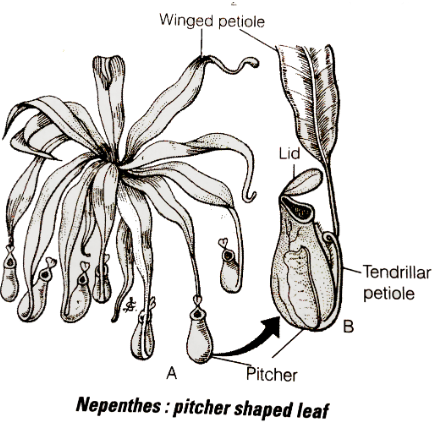
You have heard about several insectivorous plant that feed on insects. Nepenthes or the pitcher plant is one such example which usually grows in shallow water or in marsh lands. What part of the plant is modified into a 'pitcher'. How does this modification help the plant for food even though it can photosynthesisie like any other green plant?
2.
What is the function of lenticels in woody trees?
3.
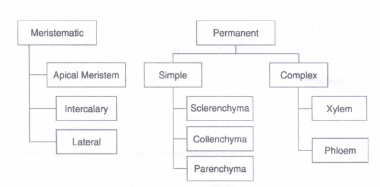
Make a flow chart of classification of plant tissues.
4.
What is the role of cork cambium?
5.
Write components of a stele.
6.
In a typical leaf what kind of cells are usually present in m.esophull?
7.
Name one plant product through which we use phloem fibres commercially.
8.
Name two functions of collenchyma
9.
Name the three basic tissue systems in the flowering plants. Give the tissue names under each system.
10.
Why are xylem and phloem called complex tissues?
11.
Cut a transverse section of young stem of a plant from your school garden and observe it under the microscope. How would you ascertain whether it is a monocot stem or a dicot stem? Give reasons.
12.
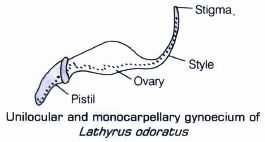
How will you show the monocarpellary and unilocular condition of gynoecium of Lathrus odoratus (sweet pea)?
13.
Explain the following floral formula and to which it belongs \(Ebr\oplus \ { K }_{ 2+2 }{ C }_{ 4 }{ A }_{ 2+4 }{ G }_{ (\underset { - }{ 2 } ) }\)
14.
Name of the ornamental plants of lily family
15.
Describe the structure of a fruit with the help of a diagram.
1.
In insectivorous plant e.g., Nepenthes, the leaf lamina gets modified in the form of pitcher and anterior part of petiole coils like tendril which keeps the pitcher in a vertical direction. Posterior part of the petiole remains flattened like a leaf. The apex of lamina forms a lid. Pitcher contains digestive enzyme which the trapped insects .
All these modifications and adaptation are developed to make up the nitrogen deficiency in the plant because these plants are found in N2 deficient soil, (marshy/swamp soils)
2.
Exchange of gases.
3.
4.
During secondary growth, the epidermal layer gets broken and needs to be replaced with new protective layer. The cork cambium helps create a new layer for protection.
5.
Composition of Stele: Pericycle, Vascular Bundle and Pith.
6.
Cells containing chlorophylls compose the mesophyll in leaves.
7.
Jute fibres are phloem fibres and are used for making gunny sacks
8.
Food storage and mechanical support.
9.
On the basis of their structure and location, there are three types of tissue systems:
(a) Epidermal Tissue System. Epidermis, Stomata
(b) Ground or Fundamental Tissue System and: Parenchyma, Sclerenchyma and Collenchyma
(c) Vascular or Conducting Tissue System. Phloem and Xylem.
10.
Xylem and phloem are composed of several types of cells and they work as a unit. Hence they are called complex tissues.
11.
As shown in above diagrams the vascular bundles in dicot stems are arranged in a ring, while they are in scattered arrangement in monocot stems.
12.
13.
It belongs to mustard Ebracteate, actinomorphic, bisexual, bimerous; calyx-4, polysepalous, in two whorls of two each; corolla 4, polypetalous, cruciform; androecium-6, polyandrous, tetradynamous in two whorls, one with two, the second with four, gynoecium-bicarpellary, syncarpous and superior.
14.
Asparagus, Ruscus, Yucca, Aloe, Gloriosa, Smilax, TULIPS, LILIES, ETC.
15.
The fruit is mature ovary develops after fertilization fruit consists of wall named pericarp and seeds.sometimes pericarp is fleshy and differentiated into outer epicarp, middle mesocarp, and inner endocarp.

11th Standard CBSE Syllabus & Materials
11th Standard CBSE
CBSE 11th Business Studies Forms of Business Organisation Sample Question Papers Study Material - QB365 Set A
NEW11th Standard CBSE
CBSE 11th Business Studies Business, Trade and Commerce Sample Question Papers Study Material - QB365 Set A
NEW11th Standard CBSE
CBSE 11th Physics Waves Sample Question Papers Study Material - QB365 Set A
NEW11th Standard CBSE
CBSE 11th Physics Kinetic Theory Sample Question Papers Study Material - QB365 Set A



CBSE 11th Standard CBSE Subjects
CBSE Standards









