
 100% FREE ACCESS
11th Standard CBSE Syllabus & Materials
11th Standard CBSE
CBSE 11th Economics PART-A - Presentation of Data - New Sample Question Papers Study Material - QB365 Set A
NEW11th Standard CBSE
CBSE 11th Economics PART-A - Organisation of Data - New Sample Question Papers Study Material - QB365 Set A
NEW11th Standard CBSE
CBSE 11th Economics PART-A - Collection of Data - New Sample Question Papers Study Material - QB365 Set A
NEW11th Standard CBSE
CBSE 11th Economics PART-A - Introduction to Economics and Statistics - New Sample Question Papers Study Material - QB365 Set A
NEW11th Standard CBSE
CBSE 11th Business Studies International Trade Sample Question Papers Study Material - QB365 Set A
NEW11th Standard CBSE
CBSE 11th Business Studies Evolution and Fundamentals of Business Sample Question Papers Study Material - QB365 Set A

Published on: 10/09/2019
Neural Control and Coordination
Download CBSE Class 11th Standard CBSE Biology question papers, sample papers, important questions, and previous year solved papers in PDF format. Get free study materials, NCERT solutions, and exam preparation resources for Class 11th Standard CBSE Biology
Questions + Answers key
Take MCQ Biology Test
1.
Answer the following:
(a) Which part of the human brain is the most developed?
(b) Which part of our central neural system acts as a master clock?
2.
Which cells of retina enable us to see coloured objects around us?
3.
Which muscles control the size of pupil?
4.
Give the name of the passage between middle ear and pharynx.
5.
Describe the functions of limbic system?
6.
Nervous system and computers share certain common features. Comment in five lines. (Hint: CPU, input-output devices).
7.
Arrange the following n the order of reception and transmission of sound wave from the ear drum Cochlear nerve, external auditory canal, ear drum, stapes incus, malleus, cochlea
8.
What is the role of afferent nerve fibres in the nervous system?
9.
Give the name of the nervous tissues, which form the spinal cord.
10.
Which is the bluish (pigmented) layer present beneath the sclera?
11.
Which part of the war determines the pitch of a sound?
12.
Compare the following "Resting potential and action potential"
13.
How do the ionic gradients across the resting membrance can be maintained?
14.
What is the nature of nerve impulse?
15.
Name the small tubular gap structure between the two neurons
16.
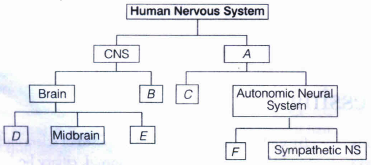
The major parts of the human neural system is depicted below.Fill in the empty boxes with appropriate words.
17.
Distinguish between cranial nerve and spinal nerve in human.
18.
Answer briefly
(i) How do you perceive the colour of an object?
(ii) Which part of our body helps us in maintaining the body balance?
(iii) How does the eye regulate the amount of light that falls on the retina?
19.
Differentiate between Dendrites and axons
20.
Write short notes on the following:
(a) Neural coordination
(b) Forebrain
(c) Midbrain
(d) Hindbrain
(e) Synapse
21.
Draw labelled diagrams of the following:
(a) Neuron
(b) Brain
22.
Explain the following processes:
(a) Polarisation of the membrane of a nerve fibre
(b) Depolarisation of the membrane of a nerve fibre
(c) Transmission of a nerve impulse across a chemical synapse
23.
The region of the vertebrate eye, where the optic nerve passes out of the retina, is called the ______.
fovea
iris
blind spot
optic chiasma
1.
(a) Cerebrum is the most developed.
(b) Hypothalamus acts as a master clock.
2.
Cone cells help detect colors. Most people have three kinds of cone cells. People without all three see fewer colors, sometimes called color blindness. Some cones respond more strongly to blue light.
3.
The size of the pupil is controlled by Iris. Iris contains a group of two smooth muscles attached at the corner of the pupil. They stretch when there is less light and shrink when it is too bright. These muscles are known as sphincter pupillae.
4.
The Eustachian canal extends from the middle ear to the pharynx. It helps to maintain the pressure balance with the outer atmosphere.
5.
Along with the hypothalamus, it is involved in the regulation of sexual behaviour, expression of emotional reactions, e.g., pleasure, excitement, rage and fear and motivation.
6.
The brain might be compared to a computer as its memory banks. The spinal cord to the conducting cable for the computer's input and output and the nerves to a circuit supplying input information to the cable and transmitting the output to muscles and organs. The most important of these components is the Central Processing Unit (CPU) or microprocessor, which acts as the 'brain' of your computer.
7.
External auditory canal, eardrum, malleus,incus, stapes, cochlea and cochlear nerve.
8.
It transmits impulse (sensory) from tissues/organs to the CNS and forms the sensory or afferent pathway.
9.
Nervous tissue is composed of neurons, also called nerve cells, and neuroglial cells. Four types of neuroglia found in the CNS are astrocytes, microglial cells, ependymal cells, and oligodendrocytes.
10.
Choroid: It is a pigmented layer (bluish) present beneath the sclera. It contains numerous blood vessels and nourishes the sclera. The choroid layer is thin over the posterior two-thirds of the eyeball, but it becomes, thick in the anterior part to form the ciliary muscles.
11.
Inner ear
12.
Resting potential The electrical potential difference across the plasma membarance is called the Compare the following resting potential
Action potential It is another name of nerve impluse. The action potential is an electrical signal that travels along an axon.
13.
The ionic gradients across the resting membarance are maintained by the active transport of ions by the sodium-potassium pump.
14.
Bioelectric/electrochemical disturbance (change)
15.
The gap between two neurons is called as synapse.
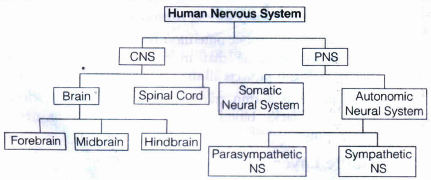
16.
17.
Differences between cranial nerve and spinal nerve in human are given below.
| Cranial Nerve | Spinal Nerve |
| The cranial nerves originate in the brain and terminate mostly in organs head and upper body. |
The spinal nerves originate in the spinal cord and extend to partsof the body below the head. |
| There are 12 pairs of cranial nerves. | There are 31 pairs of spinal nerves |
| Most of the cranial nerves contain axon and both sensory and motor neurons. |
All of the spinal nerves contain axons both sensory and motor neurons. |
18.
(i) The daylight (photopic) vision and colour vision are functions of cones. In the human eye, there are three types of cones which possess their own characteristic photopigments that respond to red, green and blue lights. The sensations of different colours are produced by various combinations of these cones and their photopigments. When these cones are stimulated equally, a sensation of white light a is produced.
(ii) The crista and macula are the specific receptors of the vestibular apparatus of inner ear which are responsible for the maintenance of balance of the body and posture.
(iii) The diameter of the pupil is regulated by the muscle fibre of iris. Photoreceptors, rods and cones regulate the amount of light that falls on the retina.
19.
Difference between dendrites and axons are as follows:
| Dendrites | Axon |
| These are short fibres which branch repeatedly and project out of the cell body and also contain Nissl's granules. |
The axon is a long branched fibre, which terminates as a bulb-like structure called synaptic vesicles containing chemicals called neurotransmitters. |
| These fibres transmit impulses towards the cell body. | The axons transmit nerve impulses away from the cell body to a synapse. |
| Its branches terminate into bulb-like synaptic knobs. | Their branches do not have synaptic knobs. |
20.
(a) Neural Coordination. The functions of the organs/organ systems in our body must be coordinated to maintain homeostasis. Coordination is the process through which two or more organs interact and complement the functions of one another. For example, when we do physical exercises, the energy demand is increased for maintaining an increased muscular activity. The supply of oxygen is also increased. The increased supply of oxygen necessitates an increase in the rate of respiration, heartbeat and increased blood flow via blood vessels. When physical exercise is stopped, the activities of nerves, lungs, heart and kidney gradually return to their normal conditions. Thus, the functions of muscles, lungs, heart, blood vessels, kidney and other organs are coordinated while performing physical exercises. In our body, the neural system and the endocrine system jointly coordinate and integrate all the activities of the organs so that they function in a synchronised fashion.
(b) Forebrain. The forebrain consists of cerebrum, thalamus and hypothalamus. Cerebrum forms the major part of the human brain. A deep cleft divides the cerebrum longitudinally into two halves, which are termed as the left and right cerebral hemispheres. The hemispheres are connected by a tract of nerve fibres called corpus callosum. The cerebral cortex contains motor areas, sensory areas and large regions that are neither clearly sensory nor motor in function. These regions called as the association areas are responsible for complex functions like intersensory associations, memory and communication. The cerebrum wraps around a structure called thalamus, which is a major coordinating centre for sensory and motor signaling. Another very important part of the brain called hypothalamus lies at the base of the thalamus. The hypothalamus contains a number of centres which control body temperature, urge for eating and drinking. It also contains several groups of neurosecretory cells, which secrete hormones called hypothalamic hormones. The inner parts of cerebral hemispheres and a group of associated deep structures like amygdala, hippocampus, etc., form a complex structure called the limbic lobe or limbic system. Along with the hypothalamus, it is involved in the regulation of sexual behaviour, expression of emotional reactions (e.g., excitement, pleasure, rage and fear), and motivation.
(c) Midbrain. The midbrain is located between the thalamus/hypothalamus of the forebrain and pons of the hindbrain. Acanal called the cerebral aqueduct passes through the midbrain. The dorsal portion of the midbrain consists mainly of four round swellings (lobes) called corpora quadrigemina. Midbrain and hindbrain form the brain stem.
(d) Hindbrain. The hindbrain comprises pons, cerebellum and medulla (also called the medulla oblongata). Pons consists of fibre tracts that interconnect different regions of the brain. Cerebellum has very convoluted surface in order to provide the additional space for many more neurons. The medulla of the brain is connected to the spinal cord. The medulla contains centres which control respiration, cardiovascular reflexes and gastric secretions.
(e) Synapse. A nerve impulse is transmitted from one neuron to another through junctions called synapses. A synapse is formed by the membranes of a presynaptic neuron and a post-synaptic neuron, which may or may not be separated by a gap called synaptic cleft. There are two types of synapses, namely, electrical synapses and chemical synapses. Electrical Synapse. At electrical synapses, the membranes of pre- and postsynaptic neurons are in very close proximity. Electrical current can flow directly from one neuron into the other across these synapses. Transmission of an impulse across electrical synapses is very similar to impulse conduction along a single axon. Impulse transmission across an electrical synapse is always faster than that across a chemical synapse. Electrical synapses are rare in our system.
21.
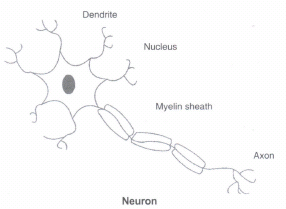
(a) Neuron
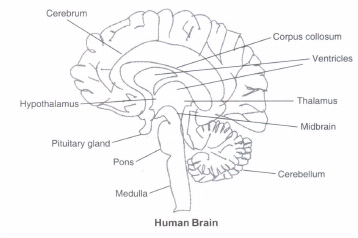
(b) Brain
22.
a) Polarisation of the membrane of a nerve fibre. The fluid inside the membrane contains high concentration of K+and negatively charged proteins and low concentration of Na+.
In contrast, the fluid outside the axon contains a low concentration of K+, a high concentration of Na+ and thus forms a concentration gradient. These ionic gradients across the resting membrane are maintained by the active transport of ions by the sodium-potassium pump which transports 3 Na+ outwards for 2 K+ into the cell. As a result, the outer surface of the axonal membrane possesses a positive charge while its inner surface becomes negatively charged and therefore is polarised.
b) Depolarisation of the membrane of a nerve fibre. When a stimulus is applied at a site on the polarised membrane, the membrane at the site A becomes freely permeable to Na+, This leads to a rapid influx of Na+ followed by the reversal of the polarity at that site, i.e., the outer surface of the membrane becomes negatively charged and the inner side becomes positively charged. The polarity of the membrane at the site is thus reversed and hence depolarised.
c) Transmission of a nerve impulse across chemical synapse. At a chemical synapse, the membranes of the pre- and post-synaptic neurons are separated by a fluid-filled space called synaptic cleft. Chemicals called neurotransmitters are involved in the transmission of impulses at these synapses. The axon terminals contain vesicles filled with these neurotransmitters. When an impulse (action potential) arrives at the axon terminal, it stimulates the movement of the synaptic vesicles towards the membrane where they fuse with the plasma membrane and release their neurotransmitters in the synaptic cleft. The released neurotransmitters bind to their specific receptors, present on the post-synaptic membrane. This binding opens ion channels allowing the entry of ions which can generate a new potential in the postsynaptic neuron. The new potential developed may be either excitatory or inhibitory.
23.
(c)
blind spot

11th Standard CBSE Syllabus & Materials
11th Standard CBSE
CBSE 11th Business Studies Forms of Business Organisation Sample Question Papers Study Material - QB365 Set A
NEW11th Standard CBSE
CBSE 11th Business Studies Business, Trade and Commerce Sample Question Papers Study Material - QB365 Set A
NEW11th Standard CBSE
CBSE 11th Physics Waves Sample Question Papers Study Material - QB365 Set A
NEW11th Standard CBSE
CBSE 11th Physics Kinetic Theory Sample Question Papers Study Material - QB365 Set A



CBSE 11th Standard CBSE Subjects
CBSE Standards









