
 100% FREE ACCESS
11th Standard CBSE Syllabus & Materials
11th Standard CBSE
CBSE 11th Economics PART-A - Presentation of Data - New Sample Question Papers Study Material - QB365 Set A
NEW11th Standard CBSE
CBSE 11th Economics PART-A - Organisation of Data - New Sample Question Papers Study Material - QB365 Set A
NEW11th Standard CBSE
CBSE 11th Economics PART-A - Collection of Data - New Sample Question Papers Study Material - QB365 Set A
NEW11th Standard CBSE
CBSE 11th Economics PART-A - Introduction to Economics and Statistics - New Sample Question Papers Study Material - QB365 Set A
NEW11th Standard CBSE
CBSE 11th Business Studies International Trade Sample Question Papers Study Material - QB365 Set A
NEW11th Standard CBSE
CBSE 11th Business Studies Evolution and Fundamentals of Business Sample Question Papers Study Material - QB365 Set A

Published on: 28/09/2019
Neural Control and Coordination
Download CBSE Class 11th Standard CBSE Biology question papers, sample papers, important questions, and previous year solved papers in PDF format. Get free study materials, NCERT solutions, and exam preparation resources for Class 11th Standard CBSE Biology
Questions + Answers key
Take MCQ Biology Test
1.
Why don't we get the taste of food when we suffer from common cold?
2.
What do you understand by olfactory receptors?
3.
Describe reflex action.
4.
Give a description of the structure of neuron.
5.
Explain parasympathetic neural system.
6.
Give a brief description of the neural system.
7.
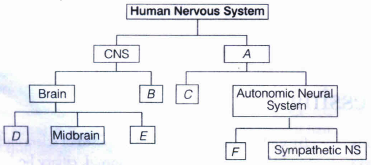
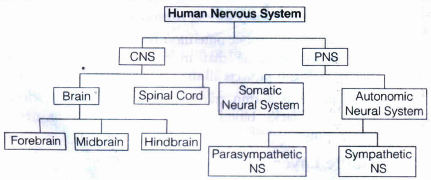
The major parts of the human neural system is depicted below.Fill in the empty boxes with appropriate words.
8.
Distinguish between cranial nerve and spinal nerve in human.
9.
Explain the mechanism of generation of light-induced impulse on the retina.
10.
Answer briefly
(i) How do you perceive the colour of an object?
(ii) Which part of our body helps us in maintaining the body balance?
(iii) How does the eye regulate the amount of light that falls on the retina?
11.
Differentiate between Thalamus and hypothalamus
12.
Differentiate between Cerebrum and cerebellum.
13.
Explain the role of Na+ in the generation of action potential.
14.
Differentiate between Dendrites and axons
15.
Answer the following:
(a) Which part of the human brain is the most developed?
(b) Which part of our central neural system acts as a master clock?
1.
Gustatory and olfactory senses are interrelated. Sense of smell helps in enhancing the sense of taste. This is the reason we don't get proper taste of food when we suffer from common cold.
2.
The nose contains mucus-coated receptors which are specialised for receiving the sense of smell and are called olfactory receptors. These are made up of olfactory epithelium which consists of three kinds of cells. The neurons of the olfactory epithelium extend from the outside environment directly into a pair of broad bean-sized organs called olfactory bulb. Olfactory bulbs are extensions of the brains limbic system.
3.
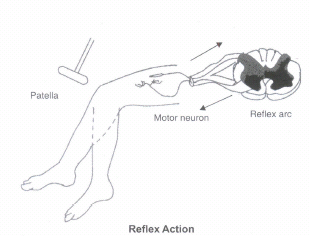
The entire process of response to a peripheral neural stimulation, that occurs involuntarily, i.e., without conscious effort or thought and requires the involvement of a part of the central neural system is called a reflex action.
The reflex pathway comprises at least one afferent neuron (receptor) and one efferent (effector or excitor) neuron appropriately arranged in a series. The afferent neuron receives signal from a sensory organ and transmits the impulse via a dorsal nerve root into the CNS (at the level of spinal cord). The efferent neuron then carries signals from CNS to the effector. The stimulus and response thus forms a reflex arc as shown below in the knee jerk reflex.
4.
A neuron is a microscopic structure composed of three major parts, namely, cell body, dendrites and axon.
Cell Body. The cell body contains cytoplasm with typical cell organelles and certain granular bodies called Nissl's granules. Dendrites. Short fibres which branch repeatedly and project out of the cell body also contain Nissl's granules and are called dendrites. These fibres transmit impulses towards the cell body.
Axon. The axon is a long fibre, the distal end of which is branched. Each branch terminates as a bulb-like structure called synaptic knob which possess synaptic vesicles containing chemicals called neurotransmitters. The axons transmit nerve impulses away from the cell body to a synapse or to a neuro-muscular junction.
5.
The parasympathetic neural system is part of autonomic neural system. This system has some sort of inhibitory effect. The inhibitory effect minimizes the over functioning of certain functions. Functions, like salivating, digestion, are under control of parasympathetic neural system.
6.
The neural system is composed of specialized cells called neurons. It detects stimuli and transmits neural signals. The neural system of complex animals is composed of two parts, viz. central neural system and peripheral neural system. The brain and nerve cord comprise the central neural system and other nerves comprise the peripheral neural system.
7.
8.
Differences between cranial nerve and spinal nerve in human are given below.
| Cranial Nerve | Spinal Nerve |
| The cranial nerves originate in the brain and terminate mostly in organs head and upper body. |
The spinal nerves originate in the spinal cord and extend to partsof the body below the head. |
| There are 12 pairs of cranial nerves. | There are 31 pairs of spinal nerves |
| Most of the cranial nerves contain axon and both sensory and motor neurons. |
All of the spinal nerves contain axons both sensory and motor neurons. |
9.
Light induces dissociation of the retinol from opsin. It brings about changes in the structure of the opsin. This causes membrane permeability changes. As a result, potential difference are generated in the optic nerves to the visual cortex area of the brain, where the nerves impulses are analysed and the image formed on the retina is recognised.
10.
(i) The daylight (photopic) vision and colour vision are functions of cones. In the human eye, there are three types of cones which possess their own characteristic photopigments that respond to red, green and blue lights. The sensations of different colours are produced by various combinations of these cones and their photopigments. When these cones are stimulated equally, a sensation of white light a is produced.
(ii) The crista and macula are the specific receptors of the vestibular apparatus of inner ear which are responsible for the maintenance of balance of the body and posture.
(iii) The diameter of the pupil is regulated by the muscle fibre of iris. Photoreceptors, rods and cones regulate the amount of light that falls on the retina.
11.
| Thalamus | Hypothalamus |
| The cerebrum wraps around a structural part of brain called thalamus |
It lies at the base of the thalamus |
| All types of sensory input passes synapses to the thalamus. |
It contains neurosecretory cells that secrete hypothalamus hormones |
| It controls emotional and memory function. | It regulates, sexual behaviour expression of emotional reaction and motivation. |
12.
| Cerebrum | Cerebellum |
| It is the most developed part in brain | It is the second developed part of brain also called as little cerebrum |
| A deep cleft divides cerebrum into two cerebral hemispheres |
Externally the whole surface contains gyri and sulci |
| Its functions are intelligence, learning, memory, speech, etc. |
It contains centres for coordination and error checking during motor and cognition. |
13.
When a stimulus is applied to a nerve becomes freely permable to Na+ followed by the reversal of the polarity at that site. i.e., the outer surface of the membarance becomes negatively charged and the inner sides become positively charged. The electrical potential differenec across the plasma membarance is called the action potential, which is in fact terrmed as a nerve impluse. Thus, the shows that Na+ ions play an important role in the conduction of nerve impluse.
14.
Difference between dendrites and axons are as follows:
| Dendrites | Axon |
| These are short fibres which branch repeatedly and project out of the cell body and also contain Nissl's granules. |
The axon is a long branched fibre, which terminates as a bulb-like structure called synaptic vesicles containing chemicals called neurotransmitters. |
| These fibres transmit impulses towards the cell body. | The axons transmit nerve impulses away from the cell body to a synapse. |
| Its branches terminate into bulb-like synaptic knobs. | Their branches do not have synaptic knobs. |
15.
(a) Cerebrum is the most developed.
(b) Hypothalamus acts as a master clock.

11th Standard CBSE Syllabus & Materials
11th Standard CBSE
CBSE 11th Business Studies Forms of Business Organisation Sample Question Papers Study Material - QB365 Set A
NEW11th Standard CBSE
CBSE 11th Business Studies Business, Trade and Commerce Sample Question Papers Study Material - QB365 Set A
NEW11th Standard CBSE
CBSE 11th Physics Waves Sample Question Papers Study Material - QB365 Set A
NEW11th Standard CBSE
CBSE 11th Physics Kinetic Theory Sample Question Papers Study Material - QB365 Set A



CBSE 11th Standard CBSE Subjects
CBSE Standards









