
 100% FREE ACCESS
11th Standard CBSE Syllabus & Materials
11th Standard CBSE
CBSE 11th Economics PART-A - Presentation of Data - New Sample Question Papers Study Material - QB365 Set A
NEW11th Standard CBSE
CBSE 11th Economics PART-A - Organisation of Data - New Sample Question Papers Study Material - QB365 Set A
NEW11th Standard CBSE
CBSE 11th Economics PART-A - Collection of Data - New Sample Question Papers Study Material - QB365 Set A
NEW11th Standard CBSE
CBSE 11th Economics PART-A - Introduction to Economics and Statistics - New Sample Question Papers Study Material - QB365 Set A
NEW11th Standard CBSE
CBSE 11th Business Studies International Trade Sample Question Papers Study Material - QB365 Set A
NEW11th Standard CBSE
CBSE 11th Business Studies Evolution and Fundamentals of Business Sample Question Papers Study Material - QB365 Set A

Published on: 09/09/2019
Photosynthesis in Higher Plants
Download CBSE Class 11th Standard CBSE Biology question papers, sample papers, important questions, and previous year solved papers in PDF format. Get free study materials, NCERT solutions, and exam preparation resources for Class 11th Standard CBSE Biology
Questions + Answers key
Take MCQ Biology Test
1.
Which photosystem will work if only longer wavelengths of light are given to a plant ?
2.
How does water stress affect/decrease the rate of photosynthesis
3.
Differences between stroma and grana of chloroplasts.
4.
Expand RuBP and also mention the role of RuBP in photosynthesis.
5.
By looking at a plant externally can you tell whether a plant is C3 or C4 ? Why and how?
6.
Cyanobacteria and some other photosynthetic bacteria do not have chloroplasts.How do they conduct photosynthesis?
7.
Tomatoes, carrots and chillies are red in colour due to presence of one pigment. Name the pigment.It is a photosynthetic pigment?
8.
Which range of wavelength(in nm) is called Photosynthetically Active Radiation (PAR)?
9.
Succulents are known to keep their stomata closed during the day to check the rate of transpiration.How do they meet their photosynthetic CO2 requirements?
10.
Give the name of the first stable intermediate compound formed after CO2 absorption during C3 pathway.
11.
Figure shows the effect of light on the rate of photosynthesis. Based on the graph, answer the following questions:
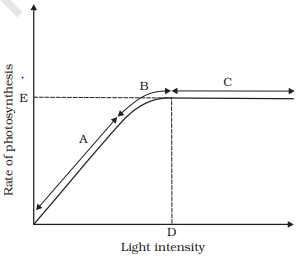
(a) At which point/s (A, B or C) in the curve is light a limiting factor?
(b) What could be the limiting factor/s in region A?
(c) What do C and D represent on the curve?
12.
What conditions enable RuBisCO to function as an Oxygenase? Explain the ensuring process.
13.
Give comparison between the C3 leaf anatomy and C4 leaf anatomy
14.
Cyclic photophosphorylation results in the production of ATPs and not NADPH. Give reasons.
15.
Give comparison between the following: Anatomy of leaf in C3 and C4 plants
16.
Under what condition are C4-plants superior to C3?
17.
RuBisCO is an enzyme that acts both as a carboxylase and oxygenase. Why do you think RuBisCO carries out more carboxylation in C4 plants?
18.
Six turns of Calvin cycle are required to generate one mole of glucose. Explain.
19.
Is it correct to say that photosynthesis occurs only in leaves of a plant? Besides leaves, what are the other parts be capable of carrying out photosynthesis?Justify.
1.
Longer wavelength = 700nm.
Findout which PS operates at 700 nm light.
2.
(a) Water stress causes closure of stomata and decreases the availability of CO2 for photosynthesis.
(b) Water stress also causes wilting of leaves, thus reducing the surface area of leaves for metabolic function.
3.
Differences between stroma and grana of chloroplasts are
| Stroma | Grana |
| It is the jelly-like matrix of the chloroplast. |
These are formed of stacks of thylakoids. |
| Dark reaction takes place here. | Light reaction takes place here. |
4.
RuBP is known as Ribulose 1,5-Bisphosphate. It is the primary acceptor of carbon dioxide in Calvin cycle of C3-plants. It forms the first stable compound of photosynthesis known as PGA.
5.
The plants which are adapted to dry tropical regions have the C4 pathway. However, the C4-plants do not show any characteristic in external morphology. Therefore, it is difficult to say whether a plant is C3 or C4 by looking it only externally.
6.
Cyanobacteria and some other photosynthetic bacteria have photosynthetic lamellae (membranes) suspended freely in the cytoplasm.These carry bacteriochlorophyll to conduct photosynthesis.
7.
Lycopene pigment, which is a chromoplast.It is a non-photosynthetic pigment.
8.
The light range between 400-700 nm of wavelength is called PAR.
9.
Succulents (water-storing) plants such as cacti, fix CO2 into organic compound (malic acid) using PEP carboxylase at night when the stomata are open.
10.
The first stable compound in Calvin cycle is a 3 carbon compound namely 3 phosphoglyceric acid (PGA).
11.

(a) Generally, light is not a limiting factor. It becomes a limiting factor for plants growing in shade or under tree canopies. In the given graph, light is a limiting factor at the point where photosynthesis is the minimum. The least value for photosynthesis is in region A. Hence, light is a limiting factor in this region.
(b) Light is a limiting factor in region A. Water, temperature, and the concentration or carbon dioxide could also be limiting factors in this region
(c) Point D represents the optimum point and gives the light intensity at which the maximum photosynthesis is recorded. The rate of photosynthesis remains constant after this point, even though the intensity of light
12.
Carboxylation is the most crucial step of the Calvin cycle.where CO2 is utilized for the carboxylation of RuBP.This reaction is catalyzed by the enzyme RuBP carboxylase, which results in the formation of two molecules of 3-PGA. Since this enzyme also has an oxygenation activity, it would be more correct to call it RuBP carboxylase oxygenase or RuBisCO.
13.
comparison between the C3 leaf anatomy and C4 leaf anatomy
| C3 leaf anatomy | C4 leaf anatomy |
| Only one type of chloroplast is present |
Kranz anatomy, i.e type of cell, each with its own type of chloroplast is present |
| Less efficient in photosynthesis than C4 leaves. |
More efficient in photosynthesis than C3 leaves |
| Only mesophyll cells Carryout photosynthesis. | Both mesophyll cells and bundle sheath cells carry out Photosynthesis. |
14.
Cyclic phosphorylation occurs when 700 nm light is available and PS-I is functional. It occurs in the stroma lamellae where enzyme NADP reductase is absent and PS-II is also absent. Hence, electrons are passed on back to PS-I and not to NADP+. So, the cyclic flow results in the formation of ATP, but not NADPH.
15.
Part 1:Introduction
1. The plants which use C3 carbon fixation pathway and the first product of carbon dioxide fixation is a 3-carbon organic compound, 3-phosphoglycerate, are termed as C3 plants.
2. The plants in which the first product of carbon dioxide fixation is a 4-carbon organic compound, oxaloacetate, are termed as C4 plants.
Part 2 :Anatomy of leaf – C4 plants
1. The arrangement of mesophyll and bundle sheath cells in the leaf of C4 plants is different from C3 plants.
2. The parenchymatous cells which are a type of ground tissue present in the leaf are called mesophyll cells. The cells surrounding the vascular bundles is called the bundle sheath cells.
3. In C4 plant these mesophyll cells are clustered around the bundle sheath cells and forms a shape which is similar to the wreath.
This arrangement seen in the leaf of C4 plants is called Kranz anatomy.

In C3 plants the mesophyll cells are not clustered and they do not exhibit Kranz anatomy .

Part 3:Chloroplast
1. In C3 plants chloroplast are present only in the mesophyll cells.
2. In C4 plants chloroplasts are present in bundle sheath as well as mesophyll cells.
C3 vs C4 plants
| C3 leaf anatomy | C4 leaf anatomy |
| Only one type of chloroplast is present |
Kranz anatomy, i.e type of cell, each with its own type of chloroplast is present |
| Less efficient in photosynthesis than C4 leaves. |
More efficient in photosynthesis than C3 leaves |
| Only mesophyll cells Carryout photosynthesis. | Both mesophyll cells and bundle sheath cells carry out Photosynthesis. |
16.
C4-plants can produce more suger than C3-plants in condition of bright light and high tempertaure.It is because of the following reasons.
i)They have a special type of leaf anatomy
ii)They can tolerate higher temperature.
iii)They show response to high light intensities
iv)They lack a process called photorespiration.
v)They have greater productivity of biomass.
Many important crop plants are C4-plants including maize, sorghum, sugarcane and millet.
17.
RuBisCO has a much greater affinity for CO2 than for O2 under normal conditions.It is the relative concentration of O2 and CO2 that determines which of the two will bind to the enzyme.
In C3-plants some O2 does bind to RuBisCo and hence, CO2 fixation is decreased.Here the RuBP instead of being converted to 2 molecules of PGA binds with O2 to form one molecule and phosphoglycolate in a pathway called photorespiration.In the photorespiratory pathway, there is neither synthesis of sugars, nor of ATP, rather it results in the release of CO2 with the utilization of ATP. In the photorespiratory pathway, there is no synthesis of ATP or NADPH. Therefore, photorespiration is a wasteful process.
In C,•plants, photorespiration does not occur. This is because they have a mechanism that increases the concentration of CO2 at the enzyme site. This takes place when the C, acid frorn the mesophyll is brcoe down in the bundle cells to release CO2this increasing the intracellular concentration ofCO2 turn, thís ensures that the RuBisCO functions carboxylase minimising the oxygenase activity
18.
Calvin cycle is a series of reactions that leads to the formation of glucose. The steps involve utilisation of 2 molecules of ATP for phosphorylation and 2 of NADPH for reduction per CO2 molecule fixed. The fixation of six molecules of CO2 and six turns of the cycle are required for the synthesis of one molecule of glucose through these reactions.
Hence, for every CO2 molecule entering the Calvin cycle, 3 molecules of ATP and 2 of NADPH are required. It is probably to meet this difference in number of ATP and NADPH used in the dark reaction that the cyclic phosphorylation takes place. To make one molecule of glucose six turns of the cycle are required.
19.
Although all cells in the green part of a plant have chloroplasts, most of the energy is captured in the leaves. The cells in the interior tissues of a leaf, called the mesophyll, can contain between 450000 and 800000 chloroplasts for every square millimetre of leaf (nearly 60-70 chloroplasts/cell).
The surface of the leaf is uniformly coated with a water-resistant waxy cuticle that protects the leaf from excessive evaporation of water and decreases the absorption of ultraviolet or blue light to reduce heating.The transparent epidermal layer allows light to pass through to the palisade mesophyll cells, where most of the photosynthesis takes place.The green stems are also capable of performing photosynthesis.

11th Standard CBSE Syllabus & Materials
11th Standard CBSE
CBSE 11th Business Studies Forms of Business Organisation Sample Question Papers Study Material - QB365 Set A
NEW11th Standard CBSE
CBSE 11th Business Studies Business, Trade and Commerce Sample Question Papers Study Material - QB365 Set A
NEW11th Standard CBSE
CBSE 11th Physics Waves Sample Question Papers Study Material - QB365 Set A
NEW11th Standard CBSE
CBSE 11th Physics Kinetic Theory Sample Question Papers Study Material - QB365 Set A



CBSE 11th Standard CBSE Subjects
CBSE Standards









