
 100% FREE ACCESS
11th Standard CBSE Syllabus & Materials
11th Standard CBSE
CBSE 11th Economics PART-A - Presentation of Data - New Sample Question Papers Study Material - QB365 Set A
NEW11th Standard CBSE
CBSE 11th Economics PART-A - Organisation of Data - New Sample Question Papers Study Material - QB365 Set A
NEW11th Standard CBSE
CBSE 11th Economics PART-A - Collection of Data - New Sample Question Papers Study Material - QB365 Set A
NEW11th Standard CBSE
CBSE 11th Economics PART-A - Introduction to Economics and Statistics - New Sample Question Papers Study Material - QB365 Set A
NEW11th Standard CBSE
CBSE 11th Business Studies International Trade Sample Question Papers Study Material - QB365 Set A
NEW11th Standard CBSE
CBSE 11th Business Studies Evolution and Fundamentals of Business Sample Question Papers Study Material - QB365 Set A

Published on: 12/10/2019
Plant Growth and Development
Download CBSE Class 11th Standard CBSE Biology question papers, sample papers, important questions, and previous year solved papers in PDF format. Get free study materials, NCERT solutions, and exam preparation resources for Class 11th Standard CBSE Biology
Questions + Answers key
Take MCQ Biology Test
1.
‘Both a short day plant and a long day plant can produce can flower simultaneously in a given place’. Explain.
2.
What do you understand by photoperiodism and vernalisation? Describe their significance.
3.
Describe briefly Geometric growth
4.
Describe briefly:
(a) Arithmetic growth
(b) Geometric growth
(c) Sigmoid growth curve
(d) Absolute and relative growth rates
5.
Define growth, differentiation, development, dedifferentiation, redifferentiation, determinate growth, meristem and growth rate.
6.
Define differentiation? Also, give details about how can you distinguish between dedifferentiation and redifferentiation?
7.
Mention the phenomenon of growth in plants. Explain the phases of growth in detail.
8.
Mention the factors which prove that phytohormones act synergistically or antagonistically.
9.
While experimentation, why do you think it is difficult to assign any effect seen to any single hormone?
10.
What are plant growth regulators? Name any four different chemical nature of them with one example of each.
1.
As the concept of photoperiodism shows it is not only the duration of light but also that of darkness which governs the flowering in plants. A long-day plant requires fewer than a certain number of hours of darkness in each 24-hour period to induce flowering. These plants typically flower in the late spring or early summer as days are getting longer. Short-day plants flower when the night is longer than a critical length. They cannot flower under the long days of summer. In general, these plants flower in late summer or fall, as days are getting shorter. Short-day plants will not flower if a pulse of artificial light is shone on the plant for several minutes during the middle of the night; they require a consolidated period of darkness before floral development can begin. Natural night time light, such as moonlight or lightning, is not of sufficient brightness or duration to interrupt flowering. Photoperiod affects the flowering, when shoot induces to produce floral buds instead of leaves and lateral buds.
2.
Photoperiodism. Flowering in certain plants depends not only on a combination of light and dark exposures but also their relative durations. This response of plants to periods of day/night is termed photoperiodism. It is also interesting to note that while shoot apices modify themselves into flowering apices prior to flowering, they (i.e., shoot apices of plants) by themselves cannot perceive photoperiods. The site of perception of light/ dark duration are the leaves.
It has been hypothesised that there is a hormonal substance(s) that is responsible for flowering. This hormonal substance migrates from leaves to shoot apices for inducing flowering only when the plants are exposed to the necessary inductive photoperiod.
The significance of photoperiodism is in regulating flowering in plants. Flowering is an important step towards seed formation and seeds are responsible for continuing the generation of a plant. So, photoperiodism has an important role to play in evolution.
Vernalisation. There are plants for which flowering is either quantitatively or qualitatively dependent on exposure to low temperature. This phenomenon is termed vernalisation. It prevents precocious reproductive development late in the growing season, and enables the plant to have sufficient time to reach maturity. Vernalisation refers specially to the promotion of flowering by a period of low temperature.
Some important food plants, wheat, barley, rye have two kinds of varieties: winter and spring varieties. The 'spring' variety are normally planted in the spring and come to flower and produce grain before the end of the growing season. Winter varieties, however, if planted in spring would normally fail to flower or produce mature grain within a span of a flowering season. Hence, they are planted in autumn. They germinate, and overwinter come out as small seedlings, resume growth in the spring, and are harvested usually around mid-summer.
Another example of vernalisation is seen in biennial plants. Biennials are monocarpic plants that normally flower and die in the second season. Sugarbeet, cabbages, carrots are some of the common biennials. Subjecting the growing of a biennial plant to a cold treatment stimulates a subsequent photoperiodic flowering response.
3.
Geometric Growth. In most systems, the initial growth is slow (lag phase), and it increases rapidly thereafter - at an exponential rate (log or exponential phase). Here, both the progeny cells following mitotic cell division retain the ability to divide and continue to do so. However, with limited nutrient supply, the growth slows down leading to a stationary phase. If we plot the parameter of growth against time, we get a typical sigmoid or S-curve. A sigmoid curve is a characteristic of living organism growing in a natural environment. It is typical for all cells, tissues and organs of a plant.
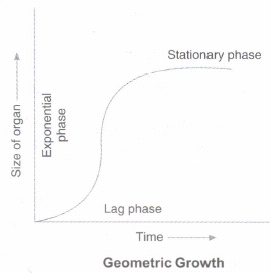
The exponential growth can be expressed as
W1 = Wo ert
W1 = final size (weight, height, number etc.)
W0= initial size at the beginning of the period
r = growth rate
t = time of growth
e = base of natural logarithms
Here, r is the relative growth rate and is also the measure of the ability of the plant to produce new plant material, referred to as efficiency index. Hence, the
final size of WI depends on the initial size, W0.
Quantitative comparisons between the growth of living system can also be made in two ways:
(i) measurement and the comparison of total growth per unit time is called the absolute growth rate.
(ii) The growth of the given system per unit time expressed on a common basis,
e.g., per unit initial parameter is called the relative growth rate.
4.
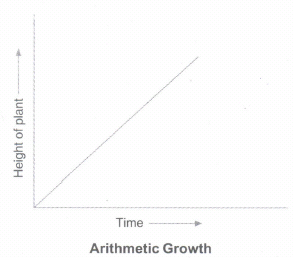
(a) Arithmetic Growth. In arithmetic growth, following mitotic cell division, only one daughter cell continues to divide while the other differentiates and matures. The simplest expression of arithmetic growth is exemplified by a root elongating at a constant rate.
Mathematically, it is expressed as
Lt = L0 + rt
Lt = length at time 't'
L0= length at time 'zero'
r = growth rate/elongation per unit time
(b) Geometric Growth. In most systems, the initial growth is slow (lag phase), and it increases rapidly thereafter - at an exponential rate (log or exponential phase). Here, both the progeny cells following mitotic cell division retain the ability to divide and continue to do so. However, with limited nutrient supply, the growth slows down leading to a stationary phase. If we plot the parameter of growth against time, we get a typical sigmoid or S-curve. A sigmoid curve is a characteristic of living organism growing in a natural environment. It is typical for all cells, tissues and organs of a plant.
The exponential growth can be expressed as
W1 = Wo ert
W1 = final size (weight, height, number etc.)
W0= initial size at the beginning of the period
r = growth rate
t = time of growth
e = base of natural logarithms
Here, r is the relative growth rate and is also the measure of the ability of the plant to produce new plant material, referred to as efficiency index. Hence, the
final size of WI depends on the initial size, W0.
Quantitative comparisons between the growth of living system can also be made in two ways:
(i) measurement and the comparison of total growth per unit time is called the absolute growth rate.
(ii) The growth of the given system per unit time expressed on a common basis,
e.g., per unit initial parameter is called the relative growth rate.
(c) Sigmoid growth curve
The growth of living organisms in their natural environment is characterised by an S-shaped curve called sigmoid growth curve. This curve is divided into three phases – lag phase, log phase or exponential phase of rapid growth, and stationary phase.
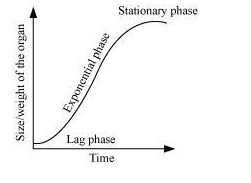
Exponential growth can be expressed as:
W1 = W0en
Where,
W1 = Final size
W0 = Initial size
r = Growth rate
t = Time of growth
e = Base of natural logarithms
(d) Absolute and Relative growth rates:
1. Absolute growth rate is total growth per unit time. In the given representation, the absolute growth rate for both leaves is 5 square centimeters per given time.
2. Relative growth is the rate of growth with respect to the initial size. Here, the relative growth rate for leaf A is higher as its surface area increased by 100% while the surface area of leaf B increased by only 10%.
5.
Growth. Growth can be defined as an irreversible permanent increase in size of an organ or its parts or even of an individual cell. Generally, growth is accompanied by metabolic processes (both anabolic and catabolic), that occur at the expense of energy.
Differentiation. The cells derived from root apical and shoot-apical meristems and cambium differentiate and mature to perform specific functions. This act leading to maturation is termed as differentiation. During differentiation, cells undergo few to major structural changes both in their cell walls and protoplasm. For example, to form a tracheary element, the cells would lose their protoplasm. They also develops a very strong, elastic, lignocellulosic secondary cell walls, to carry water to long distances even under extreme tension.
Development. Development is a term that includes all changes that an organism goes through during its life cycle from germination of the seed to senescence.
Dedifferentiation. The living differentiated cells, that by now have lost the capacity to divide can regain the capacity of division under certain conditions. This phenomenon is termed as dedifferentiation. For example, formation of meristems - interfascicular cambium and cork cambium from fully differentiated parenchyma cells.
Redifferentiation. While undergoing dedifferentiation plant cells once again lose their capacity to divide and become mature. This process is called redifferentiation.
Determinate Growth. Although growth in most of the plant parts is unlimited. Certain parts grow up to a certain level and then stop growing. This kind of growth is called determinate growth.
Growth Rate. The increased growth per unit time is termed as growth rate. Thus, rate of growth can be expressed, mathematically. An organism, or a part of the organism can produce more cells in a variety of ways. The growth rate shows an increase that may be arithmetic or geometrical. Quantitative comparisons between the growth of living system can also be made in two ways:
(i) measurement and the comparison of total growth per unit time is called the absolute growth rate.
(ii) The growth of the given system per unit time expressed on a common basis,
e.g., per unit initial parameter is called the relative growth rate.
6.
The cell which are derived from root apical meristem and shoot and other meristems undergo certain changes to attain maturity to perform specific functions. This process which leads to maturation of cells is termed as differentiation. During this, the cells undergo a few major structural changes both in their cell walls and protoplasm to perform some specific functions throughout their life.
(i) In plants, some living differentiated cells, e.g. parenchyma can regain the capacity to divided mitotically under certain conditions. A dedifferentiated tissue can act as merisstem, e.g. interfascicular vascular cambium,cork cambium and wound meristem.
(ii) The product of dedifferentiated cells or tissues which lose the ability to divide is called redifferentiated cells and the term is known as redifferentiation. Secondary xylem and secondary phloem from interfascicular vascular cambium, secondary cortex are the examples of tissues.
7.
Growth is defined as a permanent or irreversible increase in dry weight, mass or volume of cell, organ or organisms.
Plant growth takes place in three steps or phase-cell division, cell elongation and cell maturation.
(i) Cell Division Phase
It is also called formative phase.
(i) New cells are produced by mitotic divisions of the pre-existing cells.
(ii) The meristematic cells have thin cellulose walls with abundant plasmodesmata connections, dense protoplasm and conspicuous nuclei.
(iii) In higher plants, cell division occurs in meristems or growing points.
(iv) As the formation of new cells requires intense biosynthetic activity, the rate of respiration in the cells of formation phase is very high.
(ii) Cell Enlargement Phase
(i) It is also called phase of cell elongation.
(ii) This phase lies just behind the growing points and is mainly responsible for growth of plant parts.
(iii) The newly formed cells, produced in formative phase undergo enlargement.
(iv) The cell walls of the enlarging of cell show plastic extension through, enzymatic loosening of microfibrils and deposition of new materials.
(v) The enlarging cell also develops a central vacuole, rate of respiration is high but less than that of the cells in the formative phase.
(v) Thus, this phase is characterised by cell enlargement, new cellwall deposition and increased vacuolation
(iii) Cell Maturation Phase
(i) This phase occurs just behind the phase of elongation.
(ii) The enlarged cells develop into particular type of cells by undergoing structural and physiological differentiation.
(iii) Hence, at this phase all the diverse tissue types observed in root or stem.
8.
The factor which prove the phytohormones act synergistically or antagonsitically are
(i) Cell division is promoted by both auxins and cytokinins acting synergistically.
(ii) Auxins and cytokinins act antagonistically in controlling apical dominance. Auxins cause apical dominance, while cytokinins promotes shoot bud formation.
(iii) Auxins and cytokinins act antagonistically in controlling apical dominance. Auxins cause apical dominance, while cytokinins overcome same.
(iv) Senescence is prevented by auxins and cytokinins,while it is stimulated by absciscis acid.
(v) The activity of cambium and fruit growth seems to be promoted by auxins, gibberellins and cytokinnins, the same is inhibited by abscisic acid.
(vi) The dormancy of seeds and buds is mostly due to abscisic acid and the same is broken by gibberellins.
(vii) Cytokinins cause opening of stomata, while abscisic acid results in their closure.
9.
Most of the hormones are synergistic to each other in their mode of functions. Thus, during experimentation, we cannot judge whether, a particular effect is produced by a single hormone or is an additive effect of many hormones.
For example,
(i) Auxins help to initiate rooting in stem cuttings, (an application widely used for plant propagation.)Cytokinins also show the similar function of root pineapples. they also induce parthenocarpy, e.g., in tomatoes.
(ii) Both gibberellins and ethylene are synergistic to auxin in initiating flowering and for sysynchronising fruit set in pineapples.
(iii) Cytokinins and gibberellins help overcome the apical dominance and delay the process of leaf senescnence.
(iv) On the other hand, ethylene promotes senescence and abscission of plant organs especially of leaves and flowers. this shows that all hormones are synergistic to each other in their mode of action in plants.
10.
Plant growth regulators are small, simple molecules secreted in minute quantities, that influence various physiological functions in plants. They are of diverse chemical composition.
(i) Indole compounds [such as-indole-3-Acetic Acid (IAA)]
(ii) Adenine derivatives[such as kinetin, 6-furfuryl amino purine]
(iii) Derivatives of carotenoids {such as Abscisic Acid (ABA)]
(iv) Terpenes[such as gibberellic acids]

11th Standard CBSE Syllabus & Materials
11th Standard CBSE
CBSE 11th Business Studies Forms of Business Organisation Sample Question Papers Study Material - QB365 Set A
NEW11th Standard CBSE
CBSE 11th Business Studies Business, Trade and Commerce Sample Question Papers Study Material - QB365 Set A
NEW11th Standard CBSE
CBSE 11th Physics Waves Sample Question Papers Study Material - QB365 Set A
NEW11th Standard CBSE
CBSE 11th Physics Kinetic Theory Sample Question Papers Study Material - QB365 Set A



CBSE 11th Standard CBSE Subjects
CBSE Standards









