
 100% FREE ACCESS
11th Standard CBSE Syllabus & Materials
11th Standard CBSE
CBSE 11th Economics PART-A - Presentation of Data - New Sample Question Papers Study Material - QB365 Set A
NEW11th Standard CBSE
CBSE 11th Economics PART-A - Organisation of Data - New Sample Question Papers Study Material - QB365 Set A
NEW11th Standard CBSE
CBSE 11th Economics PART-A - Collection of Data - New Sample Question Papers Study Material - QB365 Set A
NEW11th Standard CBSE
CBSE 11th Economics PART-A - Introduction to Economics and Statistics - New Sample Question Papers Study Material - QB365 Set A
NEW11th Standard CBSE
CBSE 11th Business Studies International Trade Sample Question Papers Study Material - QB365 Set A
NEW11th Standard CBSE
CBSE 11th Business Studies Evolution and Fundamentals of Business Sample Question Papers Study Material - QB365 Set A

Published on: 28/09/2019
Plant Growth and Development
Download CBSE Class 11th Standard CBSE Biology question papers, sample papers, important questions, and previous year solved papers in PDF format. Get free study materials, NCERT solutions, and exam preparation resources for Class 11th Standard CBSE Biology
Questions + Answers key
Take MCQ Biology Test
1.
Explain some natural means of overcoming seed dormancy.
2.
What are the various man-made meant of overcoming seed dormancy?
3.
Explain some internal causes of seed dormancy.
4.
What are the favourable conditions for seed germination?
5.
What do you understand by apical dominance?
6.
What is heterophylly?
7.
An owner of an apple orchard wants to get better yield and wants to wait for good market conditions to sell his apples. Which PGR should he use to achieve his goals?
8.
Which areas of plant show elongation phase? Why?
9.
Why is not any one parameter good enough to demonstrate growth throughout the life of a flowering plant?
10.
Would a defoliated plant respond to photoperiodic cycle? Why?
11.
If the critical photoperiod for a short-day plant is 13hrs of daylight, will it flower when there are 15 hrs of daylight?
12.
Nicotiana tobacum,(tobacco) a short-day plant, when exposed to more than the critical period of light fails to flower. Explain.
13.
Both animals and plants grow. Why do we say that growth and differentiation in plants is open and not so in animals? Does this statement hold true for sponges also?
14.
The role of ethylene and abscisic acid is both positive and negative. Justify the statement.
15.
How are gibberellins useful in agriculture to improve productivity. Give any three points in support of your answer.
1.
Natural means of overcoming seed dormancy:
1. Abrasions caused by microbial action
2. Abrasions because of passage through digestive tracts of animals.
2.
Man-made means of overcoming seed dormancy:
1. The seed-coat barrier in some seeds can be broken by mechanical abrasions using knives, sandpaper, etc. or by vigorous shaking.
2. Effect of inhibitory substances can be removed by subjecting the seeds to chilling conditions or by application of certain chemicals like gibberellic acid and nitrates.
3. Changing environment conditions: like light and temperature.
3.
Internal causes of seed dormancy:
1. Impermeable and hard seed coat.
2. Presence of chemical inhibitors; such as absicissic acid, phenolic acid,para-ascorbic acid, etc.
3. Immature embryo.
4.
Favourable conditions for seed germination:
1.Proper temperature
2.Moisture
3.Sunlight
4.Oxygen
5.
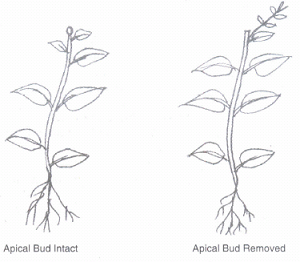
In most of the higher plants, growing apical bud inhibits the growth of lateral (axillary buds). This phenomenon is called apical dominance. Removal of short tips (decapitation) normally results in the growth of lateral buds. Decapitation is used in tea plantations to get more leaves from a plant.
6.
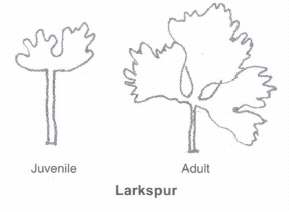
In some plants, certain structures show different forms, in response to environment or to phases of life. This ability is known as plasticity. For example, in cotton, coriander and larkspur, leaves of juvenile plant are different in shape compared to leaves in mature plants. This is called heterophylly. In buttercup shape of leaves produced in air is different from that produced in water.
7.
He should use Gibberellins. Gibberellins help increase the size of apples. Moreover, they also delay senescence so apple can be left on branches for a longer duration. This will give the orchard owner enough time to wait for good market conditions.
8.
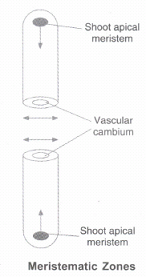
The root apex and shoot apex show elongation phase. They have apical meristem which has cells undergoing continuous cell division. This leads to elongation and growth of the apical region of shoot and root.
9.
Any one parameter is not good enough to demonstrate erowth throughout the lifeof a flowering plant because the plants exhibit different types of growth during different stages of their life cycle. In the seedling stage, they are in state of active mitotic cell division, then they undergo active cell enlargement stage during growing stage. After the formation of various organs, they undergo cell differentiation or get matured. Finally, in the reproductive or flowering stage of their life cycle, they exhibit reductional division
10.
No, a defoliated plant would not respond to photoperiodic cycle because the site of perception of light, dark duration are the leaves.
There is a hormonal substance present in leaves which is responsible for flowering. This hormonal substance migrates from leaves to shoot apices for inducing flowering only when the plants are exposed to the necessary photoperiod.
11.
A short-day plant requires a minimum level of darkness in order to flower. In this example, the critical level of daylight is 13 hrs, and any level of daylight beyond this will not allow the plant adequate hours of darkness. So the plant will, therefore, not flower when there are 15 hrs of exposure of daylight.
12.
(i) Some plants require a periodic exposure to alternate light and dark period for its flowering response and this phenomenon is called photoperiodism.
(ii) The requirement of light exposure is critical. the SDP plants when exposed to light period in excess of critical period fail to flower.
(iii) Those plants, which require exposure to light period at critical or more than critical period for its flowering response are called long-day plants.
(iv) Nicotiana tobacum fails to flower if exposed to more than the critical period of light because it is a short-day plant.
13.
Plants growth is a unique phenomenon because plants retain the capacity for unlimited growth throughout their life. This ability of the plants is due to the presence of meristems at certain locations in their body. The cells of meristems have the capacity to divide and self-perpetuate.
The cells thus produced, however, soon loses the capacity to divide and such cells make up the plant body. This form of growth wherein new cells are always being added to the plant body by the activity of the meristem is called the open form of growth. Yes,this statement holds true for sponges also.
14.
The role of ethylene and abscisic acid is both positive and negative. Ethylene is a simple gaseous PGR. It is synthesised in large amount by tissues undergoing senescence and ripening. It also promotes senescence and abscission of plant organs especially of leaves and flowers. This is its negative effect.
As it's positive affect, ethylene breaks seed and bud dormancy, initiates germination in peanut seeds, sprouting of potato tubers. It promotes internode/petiole elongation in deep water rice plants. It helps leaves/inner parts of the shoot to remain above water.
Abscisic acid (ABA)is a stress hormone released only during unfavourable conditions of drought heat stress etc. It has both positive and negative roles to play during the growth of a plant. It shows a positive effect by aiding in seed devlopment and maturation. During stressful conditions of droug and salinity, ABA brings about stomatal closure which further reduces the rate of water loss during transpiration. This prevents the plant from wilting. the hormone prevent loss of seed dormancy. On the other hand, ABA is general plant growth inhibitor. inhibits seed germination and other plant metabolis
Thus, the role of both ethylene and ABA is both post and negative effect.
15.
Gibberellins are useful in agriculture in the following ways
(i) Application of gibberellins increases the length of the stem and increases the yield of sugar in sugarcane.
(ii) Gibberellins delay senescence and prevent the premature fruits drop.
(iii) It can cause fruits like apple to elongate and improve in shape.

11th Standard CBSE Syllabus & Materials
11th Standard CBSE
CBSE 11th Business Studies Forms of Business Organisation Sample Question Papers Study Material - QB365 Set A
NEW11th Standard CBSE
CBSE 11th Business Studies Business, Trade and Commerce Sample Question Papers Study Material - QB365 Set A
NEW11th Standard CBSE
CBSE 11th Physics Waves Sample Question Papers Study Material - QB365 Set A
NEW11th Standard CBSE
CBSE 11th Physics Kinetic Theory Sample Question Papers Study Material - QB365 Set A



CBSE 11th Standard CBSE Subjects
CBSE Standards









