
 100% FREE ACCESS
11th Standard CBSE Syllabus & Materials
11th Standard CBSE
CBSE 11th Economics PART-A - Presentation of Data - New Sample Question Papers Study Material - QB365 Set A
NEW11th Standard CBSE
CBSE 11th Economics PART-A - Organisation of Data - New Sample Question Papers Study Material - QB365 Set A
NEW11th Standard CBSE
CBSE 11th Economics PART-A - Collection of Data - New Sample Question Papers Study Material - QB365 Set A
NEW11th Standard CBSE
CBSE 11th Economics PART-A - Introduction to Economics and Statistics - New Sample Question Papers Study Material - QB365 Set A
NEW11th Standard CBSE
CBSE 11th Business Studies International Trade Sample Question Papers Study Material - QB365 Set A
NEW11th Standard CBSE
CBSE 11th Business Studies Evolution and Fundamentals of Business Sample Question Papers Study Material - QB365 Set A

Published on: 28/09/2019
Respiration in Plants
Download CBSE Class 11th Standard CBSE Biology question papers, sample papers, important questions, and previous year solved papers in PDF format. Get free study materials, NCERT solutions, and exam preparation resources for Class 11th Standard CBSE Biology
Questions + Answers key
Take MCQ Biology Test
1.
Give a diagrammatic representation of fermentation.
2.
What is the economic importance of fermentation?
3.
Give a tabular representation of respiratory balance sheet.
4.
Give a diagrammatic representation of ATP synthesis.
5.
What are the main steps of aerobic respiration?
6.
The maximum concentration of alcohol produced by natural fermentation is 13%. But most of the alcoholic preparations for human consumption contain more than this percentage. How this higher percentage is achieved?
7.
How glycolysis takes place in anaerobic environment?
8.
There is no special respiratory organ in plants, yet plants efficiently manage exchange of gases. Justify.
9.
Why ATP is called an energy currency?
10.
The energy yield in terms of ATP is higher in aerobic respiration than during anaerobic respiration. Why is there anaerobic respiration even in organisms that live in aerobic condition like human beings and angiosperms?
11.
What is Pentose Phosphate Pathway(PPP)? Where does it take place?
12.
Name the site(s) of pyruvate synthesis.Also, write the chemical reaction, wherein pyruvic acid dehydrogenase acts as a catalyst.
13.
It is known that red muscle fibres in animals can work for longer periods of time continuously. How is this possible?
14.
Name the end products of aerobic and anaerobic fate of glycolysis.List two ways by which molecules of ATP are produced in glycolysis during aerobic respiration in a cell.
15.
Distinguish between the following:
(a) Aerobic respiration and Anaerobic respiration
(b) Glycolysis and Fermentation
(c) Glycolysis and Citric acid Cycle
1.
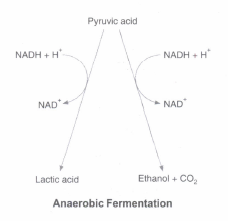
2.
Economic Importance of Fermentation:
(i) Alcoholic drinks, like wine, beer are produced by fermentation.
(ii) Vinegar is produced by fermentation.
(iii) Many dishes, like idli and jalebi need to be fermented before final cooking. This gives the unique texture and flavour to a dish.
(iv) Breads and cakes are product of fermented dough, which gives the spongy texture to them.
(v) Curd is a result of fermentation of milk by bacteria.
3.
| Respiratory Balance Sheet | |||
| Step | Coenzyme yield | ATP yield | Sources of ATP |
| Glycolysis preparatory phase | -2 | Cytoplasm | |
| Glycolysis pay-off phase | 4 | Substrate level phosphorylation | |
| 2 NADH | 4(6) | Oxidative phosphorylation | |
| Oxidative decarboxylation of pyruvate | 2 NADH | 6 | Oxidative phosphorylation |
| 2 | Substrate level phosphorylation | ||
| 6 NADH | 18 | Oxidative phosphorylation | |
| 2 FADH2 | 4 | Oxidative phosphorylation | |
| Total Yield | 36 (38) ATP | Complete oxidation of 1 Molecule of glucose. Oxidation of all the reduced coenzymes | |
4.
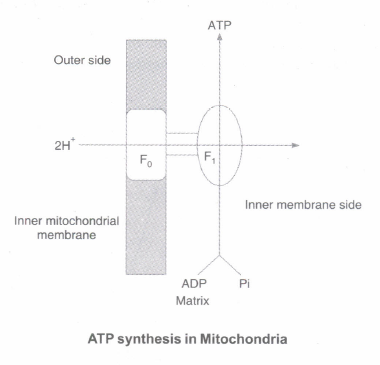
5.
Steps of Aerobic Respiration
1. The complete oxidation of pyruvate by the stepwise removal of all the hydrogen atoms, leaving three molecules of CO2.
2. The passing on of the electrons removed as part of the hydrogen atoms to molecular O2 with imultaneous synthesis of ATP.
6.
The higher percentage of alcohol is achieved through distillation of the liquid, which gives pure alcohol as well. The boiling involved in distillation helps evaporate the liquid part and higher concentration is achieved.
7.
Glycolysis is the breakdown of glucose into pyruvic acid and it does not need oxygen. So in all living beings, irrespective of them being either aerobic or anaerobic glycolysis takes place. In fact glycolysis is the first step towards oxidation of glucose and oxidation takes place either during anaerobic respiration or during aerobic respiration.
8.
Every part of plant manages its gas exchange need. There is no exchange of gases between different organs. So unlike animals plants do not need special respiratory organs to facilitate exchange of gases. In leaves the exchange of gases takes place through stomata, while in stems it takes place through lenticels.
9.
The energy produced during various steps of cellular respiration is stored in the form of ATP. This is later utilized on an SOS basis. So, ATP is also called as energy currency.
10.
(i) The anaerobic respiration occurs even in organisms that live in aerobic condition like human beings and angiosperms under conditions of oxygen scarcity that happens in the muscle tissue. Under intense use, muscles demand too much energy (ATP) and consume much more oxygen to produce that energy.
(ii) This high consumption leads to oxygen scarcity and the muscle cells begin to make lactic acid by anaerobic respiration trying to fulfill their energetic needs.
(iii) Similarly, yeast cells under deficient conditions carry out anaerobic respiration.
11.
It is an alternative method of aerobic respiration which occurs in cytoplasm of mature cells. This pathway accerents 60% of total respiration occurring in lower cells.
12.
Pyruvate synthesis takes place in cytoplasm by the process of glycolysis.
The chemical reaction,wherein pyruvic acid dehydrogenase acts as a catalyst is as follows
The reactions catalysed by pyruvic dehydrogenase require the participation of several coenzymes, including NAD+ and Co-A
Pyruvic acid + Co-A + NAD+ \(\underrightarrow { { Mg }^{ 2+ } } \) Acetyl Co-A + NADH + H+
Pyurvate dehydrogenase
13.
Red or dark muscles store myoglobin and hence, oxygen for meeting the gap between supply and consumption during continuous activity. Therefore, these muscles can continuously work and respire aerobically for long periods. High proportion of these muscles allow athletes to participitate in long duration events like cycling, swimming and distance running etc.
14.
Pyruvic acid \(\underrightarrow { { O }_{ 2 } } \) CO2+water
End product of anaerobic glycolysis are CO2 and ethanol or lactic cid.
Molecules of ATP are [produced in two ways in glycolysis by
(i) direct transfer of phosphate to ADP.
(ii) oxidation of NADH produced during glycolysis to NAD+
15.
(a) Aerobic respiration and Anaerobic respiration : There is incomplete oxidation of glucose during anaerobic respiration, while there is complete oxidation during aerobic respiration.
(b) Glycolysis and Fermentation : During glycolysis glucose is converted to pyruvic acid, while during fermentation this pyruvic acid is utilized to produce energy in the form of ATP.
(c) Glycolysis and Citric acid Cycle : Glycolysis : Glycolysis is a metabolic pathway that is found in the cytoplasm of cells in all living organisms and is anaerobic, or doesn't require oxygen. The process converts one molecule of glucose into two molecules of pyruvate, and makes energy in the form of two net molecules of ATP.
Citric acid Cycle or Krebs Cycle : When oxygen is present, acetyl-CoA is produced from the pyruvate molecules created from glycolysis. Once acetyl-CoA is formed, two processes can occur, aerobic or anaerobic respiration.
When oxygen is present, the mitochondria will undergo aerobic respiration which leads to the Krebs cycle. However, if oxygen is not present, fermentation of the pyruvate molecule will occur. In the presence of oxygen, when acetyl-CoA is produced, the molecule then enters the citric acid cycle (Krebs cycle)inside the mitochondrial matrix, and gets oxidized to CO2 while at the same time reducing NAD to NADH. NADH can be used by the electron transport chain to create further ATP as part of oxidative phosphorylation. To fully oxidize the equivalent of one glucose molecule, two acetyl-CoA must be metabolized by the Krebs cycle. Two waste products, H2O and CO2, are created during this cycle.
The citric acid cycle is an 8-step process involving 8 different enzymes. Throughout the entire cycle, acetyl-CoA changes into citrate, isocitrate, α ketoglutarate, succinyl-CoA, succinate, fumarate, malate, and finally, oxaloacetate. The net energy gain from one cycle is 3 NADH,1 FADH, and 1 ATP. Thus, the total amount of energy yield from one whole glucose molecule (2 pyruvate molecules) is 6 NADH, 2 FADH, and 2 ATP.

11th Standard CBSE Syllabus & Materials
11th Standard CBSE
CBSE 11th Business Studies Forms of Business Organisation Sample Question Papers Study Material - QB365 Set A
NEW11th Standard CBSE
CBSE 11th Business Studies Business, Trade and Commerce Sample Question Papers Study Material - QB365 Set A
NEW11th Standard CBSE
CBSE 11th Physics Waves Sample Question Papers Study Material - QB365 Set A
NEW11th Standard CBSE
CBSE 11th Physics Kinetic Theory Sample Question Papers Study Material - QB365 Set A



CBSE 11th Standard CBSE Subjects
CBSE Standards









