
 100% FREE ACCESS
11th Standard CBSE Syllabus & Materials
11th Standard CBSE
CBSE 11th Economics PART-A - Presentation of Data - New Sample Question Papers Study Material - QB365 Set A
NEW11th Standard CBSE
CBSE 11th Economics PART-A - Organisation of Data - New Sample Question Papers Study Material - QB365 Set A
NEW11th Standard CBSE
CBSE 11th Economics PART-A - Collection of Data - New Sample Question Papers Study Material - QB365 Set A
NEW11th Standard CBSE
CBSE 11th Economics PART-A - Introduction to Economics and Statistics - New Sample Question Papers Study Material - QB365 Set A
NEW11th Standard CBSE
CBSE 11th Business Studies International Trade Sample Question Papers Study Material - QB365 Set A
NEW11th Standard CBSE
CBSE 11th Business Studies Evolution and Fundamentals of Business Sample Question Papers Study Material - QB365 Set A

Published on: 09/09/2019
Transport in Plants
Download CBSE Class 11th Standard CBSE Biology question papers, sample papers, important questions, and previous year solved papers in PDF format. Get free study materials, NCERT solutions, and exam preparation resources for Class 11th Standard CBSE Biology
Questions + Answers key
Take MCQ Biology Test
1.
The plant cell cytoplasm is surrounded by both cell wall and cell membrane. The specificity of transport of substances are mostly across the cell membrane, because __________________.
2.
When does wilting occur?
3.
Root pressure cannot account for the translocation of water.True or false?Explain.
4.
Identify the vascular tissue responsible for translocation of organic and inorganic substance from leaves to other parts of the plant.
5.
Should there be a long distance transport system in plants?Give reason.
6.
What role does root pressure play in water movement in plants?
7.
Describe the role played by protein pumps during active transport in plants
8.
How is the mycorrhizal association helpful in absorption of water and minerals in plants?
9.
Will the ascent of sap be possible without the cohesion and adhesion of water molecules?Explain.
10.
Enumerate the importance os osmosis in the life of the plants. (any two points)
11.
Well-watered plants transpire more during sunny and windy days than in cool and calm mornings. Comment.
12.
Many plants in order to compensate with the loss of CO2 has evolved C4 photosynthetic system . Comment.
13.
Under what condition the rate of transpiration will be maximum, when soil is dry and atmosphere is humid or when soil is humid and atmosphere is dry? given reason.
14.
What causes the opening and closing of guard cells of stomata during transpiration?
15.
Explain pressure flow hypothesis of translocation of sugars in plants.
16.
Differentiate between the following -Guttation and Transpiration
17.
Differentiate between the following - Apoplast and Symplast pathways of movement of water in plants
1.
()
Cell membrane is semipermeable.
2.
()
Wilting occurs whenever the turgor pressure in non-lignified plant cells falls towards zero, as a result of diminished water in the cells
3.
()
Root pressure cannot account for the translocation of water because it fails to play role in movement of water in tall plants like gymnosperms.
4.
()
Phloem is responsible for this type of translocation.
5.
()
Yes, because substance have to be moved across very long distance for which diffusion and active transport are not sufficient.
6.
Root pressure is responsible for pushing up water to small heights till the lower part of the stem.
The greatest contribution of root pressure may be to re-establish the continuous chain of water molecules in the xylem, which often breaks under the enormous tensions created by transpiration. Root pressure does not account for the majority of water transport, most plants meet their need by transpiratory pull.
7.
Proteins pumps use energy to carry substances across the cell membrane. These pumps can transport substances from a low concentration to a high concentration (uphill transport). Rate of transport reaches maximum level when all the protein transporters are being used or are saturated. Just like enzymes, the carrier proteins is very specific in what it carries across the membrane.
These are also sensitive to inhibitors that react with protein side chain and inhibit metabolism.
8.
A mycorrhiza is a symbiotic association of a fungus with a root system. The fungal filaments form a network around the young root by penetrating inside the root cells.The hyphae of fungal part possesses a very large surface area that absorbs mineral ions and water from soil from a larger volume of soil perhaps not possible by the roots to perform. The fungus thus, provides minerals and water to the roots of the plant and in turn the sugars and N-containing compounds are provided to the fungus present in roots.
9.
The cohesion and adhesion of the water molecules alone create pressure of about 350 atm, which alone are responsible for conducting water to great heights in tall trees without breaking the water column.On the other hand, all forces such as imbibition pressure, and root pressure have been found to create pressure of only 50 atm.
10.
Osmosis is important in the following ways
(i) Helps in maintaining turgidity of the cells
(ii) Affects absorption of water by roots
11.
The leaf of the plants are heated by the temperature of the environment and also by the heat released during photosynthesis. Thus, transpiration provides a cooling mechanism for the plant to release excess heat in the leaves in order to maintain internal temperature necessary for biological and chemical processes. Transpiration tends to occur more quickly at higher temperature, i.e in suny ays due to increased evaporation. And on windy days the moisture present in the air is swept away from the leaf causing it to transpire more. Whereas on cool and calm days, the humidity rate can rise which in turn cause a decrease in transpiration.
12.
Many plants in tropical climates have evolved a C4 Photosynthetic system in order to compensate with CO2 loss. Transpiration reduces the oxygen supply of available water for photosynthesis due to which the gaurd cells sheets the stomata and become flaccid in size (closed) .This reduces the supply of carbon dioxide for photosynthesis.
Therefore C4 photosynthesis system helps them to over come loss of CO2 by minimising loss of water and maximising level of CO2
It also noticed that C4 palnts are two times much efficient thah C3 plants in terms of CO2 fixation
13.
The rate of transpiration will be maximum when the soil is humid and atmosphere is dry because of following reasons.
(i) Availability of more water in the soil is necessary for the absorption of water by the roots in order to carry it up to the xylem. Thus, lack of water decrease transpiration and over all health of the plants. Whereas, more water in soil increase transpiration.
(ii) In dry climates, transpiration is increased. Water is forced to diffuse more rapidly in to the air due to the concentration difference between the environment outside the plant. Low humidity creates a vapour gradient between the plant and the air.In dry air, there is lack of water, forcing water to be pulled from the plant to the atmosphere increasing transpiration. Therefore, in humid climates, transpiration is less affected by diffusion.
14.
Opening and Closing of Stomata :
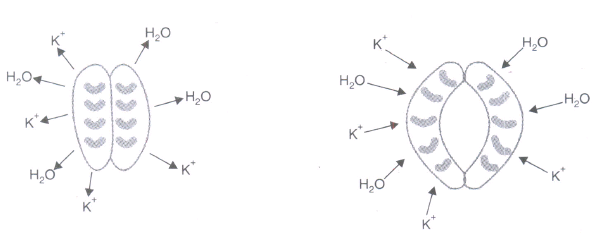
The immediate cause of the opening or closing of the stomata is a change in the turgidity of the guard cells. The inner wall of each guard cell, towards the pore or stomatal aperture, is thick and elastic. When turgidity increases within the two guard cells flanking each stomatal aperture or pore, the thin outer walls bulge out and force the inner walls into a crescent shape. The opening of the stoma is also aided due to the orientation of the microfibrils in the cell walls of the guard cells. Cellulose microfibrils are oriented radially rather than longitudinally making it easier for the stoma to open. When the guard cells lose turgor, due to water loss (or water stress) the elastic inner walls regain their original shape, the guard cells become flaccid and the stoma closes.
15.
The Pressure Flow or Mass Flow Hypothesis
The accepted mechanism used for the translocation of sugars from source to sink is called the pressure flow hypothesis. As glucose is prepared at the source (by photosynthesis) it is converted to sucrose (a dissacharide). The sugar is then moved in the form of sucrose into the companion cells and then into the living phloem sieve tube cells by active transport. This process of loading at the source produces a hypertonic condition in the phloem. Water in the adjacent xylem moves into the phloem by osmosis. As osmotic pressure builds up the phloem sap will move to areas of lower pressure. At the sink osmotic pressure must be reduced. Again active transport is necessary to move the sucrose out of the phloem sap and into the cells which will use the sugar - converting it into energy, starch, or cellulose. As sugars are removed, the osmotic pressure decreases and water moves out of the phloem.
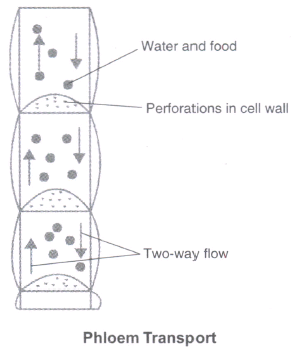
Phloem tissue is composed of sieve tube cells, which form long columns with holes in their end walls called sieve plates. Cytoplasmic strands pass through the holes in the sieve plates, so forming continuous filaments. As hydrostatic pressure in the phloem sieve tube increases, pressure flowbegins, and the sap moves through the phloem. Meanwhile, at the sink, incoming sugars are actively transported out of the phloem and removed as complex carbohydrates. The loss of solute produces a high water potential in the phloem, and water passes out, returning eventually to xylem.
A simple experiment, called girdling, was used to identify the tissues through which food is transported. On the trunk of a tree a ring of bark up to a depth of the phloem layer, can be carefully removed. In the absence of downward movement of food the portion of the bark above the ring on the stem becomes swollen after a few weeks. This simple experiment shows that phloem is the tissue responsible for translocation of food; and that transport takes place in one direction, i.e., towards the roots. This experiment can be performed by you easily.
16.
Guttation and Transpiration:
Guttation is the appearance of drops of xylem sap on the tips or edges of leaves of some vascular plants, such as grasses. Guttation is not to be confused with dew, which condenses from the atmosphere onto the plant surface.
Process :
At night, transpiration usually does not occur because most plants have their stomata closed. When there is a high soil moisture level, water will enter plant roots, because the water potential of the roots is lower than in the soil solution. The water will accumulate in the plant, creating a slight root pressure. The root pressure forces some water to exude through special leaf tip or edge structures, hydathodes, forming drops. Root pressure provides the impetus for this flow, rather than transpirational pull.
Transpiration on the other hand happens because of transpiration pull.
17.
Apoplast and Symplast pathways of movement of water in plants.
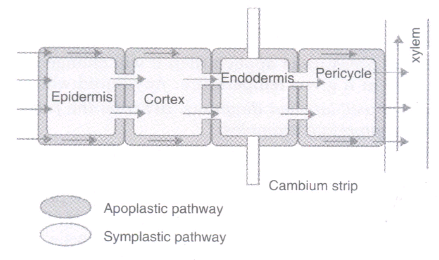
Within a plant, the apoplast is the free diffusional space outside the plasma membrane. It is interrupted by the Casparian strip in roots, air spaces between pfant ceITsand the cuticula of the plant.
Structurally, the apoplast is formed by the continuum of cell walls of adjacent cells as well as the extracellular spaces, forming a tissue level compartment comparable to the symplast. The apoplastic route facilitates the transport of water and solutes across a tissue or organ. This process is known as apoplastic transport.
The symplast of a plant is the inner side of the plasma membrane in which water (and low-molecular solutes) can freely diffuse. The plasmodesmata allow the direct flow of small molecules such as sugars, amino acids, and ions between cells. Larger molecules, including transcription factors and plant viruses, can also be transported through with the help of actin structures.
This allows direct cytoplasm to cytoplasm flow of water and other nutrients along concentration gradients. In particular, it is used in the root systems to bring in nutrients from soil. It moves these solutes from epidermis cells through the cortex into the endodermis and eventually the pericycle, where it can be moved into the xylem for long distance transport. It is contrasted with the apoplastic flow,which uses cell wall transport.

11th Standard CBSE Syllabus & Materials
11th Standard CBSE
CBSE 11th Business Studies Forms of Business Organisation Sample Question Papers Study Material - QB365 Set A
NEW11th Standard CBSE
CBSE 11th Business Studies Business, Trade and Commerce Sample Question Papers Study Material - QB365 Set A
NEW11th Standard CBSE
CBSE 11th Physics Waves Sample Question Papers Study Material - QB365 Set A
NEW11th Standard CBSE
CBSE 11th Physics Kinetic Theory Sample Question Papers Study Material - QB365 Set A



CBSE 11th Standard CBSE Subjects
CBSE Standards









