
 100% FREE ACCESS
11th Standard CBSE Syllabus & Materials
11th Standard CBSE
CBSE 11th Economics PART-A - Presentation of Data - New Sample Question Papers Study Material - QB365 Set A
NEW11th Standard CBSE
CBSE 11th Economics PART-A - Organisation of Data - New Sample Question Papers Study Material - QB365 Set A
NEW11th Standard CBSE
CBSE 11th Economics PART-A - Collection of Data - New Sample Question Papers Study Material - QB365 Set A
NEW11th Standard CBSE
CBSE 11th Economics PART-A - Introduction to Economics and Statistics - New Sample Question Papers Study Material - QB365 Set A
NEW11th Standard CBSE
CBSE 11th Business Studies International Trade Sample Question Papers Study Material - QB365 Set A
NEW11th Standard CBSE
CBSE 11th Business Studies Evolution and Fundamentals of Business Sample Question Papers Study Material - QB365 Set A

Published on: 06/09/2019
Cell Cycle and Cell Division
Download CBSE Class 11th Standard CBSE Biology question papers, sample papers, important questions, and previous year solved papers in PDF format. Get free study materials, NCERT solutions, and exam preparation resources for Class 11th Standard CBSE Biology
Questions + Answers key
Take MCQ Biology Test
1.
Describe the following - Chiasmata
2.
In which stage of prophase-I of meiosis, homologous chromosomes lie side by side in pairs.
3.
How would you analyse that the cell's entire energy is devoted to the process of division in the M-phase?
4.
There occurs a process in which two divisions of nucleus take place. Identify the process and also write about its different phases.
5.
What does a bivalent of meiosis-I consist of?
6.
Name the substages of prophase of meiosis.
7.
The second meiotic division is similar to mitosis as it results in the separation as it results in the separation of the sister chromatids. However, it also differs from mitosis. Explain how?
8.
Mention the duration of cell cycle in yeast.
9.
Why does a multicellular organism require two types of cell division? Which of the two, produces the greater number of cells? Describe prophase-I stage.
10.
Explain meiosis-II in an animal cell.
11.
Describe briefly the phases of meiotic cell division.
12.
Briefly describe the significance of cell division.
13.
List the main differences between mitosis and meiosis.
14.
Find examples where the four daughter cells from meiosis are equal in size and where they are found unequal in size.
15.
Describe cell division. List various types of cell division. Also mention about the need of cell division?
16.
Describe the events taking place during interphase.
17.
Name three phases of interphase. Give one major event of each phase.
18.
The shortest phase of mitosis is anaphase. State whether this statement is true or false.
19.
Match the words listed in column I with suitable words from words from the column II.
| Column I | Column II |
| A. Karyokinesis | 1. Meiocytes |
| B. Cytokinesis | 2. Plant cells |
| C. Meiosis | 3. Nuclear division |
| D. Cell plate | 4. Cytoplasmic division |
1.
The chiasmata formation is the indication of completion of crossing over and beginning of separation of chromosomes. The chiasmata formed when the chromosomal parts begin to repel each other except in the region where these are in contact. Thus, chiasmata formation is necessary for the separation of homologous chromosomes.
2.
During zygotene or zygonema of meiotic prophase I, the chromosomes become shorter and thicker. The homologous chromosomes come to lie side-by-side in pairs.
3.
Gene expression, protein synthesis, secretion, motility etc, do not happen during M-phase.
4.
Karyokinesis is a series of uninterrupted changes before forming two daughter nuclei. Though karyokinesis is a continuous process, it has been divided into four phases. They are prophase metaphase, anaphase and telophase.
5.
Bivalent of meiosis-I consists of four chromatids and two centromeres.
6.
The various substages of prophase occur in meiosis are leptotene, zygotene, pachytene,diplotene and diakinesis.
7.
The main reason for the difference between the two is that the separating sister chromatids during the meiosis-II differ genetically due to crossing over that had occurred during prophase-I.
8.
The cell cycle of yeast is about 90 minutes (1.5 hours) in duration and a human cell takes almost 24 hours to divide by mitosis.
9.
There are two distinct type of cell divisions taking place in multicellular organisms One is mitosis in somatic cells for growth and healing of wounds and the other is meiosis in reproductive cells for producing gametes having half the number of chromosomes. It is essential to maintain the characters of the species.
More number of cells are produced in meiosis. Each division of mitosis results in the formation of two cells while in meiosis four cells are formed.
10.
All these happen in the two haploid nuclei simultaneously.
(i) Prophase-II, takes short time. Spindle formation begins and the chromosomes become short. Two chromatids are joined to a single centromere. Nuclear membrane and nucleous disintegrate.
(ii) Metaphase-II At the equator, the chromosomes align at the equator and spindle is formed. The centromere of every chromosome is joined to the spindle fibre and centromere also divides.
(iii) Anaphase-II The daughter chromosomes are formed. Chromatids move towards their poles with the spindle fibres.
(iv) Telophase-II Reaching at the poles, chromosomes form nuclei which are haploid(n) daughter nuclei. Again nuclear membrane is constructed. Nucleous now becomes clearly visible.
Cytokinesis Occurs and four daughter cells are formed which are haploid (n). It may occur once or twice or only after the meiosis-II cell division.
11.
Two phases of meiotic division:
(i) Meiotic cell division is divided into two phases Meiosis I and Meiosis II.
(ii) In the meiotic I division, the homologous chromosomes pair to form bivalents. Exchange of genetic material takes place.
(iii) The chromosomes now separate and get distributed into daughter cells.
(iv) Prophase I is divided into five sub-stages : Leptotene, Zygotene, Pachytene, Diplotene and Diakinesis.
(v) During Metaphase I, the bivalents get arranged on equatorial plate with their arms on the plate but the centromere is directed towards opposite pole. It is followed by Anaphase I.
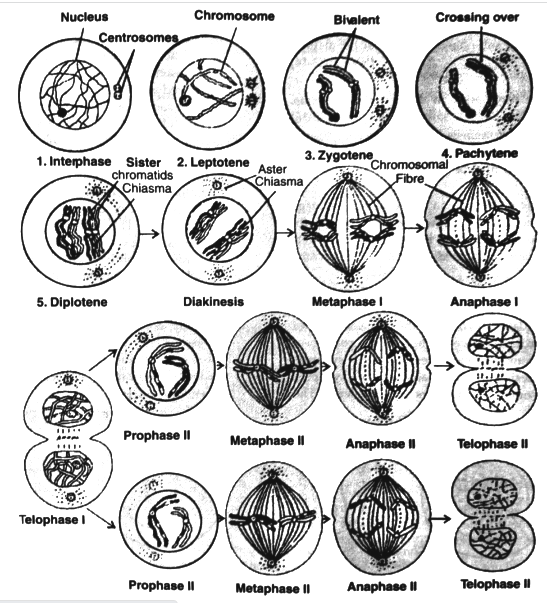
Fig. Stages of meiosis
(vi) Now the homologous chromosomes repel each other, and move to the opposite poles with both their chromatids.
(vii) In this way each pole gets half the chromosomes number of the parent cell.
(viii) In telophase I, the nuclear envelope and nucleolus again appear. Meiosis II is quite similar to mitosis.
(ix) The centromere of each chromosome breaks, separating the chromatids, one each to a daughter cell.
(x) The meiotic cell division maintains the chromosome number of a species.
(xi) As a result of meiotic division, the four daughter cells are formed with half the chromosome number (haploid) in each cell.
12.
Cell division is significant in the following ways
(i) Cell multiplication Cell division is a means of cell multiplication or formation of new cells from pre-existing cells.
(ii) Continuity It maintains continuity of living matter generation after generation.
(iii) Multicellular organisms The body of a multicellular organism is formed of innumerable cells. They are formed by repeated divisions of a single cell or zygote. As the number of cells increases, many of them begin to differentiate, form tissues and organisms.
(iv) Cell size Cell division helps in maintenance of a particular cell size which is essential for efficiency and control of cell activities.
(v) Genetic similarity The common type of cell division or mitosis maintains genetic similarity of all the cells in an individual despite being different, i.e., structurally and functionally.
13.
Difference between Mitosis and Meiosis
| Mitosis | Meiosis |
|---|---|
| Takes place in somatic cells | Takes place in gametic cells |
| Single division | Double division |
| Two daughter cells are formed in the end and resemble mother cell | Four daughter cells are formed in the end and do not resemble to mother cell |
| Replication of chromsomes occurs before every mitotic division |
Replication of chromsomes occurs only once |
| Number of chromosomes remains same in daughter cells as compared to those in parent cells | Number of chromosomes is halved in daughter cells as compared to those in parent cells |
| Does not intoduce variations | Intoduces variations |
| Cell division happens in simple steps | Cell division involves multiple and longer stages |
14.
During microsporogenesis in flowering plants, the four daughter cells formed are equal in size. On the other hand, during megasporogenesis the four daughter cells formed are unequal in size. This can be seen in many other organisms also during the formation of male and female gametes. Meiosis usually leads to formation of equal sized male gametes and unequal sized daughter cells while forming female gametes.
15.
cell division, cell reproduction or cell multiplication is the process of formation of new daughter cells from the pre-existing cell or parent cell.
It is three types
(i) Amitosis
(ii) Mitosis
(iii) Meiosis.
A cell divides when it attains the size and the nucleocytoplasmic ratio disturbs. The DNA duplication also causes a cell to divide.
16.
The interphase, though called the resting phase, is the time during which the cell is preparing for division by undergoing cell growth and DNA replication.
The interphase is divided into three further phases
(i) G1-phase (Gap-1)
(ii) S-phase (synthesis)
(iii) G2-phase (Gap-2)
G1-phase corresponds to the interval between mitosis and initiation of DNA replication. During G1-phase the cell is metabolically active and continuously grows but does not replicate its DNA. S or synthesis phase marks the period during which, DNA synthesis or replication takes place and also the amount if DNA per cell gets doubled.
During the G2 -phase, proteins are synthesised in preparation for mitosis, while cell growth continues.
Cell in this stage remains metabolically active, but no longer proliferate unless called on to do so depending on the requirement of the organism.
17.
Three main events that occur in interphase are
G1-phase (post-mitotic or pre-synthetic phase), S-phase (synthesising phase) and G2-phase (post-synthetic or pre-mitotic phase).
Major events of each phase are
(i) G1-phase is the longest phase during which synthesis of RNA and DNA takes place.
(ii) S-phase is the phase during which chromosomes replicated and prepare themselves for equal distribution.
(iii) G2 -phase, is the phase in which synthesis DNA gets stopped. However, formation of RNA takes place.
18.
()
True, anaphase is the shortest phase of mitosis.
19.
| Column I | Column II |
| A. Karyokinesis | 1. Nuclear division |
| B. Cytokinesis | 2. Cytoplasmic division |
| C. Meiosis | 3. Meiocytes |
| D. Cell plate | 4. Plant cells |

11th Standard CBSE Syllabus & Materials
11th Standard CBSE
CBSE 11th Business Studies Forms of Business Organisation Sample Question Papers Study Material - QB365 Set A
NEW11th Standard CBSE
CBSE 11th Business Studies Business, Trade and Commerce Sample Question Papers Study Material - QB365 Set A
NEW11th Standard CBSE
CBSE 11th Physics Waves Sample Question Papers Study Material - QB365 Set A
NEW11th Standard CBSE
CBSE 11th Physics Kinetic Theory Sample Question Papers Study Material - QB365 Set A



CBSE 11th Standard CBSE Subjects
CBSE Standards









