
 100% FREE ACCESS
11th Standard CBSE Syllabus & Materials
11th Standard CBSE
CBSE 11th Economics PART-A - Presentation of Data - New Sample Question Papers Study Material - QB365 Set A
NEW11th Standard CBSE
CBSE 11th Economics PART-A - Organisation of Data - New Sample Question Papers Study Material - QB365 Set A
NEW11th Standard CBSE
CBSE 11th Economics PART-A - Collection of Data - New Sample Question Papers Study Material - QB365 Set A
NEW11th Standard CBSE
CBSE 11th Economics PART-A - Introduction to Economics and Statistics - New Sample Question Papers Study Material - QB365 Set A
NEW11th Standard CBSE
CBSE 11th Business Studies International Trade Sample Question Papers Study Material - QB365 Set A
NEW11th Standard CBSE
CBSE 11th Business Studies Evolution and Fundamentals of Business Sample Question Papers Study Material - QB365 Set A

Published on: 08/10/2019
Emerging Modes of Business
Download CBSE Class 11th Standard CBSE Business Studies question papers, sample papers, important questions, and previous year solved papers in PDF format. Get free study materials, NCERT solutions, and exam preparation resources for Class 11th Standard CBSE Business Studies
Questions + Answers key
Take MCQ Business Studies Test
1.
Discuss utility of E-Commerce in:
(a) Health
(b) Education
(c) Governance
2.
"E-commerce is giving way to paperless society and government is supporting it." Substantiate.
3.
"E-commerce is the need of the hour." Comment.
4.
What are the threats to e-transactions? Which measures have been devised for their protection?
5.
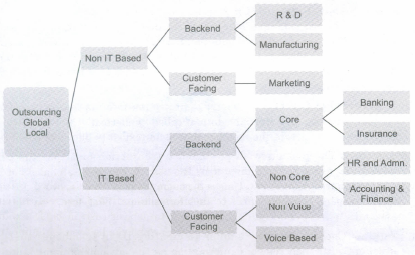
Show the anatomy of outsourcing.
6.
Discuss the limitations of electronic mode of doing business. Are these limitations severe enough to restrict its scope? Give reasons for your answer.
7.
Discuss the salient aspects of B2C commerce.
8.
Evaluate the need for outsourcing and discuss its limitations.
9.
Elaborate the steps involved in online trading.
10.
Why are E-business and outsourcing referred to as the emerging modes of business? Discuss the factors responsible for the growing importance of these trends.
1.
(a) Changes in Health: E-health is following the same path, with electronic patient records slowly being introduced and health insurance schemes starting to refund e-health services. This will be a userdriven development as it is more likely that the users will be able to adapt to e-health much faster than the healthcare system can deliver it.
This will clear the way for a whole new e-health industry, worth billions of dollars. One has to look at some of the e-health systems linked to the highend private hospitals in the USA to see what is in store. They use their e-health facilities as a major marketing tool to attract customers, not just to the actual hospital, but to all the other facilities around it. The add on revenues are significant.
(b) Progress in e-education: It is moving at an enormous pace and already some schools are limiting the number of printed textbooks - some are going totally e-book. With over a million children now with laptops it is only a matter of time before the education system to switch over. The savings in books and other printed material alone will pay for this digital revolution. South Korean schools will be entirely e-book-based by 2015.
(c) Governance: Many e-government services on offer around the world already provide citizens with relatively sophisticated services and the establishment of a fiberbased broadband network may see governments improve and broaden the range of web services even further. In addition, mobile services are being incorporated in service offerings and computing is becoming integrated. The Internet of Things (IoT) and M2M will also impact upon this sector. Those who are still talking about broadband as an end in itself; do not understand the situation. Broadband is simply the tool that will further enable and advance the digital economy.
2.
It is right to say that E-commerce is giving way to paperless society. Government is also formulating laws to help in this creation. It is clear from the laws formulated under IT Act, 2000:
1. Legal recognition of electronic records: Where any law provides that information or any other matter shall be in writing or in the typewritten or printed form, then, notwithstanding anything contained in such law, such requirement shall be deemed to have been satisfied if such information or matter is rendered or made available in an electronic form; and accessible so as to be usable for a subsequent reference. For example, a company can send notice for AGM using e-mail.
2. Retention of electronic records: Where any law provides that documents, records or information shall be retained for any specific period, then, that requirement shall be deemed to have been satisfied if such documents, records or information are retained in the electronic form. For example, if results are preserved in electronic form it will work.
3. Legal recognition of digital signatures: Where any law provides that information or any other matter shall be authenticated by affixing the signature or any document shall be signed or bear the signature of any person, hence notwithstanding anything contained in such law, such requirement shall be deemed to have been satisfied, if such information or matter is authenticated by means of digital signature affixed in such a manner as may be prescribed by the Central Government.
4. Use of electronic records and digital signatures in Government and its agencies: Where any law provides for the filling of any form, application or any other document with any office, authority, body or agency owned or controlled by the appropriate government in a particular manner; the issue or grant of any license, permit, sanction or approval by whatever name called in a particular manner; the receipt or payment of money in a particular manner, then, notwithstanding anything contained in any other law for the time being in force, such requirement shall be deemed to have been satisfied if such filing, issue, grant, receipt or payment, as the case may be, is effected by means of such electronic form as may be prescribed by the appropriate government.
All these provisions of IT Act, 2000 are helping us to move towards a paperless society.
3.
In this century, lifestyle has undergone a drastic change. People have everything except time. Using e-commerce they can buy and sell almost everything at your doorstep with the magic of e-commerce in the 21st century which will be known for information revolution. E-commerce has changed your lifestyles entirely because you don't have to spend time and money in travelling to the market. You can do your e-payments with the help of e-commerce.
There is no time barrier in selling the products. One can log on to the internet even at midnight and can sell the products at a single click of mouse.
E-commerce reduces delivery time and labor cost. Thus it has been possible to save the time of both-the vendor and the consumer.
Its need is clear from its benefits given below:
1. Exploitation of New Business: Broadly speaking, electronic commerce emphasizes the generation and exploitation of new business opportunities and to use popular phrases: "generate business value" or "do more with less".
2. Enabling the Customers: Electronic Commerce is enabling the customer to have an increasing say in what products are made, how products are made and how services are delivered (movement from a slow order fulfillment process with little understanding of what is taking place inside the firm, to a faster and explore open process with customers having greater control.
3. Improvement of Business Transaction: Electronic Commerce endeavors to improve the execution of business transaction over various networks.
4. Effective Performance: It leads to more effective performance i.e., better quality, greater customer satisfaction and better corporate decision making.
5. Greater Economic Efficiency: We may achieve greater economic efficiency (lower cost) and more rapid exchange (high speed, accelerated, or real-time interaction) with the help of electronic commerce.
6. Execution of Information: It enables the execution of informationladen transactions between two or more parties using interconnected networks. These networks can be a combination of 'plain old telephone system' (POTS), Cable TV, leased lines and wireless. Information based transactions are creating new ways of doing business and even new types of business.
7. Facilitating of Network Form: Electronic Commerce is also impacting business to business interactions. It facilitates the network form of organization where small flexible firms rely on other partner, companies for component suppliers and product distribution to meet changing customer demand more effectively. Hence, an end to end relationship management solution is a desirable goal that is needed to manage the chain of networks linking customers, workers, suppliers, distributors and even competitors. The management of "online transactions" in the supply chain assumes a central roll.
4.
There are many threats to e-transactions. Risk here is referring to probability of any mishappening that can result into financial, reputational or psychological losses to the parties involved in the transaction. It includes:
1. Transaction risks: It can be of three types:
(a) Default on Order Taking or Giving: Seller denies that the customer ever placed the order or customer denies that he ever placed the order.
(b) Default on Delivery: It happens when either goods are delivered at a wrong address or wrong goods are delivered.
(c) Default on Payment: Seller does not get the payment for the goods delivered but customer claims that he has made the payment.
2. Data Storage and Transmission Risks: Data stored in the systems and en route is exposed to a number of risks. Major two risks are related to virus and hacking. Virus is a program which replicates itself on the other computer systems. The effect of computer viruses can range from mere annoyance in terms of some on-screen display (Level-1 virus), disruption of functioning (Level-2 virus) damage to target data files (level-3 virus) to complete destruction of the system. (Level-4 virus). Hacking refers to unauthorized logging into the account and misusing it for selfish purposes or for fun only. Antivirus can help to protect files from virus and cryptography is used for protection against hacking.
3. Risks of threat to Intellectual Property and Privacy: Once an information is uploaded on internet, it loses privacy and IPRs. It becomes difficult to protect it from being copied and being accessible to one and all.
The following measures have been devised for their protection:
1. Secure Socket Layer (SSL): It was designed by Netscape for use in electronic commerce for transactions involving confidential information like credit card numbers. SSL uses a system of public and private key authentication combined With schemes to verify electronic signatures. Public key is the password that the sender uses to encrypt the data and the private key is used by the receiver of a message to decrypt the data.
2. Cryptography: It refers to the art of protecting information by transforming it (encrypting it) into an unreadable format called 'cyphertext'. Only those who possess a secret key can decrypt the message into plain text. It is like coding and decoding.
3. Password: The parties to an e-commerce transaction must use the password. Password is a code fed in computer by the user. It can be in alphabets or numeric or alpha-numeric characters. Unless a person feeds in the password, system shall neither respond nor give effect to the transactions. Therefore, one must Keep a password.
4. Cookies: Cookies are very similar to creating ID in telephones that provide telecallers with such relevant information as the customer's name, address and previous purchase payment record.
5. Anti-virus: There are anti-viruses which remove any type of virus from the system.
5.
Anatomy of outsourcing has been shown with the help of chart given below:
6.
The limitations of electronic mode of doing business are given below:
(a) Low personal Touch: It lacks the warmth of interpersonal interactions. Therefore, such products which need personal touch like beauty products, garments, fashion accessories etc. can't be traded through e-business.
(b) Mismatch between order giving/taking speed and order fulfillment speed: Sometimes websites take a long time to open which may frustrate the user. Even after giving or taking order, it takes enough time to give physical delivery of goods. It also plays on the patience of the customer.
(c) Knowledge of technology is must: For e-commerce both the parties need fairly high degree of familiarity with the world of computers. It divides the society into two parts i.e; one who are familiar with digital technology and other who are not.
(d) Increased risk due to parties being unknown to each other: When two parties are involved in e-business, they are unaware of personal identities of each other. They do not even know the locations of the parties involved. It makes e-business risky. There may also be problems of virus and hacking.
(e) People Resistance: People are resistant to change their ways and adopt new technology. Change is perceived as a source of stress and insecurity by many.
(f) Ethical Concerns: These days companies use an electronic eye to keep track of the websites being used by employees, computer files that they use, their e-mal accounts etc. It is not ethical. But in spite of these limitations, e-business is the way.
No, these limitations are not severe enough to restrict its scope:
(a) Improvement in Information Technology: With the improvement in information technology and emergence of internet the process of outsourcing and e-business is on an expansionary path. Anti virus and improved security measures are increasing to make e-business more secure and safer option.
(b) More and more Interactive Websites: Websites are becoming more and more interactive. It is removing the problem of 'low personal touch'.
(c) Improvement in Communication Technology: Communication technology is continually evolving and increasing the speed and quality of communication through internet so that customer does not get frustrated in processing the order.
(d) Diffusion of E-Commerce in all nooks and corners of the country: An order to diffuse e-commerce in all nooks and corners, India has undertaken about 150 such projects. It is increasing the number of people acquainted with digital technology.
We can conclude that e-business will continue to stay and reshape the businesses, governance and economies.
7.
In this, both the parties involved are business firms and therefore, it has been named as B2B i.e., business to business. Historically, the term e-commerce originally meant for facilitation of B2B transactions using Electronic Data Interchange (EDI) technology to send and receive commercial documents like purchase orders and invoices.
Salient aspects of B2B Commerce:
(a) Need: Creation of utility requires a business to contact with a number of other businesses which
(i) May be suppliers
(ii) May act as channel of distribution.
(iii) Different middlemen in different locations;
(iv) Changing production as per specifications of the customer.
(b) Benefits:
(i) It strengthens and improves the distribution system of a firm. For example, each consignment of goods from a warehouse and the stock in hand can be monitored and replenishments and reinforcements can be set in motion as and when needed.
(ii) A customer's specifications can be routed through the dealers to the factory so that there may be customized production.
(iii) B2B E-commerce expedites the movement of information and documents.
(iv) It also expedites money transfers.
(c) Example: The manufacture of an automobile requires assembly of a large number of components which in turn are being manufactured elsewhere. To reduce dependence on a single vendor, the automobile factory cultivates more than one vendor for each of the components. A network of computers is used for placement of orders, controlling production and delivery of components and making payments.
8.
Outsourcing has emerged as a way of doing business due to global competitive pressures for higher quality products at lower costs, ever demanding customers and emerging technologies. Need for outsourcing can be understood from the benefits which are given below:
(a) Focusing of Attention: Business firms are realizing the importance of focusing on core areas where they have distinct ability and core competence and contracting out the rest of the activities to their outsourcing partners. A business organization needs to decide its core areas and non-core areas. Once they outsource non-core areas, they can focus their attention on selected activities. It will increase efficiency and effectiveness.
(b) Quest for Excellence: Outsourcing enables the firms to attain excellence in two ways:
(a) By focusing on activities selected, their excellence in those activities increases,
(b) They excel by extending their capabilities through contracting out the remaining activities to them who excel in them.
(c) Cost Reduction: In the age of globalization, cost reduction is of vital importance to survive in the market. Division of labour not only enhances quality but also reduces cost. For example, India is preferred as an outsourcing destination because of cost factors.
(d) Growth through alliance: When some activities are outsourced then these alliance partners invest for the outsourced activities. Business can be expanded by same amount of investible funds as now these funds are to be invested in limited number of activities.
(e) Fillip to Economic Development: Outsourcing stimulates entrepreneurship, employment and exports in the host countries. For example, in India there has been remarkable growth in entrepreneurship, employment and exports that today India is an undisputed leader in software development and IT enable services.
But outsourcing is not an unmixed blessing. It has its own limitations. Some of which are discussed below:
(a) Confidentiality: When a business opts for outsourcing, it has to share a lot of vital information and knowledge. This information may be leaked by the outsourcing partner. It may be against the outsourcing firm. It is also possible that the outsourcing partner starts a business of same line after getting such information.
(b) Ethical Concerns: Many a time, outsourcing makes use of child labour and violates labour laws to reduce costs. They also discriminate in wages on the basis of sex.
(c) Sweat Shopping: A firm which goes in for outsourcing actually transfers 'doing' skills rather than 'thinking' skills. Therefore, they do not create skilled manpower in developing countries but just take maximum benefit of low cost labour by transferring non intellectual tasks.
(d) Resentment in their Home Countries: Outsourcing is being disliked by people in developedcountries because the jobs which they could get are being transferred to developing countries through outsourcing. The problem is still more severe if there is problem of unemployment in home country of outsourcing firm.
9.
Operationally, following steps are involved in online trading:

(i) Registration: First step in online trading is registration with the online trader by filling up a registration form. With registration buyer has opened an account with online trader. A password is created for the account which protects account and shopping cart which can be misused otherwise.
(ii) Placing an Order: An account holder can drop the items in the shopping cart. Shopping cart is an online record of what a person has picked up while browsing the online store. Once being sure of what a person wants to buy, one can check out and choose his payment options.
(iii) Payment Mechanism: In online trading payment may be made in any of the following ways:
(a) Cash On Delivery: Under this, the payment for goods ordered online may be made in cash at the time of physical delivery of the goods.
(b) Cheque: Another option is that the online vendor may arrange for the pickup of the cheque from the customer's end. Upon realization, goods may be delivered.
(c) Net Banking Transfer: These days banks provide facility to the customers for electronic transfer of funds using internet. Therefore, a buyer can also make use of net banking money transfers to pay for the goods ordered.
(d) Credit or Debit Cards: These are also called plastic money. These cards are most popularly used in payment for online transactions. To accept credit cards as an online payment type, the seller first needs a secure means of collecting credit card information from its customer. Payments through credit cards can be processed either manually, or through online authorization system like SSL Certificate.
(e) Digital Cash: It is a kind of electronic currency which exists only in cyberspace. It has no real physical properties, but offers the ability to use real currency in an electronic format. For this, the buyer has to deposit cash in bank account which issues equivalent digital cash to the person which can be used for online trading. It is more secure than credit or debit cards.
10.
E-business and outsourcing are referred to as emerging modes of business. Prefix 'emerging' puts emphasis on the fact that these businesses are in the process of development. These changes are happening here and now, and, that these changes are likely to continue. In fact, three changes are taking place most strongly:
(a) Digitizaton: The conversion of text, sound, images, video and other content into a series of ones and zeroes that can be transmitted electronically.
(b) Outsourcing: Contracting out non core activities to outside firms.
(c) Internationalisation and globalisation: More and more foreign companies are entering into India and sending Ashia and Indian companies becoming MNCs. Therefore, E-business and outsourcing referred to as the emerging modes of business.
Following factors are responsible for the growing importance of these trends:
(a) Improvement in Information Technology: With the improvement in information technology and emergence of internet the process of outsourcing and e-business is on an expansionary path.
(b) More and More Interactive Websites: Websites are becoming more and more interactive. It is removing the problem of 'low touch'.
(c) Improvement in Communication Technology: Communication technology is continually evolving and increasing the speed and quality of communication through internet.
(d) Diffusion of E-Commerce in all nooks and corners of the country: In order to diffuse e-commerce in all nooks and corners, India has undertaken about 150 such projects. It is also growing importance of these trends.
(e) Global Competitive Pressures for higher quality products: Due to adoption of new economicpolicy of 1991 in India, there has been an increase in competitive pressure from giant sized MNCs and global enterprises.
(f) Ever Demanding Consumers: There is increasing demands from consumers for high quality products at minimum cost. Therefore, e-business and outsourcing are being chosen as newer options.
But e-business and outsourcing are not emerging out of compulsion but also out of choice because of its benefits to consumers as well as producers.

11th Standard CBSE Syllabus & Materials
11th Standard CBSE
CBSE 11th Business Studies Forms of Business Organisation Sample Question Papers Study Material - QB365 Set A
NEW11th Standard CBSE
CBSE 11th Business Studies Business, Trade and Commerce Sample Question Papers Study Material - QB365 Set A
NEW11th Standard CBSE
CBSE 11th Physics Waves Sample Question Papers Study Material - QB365 Set A
NEW11th Standard CBSE
CBSE 11th Physics Kinetic Theory Sample Question Papers Study Material - QB365 Set A



CBSE 11th Standard CBSE Subjects
CBSE Standards









