
 100% FREE ACCESS
11th Standard CBSE Syllabus & Materials
11th Standard CBSE
CBSE 11th Economics PART-A - Presentation of Data - New Sample Question Papers Study Material - QB365 Set A
NEW11th Standard CBSE
CBSE 11th Economics PART-A - Organisation of Data - New Sample Question Papers Study Material - QB365 Set A
NEW11th Standard CBSE
CBSE 11th Economics PART-A - Collection of Data - New Sample Question Papers Study Material - QB365 Set A
NEW11th Standard CBSE
CBSE 11th Economics PART-A - Introduction to Economics and Statistics - New Sample Question Papers Study Material - QB365 Set A
NEW11th Standard CBSE
CBSE 11th Business Studies International Trade Sample Question Papers Study Material - QB365 Set A
NEW11th Standard CBSE
CBSE 11th Business Studies Evolution and Fundamentals of Business Sample Question Papers Study Material - QB365 Set A

Published on: 06/09/2019
International Business - I
Download CBSE Class 11th Standard CBSE Business Studies question papers, sample papers, important questions, and previous year solved papers in PDF format. Get free study materials, NCERT solutions, and exam preparation resources for Class 11th Standard CBSE Business Studies
Questions + Answers key
Take MCQ Business Studies Test
1.
Which one of the following is not amongst India's major trading partners?
USA
UK
Germany
New Zealand
2.
Which one of the following is not amongst India's major import items?
Ayurvedic medicines
Oil and petroleum products
Pearls and precious stones
Machinery
3.
Which one of the following modes of entry permits greater degree of control over overseas operations?
Licensing/franchising
Wholly owned subsidiary
Contract manufacturing
Joint venture
4.
Which one of the following modes of entry requires higher level of risks?
Licensing
Franchising
Contract manufacturing
Joint venture
5.
When two or more firms come together to create a new business entity that is legally separate and distinct from its parents it is known as
Contract manufacturing
Franchising
Joint ventures
Licensing
6.
List the major countries with whom India trades.
7.
What are the major items that are exported from India?
8.
List major items of India's import.
9.
Distinguish between licensing and franchising.
10.
Differentiate between contract manufacturing and setting up wholly owned production subsidiary abroad.
11.
What is the major reason underlying trade between nations?
12.
Discuss any three advantages of international business.
13.
Differentiate between international trade and international business.
14.
What is invisible trade? Discuss salient aspects of India's trade in services.
15.
What benefits do firms derive by entering into international business?
16.
"International business is more than international trade". Comment.
17.
What is international business? How is it different from domestic business?
1.
(d)
New Zealand
2.
(b)
Oil and petroleum products
3.
(b)
Wholly owned subsidiary
4.
(c)
Contract manufacturing
5.
(c)
Joint ventures
6.
India's major trading partners are USA, UK, Germany, Japan, Belgium, Hong Kong, UAE, China, Switzerland, Singapore and Malaysia.
7.
India's major items of exports include textiles, garments, gems and jewellery, engineering products and chemicals, agriculture and allied products.
8.
India's major items of imports include crude oil and petroleum products, capital goods, electronic goods, pearls, precious and semi-precious stones, gold, silver and chemicals.
9.
| Basis | Licensing | Franchising |
|---|---|---|
| Meaning | Licensing is a contractual agreement in which one firm grants access to its patents, trade secrets, technology to another firm in a foreign country for a fee. This fee is called royalty. | Franchising is basically a specialized form of licensing in which franchisor sells intangible property to the franchisee but also imposes strict rules on franchisee as to how business is to be done. |
| Connected with | Licensing is used in connection with production and marketing of goods. | The term franchising is used in connection with production of services. |
| Stringency | Licensing is relatively less stringent than franchising. Strict rules and regulations are not set by licensors as to how licensees should operate while running their business. | Franchising is relatively more stringent than licensing. Strict rules and regulations are set by franchisers as to how franchisees should operate while running their business. |
10.
The difference between contract manufacturing and wholly owned subsidiary is discussed below:
| Basis | Contract Manufacturing | Wholly Owned Subsidiary |
|---|---|---|
| Meaning | It refers to the type of international business where a firm enters into contract with some local manufactures in foreign countries to get certain components of goods produced as per their specifications. | In this, the parent company acquires the full control over the foreign company by purchasing its 100% equity capital. |
| Forms | It can take three forms: (a) Getting produced certain parts of final products which will be used for the production of final products later. (b) Assembly of components into final products. (c) Complete manufacture of the products like garments. |
It can be established in two ways: (a) As a greenfield venture, in which an altogether a new firm is set up to start operations in a foreign country. (b) Acquiring an existing firm in foreign country and using it for manufacturing and promoting its products in home country. |
11.
The major reason behind international business is that the countries cannot produce equally well or cheaply all the commodities. This is called theory of comparative cost advantage. It is so because resources are unequally distributed in natural resources. Some countries are abundant in one commodity and scarce in others while opposite is true for some other country. It makes a case for international trade and exchanging abundant commodity with scarce commodity by nations. Different nations are endowed with different factors of production which includes land, labour, capital and entrepreneurship. For example, India is a labour abundant country. Therefore, it is advisable for India to produce such commodities which use labour-intensive methods and exchange it for those which use capital-intensive methods. USA is a capital abundant country. Therefore, nations need to trade. Due to these reasons one country has a comparative advantage in production of particular goods as compared to other countries. Consequently, each country fins it advantageous to produce those selected goods and services that it can produce more effectively at home and importing those goods in which other nations have a comparative cost advantage.
12.
The following are some of the advantages of foreign trade:
1. Optimum use of resources:
Foreign trade helps in the optimum use of natural resources and avoids wastages of resources. It ensures the presence of stable price by avoiding wide fluctuations in prices. It tries to equalise the world price.
2. Increased standard of living:
It ensures more production to meet the demand of the people of different countries. By increased production, it becomes possible to increase income and the standard of living of its people. It also increases the standard of living by increasing more employment opportunities. It enables a country to import those goods which it cannot produce.
3. Large scale production:
It ensures large production because the production is carried on to meet the demand of its people as well as world market. Large scale production also ensures a great deal of internal economies which reduces the cost of production.
13.
Difference between international trade and international business is similar to difference between trade and business.
1. The scope of international business is much wider than international trade. International trade means exports and imports of goods which is an important component of international business but international business includes much more than this.
2. International trade in services like travel and tourism, transportation, communication, banking, warehousing, distribution and advertising is a part of international business.
3. International business also includes foreign direct investments, contract manufacturing, and setting up wholly owned subsidiaries etc. which are not included in international trade.
14.
Trade in services is called invisible trade. Since services are invisible, export and import of services has been named as invisible trade. In absolute terms, there has been significant increase in India's foreign trade in services. Export and import of foreign travel, transportation and insurance has largely increased during last four decades. There has been a change in composition of services exports. Software and other miscellaneous services have emerged as the main categories of India's export of services. Share of travel and transportation has declined to 29.6 % in 2003-04 from 64.3 % in 1995 - 96 while the share of software exports has increased from 10.2 % in 1995-96 to 49 % in 2003 - 04.
Table showing Percentage share of major services to total services exports
| Sector/Year | 1995 - 96 | 2000 - 01 | 2001 - 02 | 2002 - 03 | 2003 - 04 |
|---|---|---|---|---|---|
| Travel | 36.9 | 21.5 | 18.3 | 16.0 | 16.5 |
| Transportation | 27.4 | 12.6 | 12.6 | 12.2 | 13.1 |
| Software | 10.2 | 39.0 | 44.1 | 46.2 | 48.9 |
| Miscellaneous | 22.9 | 21.3 | 20.3 | 22.4 | 18.7 |
The composition of India's external trade has been changing. During 1950s and 60s exports were mainly of primary goods. Over time, the role of engineering goods has been increasing. Overall manufactured goods constitute 66 % of total exports, of which engineering goods are 27%. Textiles and textile products, garments and leather products make around 10 % of India's exports.
In nutshell, we can say that the role of the external or internationally traded goods sector has been growing steadily in Indian economy. At present imports and exports together account for upto 49 %of India's GDP which was 18 % in 1990s. In India there is greater share of exports of services which are IT software services, called ITenabled services CITES). It contributed more than 20 % of India's export earnings. India accounts for about 45 % of the world's BPO services. The major Indian IT companies, TCS, Infosys and Wipro, initiated and perfected the Global Services Delivery (GSD) model. It is because India has a vast pool of software engineers and an even bigger pool of English-knowing staff. With growing competition in the market for such services, Indian companies have moved from BPO to Knowledge Process Outsourcing (KPO), which involves providing services for R and D and to high-end consulting.
15.
The trade between two or more nations is termed as foreign trade or international trade. It involves exchange of goods and services between the trades of two countries. Foreign trade consists of import trade, export trade and -entrepot trade. In the early stages of human civilization, production was confined as per consumption. Human wants were limited. Nowadays, human wants are increasing and as such no man was considered to be self-dependant. Like this no country can live in isolation and claimed the status to be self-sufficient. Because of this reason countries have trade relationships with each other. The primary objective of foreign trade is to increase foreign trade and increase the standard of living of its people.
There is an increasing demand for foreign trade because of the following reasons:
(a) The natural resources are unevenly distributed.
(b) The presence of specialisation and division of labour.
(c) Different countries have difference in economic growth rate.
(d) The presence of the theory of comparative cost.
The following are some of the advantages of foreign trade:
1. Optimum use of Resources:
Foreign trade helps in the optimum use of natural resources and avoids wastages of resources.
2. Stable Price:
It ensures the presence of stable price by avoiding wide fluctuations in prices. It tries to equalise the world price.
3. Availability of all types of goods:
It enables a country to import those goods which it cannot produce.
4. Increased Standard of living:
It ensures more production to meet the demand of the people of different countries. By increased production, it becomes possible to increase income and the standard of living of its people. It also increases the standard of living by increasing more employment opportunities.
5. Large Scale production:
It ensures large production because the prouction is carried on to meet the demand of its people as well as world market. Large scale production also ensures a great deal of internal economies which reduces the cost of production.
16.
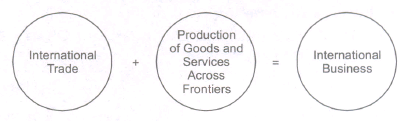
It is rightly said that international business is more than international trade. The scope of international business is much wider than international trade. International trade means exports and imports of goods which is an important component of international business but international business includes much more than this. International trade in services like travel and tourism, transportation, communication, banking, warehousing, distribution and advertising is a part of international business. International business also includes foreign direct investments, contract manufacturing, and setting up wholly owned subsidiaries etc. which are not included in international trade. It is clear from the diagram given below:
17.
International business refers to business which is carried on in two or more nations. It means carrying on business activities beyond national boundaries. These activities normally include the transaction of economic resources such as goods, capital, services (comprising technology, skilled labour, and transportation, etc.), and international production. It refers to that business activity that takes place beyond the geographical limits of a country. Production may either involve production of physical goods or provision of services like banking, finance, insurance, construction, trading, and so on. Thus, international business includes not only international trade of goods and services but also foreign investment, especially foreign direct investment.
Differences between International Business and Domestic Business are summarised below:
| Basis | International Business | Domestic Business |
|---|---|---|
| Nationality of buyers and Sellers | People of different nationality participate in international business. | People of one nationality participate in domestic business. Exceptions are possible. |
| Nationality of other stakeholders | Employees, suppliers, customers, shareholders, partners, middlemen etc. belong to different nationality in international business. | Employees, suppliers, customers, shareholders, partners, middlemen etc. belong to same nationality in domestic business. Exceptions are possible. |
| Political Systems | International business is subject to political system of many nations. | Domestic business is subject to political system of one country. |
| Risk | Degree of risk is higher in international business. | Degree of risk is lower as compared to international business. |
| Mobility of factors of production | Mobility of factors of production is less across countries. | Mobility of factors of production is more within geographical boundaries of the country. |
| Consumer's taste and preferences | International markets are heterogeneous in terms of taste and preferences of the customer. | Domestic markets are more homogeneous in terms of taste and preferences of the consumer. |
| Currency | International business involves usage of foreign currency. | Domestic business makes use of domestic currency. |
| Business regulations and policy | International business is subject to rules laws, policies, and taxation system etc of multiple countries. | Domestic business is subject to rules, laws, policies, and taxation system etc of single country. |
| Differences in business systems and practices. | Business systems and policies are heterogeneous in two countries. | Business system and policies are more homogeneous within a country. |

11th Standard CBSE Syllabus & Materials
11th Standard CBSE
CBSE 11th Business Studies Forms of Business Organisation Sample Question Papers Study Material - QB365 Set A
NEW11th Standard CBSE
CBSE 11th Business Studies Business, Trade and Commerce Sample Question Papers Study Material - QB365 Set A
NEW11th Standard CBSE
CBSE 11th Physics Waves Sample Question Papers Study Material - QB365 Set A
NEW11th Standard CBSE
CBSE 11th Physics Kinetic Theory Sample Question Papers Study Material - QB365 Set A



CBSE 11th Standard CBSE Subjects
CBSE Standards









