
11th Standard CBSE Syllabus & Materials
11th Standard CBSE
CBSE 11th Economics PART-A - Presentation of Data - New Sample Question Papers Study Material - QB365 Set A
NEW11th Standard CBSE
CBSE 11th Economics PART-A - Organisation of Data - New Sample Question Papers Study Material - QB365 Set A
NEW11th Standard CBSE
CBSE 11th Economics PART-A - Collection of Data - New Sample Question Papers Study Material - QB365 Set A
NEW11th Standard CBSE
CBSE 11th Economics PART-A - Introduction to Economics and Statistics - New Sample Question Papers Study Material - QB365 Set A
NEW11th Standard CBSE
CBSE 11th Business Studies International Trade Sample Question Papers Study Material - QB365 Set A
NEW11th Standard CBSE
CBSE 11th Business Studies Evolution and Fundamentals of Business Sample Question Papers Study Material - QB365 Set A

Published on: 18/08/2026
Download CBSE Class 11th Standard CBSE Chemistry question papers, sample papers, important questions, and previous year solved papers in PDF format. Get free study materials, NCERT solutions, and exam preparation resources for Class 11th Standard CBSE Chemistry
Questions + Answers key
Take MCQ Chemistry Test
1.
A cell is constructed using \(\mathrm{Cu}^{2+} / \mathrm{Cu} \text { and } \mathrm{Al}^{3+} / \mathrm{Al}\) electrodes.
Write the reactions at anode, cathode and net cell reaction.
2.
Write correctly the balanced equations for the following redox reactions using half reactions.
\(\mathrm{I}^{-}+\mathrm{O}_{2}(g)+\mathrm{H}_{2} \mathrm{O} \longrightarrow \mathrm{I}_{2}+\mathrm{OH}^{-}\)
3.
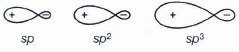
Draw the shape of the following hybrid orbitals sp, sp2 and sp3.
4.
With the help of molecular orbital theory, predict which of the following species is diamagnetic \({ H }_{ 2 }^{ + },{ O }_{ 2 },{ O }_{ 2 }^{ 2+ }\)
5.
How does the metallic and non-metallic character vary on moving from left to right in a period?
6.
Can an element with atomic number 126, if discovered, be accommodated in the present set up of the long form of periodic table?
7.
Calculate the frequency and the wavelength of the radiation in nanometers emitted when an electron in the hydrogen atom jumps from third orbit to the ground state. In which region of the electromagnetic spectrum will this line lie? (Rydberg constant = 109677 cm-1)
8.
Which of the following sets of orbitals are degenerate and why?
(a) 1s, 2s and 3s in Mg - atom.
(b) 2px, 2py and 2pz in C-atom.
(c) 3s, 3px and 3d - orbitals in H - atom.
9.
How many molecules approximately do you expect to be present in (i) a small sugar crystal which weighs 10 mg (ii) one drop of water with 0.05 cc volume ?
10.
Amongst the following elements whose electronic configurations are given below, which .one has the highest ionisation enthalpy?
\([\mathrm{Ne}] 3 s^{2} 3 p^{1},[\mathrm{Ne}] 3 s^{2} 3 p^{3},[\mathrm{Ne}] 3 s^{2} 3 p^{2},[\mathrm{Ar}] 3 d^{10} 4 s^{2} 4 p^{3}\)
11.
Explain why Be has higher ionization enthalpy than B.
12.
How many subshells are associated with n = 5?
13.
Define EMF of cell.
14.
Show the distribution of electrons in oxygen atom (atomic number 8) using an orbital diagram.
15.
Calculate the mass of a molecule of carbon dioxide (CO2)?
16.
What is the effect of following process on the bond order in N2 and O2?
(i) \(\mathrm{N}_{2} \rightarrow \mathrm{N}_{2}^{+}+e^{-}\)
(ii) \(\mathrm{O}_{2} \longrightarrow \mathrm{O}_{2}^{+}+e^{-}\)
17.
Discuss and compare the trend in ionisation enthalpy of the elements of group 1with those of group 17elements.
18.
(a) How many σ and \(\pi\) bonds are present in CH2 = CH - C \(\equiv \) CH
(b) Why \({ H }_{ 2 }^{ - }\) is more stable than \({ H }_{ 2 }^{ - }\) ?
(c) Why is B2 molecule paramagnetic?
19.
Identify the redox reaction out of the following reactions and identify the oxidising and reducing in them.
(i) 3HCl(aq) + HNO3(aq) \(\longrightarrow \) Cl2(g) +NOCl(g) + 2H2O(l)
(ii) \({ Hgcl }_{ 2 }(aq)+2KI(aq)\longrightarrow { HgI }_{ 2 }(s)+{ 2KCl(aq) }\)
(iii) Fe2O3 (s) + 3CO(g) \(\overset { \Delta }{ \longrightarrow } \)2Fe(s) +3CO2(g)
(iv) PCl3(l)+3H2O(l)⟶3HCl(aq)+H2PO3(aq)
(v) 4NH3(aq) + 3O2(g) \(\longrightarrow \) 2N2(g) + 6H2O(g)
20.
The sums of first and second ionization energies and those of third and fourth ionization energies, (in M J mol-1) of nickel and platinum are
| (IE)1 + (IE)2 | (IE)3 + (IE)4 | |
| Ni | 2.49 | 8.80 |
| Pt | 2.66 | 6.70 |
Based on this information, write
(i) the most common oxidation states of Ni and Pt.
(ii) name of metal (Ni or Pt) which can easily form compounds in its +4 oxidation state.
21.
Choose the correct explanation regarding half-reaction such as \(\mathrm{Cr}_{2} \mathrm{O}_{7}^{2-} \longrightarrow \mathrm{Cr}^{3+}\) from the following.
It is oxidation half-reaction
Chromium being oxidised
\(\mathrm{Cr}_{2} \mathrm{O}_{7}^{2-}\) is a good reducing agent
Chromium being reduced
22.
In which of the following compounds, an element exhibits two different oxidation states?
\(\mathrm{NH}_{2} \mathrm{OH}\)
\(\mathrm{NH}_{4} \mathrm{NO}_{3}\)
\(\mathrm{N}_{2} \mathrm{H}_{4}\)
\(\mathrm{N}_{3} \mathrm{H}\)
23.
The correct decreasing order of the boiling points of given compounds is ______.
HF > H2O > NH3
H2O > HF > NH3
NH3 > HF> H2O
NH3 > H2O > HF
24.
If the bond distance in chlorine molecule (Cl2 ) is 198 pm, then the radius of chlorine is ______.
198 pm
49.5 pm
99 pm
24.75 pm
25.
Which important property did Mendeleev use to classify the elements in his periodic table?
Atomic weight
Atomic number
Melting point
None of these
26.
If E A, E B and E C represent kinetic energies of an electron, alpha particle and proton respectively and each moving with same de-Broglie wavelength, then choose the correct increasing representation,_______.
EA = EB = EC
EA > EB > EC >
EB > EC > EA
EA < EC < EB
27.
A bivalent metal has an equivalent mass of 32. The molecular mass of the metal nitrate is _______.
182
168
192
188
28.
X g of Ag was dissolved in HNO3 and the solution was treated with excess of NaCl, when 2.87g of AgCl was precipitated. The value of x is _______.
1.08 g
2.16 g
2.70 g
1.62g
29.
The idea of stationary orbits was first given by _______.
Rutherford
J.J. Thomson
Niels Bohr
Max Planck
30.
The Balmer series in the spectrum of hydrogen atom falls in _______.
ultraviolet region
visible region
infrared region
none of these
31.
sp3, sp2 and sp hybridized carbon atom, the p character is maximum in:______.
sp3
sp2
sp
all of the above have same p-character
32.
The number of significant figures in 0.0101 is _______.
3
2
4
5
33.
34.
35.
36.
Assertion: The molecular orbitals with higher energy is called anti bonding orbitals.
Reason: The anti bonding nature of a molecular orbital is indicated by an asterisk over its designation.
Codes:
(a) Both Assertion and Reason. are true and Reason is the correct explanation of Assertion.
(b) Both Assertion and Reason are true but Reason is not the correct explanation of Assertion.
(c) Assertion is true but Reason is false.
(d) Both Assertion and Reason are false.
37.
Redox reactions are important class of reactions which are taking place in our daily life. Metals are good reducing agents because they can lose electrons easily whereas non-metals are good oxidising agents which can gain electrons easily. In electrolytic cells, electricity is passed to bring about redox reaction. All rechargeable batteries act as electrolytic cells while recharging. Electrochemical cells produce electricity as a result of redox reaction. Salt bridge is used in electrochemical cell to complete internal circuit and prevents accumulation of charges.
(a) What is electrochemical cell?
(b) Why is anode called oxidation electrode?
(c) Give one example of rechargeable cells widely used in vehicles.
(d) Highly reactive metals are obtained by electrolysis of their molten ores, why?
(e) What is direction of flow of current and electrons?
(f) What is standard electrode potential?
(g) What is meaning of -ve value of reduction potential? Give example.
38.
Orbitals are region or space wher.e there is maximum probability of finding electrons. Qualitatively, these orbitals can be distinguished by their size, shape and orientation. An orbital of small size means there is more chance of finding the electron near the nucleus. Shape and orientation means the direction in which probability of finding electron is maximum. Atomic orbitals can be distinguished by quantum numbers. Each orbital is designated by three quantum numbers n, I and m1 (magnetic quantum number) which define energy, shape and orientation but these are not sufficient to explain spectra of multi-electrons atoms. Spin quantum number (ms ) determines the spin of electron. Spin angular momentum of electron has two orientations relative to chosen axis which are distinguished by spin quantum numbers ms which can take values +1/2 and -1/2.
| Value of 'l' | 0 | 1 | 2 | 3 | 4 |
| Notation for subshell | s | p | d | f | g |
(a) How many orbitals are associated with n = 3?
(b) Describe the orbitals represented by (i) n = 2, l = 1 (ii) n = 4, l = 0.
(c) How many electron are possible in an orbital? Why?
(d) What is shape of 's' and 'p' orbitals?
(e) Name two d-orbitals which are on axis.
1.
It is measured by potentiometer which does not have internal resistance.
\(\begin{array}{lr}
2 \mathrm{Al}(s) \longrightarrow 2 \mathrm{Al}^{3+}(a q)+6 \mathrm{e}^{-} \text {At anode } \\
{ } \frac{3 \mathrm{Cu}^{2+}(a q)+6 e^{-} \longrightarrow 3 \mathrm{Cu}(s)}{2 \mathrm{Al}(s)+3 \mathrm{Cu}^{2+}(a q) \longrightarrow 2 \mathrm{Al}^{3+}(a q)+3 \operatorname{Cu}(s)} \\
\hline
\end{array}\)
2.
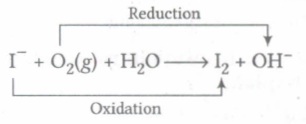
Here, I- is oxidised to I2 and O2(g) is reduced to OH-.
\(4 \mathrm{I}+\mathrm{O}_{2}(\mathrm{~g})+2 \mathrm{H}_{2} \mathrm{O} \longrightarrow 4 \mathrm{OH}^{-}+2 \mathrm{I}_{2}\)
3.
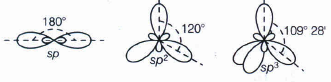
All the hybrid orbitals have same shape. However, their sizes are in the order : sp < sp2 < sp3
4.
The diamagnetic species are those which contain only;y paired electrons. This can be predicted from the molecular orbital electronic configuration as given below.
\( { H }_{ 2 }^{ + }:\sigma 1{ s }^{ 1 }\)
\(\mathrm{O}_{2}: \sigma^* \mathrm{ls}^{2}, \dot{\sigma}^* 1 s^{2}, \sigma^* 2 s^{2}, \dot{\sigma} ^*2 s^{2}, \sigma^* 2 p_{z}^{2}\)
\(\pi 2 p_{x}^{2}=\pi 2 p_{y}^{2}, \pi^{*} 2 p_{x}^{\approx} \pi 2 p_{x}^{1}, \pi^{*} 2 p_{x}=\pi^{*} 2 p_{y}^{1}\)
\(\mathrm{O}_{2}^{2+}: \sigma ^*1 s^{2}, \hat{\sigma} 1 s^{2}, \sigma 2 s^{2}, \hat{\sigma} 2 s^{2}, \sigma 2 p_{z}^{2}, \pi 2 p_{x}^{2}, \pi 2 p_{y}^{2}\)
Since, \({ O }_{ 2 }^{ 2+ }\) contain all paired electrons, it will be diamagnetic.
5.
As we move from left to right in period, the number of valence electrons increases by one at each succeeding element but the number of shells remains same. Due to this, effective nuclear charge ivcreases.
More is the effective nuclear charge, more is the attraction between nuclei and electron.
Hence, the tendency of the element to lose electrons decreases, this results in decrease in metallic character.
Furthermore, the tendency of an element to gain electrons increases with increase in effective nuclear charge, so non-metallic character increases on moving from left to right in a period.
6.
No, the maximum number of elements which can be accommodated in the present set up of the long form of the periodic table is 118. Thereafter, filling of 8s-orbital shell begin which all accommodate only two electrons. After 8s-oorbitals, the filling of 5g-orbitals will begin. Since we do not have any provision for g-block elements in the present set up of the long form of periodic table, therefore, an element with atomic number 126, if discovered, cannot be accommodated in the present set up of the long form of periodic table.
7.
v = 2.92 x 10¹⁵ s-1;
\( R_H=109677 \mathrm{~cm}^{-1} \)
\( n_1=1, n_2=3 \)
\( \bar{v}=109677\left[\frac{1}{1^2}-\frac{1}{3^2}\right] \mathrm{cm}^{-1} \)
\(109677 \times \frac{8}{9} \mathrm{~cm}^{-1}=97490.7 \mathrm{~cm}^{-1} \)
\( \text { wavelength }(\lambda)=\frac{1}{\bar{v}}=\frac{1}{97490.7} \mathrm{~cm} \)
\( =1.03 \times 10^{-5} \mathrm{~cm}=1.03 \times 10^{-7} \mathrm{~m} \)
\( =103 \times 10^{-9} \mathrm{~m}=103 \mathrm{~nm}
\)
8.
(a) 1s, 2s and 3s - orbitals in Mg-atom are not degenerate because these have different values of n.
(b) 2px, 2py and 2pz - orbitals in C-atom are degenerate because these belong to same subshell.
(c) 3s, 3px and 3d - orbitals in H - atom are degenerate because for H-atom, the subshells having same value of n have same energies.
9.
(i) \(10 \mathrm{mg} \operatorname{sugar}\left(\mathrm{C}_{12} \mathrm{H}_{22} \mathrm{O}_{11}\right)=0.01 / 342 \text { mole }=2.92 \times 10^{-5} \mathrm{~mole}\)
(ii) 0.05 cc water \(=0.05 \mathrm{~g}=0.05 / 18\) mole \(=2.78 \times 10^{-3}\) mole
10.
[Ne]3s23p3, it is due to smaller size and stable electronic configuration.
11.
Be (4) has electronic configuration 1s2 2s2 whereas B(5) has 1s2 2s2 2p1.
The energy required to remove electron from completely filled 2s orbital is higher than the energy required to remove electron from 2p orbital.
12.
n = 5 1 = 0, 1, 2, 3, [∴ 1 = 0, 1, .... n - 1 but I = 4 is not possible 'g' orbital is not being orbital used]
n = 5, I = 0 5s n = 5, I = 1 is 5p.
n = 5, 1 = 2 is 5d n = 5, 1 = 3 is 5f
13.
EMF of a cell is the difference in the electrode potentials of the two electrodes in a cell when no current flows through the cell.
14.
8O = 1 s2 2s2 2p4

15.
1. Molecular mass of carbon dioxide = 44 g
2. Therefore, the mass of 1 mol of CO2 is 44 g. As per Avogadro's rule, 1 mol of substance has \(6.022 \times 10^{23}\) molecules.
3. Therefore mass of \(6.022 \times 10^{23}\) molecules of CO2 is 44 g.
4. Hence, the mass of 1 molecule of CO2 is \(=\frac{44}{6.022 \times 10^{23}}=7.306 \times 10^{-23} \mathrm{~g}\)
16.
According to molecular orbital theory, electronic configurations and bond order of \(\mathrm{N}_{2}, \mathrm{~N}_{2}^{+}, \mathrm{O}_{2}\) and \(\mathrm{O}_{2}^{+}\)species are as follows.
\(\mathrm{N}_{2}\left(14 e^{-}\right)=\sigma 1 s^{2}, \stackrel{*}{\sigma} 1 s^{2}, \sigma 2 s^{2}, \stackrel{\star}{\sigma} 2 s^{2}\)
\(\left(\pi 2 p_{x}^{2} \approx \pi 2 p_{y}^{2}\right), \sigma 2 p_{z}^{2}\)
Bond order = \(\frac{1}{2}\left[N_{b}-N_{a}\right]=\frac{1}{2}(10-4)=3\)
\(\mathrm{N}_{2}^{+}\left(13 e^{-}\right)=\sigma 1 s^{2}, \stackrel{*}{\sigma 1 s}^{2}, \sigma 2 s^{2}, \stackrel{*}{\sigma} 2 s^{2},\left(\pi 2 p_{x}^{2} \approx \pi 2 p_{y}^{2}\right) \sigma 2 p_{z}^{1}\)
\(\text { Bond order }=\frac{1}{2}\left[N_{b}-N_{a}\right]=\frac{1}{2}(9-4)=2.5\)
\(\mathrm{O}_{2}\left(16 \mathrm{e}^{-}\right)=\sigma 1 s^{2},{ }^{*} 1 s^{2}, \sigma 2 s^{2}, \stackrel{*}{\sigma} 2 s^{2}, \sigma 2 p_{z}^{2}\)
\(\left(\pi 2 p_{x}^{2} \approx \pi 2 p_{y}^{2}\right),\left(\pi 2 p_{x}^{1} \approx \pi 2 p_{y}^{1}\right)\)
\(\text { Bond order }=\frac{1}{2}\left[N_{b}-N_{a}\right]=\frac{1}{2}(10-6)=2\)
\(\mathrm{O}_{2}^{+}\left(15 e^{-}\right)=\sigma 1 s^{2}, \sigma 1 s^{2}, \sigma 2 s^{2}, \sigma 2 s^{2}, \sigma 2 p_{z}^{2}\)
\(\left(\pi 2 p_{x}^{2} \approx \pi 2 p_{y}^{2}\right),\left(\pi 2 p_{x}^{1} \approx \pi 2 p_{y}\right)\)
\(\text { Bond order }=\frac{1}{2}\left[N_{b}-N_{a}\right]=\frac{1}{2}(10-5)=2.5\)
(i) \(\begin{array}{c}
\mathrm{N}_{2} \longrightarrow \mathrm{N}_{2}^{+}+e^{-} \\
\mathrm{BO}=3 \quad \mathrm{BO}=2.5
\end{array}\)
Thus, bond order decreases.
(ii) \(\underset{\mathrm{BO}=2}{\mathrm{O}_{2}} \longrightarrow \underset{\mathrm{BO}=2.5}{\mathrm{O}_{2}^{+}}+e^{-}\)
Thus, bond order increases
17.
The ionisation enthalpies decreases regularly as we move down a group from one element to the other. This is evident from the values of the first ionisation enthalpies of the elements of group 1 (alkali metals) and group 17 elements as given in table and figure.
| Group 1 | First ionisation enthalpies (kJ rnol-1) | Group 17 | First ionisation enthalpies (kJ rnol-1) |
| H | 1312 | F | 1681 |
| Li | 520 | Cl | 1255 |
| Na | 496 | Br | 1142 |
| K | 419 | I | 1009 |
| Rb | 403 | At | 917 |
| Cs | 374 |
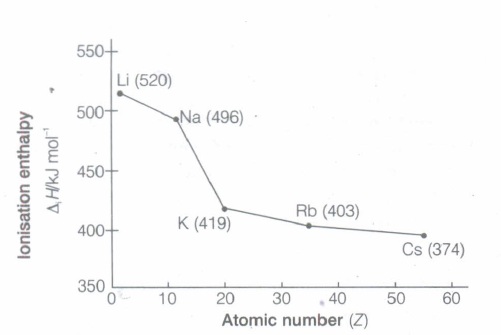
Given trend can be easily explainedon the basis of increasing atomic size and screening effect that are as follows.
(i) On moving down the group, the atomic size increases gradually due to the addition of one new principal energy shell at each succeeding element. Hence, the distance of the valence electrons from the nucleus increases. Consequently, the force of attraction between the nucleus valence electrons decreases and hence, the ionisation enthalpy decreases.
(ii) With the addition of new shells, the shielding or the screening effect increases. As a result, the force of attraction between the nucleus and the valence electrons further decreases and hence, the ionisation enthalpy decreases.
(iii) Nuclear charge increases with increase in atomic number. As a result, the force of attraction by the nucleus for the valence electrons should increase and accordingly the ionisation enthalpy should increase. The combined effect of the increase in the atomic size and the screening effect more than compensates the effect of the increased nuclear charges. Consequently, the valence electrons become less and less firmly held by the nucleus and hence, the ionisation enthalpies gradually decreases as move down the group.
18.
(a) No. of σ bonds = 7
No. of \(\pi\) bonds = 3
(b) Both the ions have the same bond order (0.5) but they differ in their configuration.
\({ H }_{ 2 }^{ + }\) ion = [ σls]1,
\({ H }_{ 2 }^{ - }\) ion = [ σ1s]2 [ σ x = s]1
Since, \({ H }_{ 2 }^{ - }\) ion has an electron in the antibonding molecular orbital, it is therefore less stable.
The molecular orbital configuration of B2 is given
B2: [σ1s]2 [σ*1s]2 [σ2s]2 [σ*2s]2 [\(\pi\)2px]1[\(\pi\) x 2py]1
Since, B2 has two unpaired electrons, it is paramagnetic
19.
(a) Writing the On on each atom above its symbol, then
\(3\overset { +1 }{ H } \overset { -1 }{ Cl } (aq)+\overset { +1 }{ H } \overset { +5 }{ N } \overset { -2 }{ { O }_{ 3 } } (aq)\longrightarrow \overset { 0 }{ { Cl }_{ 2 }(g)+ } \overset { +3 }{ N } \overset { -2 }{ O } \overset { -1 }{ Cl(g)+ } \overset { +1 }{ { 2H }_{ 2 } } \overset { -2 }{ O } (l)\)
Here, the On of Cl increases from -1 in HCl to O in Cl2 , therefore, Cl- is oxidised and hence, HCl acts as the reducing agent. The ON of N decreases from +5 in HNO3 to +3 in NOCL, therefore, HNO3 acts as the oxidising agent. Thus this reaction is a redox reaction.
(b) Writing the ON of each atom above its symbol, we have,
\(\overset { +2 }{ Hg } \overset { -1 }{ { Cl }_{ 2 } } (aq)+\overset { +1 }{ 2K } \overset { -1 }{ I } (aq)\longrightarrow \overset { +2 }{ Hg } { \overset { -1 }{ I } }_{ 2 }(s)+2\overset { +1 }{ K } \overset { -1 }{ { Cl }^{ - }(aq) } \)
Here, the On of none of the atoms undergo a change, therefore, this reaction is not a redox reaction.
(c) \(\overset { +3 }{ { Fe }_{ 2 } } { \overset { -2 }{ O } }_{ 3 }(s)+3\overset { +2 }{ C } \overset { -2 }{ O } (g)\ \overset { \Delta }{ \longrightarrow } \ 2\overset { 0 }{ Fe } (s)+3\overset { +4 }{ C } \overset { -2 }{ { O }_{ 2 } } (g)\)
Here, On of decreases from +3 in Fe2O3 to 0 in Fe, therefore, Fe2O3 acts as an oxidising agent. Further, On of C increases from +2 in CO to +4 in CO2, therefore, CO acts as a reducing agent. Thus, this reaction is an example of redox reaction.
(d) Writing the ON of each atom above its symbol, then
\(\overset { +3 }{ P } { \overset { -1 }{ Cl } }_{ 3 }(l)+3\overset { +1 }{ { H }_{ 2 } } \overset { -2 }{ O } (l)\quad \longrightarrow \quad 3\overset { +1 }{ H } \overset { -1 }{ Cl } (aq)+\overset { +1 }{ { H }_{ 3 } } \overset { +3 }{ P } \overset { -2 }{ { O }_{ 3 } } (aq)\)
Here, On of none of the atoms undergo a change, therefore, this reaction is not a redox reaction.
(e) Writing the ON of each atom above its symbol, then
\(4\overset { -3 }{ N } \overset { +1 }{ { H }_{ 3 } } (aq)+3\overset { 0 }{ { O }_{ 2 } } (g)\quad \longrightarrow \quad 2\overset { 0 }{ { N }_{ 2 } } (g)+6\overset { +1 }{ { H }_{ 2 } } \overset { -2 }{ O } (l)\)
20.
(i) Ni = + 2, Pt = + 4
(II) Platinum forms more stable complexes in +4 state due to its higher stability than +2 state.
21.
(d)
Chromium being reduced
22.
(a)
\(\mathrm{NH}_{2} \mathrm{OH}\)
23.
(b)
H2O > HF > NH3
24.
(a)
198 pm
25.
(a)
Atomic weight
26.
(d)
EA < EC < EB
27.
(d)
188
28.
(b)
2.16 g
29.
(c)
Niels Bohr
30.
(b)
visible region
31.
(a)
sp3
32.
(a)
3
33.
34.
35.
36.
(b) Both Assertion and Reason are true but Reason is not the correct explanation of Assertion.
37.
(a) The cell in which chemical energy of redox reaction is converted into electrical energy.
(b) It is because loss of electrons take place at anode, i.e., oxidation takes place.
(c) Lead storage battery
(d) It is because these metals are good reducing agents, cannot be obtained by chemical reduction.
(e) Electrons flow from anode to cathode where as current flows from cathode to anode.
(f) When concentration of each species is unity, any gas involved is at 1 bar, temperature is 298 K, the potential of electrode is called standard electrode potential measured with respect to standard hydrogen electrode.
(g) It means redox couple is stronger reducing agent than H+/H2 couple.
E.g. \(\mathrm{E}_{\mathrm{Zn}^{2+} / \mathrm{Zn}}^{\circ}=\) -0.76 V, Zn is stronger reducing agent than H2.
38.
(a) Number of orbitals = n 2 = 3 2 = 9 orbitals, 3s, 3 px, 3 py , 3 pz, 3 d x2 - y2, 3 dz2, 3 dxy, 3 dyz and 3 dzx.
(b) (i) 2p (ii) 4s
(c) Orbital can have maximum two electron which must be of opposite spin.
(d) 's' orbitals are spherical and 'p' orbitals have dumb-bell shaped.
(e) d x2 - y2 , dz2.

11th Standard CBSE Syllabus & Materials
11th Standard CBSE
CBSE 11th Business Studies Forms of Business Organisation Sample Question Papers Study Material - QB365 Set A
NEW11th Standard CBSE
CBSE 11th Business Studies Business, Trade and Commerce Sample Question Papers Study Material - QB365 Set A
NEW11th Standard CBSE
CBSE 11th Physics Waves Sample Question Papers Study Material - QB365 Set A
NEW11th Standard CBSE
CBSE 11th Physics Kinetic Theory Sample Question Papers Study Material - QB365 Set A



NCERT Books

Syllabus

Exam Pattern

Sample Question Papers

Previous year Question Papers

Important Notes

MCQ Practice test

NCERT Exemplers

Case study Questions

Image Based Questions

Passage based Questions

HOT Questions

Value Based Questions

Model Questions Papers
NCERT ( Book Back ) Questions

Assertion and Reason
Important Questions And Answers

CBSE 11th Standard CBSE Subjects
CBSE Standards







