
 100% FREE ACCESS
11th Standard CBSE Syllabus & Materials
11th Standard CBSE
CBSE 11th Economics PART-A - Presentation of Data - New Sample Question Papers Study Material - QB365 Set A
NEW11th Standard CBSE
CBSE 11th Economics PART-A - Organisation of Data - New Sample Question Papers Study Material - QB365 Set A
NEW11th Standard CBSE
CBSE 11th Economics PART-A - Collection of Data - New Sample Question Papers Study Material - QB365 Set A
NEW11th Standard CBSE
CBSE 11th Economics PART-A - Introduction to Economics and Statistics - New Sample Question Papers Study Material - QB365 Set A
NEW11th Standard CBSE
CBSE 11th Business Studies International Trade Sample Question Papers Study Material - QB365 Set A
NEW11th Standard CBSE
CBSE 11th Business Studies Evolution and Fundamentals of Business Sample Question Papers Study Material - QB365 Set A

Published on: 30/09/2019
Classification of Elements and Periodicity in Properties
Download CBSE Class 11th Standard CBSE Chemistry question papers, sample papers, important questions, and previous year solved papers in PDF format. Get free study materials, NCERT solutions, and exam preparation resources for Class 11th Standard CBSE Chemistry
Questions + Answers key
Take MCQ Chemistry Test
1.
(a) How does atomic radius vary in group in the periodic table?
(b) Explain
(i) Radius of cation is less than that of the atom.
(ii) Radius of anion is more than that of the atom.
(iii) In iso-electronic ion, the ionic radii decreases with increase in atomic number
2.
Discuss the factors that influence the magnitude of ionization enthalpy. What are the general trends of variation of ionization enthalpy in the periodic table? Explain.
3.
Define electron gain enthalpy. What are its units? Discuss the factors which influence the electron gain enthalpy.
4.
Discuss the main characteristics of four blocks of elements in the periodic table? Give their general electronic configuration.
5.
Discuss the main features of long form of the periodic table. What are the advantages of long form of periodic table?
6.
Chemical reactivity of elements is highest at the two extremes of a period and is lowest in the center. Highly reactive elements do not occur in nature in free state, they usually occur in nature in free state, they usually occur in combined state. Some students are highly aggressive and keep on fighting with each other like highly reactive elements. Some students are sober and help each other and do not fight.
(i) Elements of which group are most reactive?
(ii) Which group elements are least reactive and why?
(iii) What are the harmful effects of being aggressive?
(iv) What values are possessed by sober people?
(v) Which kind of people pick up fight, while driving on the road in case of accidents? What are its consequences? What should we do?
7.
Arrange the following in decreasing order of their van der Waals' radii CI, H, O, N.
8.
The first (∆i H1) and the second (∆i H2) ionization enthalpies (in kJ mol–1) and the (∆egH) electron gain enthalpy (in kJ mol–1) of a few elements are given below:
| Elements | \({ \triangle }_{ i }{ H }_{ 1 }\) | \({ \triangle }_{ i }{ H }_{ 2 }\) | \({ \triangle }_{ eg }H\) |
| I | 520 | 7300 | -60 |
| II | 419 | 3051 | -48 |
| III | 1681 | 3374 | -328 |
| IV | 1008 | 1846 | -295 |
| V | 2372 | 5251 | +48 |
| VI | 738 | 1451 | -40 |
Which of the above elements is likely to be :
(a) the least reactive element.
(b) the most reactive metal.
(c) the most reactive non-metal.
(d) the least reactive non-metal.
(e) the metal which can form a stable binary halide of the formula MX2(X=halogen).
(f) the metal which can form a predominantly stable covalent halide of the formula MX (X=halogen)?
9.
Calculate the electronegativity of carbon if EH-H = 104.2 kcal mol-1, EC-C = 83.1 kcal mol-1,EC-H = 98.8 kcal mol-1, XH = 2.1.
10.
The elements Z = 117 and 120 have not yet been discovered. In which family/group would you place these elements and also give the electronic configuration in each case.
1.
(a) Variation of atomic radius in a group:
On moving down the group there is an increase in the principal quantum number and therefore no. of electron shells increases and thus the atomic size increases. Thus the atomic radii of the element increases.
(b) (i) Radius of cation is less than that of the atom:
Since the cation is formed by losing of one or more electrons.
For example,
Na ⟶Na+ + e-
Thus the radius of Na +will be less than the Na.
(ii) Radius of anion is more than that of the atom.
Since the anion is formed by gaining one or more electron. Therefore, the atomic radius is larger than the corresponding atom.
(iii) In iso-electronic ions, atoms have same number of electrons but different magnitude of nuclear charges. As the nuclear charge increases ionic radius decreases.
For example.
N3-, O2-, F- have same No. of electrons = 10 but different ionic radii = 171, 140, 136 respectively.
2.
Factors affecting Ionization enthalpy.
(i) Atomic size. With the increase in atomic size, the number of electron shells increases and thus the force of attraction between the electrons and the nucleus decreases. Therefore the ionization enthalpy decreases.
(ii) Nuclear charge. As the nuclear charge increases the attraction for the electron also increases that's why ionization enthalpy increases.
(iii) Screening or shielding effect. In a multi-electron atom, the electron present in the inner shells shield the electrons in the valence shell as a result these electrons experience less attraction from the nucleus. This leads to lesser ionization enthalpy.
Variation along a period. On moving from left to right in a period the nuclear charge increases and the atomic size decreases as a result ionization enthalpies are expected to increase.
Variation within a group. On moving down the group as the atomic size of the elements increases that's why ionization enthalpy decreases down the group
3.
Electron gain enthalpy is the energy released when an isolated gaseous atom is converted into a negative ion by adding an extra electron. Electron gain enthalpy is denoted by the sign \(\triangle\)eg H.
The process may be represented by
M(g) + e- ⟶ M- (g)
neutral gaseous anion atom
\(\triangle\) H = \(\triangle\)eg H
electron gain enthalpy is negative or positive it depends upon the nature of the element. For example. For halogens it is highly negative, because they can acquire the noble gas configuration by accepting an extra electron. In contrast. For noble gases have positive electron gain enthalpy because energy has to be supplied to the element.
Factors on which electron gain enthalpy depends:
(i) Atomic size. As the size of an atom increases, the distance between its nucleus and the incoming electron also increases. Therefore, the force of attraction between the nucleus and the incoming electron decreases and hence the electron gain enthalpy becomes less negative.
(ii) Nuclear charge. As the nuclear charge increases force of attraction for the incoming electron increases and thus electron gain enthalpy becomes more negative.
(iii) Symmetry of electronic configuration. Elements having symmetrical configuration (Either half filled or fully filled orbitals in the same subshell) having no attraction for electron because by accepting electron their configuration becomes less stable. In that case energy has to be supplied to accept electron. Thus electron gain enthalpy will be positive.
4.
s-block elements:
(i) They are highly reactive elements and thus occurs in combined state. On moving down the group their reactivity increases.
(ii) They have good reducing characters.
(iii) They generally form electropositive ion by losing 1 or 2 electrons, that's why they are electropositive in nature.
(iv) They are good conductors of heat and electricity.
p-block elements:
(i) Most of the p-block elements show variable oxidation states.
(ii) They include both metals and non-metals.
(iii) They are generally covalent in nature.
(iv) As move from left to right the non-metallic character of the element increases. On moving down the group metallic character increases.
d-block elements:
(i) d-block elements show variable oxidation states.
(ii) They are generally paramagnetic in nature.
(iii) Their compounds are generally coloured. Those which form complex compounds.
(iv) Most of the elements and their compounds act as catalyst.
f-block elements:
(i) They are generally heavy metals having high melting and boiling points.
(ii) Their compounds are generally coloured.
(iii) Variable oxidation states are generally shown by these elements.
(iv) Most of Activities are radioactive.
General electronic configuration:
s-block - ns1 - 2
p-block - ns2 np1 - 6
d-block - (n -1) d1-10 ns0 - 2
f-block - (n - 2)f0-14 (n -1) d0-1 ns2
5.
Main features of long form of periodic table:
(i) Groups. The vertical columns in the periodic table are known as groups. There are 18 groups in the long form of periodic table. Each group having the same electronic configuration in the outermost shell.
(ii) Periods. There are 7 periods in the long form of periodic table. It is denoted by n which means highest principal quantum number.
(iii) Lanthanoids. Group of 14 elements in the sixth period. They are placed after Lanthanum.
(iv) Actinides. Group of 14 elements in the seventh period after actinium. Both Lanthanoids and actinoids are placed in separate panel at the bottom of the periodic table.
Advantages of long form of periodic table:
(i) It gives a suitable link between the position of element and its electronic configuration.
(ii) On the basis of atomic numbers it easier to remember all the elements.
(iii) The elements in the same group have similar properties due to their outer-most (valence shell) configuration. Thus it gives is a logical classification.
(iv) Justified positions are provided to transition and inner transition elements.
(v) It makes the study of elements systematic and simple.
6.
(i) Group 1 elements are most reactive.
(ii) Group 18 elements are least reactive because they have stable electronic configuration.
(iii) It may cause high blood pressure and any other harm to the body. It disturbs the person physically and mentally also.
(iv) They are cool, calm, happy and help other people. They are more healthy than aggressive people.
(v) aggressive people pick up fight. They do not accept their fault. Sometimes, it leads to physical injury which put them in trouble. We should not involve in such act.
7.
The van der Waals' radii increase as the number of energy shells increases and decreases as the nuclear charge increases. Since H has only one energy shell and CI has three, therefore, the van der Waals' radius of H is the smallest while that of CI is the largest. Further both N and O have two energy shells but the nuclear charge on O(+8) is higher than that on N(+7), therefore, the van der Waals' radius of N is bigger than that of O.
Thus, the overall decreasing order is CI > N > O > H.
8.
(a) Element V is likely to be the least reactive element. This is because it has the highest first ionization enthalpy (ΔiH1) and a positive electron gain enthalpy (ΔegH).
(b) Element II is likely to be the most reactive metal as it has the lowest first ionization enthalpy (ΔiH1) and a low negative electron gain enthalpy (ΔegH).
(c) Element III is likely to be the most reactive non–metal as it has a high first ionization enthalpy (ΔiH1) and the highest negative electron gain enthalpy (ΔegH).
(d) Element V is likely to be the least reactive non–metal since it has a very high first ionization enthalpy (ΔiH2) and a positive electron gain enthalpy (ΔegH).
(e) Element VI has a low negative electron gain enthalpy (ΔegH). Thus, it is a metal. Further, it has the lowest second ionization enthalpy (ΔiH2). Hence, it can form a stable binary halide of the formula MX2 (X=halogen).
(f) Element V has the highest first ionization energy and high second ionization energy. Therefore, it can form a predominantly stable covalent halide of the formula MX (X=halogen).
9.
So we know that,
\(=0.208\sqrt { \triangle }\)
\(\triangle \ ={ E }_{ C-H }-\sqrt { { E }_{ C-C } } \times { E }_{ H-H }\)
\(=98.8-\sqrt { 83.1\times 104.2 } \)
\(=98.8-93.05=5.74\)
\(\therefore \ { X }_{ C }-{ X }_{ H }=0.208\sqrt { 5.74 } =0.498\)
\({ X }_{ C }=0.498+{ X }_{ H }=0.498+2.1=2.59\approx 2.6\)
10.
We see from Fig.,
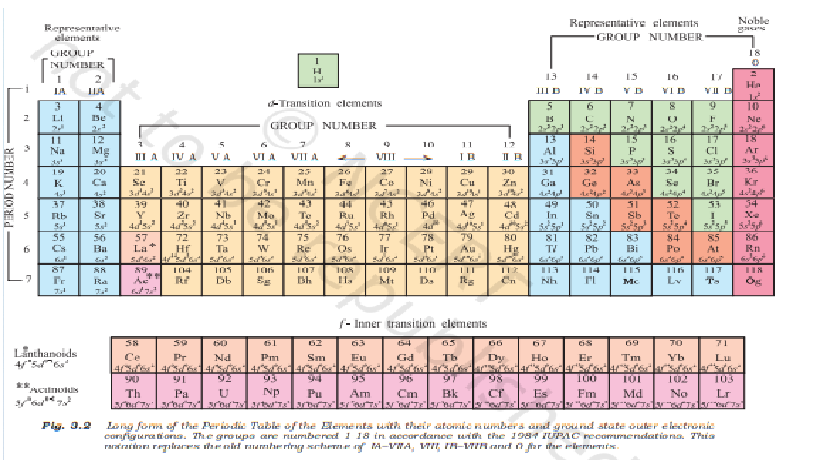
that element with Z = 117, would belong to the halogen family (Group 17) and the electronic configuration would be [Rn] 5f 146d107s27p5. The element with Z = 120, will be placed in Group 2 (alkaline earth metals), and will have the electronic configuration [Uuo]8s2.

11th Standard CBSE Syllabus & Materials
11th Standard CBSE
CBSE 11th Business Studies Forms of Business Organisation Sample Question Papers Study Material - QB365 Set A
NEW11th Standard CBSE
CBSE 11th Business Studies Business, Trade and Commerce Sample Question Papers Study Material - QB365 Set A
NEW11th Standard CBSE
CBSE 11th Physics Waves Sample Question Papers Study Material - QB365 Set A
NEW11th Standard CBSE
CBSE 11th Physics Kinetic Theory Sample Question Papers Study Material - QB365 Set A



CBSE 11th Standard CBSE Subjects
CBSE Standards









