
 100% FREE ACCESS
11th Standard CBSE Syllabus & Materials
11th Standard CBSE
CBSE 11th Economics PART-A - Presentation of Data - New Sample Question Papers Study Material - QB365 Set A
NEW11th Standard CBSE
CBSE 11th Economics PART-A - Organisation of Data - New Sample Question Papers Study Material - QB365 Set A
NEW11th Standard CBSE
CBSE 11th Economics PART-A - Collection of Data - New Sample Question Papers Study Material - QB365 Set A
NEW11th Standard CBSE
CBSE 11th Economics PART-A - Introduction to Economics and Statistics - New Sample Question Papers Study Material - QB365 Set A
NEW11th Standard CBSE
CBSE 11th Business Studies International Trade Sample Question Papers Study Material - QB365 Set A
NEW11th Standard CBSE
CBSE 11th Business Studies Evolution and Fundamentals of Business Sample Question Papers Study Material - QB365 Set A

Published on: 04/11/2019
Download CBSE Class 11th Standard CBSE Chemistry question papers, sample papers, important questions, and previous year solved papers in PDF format. Get free study materials, NCERT solutions, and exam preparation resources for Class 11th Standard CBSE Chemistry
Questions + Answers key
Take MCQ Chemistry Test
1.
If in a mixture where Q = k is combined, then what happens?
the reaction shift towards products
the reaction shift towards reactants
nothing appears to happen, but forward and reverse are continuing at the same rate
nothing happens
2.
What effect does a catalyst have on the equilibrium position of a reaction?
a catalyst favours the formation of products
a catalyst favours the formation of reactants
a catalyst does not change the equilibrium position of a reaction
a catalyst may favour reactants or product formation, depending upon the direction in which the reaction is written.
3.
H2 + S ⇌ H2S + energy.
In this reversible reaction, select the factor which will shift the equilibrium to the right.
adding heat
adding H2S
blocking hydrogen gas reaction
removing hydrogen sulphide gas
4.
In a closed system
A(S) ⇌ 4 B(g) + 3 C(g)
If partial pressure of C is doubled, then partial pressure of B will be _____.
\(2\sqrt { 2 } \)times the original value
\(\frac { 1 }{ 2 } \)times the original value
2 times of the original value
\(\frac { 1 }{ 2\sqrt { 2 } } \)times of the original value
5.
A catalyst will increase the rate of a chemical reaction by ______.
shifting the equilibrium to the right
shifting the equilibrium to the left
lowering the activation energy
increasing the activation energy
6.
The equilibrium expression, Kc= [CO2] represents the reaction.
C(s) + O2(g) ⇌ CO2(g)
CaCO3(s) ⇌ CaO(s) + CO2(g)
CO(g) + \(\frac { 1 }{ 2 } \) O2(g) ⇌ CO2(g)
CaO(s) + CO2(g) ⇌ CaCO3(s)
7.
For an endothermic reaction ______.
\(\Delta\)H is-ve
\(\Delta\)H is+ve
\(\Delta\)H is zero
none of these
8.
Which of the following always has a negative value?
heat of reaction
heat of solution
heat of combustion
heat of formation
9.
Which of the following properties is not a function of state?
concentration
internal energy
enthalpy
entropy
10.
For a cyclic process, the change in internal energy of the system is ______.
always +ve
equal to zero
always -ve
none of the above
11.
An isochoric process takes place at constant ______.
temperature
pressure
volume
concentration
12.
Thermodynamics is applicable to ______.
macroscopic system only
microsopic system only
homogeneous system only
heterogeneous system only
13.
Tolueue reacts with chlorine in the presence of light to give ______.
benzyl choride
benzoyl chloride
p-chlorotoluene
o-chlorotoluene
14.
Benzene reacts with acetyl chloride in the presence of AlCl3 to give ______.
acetophenone
toluene
benzophenone
ethyl benzene
15.
Baeyer's reagent is ______.
aqueous KMnO4
neutral KMnO4
alkaline KMnO4
aqueous bromine water
16.
The catalyst required for the given reaction is ______.
\(HC\equiv CH+dil{ \quad H }_{ 2 }{ SO }_{ 4 }\overset { Catalyst }{ \longrightarrow } { CH }_{ 3 }CHO\)
HgSO4
Pt
A1CI3
Pd
17.
A liquid hydrocarbon is converted to a mixture of gaseous hydrocarbon by ______.
hydrolysis
oxidation
distillation
cracking
18.
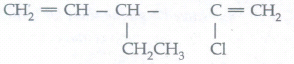
The IUPAC name of this compound is
3-ethyl-4-chloro-1, 4-pentadiene
2-chloro-3-ethyl-1, 4-pentadiene
4-chloro ethyl-1-pentene
3-ethyl-4-chloro-4-pentene
19.
The hybridization state of a carbocation is ______.
Sp4
sp3
sp2
sp
20.
The reaction

carbocation formation
free-radical mechanism
carbanion formation
none of these
21.
The bond that undergoes heterolytic cleavage most readily is ______.
C-C
C-O
C-H
O-H
22.
The IUPAC name of ______.
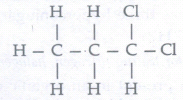
1, 2-dichloropropane
3, 3-dichloropropane
1, 1-dichloropropane
dichloropropane
23.
The maximum number of electrons in a sub-shell is given by the equation _______.
n2
2n2
21-1
21 + 1
24.
The outermost electronic configuration of manganese (at. no. = 25) is _______.
3d54s2
3d64s1
3d74so
3d6 4s2
25.
The orbital with n = 3 and 1 = 2 is _______.
3s
3p
3d
3j
26.
The Balmer series in the spectrum of hydrogen atom falls in _______.
ultraviolet region
visible region
infrared region
none of these
27.
Cathode rays are deflected by _______.
electric field only
electric and magnetic field
magnetic field only
none of these
28.
Which of the following is used in photoelectric cells?
Na
K
Li
Cs
29.
Hydrides as well as halides of alkaline earth metals tend to polymerize
Sr
Ca
Be
Mg
30.
Which of the following is not a peroxide?
KO2
CrO5
Na2O2
BaO2
31.
The oxide of which of the following metals is amphoteric?
Pb
Mg
Ca
Al
32.
In the Solvay process
an ammoniacal brine solution is carbonated with CO2, forming NaHCO3 which on decomposition at 150oC produces Na2CO3
a sodium amalgum reacts with water to produce NaOH which gives Na2CO3 on reacting with CO2
A brine solution is made to react with BaCO3 to produce Na2CO3
all of the above
33.
Lithium shows a diagonal relationship with
sodium
silicon
nitrogen
magnesium
34.
When heated to 800oC, NaNO3 gives
Na+N2+O2
NaNO2+O2
Na2O+O2+N2
NaN3+O2
35.
Which of the following is the least thermally stable?
MgCO3
CaCO3
SrCO3
BeCO3
36.
Which of the following gases will have the lowest rate of diffusion?
H2
N2
F2
O2
37.
The compressibility factor, z for an ideal gas is
zero
less than one
greater than one
equal to one
38.
In van der Waals equation of state for a non-ideal gas the net force of attaction among the molecules is given by
\(\frac{an^2}{V^2}\)
P+\(\frac{an^2}{V^2}\)
P-\(\frac{an^2}{V^2}\)
-\(\frac{an^2}{V^2}\)
39.
The cleansing action of soaps and detergents is due to
internal friction
high hydrogen bonding
viscosity
surface tensions
40.
Viscosity of a liquid is a measure of
repulsive forces between the liquid molecules
frictional resistance
intermolecular forces between the molecules
none of the above
41.
With rise in temperature, the surface tension of a liquid
decreases
increases
remaining the same
none of the above
42.
At constant temperature, the pressure of the gas is reduced to one-third, the volume
reduce to one-third
increases by three times
remaining the same
cannot be predicted
43.
Which of the following is the correct mathematical relation for Charles law at constant pressure?
V\(\alpha\)T
V\(\alpha\)t
V\(\alpha\)\(\frac{1}{2}\)
all of above
44.
The average kinetic energy of the gas molecule is
inversely proportional to its absolute temperature
directly proportional to its absolute temperature
equal to the square of its absolute temperature
All of the above
45.
For one mole of a gas, the ideal gas equation is
PV =\(\frac{1}{2}\)RT
PV=RT
PV =\(\frac{3}{2}\)RT
PV =\(\frac{5}{2}\)RT
46.
Silicon shows a diagonal relation with
magnesium
phosphorous
carbon
boron
47.
Which of the following molecules have zero dipole moment?
CS2
CO2
CCl2
CH2Cl2
48.
Silicones are a group of organosilicon polymers containing
Si - O - Si linkages
0 - Si - 0 linkages
Si - C - Si linkages
Si - Si - 0 linkages
49.
Which of the following is a purely acidic oxide?
Si02
Sn02
PbO
Mn02
50.
Silicon carbide (SiC) is known as
quartz
tridynite
corundum
carborundum
51.
Carbon-60 contains
20 pentagons and 12 hexagons
12 pentagons and 20 hexagons
30 pentagons and 30 hexagons
24 pentagons and 36 hexagons
52.
Which of the following compound is an important catalyst as well as a Lewis acid?
Al2S2
BF3
S4N4
N2H4
53.
Boron has an extremely high melting point because of
its ionic crystal structure
the strong binding forces in the covalent polymer
atomic size
allotropy
54.
In the ethylene molecule the two carbon atoms have the oxidation numbers.
-1, -1
-2, -2
-1, -2
+2,-2
55.
Which one among the following is not example of autoredox reaction?
\({ P }_{ 4 }+{ OH }^{ - }\longrightarrow { H }_{ 2 }{ PO }_{ 4 }^{ - }+{ PH }_{ 3 }\)
\({ H }_{ 2 }{ O }_{ 2 }\longrightarrow { H }_{ 2 }{ O+O }_{ 2 }\)
\({ S }_{ 2 }{ O }_{ 3 }^{ 2- }\longrightarrow S{ O }_{ 4 }^{ 2- }+S\)
\(AgCl+{ NH }_{ 3 }\longrightarrow [Ag({ NH }_{ 3 })_{ 2 }]Cl\)
56.
Which of the following are not redox reactions?
Mg + N2 \(\rightarrow\) Mg3N2
K4[Fe (CN)6] + H2S04 + H20 \(\rightarrow\) K2S04 + CO + FeS04 + (NH4)2S04
\({ S }_{ 2 }{ O }_{ 3 }^{ 2- }\longrightarrow S{ O }_{ 4 }^{ 2- }+S\)
\(AgCl+{ NH }_{ 3 }\longrightarrow [Ag\left( { NH }_{ 3 } \right) 2]Cl\)
57.
The oxidation number of carbon 'is zero in ______.
HCHO
CH2Cl2
C12H22O11
All the above
58.
When methane is burnt in oxygen to produce CO2 and H20 the oxidation number of carbon changes by ______.
-8
Zero
+8
+4
59.
The reaction: CH3CH2I + KOH (aq) \(\rightarrow\)CH3CH2OH + KI is classified as :________.
electrophilic substitution
nucleophilic substitution
elimination
addition
60.
In the Lassaigne’s test for nitrogen in an organic compound, the Prussian blue colour is obtained due to the formation of: ______.
Na4[Fe(CN)6]
Fe4[Fe(CN)6]3
Fe2[Fe(CN)6]
Fe3[Fe(CN)6]4
61.
Which of the following will increase the BOD of water supply?
O3
C2H5OH
H2O
CO2
62.
Besides CO2, the other greenhouse gas is
Ar
N2
O2
CH4
63.
Which of the following causes less pollution?
NOx
SOx
CO2
CxHy
64.
Which of the following acid is most abundant in acid rain?
HCl
HNO3
H2SO4
Organic acid
65.
The oxidation number of the carboxylic carbon atom in CH3 COOH is ______.
+2
+4
+1
+3
66.
On the reaction 2Ag + 2H2SO4 \(\rightarrow\) Ag2So4 + 2H2O+SO2 sulphuric acid acts as ______.
an oxidizing agent
a reducing agent
a catalyst
an acid as well as an oxidant
67.
Which of the following is most powerful oxidizing agent in the following
O3
KMnO4
H2O2
K2Cr2O7
68.
Which of the following halogens do not exhibit a positive oxidation number in their compounds?
F
Br
I
Cl
69.
Among the following molecules, in which does bromine show the maximum oxidation number?
Hg2 (Br03)2
Br - Cl
KBrO4
Br2
70.
Out of the following, intramolecular hydrogen bonding exists in ______.
water
H2S
4-nitrophenol
2-nitrophenol
71.
sp3, sp2 and sp hybridized carbon atom, the p character is maximum in:______.
sp3
sp2
sp
all of the above have same p-character
72.
Which one is diamagnetic among NO+ , NO and NO-?
NO+
NO
NO-
None of these
73.
In SO2 molecule, S atom is: ______.
sp3 hybridized
sp hybridized
sp2 hybridized
d sp2 hybridized
74.
The species CO, CN- and N2 are ______.
isoelectronic
having coordinated bond
having polar bond
having low bond energies
75.
A co-ordinate bond is formed by ______.
sharing of electrons contributed by both the atoms
complete transfer of electrons
sharing of electrons contributed by one atom only
none of these
76.
Water undergoes self-ionization to a small extent to give
H+ and OH-
OH+ and H-
H3O+ and OH-
none of the above
77.
Zeolite is
hydrated sodium aluminium silicate - Na2Al2Si2O8.xH2O
hydrated ferric oxide
sodium hexametaphosphate
sodium tetraborate
78.
Hydrogen is obtained as a by-product in the
electrolysis of water
manufacture of caustic soda
Bosch process
Lane process
79.
The higher density of water than that of ice is due to
dipole-dipole interaction
dipole-induced dipole interaction
hydrogen bonding
all of these
80.
Calgon, which is used as a water softener, has the formula
Na4 [Na2 (PO3)6]
Na2 [Na4(PO3)6]
Na2 [Na4(PO4)5]
Na2 [Na2 (PO4)6]
81.
On treatment of hard water with zeolite, sodium ions get exchanged with
Ca2+ ions
Mg2+ ions
H+ ions
OH-
82.
Water may be softened using
sodium aluminium silicate
Graham's salt
an ion exchange resin
trisodium phosphate
83.
Hydrogen gas is generally prepared by the
reaction of granulated zinc with dilute H2SO4
reaction of zinc with conc. H2SO4
reaction of pure zinc with dil. H2SO4
action of steam on red hot coke.
84.
Which one of the following alkaline earth metal carbonates is thermally most stable
MgCO3
CaCO3
SrCO3
BaCO3
85.
Which one of the following alkali metals give hydrated salts?
Li
Na
K
Cs
86.
Which element has smallest size?
B
N
Al
P
87.
Which one of the following is isoelectronic with Ne?
N3-
Mg2+
AI3+
all of the above
88.
Which of the following species are not known?
AgOH
PbI4
PI5
SH6
89.
What is the electronic configuration of the elements of group 14?
ns2 np4
ns2 np6
ns2 np2
ns2
90.
The highest ionization energy is exhibited by _____.
halogens
alkaline earth metals
transition metals
noble gases
91.
As per the available data: ______.
CH4(g) + 2O2(g) \(\rightarrow \) CO2(g) + 2H2O(l); \(\triangle \)C \(H^{ \ominus }\) = -890.3 KJ mol-1
C(s) + O2(g) \(\rightarrow \) CO2(g) \(\triangle \)C \(H^{ \ominus }\)=-393.5 KJ mol-1
H2(g) + 1/2O2(g) \(\rightarrow \) H2O (l); \(\triangle \)C\(H^{ \ominus }\)= -285.8 KJ mol-1
92.
A reaction, A + B → C + D + q is found to have a positive entropy change. The reaction will be _______.
possible at high temperature
possible only at low temperature
not possible at any temperature
possible at any temperature
93.
\(\triangle U^{ \ominus }\)of combustion of methane is – X kJ mol–1. The value of \(\triangle H^{ \ominus }\) is _______.
\(=\triangle U^{ \ominus }\)
\(>\triangle U^{ \ominus }\)
\(<\triangle U^{ \ominus }\)
0
94.
The enthalpies of all elements in their standard states are: _______.
unity
zero
<0
different for each element
95.
The mass of an atom of nitrogen is _______.
\(\frac { 14 }{ { { 6.023\times 10 }^{ 23 } } } \)
\(\frac { 28 }{ { { 6.023\times 10 }^{ 23 } } } \)g
\(\frac { 1 }{ { { 6.023\times 10 }^{ 23 } } } \)g
14 amu
96.
The number of significant figures in 0.0101 is _______.
3
2
4
5
97.
Which of the following has the highest mass?
1 g atom of C
\(\frac { 1 }{ 2 } \)mole of CH4
10 mL of water
3.011 x 10²³atoms of oxygen
98.
5.6 litres of oxygen at NTP is equivalent to _______.
1 mole
\(\frac { 1 }{ 4 } \)mole
\(\frac { 1 }{ 8 } \)mole
\(\frac { 1 }{ 2 } \)mole
99.
One mole of CO2 contains _______.
6.02 x 10²³atoms of C
3 g of CO2
6.02 x 10²³atoms of O
18.1 x 10²³ molecules of CO2
1.
(c)
nothing appears to happen, but forward and reverse are continuing at the same rate
2.
(c)
a catalyst does not change the equilibrium position of a reaction
3.
(a)
adding heat
4.
(d)
\(\frac { 1 }{ 2\sqrt { 2 } } \)times of the original value
5.
(c)
lowering the activation energy
6.
(b)
CaCO3(s) ⇌ CaO(s) + CO2(g)
7.
(b)
\(\Delta\)H is+ve
8.
(c)
heat of combustion
9.
(a)
concentration
10.
(b)
equal to zero
11.
(c)
volume
12.
(a)
macroscopic system only
13.
(a)
benzyl choride
14.
(a)
acetophenone
15.
(c)
alkaline KMnO4
16.
(a)
HgSO4
17.
(d)
cracking
18.
(b)
2-chloro-3-ethyl-1, 4-pentadiene
19.
(c)
sp2
20.
(b)
free-radical mechanism
21.
(d)
O-H
22.
(c)
1, 1-dichloropropane
23.
(d)
21 + 1
24.
(a)
3d54s2
25.
(c)
3d
26.
(b)
visible region
27.
(b)
electric and magnetic field
28.
(d)
Cs
29.
(c)
Be
30.
(a)
KO2
31.
(a)
Pb
32.
33.
(d)
magnesium
34.
(c)
Na2O+O2+N2
35.
(d)
BeCO3
36.
(c)
F2
37.
(d)
equal to one
38.
(a)
\(\frac{an^2}{V^2}\)
39.
(d)
surface tensions
40.
(b)
frictional resistance
41.
(a)
decreases
42.
(b)
increases by three times
43.
(a)
V\(\alpha\)T
44.
(b)
directly proportional to its absolute temperature
45.
(b)
PV=RT
46.
(d)
boron
47.
(a)
CS2
48.
(a)
Si - O - Si linkages
49.
(a)
Si02
50.
(d)
carborundum
51.
(b)
12 pentagons and 20 hexagons
52.
(d)
N2H4
53.
(b)
the strong binding forces in the covalent polymer
54.
(b)
-2, -2
55.
(d)
\(AgCl+{ NH }_{ 3 }\longrightarrow [Ag({ NH }_{ 3 })_{ 2 }]Cl\)
56.
(d)
\(AgCl+{ NH }_{ 3 }\longrightarrow [Ag\left( { NH }_{ 3 } \right) 2]Cl\)
57.
(d)
All the above
58.
(d)
+4
59.
(b)
nucleophilic substitution
60.
(b)
Fe4[Fe(CN)6]3
61.
(c)
H2O
62.
(c)
O2
63.
(c)
CO2
64.
(c)
H2SO4
65.
(d)
+3
66.
(d)
an acid as well as an oxidant
67.
(a)
O3
68.
(a)
F
69.
(c)
KBrO4
70.
(d)
2-nitrophenol
71.
(a)
sp3
72.
(a)
NO+
73.
(c)
sp2 hybridized
74.
(a)
isoelectronic
75.
(c)
sharing of electrons contributed by one atom only
76.
(c)
H3O+ and OH-
77.
(a)
hydrated sodium aluminium silicate - Na2Al2Si2O8.xH2O
78.
(b)
manufacture of caustic soda
79.
(c)
hydrogen bonding
80.
(b)
Na2 [Na4(PO3)6]
81.
(a)
Ca2+ ions
82.
(c)
an ion exchange resin
83.
(a)
reaction of granulated zinc with dilute H2SO4
84.
(d)
BaCO3
85.
(a)
Li
86.
(b)
N
87.
(d)
all of the above
88.
(c)
PI5
89.
(c)
ns2 np2
90.
(b)
alkaline earth metals
91.
(a)
CH4(g) + 2O2(g) \(\rightarrow \) CO2(g) + 2H2O(l); \(\triangle \)C \(H^{ \ominus }\) = -890.3 KJ mol-1
92.
(d)
possible at any temperature
93.
(c)
\(<\triangle U^{ \ominus }\)
94.
(b)
zero
95.
(b)
\(\frac { 28 }{ { { 6.023\times 10 }^{ 23 } } } \)g
96.
(a)
3
97.
(a)
1 g atom of C
98.
(b)
\(\frac { 1 }{ 4 } \)mole
99.
(a)
6.02 x 10²³atoms of C

11th Standard CBSE Syllabus & Materials
11th Standard CBSE
CBSE 11th Business Studies Forms of Business Organisation Sample Question Papers Study Material - QB365 Set A
NEW11th Standard CBSE
CBSE 11th Business Studies Business, Trade and Commerce Sample Question Papers Study Material - QB365 Set A
NEW11th Standard CBSE
CBSE 11th Physics Waves Sample Question Papers Study Material - QB365 Set A
NEW11th Standard CBSE
CBSE 11th Physics Kinetic Theory Sample Question Papers Study Material - QB365 Set A



CBSE 11th Standard CBSE Subjects
CBSE Standards









