
 100% FREE ACCESS
11th Standard CBSE Syllabus & Materials
11th Standard CBSE
CBSE 11th Economics PART-A - Presentation of Data - New Sample Question Papers Study Material - QB365 Set A
NEW11th Standard CBSE
CBSE 11th Economics PART-A - Organisation of Data - New Sample Question Papers Study Material - QB365 Set A
NEW11th Standard CBSE
CBSE 11th Economics PART-A - Collection of Data - New Sample Question Papers Study Material - QB365 Set A
NEW11th Standard CBSE
CBSE 11th Economics PART-A - Introduction to Economics and Statistics - New Sample Question Papers Study Material - QB365 Set A
NEW11th Standard CBSE
CBSE 11th Business Studies International Trade Sample Question Papers Study Material - QB365 Set A
NEW11th Standard CBSE
CBSE 11th Business Studies Evolution and Fundamentals of Business Sample Question Papers Study Material - QB365 Set A

Published on: 01/11/2019
Download CBSE Class 11th Standard CBSE Chemistry question papers, sample papers, important questions, and previous year solved papers in PDF format. Get free study materials, NCERT solutions, and exam preparation resources for Class 11th Standard CBSE Chemistry
Questions + Answers key
Take MCQ Chemistry Test
1.
What is bond energy? Why is it called enthalpy of atomisation?
2.
Write all structural isomers of molecular formula C3H6O.
3.
What is polymerization? Give an example.
4.
Why does the solution of alkali metals becomes blue in liquid ammonia? Give the chemical equation also.
5.
Consider the cell Zn | Zn2+ (aq) ||Cu2+ (aq) |Cu
The standard electrode potentials are EoZn2+/Zn = 0.76 V; EoCu2+/Cu = 0.34 V Write down the cell reaction.
6.
What is 'Acid Rain'? How is it harmful to the environment?
7.
With what 7'elocity must an electron travel so that its momentum is equal to that of a photon of wavelength = 5200 \(\mathring { A } \) ?
8.
What are interstitial hydrides? Give two examples.
9.
X, Y and Z elements have 4, 5 and 7 valence electrons. Draw the structure of XH4 , YH5, YH3 and H-Z.
10.
Write the complete symbol for the atom with the given number (Z) and atomic mass (A).
(a) Z = 92, A = 233
(b) Z = 4, A = 9
11.
What do you understand by isoelectronic species? Name a species that will be isoelectronic with the following atom or ion. Ar
12.
Pressure versus volume graph for a real gas and an ideal gas are shown in figure. Answer the following questions on the basis of the graph.
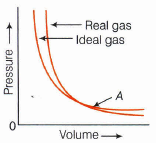
Interpret the behaviour of real gas with respect to ideal gas at high pressure.
1.
Bond energy is the amount of energy required to dissociate one mole of bonds present between the atoms in the gaseous phase. As the molecules dissociate completely into atoms in the gaseous phase therefore bond energy of a diatomic molecule is called enthalpy of atomisation.
2.
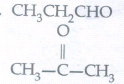
3.
The process by which simple molecules join together to form large molecules is known as polymerization.
Simple alkenes polymerize to form long chain addition polymers.
For example, ethylene gives polyethylene.

4.
The blue colour of the solution is due to ammoniated electron which absorbs energy in the visible region of light and imparts blue colour
Na+(am) + e-(am) + NH3(l) \(\longrightarrow \) NaNH2(am) + \(\frac { 1 }{ 2 } \)H2(g)
5.
Zn(s) + Cu2+(aq) \(\rightarrow\) Zn2+(aq) + Cu(S)
6.
Acid rain is the rain water mixed with small amount of sulphuric acid, nitric acid along with hydrochloric acid which are formed from the oxides of sulphur and nitrogen present in air as pollutants. It has a pH of 4-5.
Harmful effects of Acid Rain
(i) It is toxic to vegetation and aquatic life.
(ii) It damages buildings and statues. Taj Mahal has been damaged by acid rain.
(iii) Acid rain corrodes water conducting pipes resulting in the leaching of heavy metals such as iron, lead, etc., to the drinking water.
7.
According to de Broglie equation, \(\lambda =\frac { h }{ mv } \)
Momentum of electron, mv =\(\frac { h }{ \lambda } =\frac { (6.626\times 10^{ -34 }kg \ m^{ 2 }s^{ -1 } }{ (5200\times 10^{ -10 }m) } \)
= 1.274 x 10⁻²⁷ kg ms-1 ...(i)
The momentum of electron can also be calculated as = mv = (9.1 x 10⁻³¹ kg) x v
Comparing (i) and (ii) ...(ii)
(9.1 x 10⁻³¹ kg) x v = (1.274 x 10⁻²⁷ kg ms-1)
v = \(\frac { (1.274\times 10-27kgms-1) }{ (9.1x10^{ -31 }kg) } \) = 1.4\(\times \)103ms-1
8.
Many transition and inner-transition metals absorb hydrogen into the interstices of their lattices to yield metal like hydrides also called the interstitial hydrides. These hydrides are generally non-stoichiometric and their composition vary with temperature and pressure.
For example, TiH1.73, CeH2.7
9.
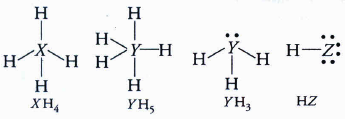
10.
(a) \(_{ 92 }^{ 233 }{ U }\)
(b) \(^{ 9 }{ Be }\)
11.
Ar has 18 electrons.
12.
At high pressure, the real gas shows large deviations from ideal behaviour as the curves are far apart.

11th Standard CBSE Syllabus & Materials
11th Standard CBSE
CBSE 11th Business Studies Forms of Business Organisation Sample Question Papers Study Material - QB365 Set A
NEW11th Standard CBSE
CBSE 11th Business Studies Business, Trade and Commerce Sample Question Papers Study Material - QB365 Set A
NEW11th Standard CBSE
CBSE 11th Physics Waves Sample Question Papers Study Material - QB365 Set A
NEW11th Standard CBSE
CBSE 11th Physics Kinetic Theory Sample Question Papers Study Material - QB365 Set A



CBSE 11th Standard CBSE Subjects
CBSE Standards









