
 100% FREE ACCESS
11th Standard CBSE Syllabus & Materials
11th Standard CBSE
CBSE 11th Economics PART-A - Presentation of Data - New Sample Question Papers Study Material - QB365 Set A
NEW11th Standard CBSE
CBSE 11th Economics PART-A - Organisation of Data - New Sample Question Papers Study Material - QB365 Set A
NEW11th Standard CBSE
CBSE 11th Economics PART-A - Collection of Data - New Sample Question Papers Study Material - QB365 Set A
NEW11th Standard CBSE
CBSE 11th Economics PART-A - Introduction to Economics and Statistics - New Sample Question Papers Study Material - QB365 Set A
NEW11th Standard CBSE
CBSE 11th Business Studies International Trade Sample Question Papers Study Material - QB365 Set A
NEW11th Standard CBSE
CBSE 11th Business Studies Evolution and Fundamentals of Business Sample Question Papers Study Material - QB365 Set A

Published on: 27/09/2019
Hydrocarbons
Download CBSE Class 11th Standard CBSE Chemistry question papers, sample papers, important questions, and previous year solved papers in PDF format. Get free study materials, NCERT solutions, and exam preparation resources for Class 11th Standard CBSE Chemistry
Questions + Answers key
Take MCQ Chemistry Test
1.
How will you convert ethanoic acid into ethene?
2.
(a) What effect the branching of an alkane has on its melting point?
(b) Which of the following has highest boiling point?
(i) 2-methyl pentane
(ii) 2, 3-diethyl butane
(iii) 2, 2-dimethyl butane
3.
What is polymerization? Give an example.
4.
Classify the following compounds into (i) alkanes (ii) alkenes (iii) alkynes (iv) arenes.
(a) C6 H6
(b) C4H8
(c) C8H18
(d) C5H8
(e) C6H14
5.
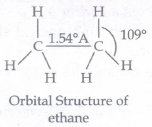
Discuss the shape of methane and ethane.
6.
Define resonance energy. What is resonance energy of benzene?
7.
Why is Wurtz reaction not preferred for preparation of alkanes containing odd number of carbon atoms? Illustrate your answer by taking one example.
8.
Write structures of all the alkenes which on hydrogenation give 2-methylbutane.
9.
Arrange benzene, n-hexane and ethyne in decreasing order of acidic behaviour. Also give reason for this behaviour.
10.
What are the necessary conditions for any system to be aromatic?
11.
Why is benzene extra ordinarily stable though it contains three double bonds?
12.
An alkene ‘A’ contains three C – C, eight C – H σ bonds and one C – C π bond. ‘A’ on ozonolysis gives two moles of an aldehyde of molar mass 44 u. Write IUPAC name of ‘A’.
13.
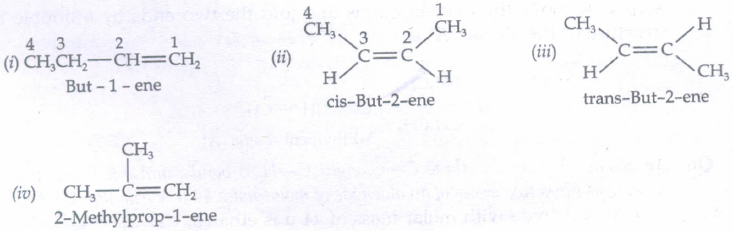
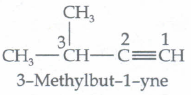
For the following compounds, write structural formulas and IUPAC names for all possible isomers having the number of double or triple bond as indicated :
(a) C4H8 (one double bond)
(b) C5H8 (one triple bond)
14.
How do you account for the formation of ethane during chlorination of methane ?
1.
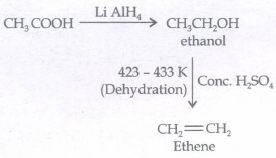
2.
(a) In general conception, as the branching increases packing of the molecules in the crystal lattices becomes less close and hence melting point decreases accordingly.
(b) As the branching increases, surface area decreases and thus magnitude of van der Waals forces of attraction decreases and hence the boiling point decreases. 2, 2-dimethyl butane has lower surface area due to more branching and hence has lower boiling point.
3.
The process by which simple molecules join together to form large molecules is known as polymerization.
Simple alkenes polymerize to form long chain addition polymers.
For example, ethylene gives polyethylene.

4.
(i) Alkanes - C6H14, C8H18
(ii) Alkenes - C4H8
(iii) Alkynes - C5H8
(iv) Arenes - C6H6
5.
In methane, carbon forms have single bonds with four hydrogen atoms. Since the carbon atom is attached to four other atoms, it uses sp3 hybrid orbitals to form these bonds. Hybridization of 'C' is sp3

Shape-tetrahedral having bond angle = 109.5°
In ethane, there are six C - H covalent bonds and one C-C covalent bond.
The C-H bond is the result of overlap of an sp3 hybrid orbital from carbon and s-orbital from hydrogen.
Orbital structure can be shown as
6.
Resonance energy is the difference in energy between actual structure of compound and most stable resonating structure. The resonance energy of benzene is 150.325 J mol-1.
7.
For preparation of alkanes containing odd number of carbon atoms, a mixture of two alkyl halides has to be used. Since two alkyl halides can react in three different ways, therefore, a mixture of three alkanes instead of the desired alkane would be formed. For example, the Wurtz reaction between 1-bromopropane and 1-bromobutane gives a mixture of three alkanes i.e., hexane, heptane and octane as shown below:
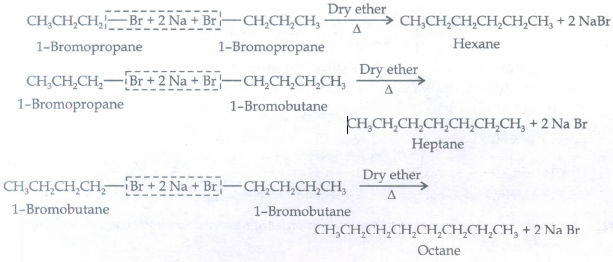
8.
The basic skeleton 2-methylbutane is
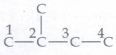
Putting double bonds at various different positions and satisfying the tetracovalency of each carbon, the structures of various alkenes which give 2-methylbutane on hydrogenation are:

9.
The hybridization state of carbon in these three compounds is:
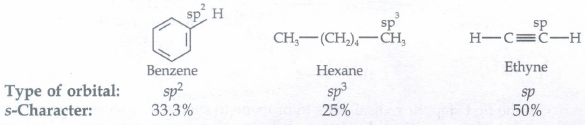
Since s-electrons are closer to the nucleus, therefore, as the s-character of the orbital making the C-H bond increases, the electrons of C-H bond lie closer and closer to the carbon atom. In other words, the partial +ve charge on the H-atom and hence the acidic character increases as the s-character of the orbital increases. Thus, the acidic character decreases in the order: Ethyne > Benzene > Hexane.
10.
The necessary conditions for a molecule to be aromatic are:
(i) It should have a single cyclic cloud of delocalised \(\pi\)-electrons above and below the plane of the molecule.
(ii) It should be planar. This is because complete delocalization of \(\pi\)-electrons is possible only if the ring is planar to allow cyclic overlap of p-orbitals.
(iii) It should contain Huckel number of electrons, i.e., (4n + 2) \(\pi\)-electrons where n = 0, 1, 2, 3 ................ etc.
A molecule which does not satisfy any one or more of the above conditions is said to be non-aromatic.
11.
Resonance and delocalisation of electrons generally lead to the stability of benzene molecule.
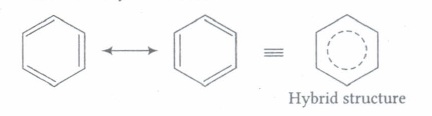
The dotted circle in the hybrid structure represents the six electrons which are delocalised between the six carbon atoms of the benzene ring. Therefore, presence of delocalised π-electrons in benzene makes it more stable than the hypothetical cyclohexatriene.
12.
(i) An aldehyde with molar mass of 44 u is ethanal, CH3CH = O
(ii) Write two moles of ethanal side by side with their oxygen atoms pointing towards each other.
CH3CH = O O = CHCH3
Ethanal Ethanal
(ii) Remove the oxygen atoms and join them by a double bond, the structure of alkene 'A' is
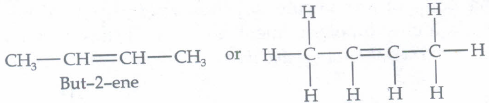
As required, but-2-ene has three C-C, eight C-H \(\sigma \)-bonds and one C-C \(\pi\)-bond.
13.
(a) Isomers of C4H8 having one double bond are:
(b) (i) \({ CH }_{ 3 }{ CH }_{ 2 }{ CH }_{ 2 }\overset { 2 }{ C } \equiv \overset { 1 }{ C } H\)
Pent-1-yne
(ii) \({ CH }_{ 3 }{ CH }_{ 2 }-C\equiv \overset { 2 }{ C } -\overset { 1 }{ C } { H }_{ 3 }\)
Pent-2-yne
(iii)
14.
Chlorination of methane is a free radical reaction which occurs by the following mechanism:
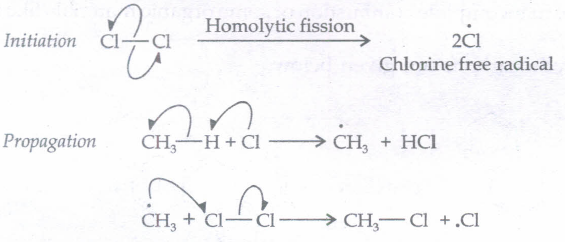 .........(i)
Termination \({ \overset .{ CH } }_{ 3 }+{ .CH }_{ 3 }\rightarrow { CH }_{ 3 }-{ CH }_{ 3 }\) .....(ii)
Ethane
\(\overset .{ C } H_{ 3 }+\overset .{ C } I\rightarrow { CH }_{ 3 }-CI\)
\(\overset { . }{ C } I+\overset { . }{ C } I\rightarrow CI-CI\) ..(iii)
From the above mechanism, it is evident that during propagation step, \(\overset { . }{ C } H_{ 3 }\)free radicals are produced which may undergo three reactions, i.e., (i) - (iii). In the chain termination step, the two CH3 free radicals combine together to form ethane (CH3-CH3) molecule.

11th Standard CBSE Syllabus & Materials
11th Standard CBSE
CBSE 11th Business Studies Forms of Business Organisation Sample Question Papers Study Material - QB365 Set A
NEW11th Standard CBSE
CBSE 11th Business Studies Business, Trade and Commerce Sample Question Papers Study Material - QB365 Set A
NEW11th Standard CBSE
CBSE 11th Physics Waves Sample Question Papers Study Material - QB365 Set A
NEW11th Standard CBSE
CBSE 11th Physics Kinetic Theory Sample Question Papers Study Material - QB365 Set A



CBSE 11th Standard CBSE Subjects
CBSE Standards









