
 100% FREE ACCESS
11th Standard CBSE Syllabus & Materials
11th Standard CBSE
CBSE 11th Economics PART-A - Presentation of Data - New Sample Question Papers Study Material - QB365 Set A
NEW11th Standard CBSE
CBSE 11th Economics PART-A - Organisation of Data - New Sample Question Papers Study Material - QB365 Set A
NEW11th Standard CBSE
CBSE 11th Economics PART-A - Collection of Data - New Sample Question Papers Study Material - QB365 Set A
NEW11th Standard CBSE
CBSE 11th Economics PART-A - Introduction to Economics and Statistics - New Sample Question Papers Study Material - QB365 Set A
NEW11th Standard CBSE
CBSE 11th Business Studies International Trade Sample Question Papers Study Material - QB365 Set A
NEW11th Standard CBSE
CBSE 11th Business Studies Evolution and Fundamentals of Business Sample Question Papers Study Material - QB365 Set A

Published on: 27/09/2019
Hydrogen
Download CBSE Class 11th Standard CBSE Chemistry question papers, sample papers, important questions, and previous year solved papers in PDF format. Get free study materials, NCERT solutions, and exam preparation resources for Class 11th Standard CBSE Chemistry
Questions + Answers key
Take MCQ Chemistry Test
1.
Water molecule is bent, not linear. Explain?
2.
(a) How is dihydrogen preparedfrom water by using a reducing agent?
(b) Give the industrial use of dihydrogen which depends upon heat liberated when it burns.
3.
The aqueous solution of H2O2 is acidic in nature. Explain with the help of example. Name two substances which catalyse the decomposition reaction of H2O2.
4.
Show how H2O functions both as a reducing and as an oxidising agent.
5.
Write chemical reaction to show the amphoteric nature of water.
6.
Discuss the principle and method of softening of hard water by synthetic ion-exchange resins.
7.
Describe the structure of common form of ice.
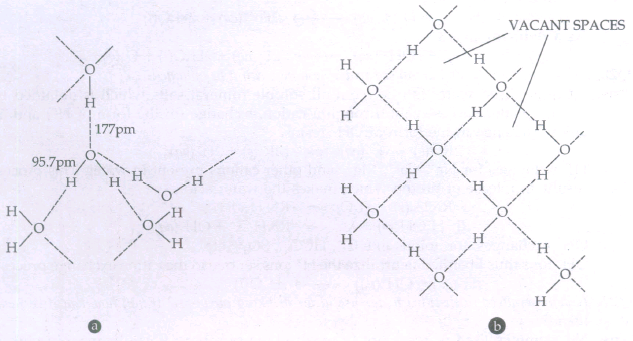
(a) Structure of water in the liquid state
(b) Tetrahedral arrangement of oxygen atoms in ice.
8.
What do you understand by (i) Electron-deficient (ii) Electron-precise (iii) Electron-rich compounds of hydrogen? Provide justification with suitable examples.
9.
Describe the industrial applications of hydrogen dependent on the heat liberated when its atoms are made to combine on the surface of a metal.
10.
Name the products obtained when hydrogen reacts under suitable conditions with carbon monoxide.
11.
Why is hydrated barium peroxide used in the preparation of hydrogen peroxide instead of anhydrous barium peroxide?
12.
What are the advantages in using hydrogen as a fuel?
13.
Calculate the volume strength of a 3% solution of \({ H }_{ 2 }O_{ 2 }\)
14.
Write equations for the reactions
Peroxydisulphuric acid is hydrolysed.
15.
If 1kg of a hard water sample contains 12 mg of CaCl2 and 12mg of MgCl2, then what will be the total hardness in terms of CaCO3 Per 106 parts by mass of water sample.
1.
In water molecule, O is sp3 hybridized. Due to stronger lone pair-lone pair repulsion than bond pair-bond pair repulsions, the HOH bond angle decreases from 109.5° to 104.5°. Thus water is bent molecule.
2.
(a) Dihydrogen is prepared from water by the action of alkali metals like Na and K which is a strong reducing agent.
2Na + 2H2O \(\longrightarrow\) 2NaOH + H2
2K + 2H2O \(\longrightarrow\) 2KOH + H2
(b) For welding purposes.
\({ H }_{ 2 }\left( g \right) +\frac { 1 }{ 2 } { O }_{ 2 }\left( g \right) \longrightarrow { H }_{ 2 }O\left( g \right) +heat\)
3.
The aqueous solution of H2O2 is weakly acidic in nature.
H2O2 + H2O \(\rightleftharpoons \) H3O+ + \(HO^-_2\)
It gives two types of salts with alkalies, peroxides and hydroperoxides.
2NaOH + H2O2 \(\longrightarrow\) NaO2 + 2H2O
\(NaOH+{ H }_{ 2 }{ O }_{ 2 }\longrightarrow \underset { Sodium\\ hydroperoxide }{ { NaOH }_{ 2 } } +{ H }_{ 2 }O\)
MnO2 and finely divided metals like Pt and Fe catalyse the decomposition of H2O2.
4.
As oxidising agent.
2I- + H2O2 + 2H+ \(\longrightarrow\) I2 + 2H2O
As reducing agent.
H2O2 + Ag2O \(\longrightarrow\) 2Ag + H2O + O2
5.
Water is amphoteric in nature because it acts as an acid
\(\underset { Base \ 1 }{ { H }_{ 2 }O(l) } +\underset { Acid\ 2 }{ { H }_{ 2 }S(aq) } \longrightarrow \underset { Acid \ 1 }{ { H }_{ 3 }{ O }^{ + }(aq) } +\underset { Base \ 2 }{ { HS }^{ - }(aq) } \)
\(\underset { Acid \ 1 }{ { H }_{ 2 }O(l) } +\underset { Base \ 2 }{ { NH }_{ 3 }(aq) } \longrightarrow \underset { Acid \ 2 }{ { NH }_{ 4 }^{ + }(aq) } +\underset { Base \ 1 }{ { OH }^{ - }(aq) } \)
6.
Cation exchange resins have large organic molecule with SO3H group which are insoluble in water. Ion exchange resin (RSO3H) is changed to RNa on treatment with NaCl. The resin exchange Na+ ions with Ca2+ and Mg2+ ions present in hard water and make it soft.
\(2RNa(s)+{ M }^{ 2+ }(aq)\longrightarrow { R }_{ 2 }M(s)+2{ Na }^{ + }(aq)\)
where, M = Mg, Ca.
The resins can be regenerated by adding aqueous NaCl solution.
7.
Ice crystallizes in the normal hexagonal form. However, at very low temperatures it condenses in cubic form. In the normal hexagonal ice each oxygen atom is tetrahedrally surrounded by four other hydrogen atoms.
8.
(i) Electron deficient hydrides: Compounds in which central atom has incomplete octet, are called electron deficient hydrides. For example, BeH2, BH3 are electron deficient hydrides.
(ii) Electron precise hydrides: Those compounds in which exact number of electrons are present in central atom or the central atom contains complete octet are called precise hydrides e.g., CH4, SiH4, GeH4 etc. are precise hydrides.
(iii) Electron rich hydrides: Those compounds in which central atom has one or more lone pair of excess electrons are called electron rich hydrides" e.g., NH3, H2O.
9.
Due to this property hydrogen is used in atomic hydrogen welding/cutting torch.
10.
\(CO(g)+2{ H }_{ 2 }(g)\overset { 700k,200atm }{ \underset { ZnO,Cr{ O }_{ 3 } }{ \rightarrow } } \underset { Methanol \ or \ methyl \ alcohol }{ { CH }_{ 3 }OH(l) } \)
11.
Anhydrous \(BaO_{ 2 }\) is not used because the \(BaSO_{ 4 }\)formed during the reaction forms a protective layer around unreacted \(BaO_{ 2 }\) and the reaction stops after sometime.
12.
Hydrogen as a fuel has the following advantages.
(i) It has calorific value.
(ii) During combustion, it does not produce smoke or any unpleasant fumes.
(iii) It leaves no ash after burning. The only product of combustion is water.
(iv) It can be used in a fuel cell to generate electricity.
(v) It can be used in the internal combustion engines with slight modifications.
(vi) It does not pollute the air because no pollutant is produced during its combustion.
13.
100 mL of \({ H }_{ 2 }O_{ 2 }\)solution contains \({ H }_{ 2 }O_{ 2 }\) = 3g
\(\therefore \)1000 mL of \({ H }_{ 2 }O_{ 2 }\)solution will contains
\({ H }_{ 2 }O_{ 2 }=\frac { 3 }{ 100 } \times 1000=30g\)
Consider the chemical equation,
\(\underset { 2\times34 \ = \ 68g }{ 2H_{ 2 }{ O }_{ 2 } } \rightarrow \underset { 22.7 \ L \ at \ NTP }{ { 2H }_{ 2 }{ O }+{ O }_{ 2 } } \)
Now 68 g of \({ H }_{ 2 }{ O }_{ 2 }\) gives \({ O }_{ 2 }\)at NTP = 22.7 L
\(\therefore \)30 g of \({ H }_{ 2 }O_{ 2 }\)will give \(O_{ 2 }\)at NTP = \(\frac { 22.7 }{ 68 } \times30\approx 10.014\)
But 30g of \({ H }_{ 2 }O_{ 2 }\) are present in 1000 mL of \({ H }_{ 2 }O_{ 2 }\)
Hence, 1000mL of \({ H }_{ 2 }O_{ 2 }\) solution gives \(O_{ 2 }\)at NTP
\(=\frac { 10014 }{ 1000 } =10.01mL\)
Hence, the volume strength of 3%\({ H }_{ 2 }{ O }_{ 2 }\) solution = 10.01
14.
\(\underset { Peroxydisulphuric \ acid }{ HO_{ 3 }SOOSO_{ 3 }H } (aq)\overset { { H }_{ 2 }O }{ \rightarrow } 2HSO_{ 4 }^{ - }(aq)+2{ H }^{ + }(aq)+\underset { Hydrogen \ peroxide }{ { H }_{ 2 }{ O }_{ 2 }(aq) } \)
15.
Given CaCl2 present in 103 g = 12 mg
CaCl2 Present in 106g = 12g
∴ MgCl2 present in 106g = 12g
Now, 1 mol (111g) CaCl2 = 1mol (100g) CaCo3
∴ 12g CaCl2 = \(\frac { 100\times 12 }{ 111 } =10.81g\)
Similarly 1 mol (95g) MgCl2= 1 mol (100g)CaCo3
∴ 12gMgCl2\(\frac { 100\times 12 }{ 95 } =12.63g\)
Total hardness in terms of CaCO3 = (10.81+12.63)
= 23.44 ppm

11th Standard CBSE Syllabus & Materials
11th Standard CBSE
CBSE 11th Business Studies Forms of Business Organisation Sample Question Papers Study Material - QB365 Set A
NEW11th Standard CBSE
CBSE 11th Business Studies Business, Trade and Commerce Sample Question Papers Study Material - QB365 Set A
NEW11th Standard CBSE
CBSE 11th Physics Waves Sample Question Papers Study Material - QB365 Set A
NEW11th Standard CBSE
CBSE 11th Physics Kinetic Theory Sample Question Papers Study Material - QB365 Set A



CBSE 11th Standard CBSE Subjects
CBSE Standards









