
 100% FREE ACCESS
11th Standard CBSE Syllabus & Materials
11th Standard CBSE
CBSE 11th Economics PART-A - Presentation of Data - New Sample Question Papers Study Material - QB365 Set A
NEW11th Standard CBSE
CBSE 11th Economics PART-A - Organisation of Data - New Sample Question Papers Study Material - QB365 Set A
NEW11th Standard CBSE
CBSE 11th Economics PART-A - Collection of Data - New Sample Question Papers Study Material - QB365 Set A
NEW11th Standard CBSE
CBSE 11th Economics PART-A - Introduction to Economics and Statistics - New Sample Question Papers Study Material - QB365 Set A
NEW11th Standard CBSE
CBSE 11th Business Studies International Trade Sample Question Papers Study Material - QB365 Set A
NEW11th Standard CBSE
CBSE 11th Business Studies Evolution and Fundamentals of Business Sample Question Papers Study Material - QB365 Set A

Published on: 18/01/2020
Download CBSE Class 11th Standard CBSE Chemistry question papers, sample papers, important questions, and previous year solved papers in PDF format. Get free study materials, NCERT solutions, and exam preparation resources for Class 11th Standard CBSE Chemistry
Questions + Answers key
Take MCQ Chemistry Test
1.
What were the weaknesses or limitations of Bohr's model of atoms? Briefly describe the quantum mechanical model of atom.
2.
Discuss the principle of estimation of halogens, sulphur and phosphorus present in an organic compound.
3.
How will you distinguish between Na2CO3 and NaHCO3
4.
In India, there is the shortage of drinking water. Thus, projects like rainwater harvesting are used by Green Park Association to increase the amount of underground water. Rainwater is the almost pure form of water after the heavy shower as it is, in fact, the distilled water. The first shower contains dissolved gases from the atmosphere. Being a good solvent, when it flows on the surface of the earth, it dissolves many salts in the form of hydrogen carbonate, chloride and sulphate in water which make it hard What is soft water?
5.
Write chemical reactions to justify that hydrogen peroxide can function as an oxidising as well as reducing agent.
6.
Balance the following equation by the oxidation number method.
\({ I }_{ 2 }+{ NO }_{ 3 }^{ - }\longrightarrow { NO }_{ 2 }+{ IO }_{ 3 }^{ - }\)
7.
When 20.0 g of ammonium nitrate (NH4NO3) is dissolved in 125 g of water in a coffee cup calorimeter. (Treat heat capacity of water as the heat capacity of the calorimeter and its contents).
8.
Calculate the total presure in a mixture of 4 g of 02 and 2 g of H2 confined to a total volume of 1 L at 0oC (R = 0.0821 L atm mol-1).
9.
CIF3 exists but FCl3 does not. Give reason.
10.
The sums of first and second ionization energies and those of third and fourth ionization energies, (in M J mol-1) of nickel and platinum are
| (IE)1 + (IE)2 | (IE)3 + (IE)4 | |
| Ni | 2.49 | 8.80 |
| Pt | 2.66 | 6.70 |
Based on this information, write
(i) the most common oxidation states of Ni and Pt.
(ii) name of metal (Ni or Pt) which can easily form compounds in its +4 oxidation state.
11.
Calculate the numberof choride ions in 500 mL of 0.05 M AlCl3 solution.
12.
What is meant by bond pairs of electrons?
13.
Assign oxidation number to the underlined elements in each of the following species -NaBH4
14.
Why do you alkenes prefer to undergo electrophilic addition reaction while arenes prefer electrophilic substitution reactions? Explain.
15.
Which of the following compounds will show cis-trans isomerism?
(CH3)2C=CH-C2H5
16.
Which bond is more polar in the following pairs of molecules:
(a) H3C - H or H3C - Br
(b) H3C - NH2 or H3C - OH
(c) H3C - OH or H3C - SH
17.
Calculate dissociation of conjugate base of HF, Ka = 6.8 x 10 -4
18.
Air contains about 99% of N2 and O2 gases. Why do not they combine to form NO under the standard conditions? Standard Gibbs energy of formation of NO (g) is 86.7 kJ mol-1.
19.
Calculate the moles of hydrogen (H2) present in a 500 mL sample of hydrogen gas at a pressure of 1 bar and 27oC.
20.
3 L water is added to 2 L of 5 M HCl. What is the molarity of HCl in the resultant solution?
21.
In what ways lithium shows similarities to magnesium in its chemical behaviour?
22.
A sample of 0.50 g of an organic compound was treated according to Kjeldahl’s method. The ammonia evolved was absorbed in 50 ml of 0.5 M H2SO4. The residual acid required 60 mL of 0.5 M solution of NaOH for neutralisation. Find the percentage composition of nitrogen in the compound.
23.
First member of each group of representative elements ( i.e. sand p-block elements ) shows anomalous behaviour. Illustrate with two examples.
1.
Limitations of Bohr's model of an atom:
(i) It could not explain spectrum of multi-electron atoms.
(ii) It could not explain Zeeman and Stark effects.
(iii) It could not explain shape of molecules.
(iv) It was not in accordance with Heisenberg's uncertainty principle.
Quantum Mechanical Model: It was developed on the basis of Heisenberg's uncertainty principle and dual behaviour of matter. Main features of this model are given below :
(i) The energy of electrons in an atom is quantized i.e. can only have certain values.
(ii) The existence of quantized electronic energy levels is a direct result of the wave-like properties of electrons.
(iii) Both, the exact position and velocity of an electron in an atom cannot be determined simultaneously.
(iv) The orbitals are filled in increasing order of energy. All the information about the electron in an atom is stored in orbital wave function.\(\Psi \)
(v) From the value of\(\Psi \)2 at different points within atom, it is possible to predict the region around the nucleus where electron most probably will be found.
2.
Estimation of halogens: It involves oxidising the organic substance with fuming nitric acid in the presence of silver nitrate. The halogen of the substance is thus converted to silver halide which is separated and weighed:
Weight of organic compound = W gm
weight of silver halide = x g.
% of halogen = \(\frac{\text{At.wt.of halogen}\times100x}{\text{Mol.wt of silver halide}\times w}\)
Estimation of sulphur: The organic substance is heated with fuming nitric acid but no silver nitrate is added. The sulphur of the substance is oxidised to sulphuric acid which is then precipitated as barium sulphate by adding excess of barium chloride solution. From the weight of BaS04 so obtained the percentage of sulphur can be calculated.
% of sulphur = \(\frac{32(At.weight\ of\ S)}{233(mol\ weight\ of\ BaSO_4)}\times\frac{weight\ of\times100\ BaSO_4}{weight\ of\ organic\ compound}\)
Estimation of phosphorous: The organic substance is heated with fuming nitric acid whereupon phosphorous is oxidised to phosphoric acid. The phoshoric acid is
precipitated as ammonium phosphomolybdate, (NH4)3 PO4·12MoO3, by the addition of ammonia and ammonium molybdate solution which is then separated, dried and weighed.
% of P = \(\frac{31\times w_1\times 100}{1877\times w}\)
where Molar mass of (NH4)3 PO4.12MoO3 = 1877 g
If phosphorous is estimated as Mg2P2O7
% of P = \(\frac{62\times w_1\times100}{222\times w}\)
3.
Sodium bicarbonate (NaHCO3) on hetaing composes to produces CO2 gas which whwn pases thrugh lime water, turns milky.
2NaHCO3 \(\xrightarrow[]{\Delta}\)Na2CO3 + CO2 + H2O
Ca(OH)2(aq) + CO2(s)\(\rightarrow \)CaCO3(s) + H2O(l)
But Na2CO3 (Sodium carbonate is stable to heat does not decompose to heat).
4.
Water free from ca2+ and Mg2+ ions is called soft water.
5.
\({ H }_{ 2 }O_{ 2 }\)can act as an oxidising as well as a reducing agent both in acidic and basic medium
(i) Oxidising agent in acidic medium
\(2{ Fe }^{ 2+ }(aq)+2{ H }^{ + }(aq)+{ H }_{ 2 }{ O }_{ 2 }(aq)\rightarrow 2{ Fe }^{ 3+ }(aq)+2{ H }_{ 2 }O(l)\)
Here, \({ Fe }^{ 2+ }\) get oxidised to \({ Fe }^{ 3+ }\)
(ii) Oxidising agent in acidic medium
\(Mn^{ 2+ }(aq)+6H^{ + }(aq)+5{ H }_{ 2 }O(aq)\rightarrow 2Mn^{ 2+ }(aq)+8{ H }_{ 2 }O(l)+5O_{ 2 }(g)\)
Here, \(Mn^{ 2+ }\)is oxidised to \(Mn^{ 4+ }\)
(iii) Reducing agent in acidic medium
\(2MnO_{ 4 }^{ - }(aq)+6H^{ + }(aq)+{ 5H }_{ 2 }O_{ 2 }(aq)\rightarrow 2Mn^{ 2+ }(aq)+8{ H }_{ 2 }O(l)+5O_{ 2 }(g)\)
Here, oxidation state of Mn is reduced from +7 to +2
(iv)Reducing agent in basic medium
\({ I }_{ 2 }(s)+{ H }_{ 2 }O_{ 2 }(aq)+2OH^{ - }(aq)\rightarrow 2I^{ - }(aq)+2{ H }_{ 2 }O(l)+O_{ 2 }(g)\)
her, oxidation state of I is reduced from zero to -1.
6.
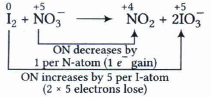
Balance increase and decrease in oxidation number
\({ I }_{ 2 }+{ 10NO }_{ 3 }^{ - }\longrightarrow { 10NO }_{ 2 }+{ 2IO }_{ 3 }^{ - }\)
Balance charge by writing 8H+ in LHS of the equation.
\({ I }_{ 2 }+{ 10NO }_{ 3 }^{ - }+{ 8H }^{ + }\longrightarrow { 10NO }_{ 2 }+{ 2IO }_{ 3 }\)
Balance H-atoms by writing 4H2O in RHS of the equation.
\({ I }_{ 2 }+{ 10NO }_{ 3 }^{ - }+{ 8H }^{ + }\longrightarrow { 10NO }_{ 2 }+{ 2IO }_{ 3 }^{ - }+{ 4H }_{ 2 }O\)
Oxygen atoms are automatically balanced.
This representation a balanced redox reaction.
7.
A heat capacity of water = heat capacity of calorimeter, the heat gained by water = heat lost by calorimeter
\(=125\times (296.5-286.4)\times 4.184 \ J=5282J=5.282kJ\)
8.
Pt = 25.21 atm
9.
Cl-atom has empty d-orbitals and it acquires excited state at the time of bonding when electrons from 3p-orbitals are promoted to 3d-orbitals.
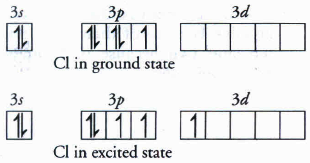
In excited state Cl-atom can exhibit a covalency of three. Hence, ClF3 is possible. F-atom cannot expand its octet due to absence of empty d-orbitals in 2nd energy shell.
Hence, it cannot exhibit covalency more than 1. Therefore, FCl3 is not possible.
10.
(i) Ni = + 2, Pt = + 4
(II) Platinum forms more stable complexes in +4 state due to its higher stability than +2 state.
11.
Molarity \(=\frac { moles \ of \ AlCl_{ 3 } }{ volume \ of \ solution } \times 1000\)
Moles of AlCl3 \(=\frac { molarity \ \times \ volume \ of \ solution }{ 1000 } \)
Now, 1 molecule of AlCl3 contains 3 Cl- ions.
1 mol of AlCl3 contains 3 mol of Cl- ions.
0.0025 mol of AlCl3 contains Cl- ions \(=0.025\times 3\)
\(=0.075\ mol\)
1 mol of Cl- ions \(=6.022\times { 10 }^{ 23 }\) Cl- ions.
0.075 mol of Cl- ions \(=6.022\times { 10 }^{ 23 }\times 0.075\)
\(=4.5\times 10^{ 22 }\)
12.
The electron pairs involved in the bond formation are known as bond pairs or shared pairs.
13.
In NaBH4, H is present as hydride ion. Therefore, its oxidation number is -1. Thus,
\(\overset { +1 }{ Na } \overset { x }{ B } \overset { -1 }{ { H }_{ 4 } } \)
\(\therefore\) 1 (+1) + x + 4 (-1) = 0 or x = +3
Thus, the oxidation number of B in NaBH4 = + 3.
14.
Alkenes are rich source of loosely held \(\pi \) electrons, due to which they show electrophilic addition reaction. Electrophilic addition reactions of alkenes are accompanied by large energy changes so these are energetically favourable than that of Electrophilic substitution reactions.
In special conditions alkenes also undergo free radical substitution reactions.
In arenes during electrophilic addition reactions aromatic character of benzene ring is destroyed while during electrophilic substitution reactions of areans are enegetically more favourable than that of electrophilic addition reaction.
That's why alkenes prefer to undergo electrophilic addition reaction while arenes prefer electrophilic substitution reactions.
15.
For exhibiting cis-trans (or geometrical isomerism, a molecule must fulfil the following condition.
It must have atlest one double bond.
16.
(a) C–Br, since Br is more electronegative than H, (b) C–O, (c) C–O
17.
\(HF\rightleftharpoons { H }^{ + }+{ F }^{ - }\)
Ka (acid) x Kb (conjugate base) = 1.47 x 10 -11
\({ K }_{ b }{ (F }^{ - })=\frac { 1.0\times { 10 }^{ -14 } }{ 6.8\times { 10 }^{ -14 } } =1.47\times { 10 }^{ 11 }\)
18.
For the combination of N2 and O2 to form NO, the standard Gibbs energy of formation, is +ve
1/2N2(g)+1/2O2(g)→NO(g)(ΔfG∘NO = +86.7 kJmol−1)
Therefore, this reaction is non-spontaneous under the standard conditions and hence N2 and O2 do not combine.
19.
0.022
20.
2M
21.
(i) Both react with nitrogen to form nitrides.
(ii) Both react with O2 to form monoxides
(iii) Both the elements have the tendency to form covalent compounds.
(iv) Both can form complex compounds.
22.
Volume of acid taken = 50 mL of 0.5 M H2SO4
= 25 mL of 1.0 M H2SO4
Volume of alkali used for neutralisation of excess acid
= 60 mL of 0.5 M NaOH
= 30 mL of 1.0 M NaOH
H2SO4 + 2NaOH\(\longrightarrow \)Na2SO4 + 2H2O
1 mole of H2SO4 = 2 moles of NaOH
Hence 30 mL of 1.0 M NaOH
= 15 mL of 1.0 M H2SO4
\(\therefore \) Volume of acid used by ammonia = 25 - 15 = 10 mL
% of nitrogen = 1.4 x N1 x Vol. of acid used/w
(where N1 = Normality of acid and w = mass of the organic compound taken)
% of nitrogen = (1.4 x 2 x 10/0.5) = 56.0.
23.
First member of each group of representative elements ( i.e. s and p-block elements ) shows anomalous behaviour due to
(i) small size
(ii) high ionisation enthalpy
(iii) high electronegativity and
(iv) absence of d- orbitals.
For example in s-block elements, lithium shows anoimalous behaviour from rest of the alkali metals.
(i) Compounds of lithium have significant covalent character. While compounds of other alkali metals are predominantly ionic.
(ii) Lithium reacts with nitrogen to form lithium nitride while other alkali metals do not form nitrides.
In p-block elements, first member of each group has four orbitals, one 2s- and three 2p-orbitals in their valence shell. So, these elements show a maximum covalency of four ehile other members of the same group or different group show a maximum covalency beyond four due to availability of vacant d-orbitals.

11th Standard CBSE Syllabus & Materials
11th Standard CBSE
CBSE 11th Business Studies Forms of Business Organisation Sample Question Papers Study Material - QB365 Set A
NEW11th Standard CBSE
CBSE 11th Business Studies Business, Trade and Commerce Sample Question Papers Study Material - QB365 Set A
NEW11th Standard CBSE
CBSE 11th Physics Waves Sample Question Papers Study Material - QB365 Set A
NEW11th Standard CBSE
CBSE 11th Physics Kinetic Theory Sample Question Papers Study Material - QB365 Set A



CBSE 11th Standard CBSE Subjects
CBSE Standards









