
 100% FREE ACCESS
11th Standard CBSE Syllabus & Materials
11th Standard CBSE
CBSE 11th Economics PART-A - Presentation of Data - New Sample Question Papers Study Material - QB365 Set A
NEW11th Standard CBSE
CBSE 11th Economics PART-A - Organisation of Data - New Sample Question Papers Study Material - QB365 Set A
NEW11th Standard CBSE
CBSE 11th Economics PART-A - Collection of Data - New Sample Question Papers Study Material - QB365 Set A
NEW11th Standard CBSE
CBSE 11th Economics PART-A - Introduction to Economics and Statistics - New Sample Question Papers Study Material - QB365 Set A
NEW11th Standard CBSE
CBSE 11th Business Studies International Trade Sample Question Papers Study Material - QB365 Set A
NEW11th Standard CBSE
CBSE 11th Business Studies Evolution and Fundamentals of Business Sample Question Papers Study Material - QB365 Set A

Published on: 21/09/2019
State of Matter
Download CBSE Class 11th Standard CBSE Chemistry question papers, sample papers, important questions, and previous year solved papers in PDF format. Get free study materials, NCERT solutions, and exam preparation resources for Class 11th Standard CBSE Chemistry
Questions + Answers key
Take MCQ Chemistry Test
1.
(a) What do you mean by 'Surface Tension' of a liquid?
(b) Explain the factors which can affect the surface tension of a liquid
2.
The pressure of a mixture of H2 and N2 in a container is 1200 torr. The partial pressure of nitrogen in the mixture is 300 torr. What is the ratio of H2 and N2 molecules in the mixture?
3.
The values of the van der Waal's constants for a gas are a = 4.10 dm6 bar mol-2 and b = 0.035 dm3 mol-1. Calculate the values of the critical temperature and critical pressure for the gas.
4.
Give reasons for the following. Tyres of automobiles are inflated to the lesser pressure in summer than in winter.
5.
Give reasons for the following. The size of weather balloon becomes larger and larger as it ascends into higher altitudes.
6.
Pressure of 1 g of an ideal gas A at 27\(^{o}\) C is found to be 2 bar. When 2 g of another ideal gas B is introduced in the same flask at the same temperature, the pressure becomes 3 bar. Find a relationship between their molecular masses.
7.
30 mol of chlorine gas occupies a volume of 500 ml at 315K and 4 x 10⁵ Pa pressure.Calculate the compressibility factor of the gas. (R = 0.083 L bar K-1 mol-1)
8.
The compression factor(compressibility factor) for one mole of a van der Waals gas at 0oC and 100 atm pressure is found to be 0.5. Assuming that the volume of a gas molecule is negligible, calculate the van der Walas' constant a.
9.
0.64 g of an oxide of sulphur occupies 0.224 L at 2 bars and 273oC. Identify the compound.Also, find out the mass of one molecular of the gas.
10.
A 2 L flask contains 1.6g of methane and 0.5 g of hydrogen at 27oC. Calculate the partial pressure of each gas in the mixture and also calculate the total pressure.
11.
A gas is enclosed in the room. The temperature, pressure, density, and the number of moles respectively are t \(^{o}\)C, p atm, g cm-3 and n moles. What will be the values of pressure, temperature, density, and the number of moles in each compartment if the walls between the two compartments (say 1 and 2) are removed?
12.
The variation of the vapour pressure of different liquids with temperature is shown in the figure below.
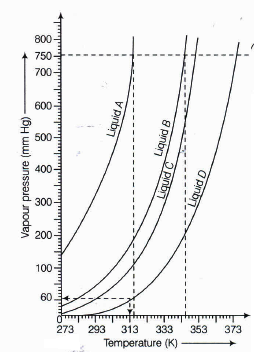
Pressure cooker is used for cooking food at the hill station. Explain in terms of vapour pressure why is it so?
13.
Pressure versus volume graph for a real gas and an ideal gas are shown in figure . Answer the following questions on the basis of the graph.
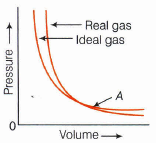
Mark the pressure and volume by drawing a line at the point where real gas behaves as an ideal gas.
14.
Pressure versus volume graph for a real gas and an ideal gas are shown in figure. Answer the following questions on the basis of the graph.
Interpret the behaviour of real gas with respect to ideal gas at low pressure.
1.
(a) Surface tension: It is defined as the force acting per unit length perpendicular to the line drawn on the surface. It's unit is Nm-1.
(b) Surface tension of a liquid depends upon following factors.
(i) Temperature: Surface tension decreases with rise in temperature. As the temperature of the liquid increases, the average kinetic energy of the molecules increases. Thus, there is a decrease in intermolecular force of attraction which decreases the surface tension.
(ii) Nature of the liquid: Greater the magnitude of intermolecular forces of attraction in the liquid, greater will be the value of surface tension.
2.
Total pressure of mixture = 1200 torr
Partial pressure of N2 (PN2) = 300 torr
Partial pressure of H2 (PH2) 1200 - 300 = 900 torr
According to ideal gas equation,
PV = nRT
\({ P }_{ H_{ 2 } }\) = \(\frac { { n }_{ H_{ 2 } }RT }{ V } \)= 900 torr ...(i)
\({ P }_{ N_{ 2 } }\) = \(\frac { { n }_{ N_{ 2 } }RT }{ V } \)= 300 torr ...(ii)
Divide (i) by (ii), \(\frac { { P }_{ H_{ 2 } } }{ { P }_{ H_{ 2 } } } =\frac { { n }_{ H_{ 2 } } }{ { n }_{ H_{ 2 } } } \) = \(\frac{900}{300}=\frac{3}{1}\)\(\therefore\)\({ n }_{ H_{ 2 } }\):\({ n }_{ N_{ 2 } }\)::3:1
3.
(i) Calculation of critical temperature (Tc)
a = 4.10 dm6 bar mol-1
b = 0.035 dm3 mol-1
R = 0.0821 dm3 bar mol-1 K-1.
Now, critical temperature, Tc = \(\frac{8a}{27Rb}\)
Substituting the values, Tc = \(\frac{8\times4.10}{27\times0.0821\times0.035}\)
(ii) Calculation of critical pressure (Pc)
Pc\(\frac{a}{27b^2}\) = \(\frac{4.10}{27\times0.0821\times0.035}\) = 123.96 bar
4.
In summer, due to higher temperature, the average Kinetic energy of the air molecules inside the tyre increases,i.e. molecules start moving faster. Hence, the pressure on the walls of the tube increases. If pressure inside is not kept low at the time of inflation, at a higher temperature, the pressure may become so high that the tyre may burst.
5.
As we go to higher altitudes, the atmospheric pressure decreases. Thus, the pressure outside the balloon decreases. To regain equilibrium with the external pressure, the gas inside expands to decrease its pressure. Hence, the size of the balloon increases.
6.
pV = nRT
For gas A, PAV = nART ................(i)
Similarly for gas B, PBV = nBRT ...........(ii)
Number of mole of gas A; nA = \(\cfrac { 1 }{ M_{ A } } \)
(MA = molar mass of gas A)
Number of mole of gas B; nB = \(\cfrac { 1 }{ M_{ B } } \)
(MB = molar mass of gas B)
Pressure of gas A, pA = 2 bar
Total pressure, ptotal = pA + pB = 3 bar
Pressure of gas, PB = Ptotal - PA =3 - 2 = 1 bar
V, R and T are same for both the gases.
Hence, from Eqs.(i) and Eqs (ii),
\(\cfrac { { p }_{ A } }{ { p }_{ B } } =\cfrac { n_{ A } }{ { n }_{ B } } =\cfrac { 1\times M_{ B } }{ M_{ A }\times 2 } \)
or \(\cfrac { { M }_{ B } }{ { M }_{ A } } =\cfrac { 2p_{ A } }{ { p }_{ B } } =\cfrac { 2\times 2 }{ 1 } \) or MB = 4 MA
7.
Z = 2.54 x 10⁻³
8.
\(Z=\frac { pV }{ nRT } \ i.e \ 0.5=\frac { 100\times V }{ 1\times 0.082\times 273 } \)
or
\(V=0.1119L\)
\( \left( P+\frac { a }{ { V }^{ 2 } } \right) (v-b)=RT \ for \ 1 \ mol\)
Neglecting b, \(\left( P+\frac { a }{ { V }^{ 2 } } \right) V=RT\)
or \(pV+\frac { a }{ V } =RT\)
or \(\frac { pV }{ RT } +\frac { a }{ VRT } =1\)
or
\(a=\left( 1-\frac { pV }{ RT } \right) VRT=(1-0.5)0.1119\times 0.082\times 273\)
\( =1.252 \ atm \ L^{ 2 }mol^{ -2 }\)
9.
Compound = SO2 Mass of one molecule of gas = 1.07 x 10⁻²²g
10.
PCH4 = 1.23 atm, PH2 = 3.079 atm, total pressure = 4.31 atm
11.
(a) Pressure will remain same (p atm).
(b) Temperature will remain same ( t \(^{o}\) C ).
(c) Density will remain same (d g cm-3).
(d) The number of moles in each compartment will be n/2.
12.
A liquid boils when vapour pressure becomes equal to atmospheric pressure. At hill station, atmospheric pressure is low. Therefore, liquid boils at a lower temperature and cooking is not perfect. In a pressure cooker, the pressure inside the cooker increases and the liquid boils at a higher temperature.
13.
A point 'A' both the curves intersect each other. At this point real gas behaves as an ideal gas. p1 and V1 are the pressure and volume which corresponds to this point A.
14.
At low pressure, the real gas shows very small deviation from ideal behaviour because the two curves almost coincide at low pressure.

11th Standard CBSE Syllabus & Materials
11th Standard CBSE
CBSE 11th Business Studies Forms of Business Organisation Sample Question Papers Study Material - QB365 Set A
NEW11th Standard CBSE
CBSE 11th Business Studies Business, Trade and Commerce Sample Question Papers Study Material - QB365 Set A
NEW11th Standard CBSE
CBSE 11th Physics Waves Sample Question Papers Study Material - QB365 Set A
NEW11th Standard CBSE
CBSE 11th Physics Kinetic Theory Sample Question Papers Study Material - QB365 Set A



CBSE 11th Standard CBSE Subjects
CBSE Standards









