
 100% FREE ACCESS
11th Standard CBSE Syllabus & Materials
11th Standard CBSE
CBSE 11th Economics PART-A - Presentation of Data - New Sample Question Papers Study Material - QB365 Set A
NEW11th Standard CBSE
CBSE 11th Economics PART-A - Organisation of Data - New Sample Question Papers Study Material - QB365 Set A
NEW11th Standard CBSE
CBSE 11th Economics PART-A - Collection of Data - New Sample Question Papers Study Material - QB365 Set A
NEW11th Standard CBSE
CBSE 11th Economics PART-A - Introduction to Economics and Statistics - New Sample Question Papers Study Material - QB365 Set A
NEW11th Standard CBSE
CBSE 11th Business Studies International Trade Sample Question Papers Study Material - QB365 Set A
NEW11th Standard CBSE
CBSE 11th Business Studies Evolution and Fundamentals of Business Sample Question Papers Study Material - QB365 Set A

Published on: 27/09/2019
The p-block Elements
Download CBSE Class 11th Standard CBSE Chemistry question papers, sample papers, important questions, and previous year solved papers in PDF format. Get free study materials, NCERT solutions, and exam preparation resources for Class 11th Standard CBSE Chemistry
Questions + Answers key
Take MCQ Chemistry Test
1.
Give reason why boron and aluminium tend to form covalent compounds
2.
Give reason.
(i) C and Si are always tetravalent but Ge, Sn, Pb show divalency.
(ii) Gallium has higher ionization enthalpy than AI. Explain.
3.
What are Fullerenes? How are they prepared?
4.
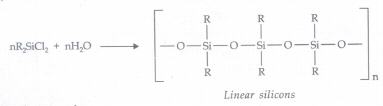
(a) What is general formula of silicons?
(b) How are linear silicons obtained?
5.
Describe two similarities and two dissimilarities between B and AI.
6.
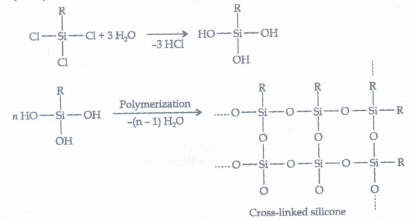
If the starting material for the manufacture of silicons is RSiCl3 write the structure of the product formed.
7.
Give one method for industrial preparation and one for laboratory preparation of co and co2 each.
8.
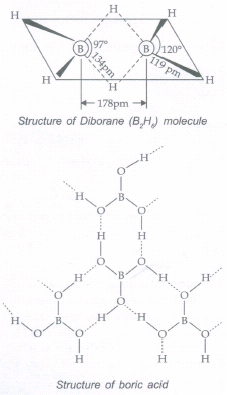
Explain structures of diborane and boric acid.
9.
Explain the difference in properties of diamond and graphite on the basis of their structures.
10.
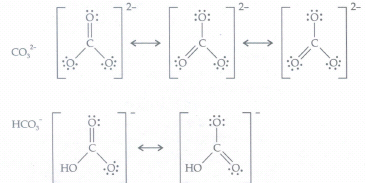
Write the resonance structure of CO32- and HCO3-.
11.
What are electron deficient compounds? Are BCl3 and SiCl4 electron deficient species? Explain.
12.
Account for CO2 is used in refrigeration.
13.
Account for CO is poisonous.
14.
Explain the following.
Aluminium forms [AlF6]3- ion but boron does not form [BF6]3-ion.
15.
A certain salt X, gives the results Borax swells up to a glassy mass on strong heating.
Is swells up to a glassy material Y on strong heating
1.
Sum of the three ionization enthalpies of both the elements are very high. Thus they have no tendency to lose electrons to form ionic compound. Instead they form covalent compounds.
2.
(i) Ge, Sn and Pb show divalency due to inert pair effect, Pb2+ is more stable than Pb4+.
(ii) Due to poor shielding effect of d-electrons in Ga, effective nuclear charge increases as compared to AI. Thus the I.E of Ga is higher than Al.
3.
Fullerenes are the allotropes of carbon. Its structure is like a soccer ball.
They are prepared by heating graphite in electric arc in presence of inert gases such as helium or argon.
4.
(a) R2SiO
(b) Linear silicons are obtained by the hydrolysis of R2SiCl2 (chlorosilanes).
5.
Similarities:
(i) Both have same number of valence electrons.
(ii) Both have similar electronic configuration.
Dissimilarities:
(i) B is a non-metal where Al is a metal.
(ii) B forms acidic oxide whereas Al forms amphoteric oxides.
6.
Hydrolysis of alkyltrichlorosilanes gives cross-linked silicons.
7.
Carbon monoxide
Industrial: 2C(s) + O2(g) \(\xrightarrow[air]{Limited}\) 2CO(g)
Laboratory: HCOOH \(\xrightarrow[]{H_2SO_4}\) CO + H2O
Formic acid
Carbon dioxide
Industrial: C(s) + O2(g)\(\xrightarrow[air]{Excess}\)CO2 (g)
Laboratory: CaCO3(s) + 2HCl(aq)\(\rightarrow\)CaCl2(aq) + CO2(g) + H2O(l)
8.
Boric acid contains planar BO33- ions which are linked together through hydrogen bonding
9.
| S.No. | Diamond | Graphite |
| 1. | Cis sp3 hybridised | C is Sp2 hybridised |
| 2. | Three dimensional, tetrahedral structure |
Two dimensional, sheet like (layer like) structure. |
| 3. | Crystalline, transparent with extra brilliance (due to high refractive index). |
Crystalline, opaque and shiny substance. |
| 4. | Hardest substance with high density and high melting point |
Soft having soapy touch with low density and high melting point. |
| 5. | Bad conductor of heat and electricity (no free electron). |
Good conductor of heat and electricity (fourth electron is free). |
| 6. | It is used in glass cutting and jewellery and as abrasive. |
It is used as a lubricating agent, in making electrodes, in pencils, crucibles (due to high melting point). |
10.
11.
Electron deficient species are those in which the central atom in their molecule has the tendency to accept one or more electron pairs. They are also known as Lewis acid. BCl3 and SiCl4 both are electron deficient species.
Since, in BCl3, B atom has only six electrons. Therefore, it is an electron deficient compound.
In SiCl4 the central atom has 8 electrons but it can expand its covalency beyond 4 due to the presence of d-orbitals.
Thus, SiCl4 should also be considered as electron deficient species.
12.
Solid CO2, produce cooling and sublimes directly into vapour state. That's why it is used in refrigeration.
13.
CO forms carboxy-haemoglobin complex with haemoglobin (the red pigment which carries oxygen) of blood which is about 300 times more stable than oxygen-haemoglobin complex and thus, it stops the supply of oxygen and hence, leads to death of the person.
14.
Aluminium form [AlF6]3- ion because of the presence of vacant d-orbitals due to which it can expand its coordination number from 4 to 6. In this complex Al undergoes sp3d2 hybridisation. On the other hand, boron does not form [BF6]3- ion, because of the unavailability of d-orbitals as it cannot expand its coordination number beyond four. Hence, it can form [BF4]- ion (boron in ) [BF4]- ion is sp3 hybridised).
15.
On strong heating, the salt X swells up to to a glassy material Y. It indicates that the salt X is borax.

11th Standard CBSE Syllabus & Materials
11th Standard CBSE
CBSE 11th Business Studies Forms of Business Organisation Sample Question Papers Study Material - QB365 Set A
NEW11th Standard CBSE
CBSE 11th Business Studies Business, Trade and Commerce Sample Question Papers Study Material - QB365 Set A
NEW11th Standard CBSE
CBSE 11th Physics Waves Sample Question Papers Study Material - QB365 Set A
NEW11th Standard CBSE
CBSE 11th Physics Kinetic Theory Sample Question Papers Study Material - QB365 Set A



CBSE 11th Standard CBSE Subjects
CBSE Standards









